What Is Agentic Email? The Future of AI Email Management
By Chris Stefaner, Co-founder of Swizero
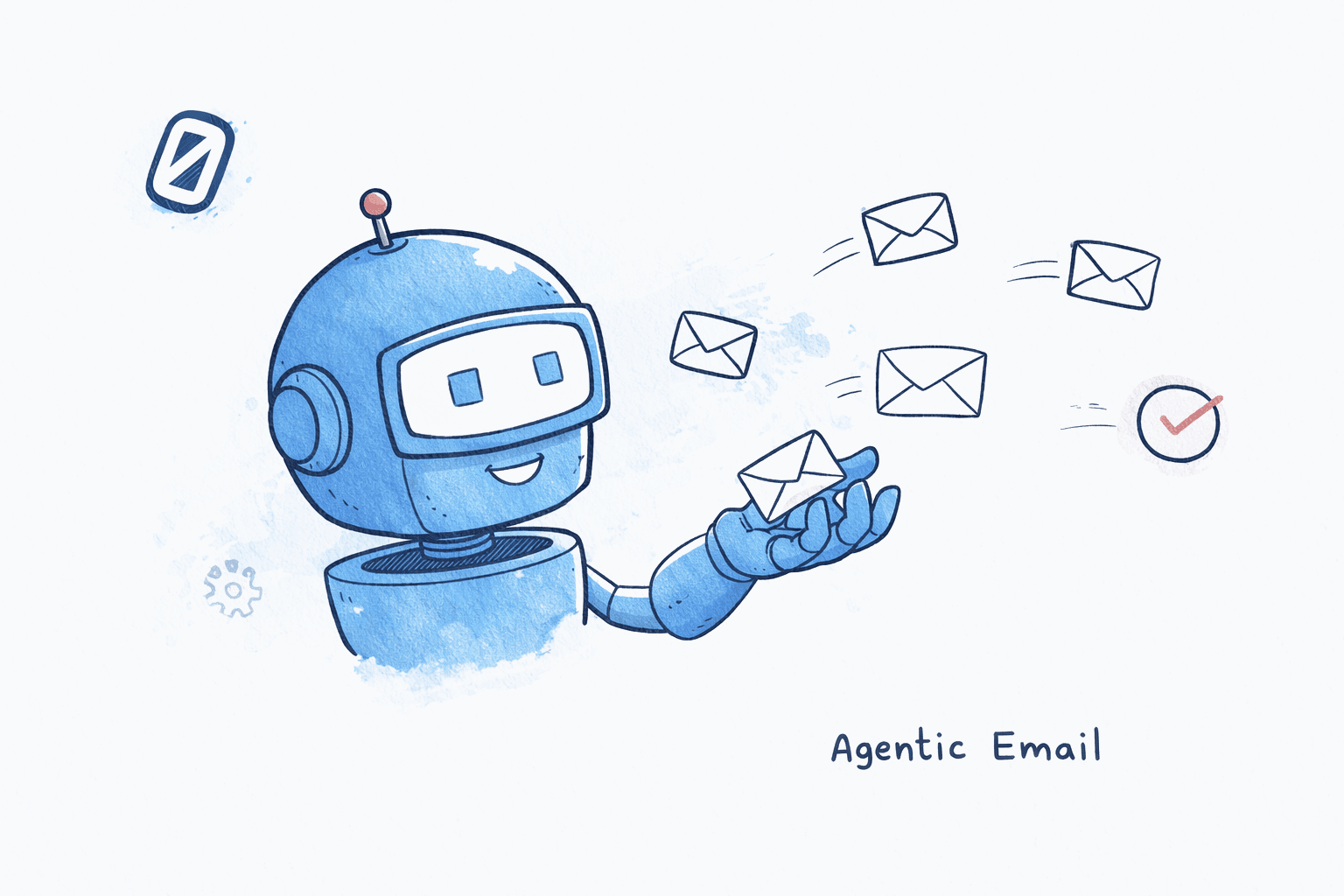
Most people who hear “agentic email” for the first time assume it means email with better AI features. It does not. Agentic email is a fundamentally different category of email management, one where autonomous AI agents triage, draft, prioritize, and act on your inbox without requiring constant human input. The shift is comparable to the gap between a spellchecker and a ghostwriter. One highlights problems. The other does the work.
The term borrows from “agentic AI,” a concept Andrew Ng, founder of DeepLearning.AI and Adjunct Professor at Stanford, identified in March 2024 as the most promising direction in the field. Ng defined four design patterns for agentic workflows: reflection, tool use, planning, and multi-agent collaboration. Apply those patterns to email and you get something no traditional inbox has ever offered: an email client that observes your behavior, learns your priorities, takes action on routine messages, and escalates only what genuinely needs you.
The email industry has spent two decades building faster ways to scroll through an infinite list. Agentic email asks a different question: what if the list handled itself?
Key Takeaway
Agentic email is email managed by autonomous AI agents that can triage, prioritize, draft, and act on messages without step-by-step human instruction. Unlike traditional AI email features (smart replies, summaries), agentic email operates continuously, makes multi-step decisions, and uses external tools like calendars and CRMs. The category is emerging rapidly: Gartner predicts 40% of enterprise apps will embed task-specific AI agents by the end of 2026.
How Is Agentic Email Different from AI Email Assistants?#
Agentic email and AI email assistants are not two names for the same thing. They represent different levels of autonomy, and the distinction matters for how you interact with your inbox.
An AI email assistant is reactive. You open your inbox, the assistant offers a smart reply, you accept or edit it, and the assistant waits for your next action. Apple Intelligence’s email summarization, launched with iOS 18.2 in December 2024, is a good example: it generates on-device summaries that replace preview text beneath each message. Useful, but you still drive every decision. The assistant does not read your calendar, does not know your meeting got canceled, and does not act on that information.
An email AI agent, by contrast, runs a continuous loop. It observes your inbox, performs email triage to decide which messages need your attention, drafts responses for routine threads, and can interact with external systems like calendars, CRMs, or project management tools. If you’ve read our breakdown of how AI email assistants actually work, you already know the technical stack powering these systems: embeddings, retrieval-augmented generation, large language models. What makes an agent different is the action layer on top. It does something with the intelligence, without waiting for permission on every step.
Martin Fowler, the widely cited software architect, wrote about agentic email in 2025, warning that it immediately triggers what he calls “The Lethal Trifecta”: untrusted content, sensitive information, and external communication, all present in a single system. “Senior and powerful people are setting up agentic email while running the risk of major security breaches,” Fowler cautioned.
| Feature | Traditional Email | AI Email Assistant | Agentic Email |
|---|---|---|---|
| Triage | Manual sorting | Suggested categories | Autonomous prioritization |
| Drafting | You write everything | Smart reply suggestions | Full drafts, multi-step threads |
| Calendar integration | Separate app | Basic time suggestions | Reads, confirms, reschedules meetings |
| Action trigger | Always you | Always you | Agent acts; you approve or override |
| Learning | Rules you set | Pattern matching | Continuous behavioral adaptation |
The practical difference: with an AI assistant, you still check email 15 times a day and make every decision. With agentic email, the agent handles the routine 80% and surfaces the 20% that requires your judgment. If you’ve explored how to use an AI agent to sort emails, you’ve seen the early versions of this shift in practice.
Why Is Agentic Email Emerging Now?#
Agentic email is not emerging because of a single breakthrough. It is emerging because three independent trends converged in 2025 and 2026.
First, the models got good enough. Large language models can now reliably classify email intent, extract action items, and generate contextually appropriate responses across professional registers. The hallucination rates that made autonomous email actions dangerous in 2023 have dropped significantly with techniques like retrieval-augmented generation and structured outputs.
Second, the agent infrastructure matured. Google’s announcement of Gemini Spark at I/O 2026 represents the highest-profile entry into agentic email to date. Built on Gemini 3.5 and powered by the Antigravity agent harness, Spark runs on dedicated cloud virtual machines, meaning it operates 24/7 even when your phone and laptop are off. It connects natively with Gmail, Calendar, Drive, and supports the Model Context Protocol (MCP) for external integrations. Microsoft is building comparable agent capabilities into Copilot. The infrastructure for always-on email agents now exists at platform scale.
Third, the market is moving fast. The global agentic AI market was valued at $7.29 billion in 2025 and is projected to reach $139.19 billion by 2034, a compound annual growth rate of 40.5%, according to Fortune Business Insights’ 2026 agentic AI market report. Gartner predicts that 40% of enterprise applications will embed task-specific AI agents by the end of 2026, up from less than 5% in 2025. Email, where knowledge workers spend 28% of their workday, is a natural first target for agent deployment.
Agentic AI Market Growth (USD Billions)
Source: Fortune Business Insights, Agentic AI Market Report, 2026. Published endpoints are 2026 ($9.14B) and 2034 ($139.19B); intermediate years are interpolated at the report stated 40.5% CAGR. Two-year intervals.
I’ll be honest: two years ago, I would have dismissed the idea of giving an AI agent unsupervised access to my inbox. The models were too unreliable, the stakes too high. What changed is not just model quality. It is the emergence of architectural patterns, like human-in-the-loop approval gates and risk-contingent autonomy, that make graduated trust possible.
What Does “Agentic” Actually Mean in the Context of Email?#
“Agentic” is a term from AI research that describes systems with genuine agency: the capacity to make choices and take actions independently to achieve a goal. In Andrew Ng’s framework, an agentic system must demonstrate at least three of four capabilities: reflection (evaluating its own outputs), tool use (interacting with external APIs), planning (breaking goals into steps), and multi-agent collaboration (coordinating with specialized sub-agents).
Applied to email, here is what each pattern looks like:
Reflection. The agent drafts a reply to a client, reviews the draft against your previous communication style, adjusts the tone from formal to conversational because your history with this contact is casual, and produces a final version. Current smart reply features skip this entirely. They generate one option and wait.
Tool use. A vendor emails asking to reschedule a meeting. The agent reads the email, checks your calendar for openings, cross-references with your CRM to confirm the vendor’s priority level, and proposes three alternatives. No manual context-gathering required.
Planning. An investor sends a due diligence questionnaire with 12 items. The agent decomposes the request into individual tasks, identifies which answers exist in your Drive documents, drafts responses for the factual items, and flags the three questions that require your personal input. One email becomes a structured workflow.
Multi-agent collaboration. Your travel booking agent coordinates with your email agent. A flight change notification arrives in your inbox. The email agent detects the schedule conflict, the travel agent finds alternative flights, and the email agent drafts a message to your meeting contact proposing a new time. Multiple specialized agents handle what would have taken you 20 minutes of app-switching.
Most products marketed as “AI email agents” in 2026 can do the first step of each example. They read the email and generate a suggestion. Then they stop. The word “agentic” specifically means they continue through the full chain of action.
If the gap between AI suggestions and autonomous action resonates, Swizero bridges it differently: instead of giving AI full control of your inbox, it caps what you see to a fixed card limit of AI-ranked messages. You get the prioritization intelligence without surrendering the decision-making.
What Are the Risks of Agentic Email?#
The promise of agentic email is real, but so are the risks. Ignoring them would be dishonest, and most coverage of agentic AI glosses over the hard parts.
The Trust Problem#
A 2025 study by Zhiping Zhang and colleagues at UC San Diego, published on arXiv, tested how agent autonomy affects user trust across 450 participants. The finding was stark: personalization without considering users’ privacy preferences increased privacy concerns and decreased both trust and willingness to use. The researchers identified “risk-contingent autonomy,” where the agent delegates control back to users upon detecting potential privacy leakage, as the design pattern that actually maintained trust.
The broader consumer sentiment confirms this. A March 2026 Malwarebytes survey of 1,235 respondents across 72 countries found that 90% are worried about AI using their data without consent. In practical terms, 88% reported they do not freely share personal information with AI tools.
One caveat: the Malwarebytes survey sampled newsletter readers who self-selected into a privacy-focused audience, so the 90% figure likely skews higher than the general population. But even halved, the trust deficit is enormous.
The Security Surface#
Fowler’s “Lethal Trifecta” is not theoretical. An agentic email system that can read your inbox, access external tools, and send messages on your behalf creates a surface area that prompt injection attacks can exploit. A carefully crafted email could, in theory, instruct the agent to forward sensitive data or take unauthorized actions.
Gartner itself projects that over 40% of agentic AI projects will be canceled by end of 2027 due to escalating costs, unclear business value, or inadequate risk controls. The technology is real. The implementation maturity is not.
The Privacy Architecture Question#
Where your email data goes matters more when an agent processes every message autonomously. Traditional email apps read messages when you open them. An agentic email system reads every message, all the time, to classify, prioritize, and act. That is a qualitatively different privacy footprint, which is why the architecture behind AI email privacy becomes a decisive factor in choosing an agentic email tool. Cloud processing, on-device processing, zero-retention guarantees: these are not marketing checkboxes. They are structural choices that determine whether an agent’s continuous access to your inbox creates risk or safety.
Where Is Agentic Email Headed?#
The trajectory is clear, even if the timeline is uncertain.
Near-term (2026-2027): Gmail’s Gemini Spark and Microsoft Copilot establish agentic email as a mainstream feature. Early adopters experiment with autonomous triage and drafting, but most users keep human-in-the-loop approval for sends. The inbox becomes what Salesforce’s research team described as “an AI-curated feed” rather than a chronological list.
Medium-term (2028-2029): Gartner’s five-stage model predicts that by 2028, networks of agents will collaborate across platforms, and by 2029, at least half of knowledge workers will create, govern, and deploy agents on demand. Multi-agent email workflows, where your scheduling agent, CRM agent, and email agent coordinate autonomously, become standard for power users.
The question nobody is asking: What happens to email volume when agents handle both sides of the conversation? If my agent triages my inbox and your agent triages yours, we enter a world where AI systems negotiate meeting times, exchange routine information, and resolve scheduling conflicts without either human ever reading a message. Email does not die. It becomes infrastructure that agents use, not a channel that humans scroll through.
The rise of privacy-first email is not a separate trend from agentic email. It is a prerequisite. Users will only grant agents continuous inbox access if they trust the privacy architecture underneath. The market data supports this: the email encryption market is growing at 20% annually precisely because the AI capabilities being layered on top demand a stronger privacy foundation.
Swizero’s approach to this future is distinctive. Rather than building a fully autonomous agent that manages your inbox behind the scenes, Swizero puts a constraint on the problem first. Its AI ranks every email by importance and surfaces only a fixed card limit, giving you a session that finishes. The concept of an email finish line is central to this design. The intelligence is agentic in nature: it observes, prioritizes, and summarizes autonomously. But the action layer, the swiping, the deciding, that stays with you. It is a philosophy rooted in the belief that the point of email technology is to give you a finish line, not to remove you from the process entirely.
Frequently Asked Questions#
What is agentic email in simple terms?#
Agentic email is email managed by AI agents that can independently triage, prioritize, draft, and take actions on your messages without needing step-by-step instructions. Unlike traditional AI features that wait for your input, agentic email systems operate continuously and make multi-step decisions, such as reading an email, checking your calendar, and proposing meeting times in a single automated workflow.
How is agentic email different from email automation?#
Email automation follows predefined rules: if a message matches a filter, move it to a folder. Agentic email uses AI models that interpret context, assess intent, and adapt their behavior based on your communication patterns. An automation rule cannot distinguish between a routine vendor invoice and an urgent client request with the same subject line. An email AI agent can, because it understands the content semantically and weighs sender relationships, timing, and thread history.
Is agentic email safe to use?#
Safety depends entirely on the architecture. Systems that process email data on-device or use zero-retention cloud processing offer stronger privacy guarantees than those that store and analyze your messages on remote servers. The biggest risk is granting an autonomous agent the ability to both read your inbox and send messages, which creates a security surface for prompt injection attacks. The safest implementations use human-in-the-loop approval for outbound actions and risk-contingent autonomy that escalates high-stakes decisions to you.
What email apps use agentic AI in 2026?#
Google’s Gemini Spark, announced at I/O 2026, is the highest-profile agentic email product, running 24/7 on cloud infrastructure with Gmail, Calendar, and Drive integration. Microsoft Copilot offers comparable agent capabilities within Outlook. Several independent apps are building agentic features with varying degrees of autonomy, from fully autonomous agents to constrained-autonomy approaches that combine AI prioritization with human decision-making. For a full side-by-side breakdown, see our roundup of the best AI email assistants in 2026.
Will agentic email replace human email management?#
Not entirely, and possibly not ever. The research suggests that the most effective model is graduated autonomy: agents handle the routine 80% of email (newsletters, confirmations, scheduling logistics) while humans retain control over the 20% that involves judgment, nuance, or high stakes. The goal of agentic email is not to remove you from your inbox but to remove the parts of your inbox that do not require you.
Sources#
- Four Design Patterns for AI Agentic Workflows - Andrew Ng, DeepLearning.AI, March 2024. Identified reflection, tool use, planning, and multi-agent collaboration as core agentic patterns.
- Agentic Email (Bliki) - Martin Fowler, 2025. Defined “The Lethal Trifecta” of risks in agentic email: untrusted content, sensitive information, external communication.
- Google Introduces Gemini Spark at I/O 2026 - TechCrunch, May 2026. 24/7 agentic assistant with Gmail integration, running on Gemini 3.5 and Antigravity harness.
- Agentic AI Market Report - Fortune Business Insights, 2026. Market valued at $7.29B in 2025, projected to reach $139.19B by 2034 at 40.5% CAGR.
- Gartner Predicts 40% of Enterprise Apps Will Feature AI Agents by 2026 - Gartner, August 2025. Up from less than 5% in 2025.
- Gartner Predicts Over 40% of Agentic AI Projects Will Be Canceled by End of 2027 - Gartner, June 2025. Due to costs, unclear value, or risk controls.
- Autonomy Matters: A Study on Personalization-Privacy Dilemma in LLM Agents - Zhiping Zhang et al., arXiv, October 2025. 450-participant study showing risk-contingent autonomy maintains trust.
- Malwarebytes Survey: 90% Don’t Trust AI with Their Data - Malwarebytes, March 2026. 1,235 respondents across 72 countries.
- The Social Economy: Unlocking Value and Productivity Through Social Technologies - McKinsey Global Institute, 2012. Knowledge workers spend 28% of workday on email.
- How to Win the Battle for Attention in the Agentic Email Inbox - Salesforce, 2026. Describes the inbox shifting from a chronological list to an AI-curated feed.
Your inbox doesn't have to feel like this.
Be among the first to experience a finished inbox.
Join the finite inbox beta