Email Workplace Power Dynamics: How Your Inbox Reveals the Office Hierarchy
By Chris Stefaner, Co-founder of Swizero
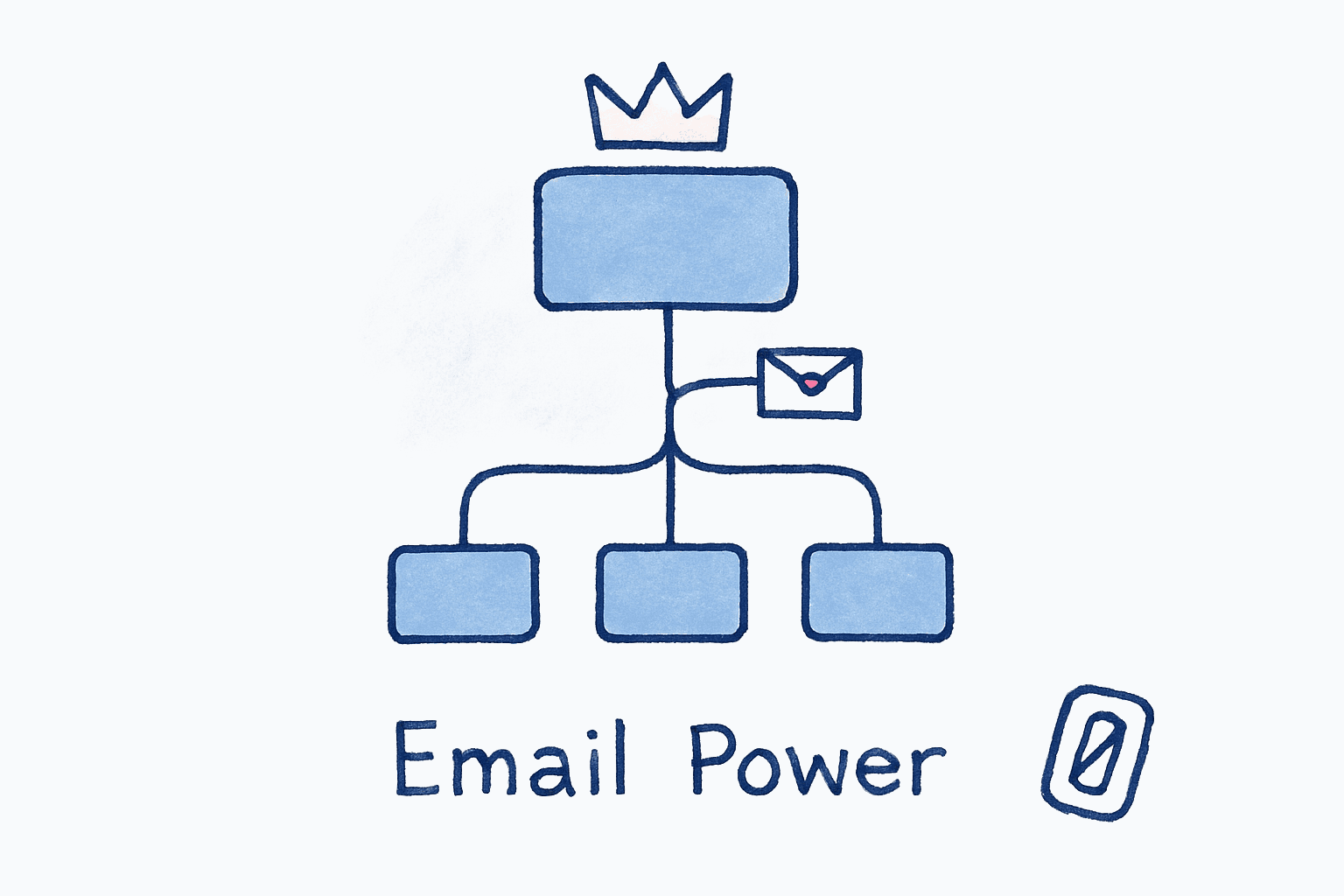
Every email you send carries two messages. The first is whatever you typed. The second is a declaration of where you sit in the organizational hierarchy, whether you intended it or not.
That is the finding that emerges from a decade of organizational communication research: email is not a neutral channel. It is a stage for performing status, enforcing accountability, and playing politics. The words you choose, the speed of your reply, who you CC, whether you BCC, even the length of your message all function as power signals that colleagues decode instantly.
Here is the uncomfortable editorial position this article takes: most email productivity advice ignores the power dynamics that actually govern inbox behavior. Tips like “batch your email” or “keep replies short” assume everyone operates from the same position. They don’t. A junior analyst who takes four hours to reply sends a very different signal than a VP who does the same thing. Until we account for the politics embedded in email, no amount of productivity hacking will change how your inbox makes you feel.
Key Takeaway
Email encodes workplace power dynamics through response time, CC behavior, message length, and strategic BCC use. Research from the Enron corpus, Cornell University, and the Journal of Business Ethics shows these patterns are systematic and predictable, not accidental. Recognizing email as a political tool, not just a communication tool, is the first step toward healthier inbox behavior.
Why Does Response Time Signal Status in Email?#
The short answer: because the person with more power controls the clock.
A 2021 study by Laura Giurge (London Business School) and Vanessa Bohns (Cornell University) published in Organizational Behavior and Human Decision Processes documented what the researchers called the “email urgency bias.” Across eight pre-registered experiments with 4,004 participants, they found that email receivers consistently overestimate how quickly senders expect a response. The gap between perceived and actual expectations was largest for emails received outside business hours.
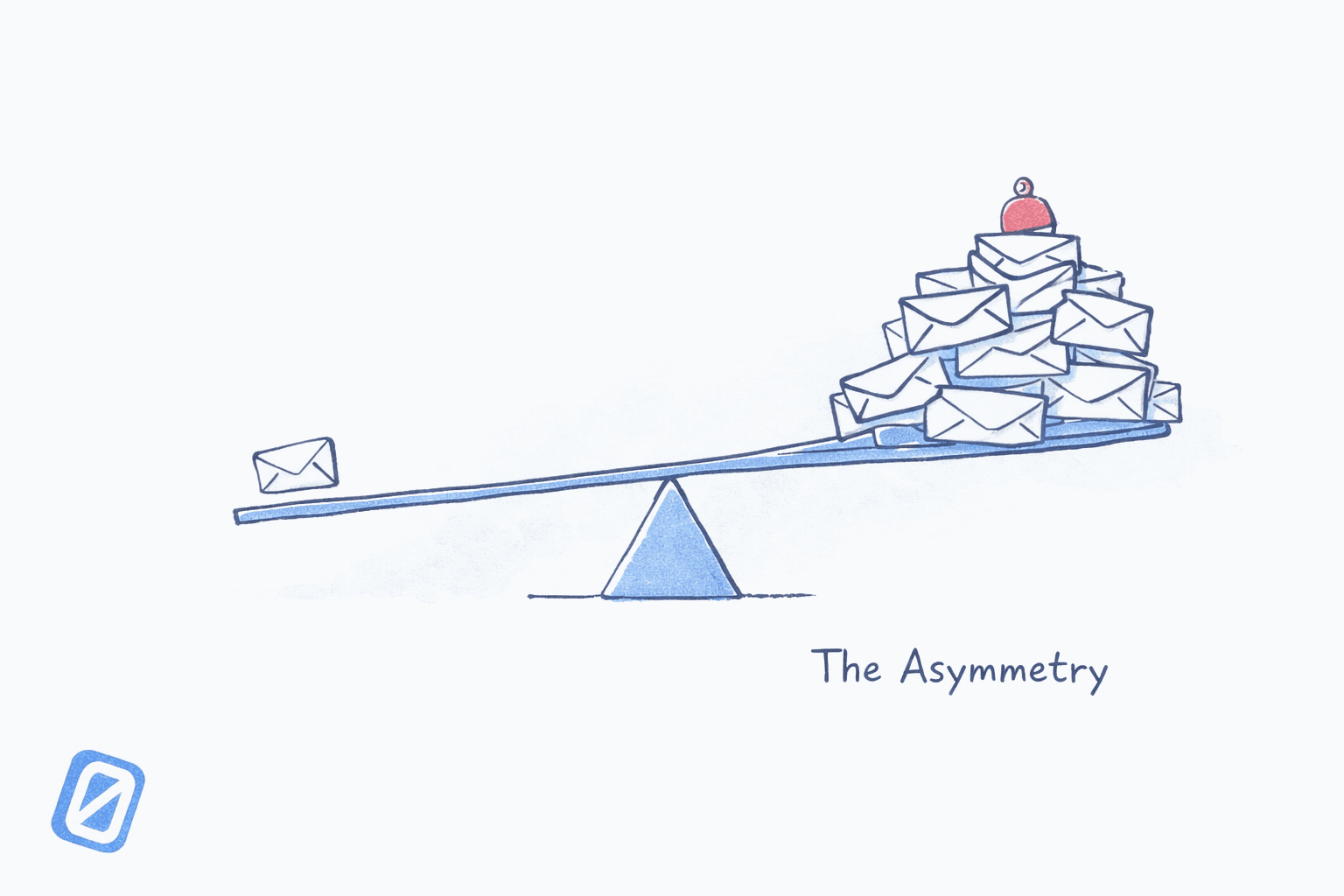
But here is what the urgency bias research implies without stating directly: the bias runs downhill. Junior employees feel the pressure to respond immediately because their professional standing depends on perceived responsiveness. Senior employees face no equivalent pressure. A CEO who replies in three days is “busy.” An intern who does the same is “unresponsive.”
Gloria Mark, Professor of Informatics at UC Irvine and author of Attention Span, has studied why people feel compelled to respond to email even when it costs them focus. Her research found that “from a cost-benefit point of view, in terms of worker time, email does not pay off,” yet people still prioritize it because of “power dynamics in the workplace, and a host of other reasons.”
The asymmetry is measurable. According to data compiled in a 2021 analysis by EmailAnalytics, the average professional email response time is 3 hours, 38 minutes, and 31 seconds during work hours. But that average masks enormous variation by role: executives routinely operate on multi-day reply cycles while expecting same-day or faster responses from reports.
I could write a whole post about response time alone (and we have: email response time research covers the benchmarks in depth). But the power dynamics angle is what most productivity advice misses. Response speed is not just a workflow metric. It is a status performance.
The CC Function: Transparency or Surveillance?#
CC began as a practical feature: keep relevant parties informed. It has evolved into something far more complicated. Organizational researchers have identified three distinct functions of CCing in workplace email: accountability, collective decision-making, and self-projection. Only one of those is about information sharing.
The most rigorous study on CC behavior comes from Haesevoets, De Cremer, and colleagues, published in the Journal of Business Ethics in 2019. Their paper, “Transparency and Control in Email Communication: The More the Supervisor is Put in CC the Less Trust is Felt,” ran five sequential studies and found a consistent result: CC use enhances perceived transparency but simultaneously increases the experience of being controlled. The net effect on trust is negative.
Employees felt trusted the least when the supervisor was always included in CC. In two field surveys, the negative effect on felt trust lowered perceptions of psychological safety and contributed to what the researchers described as a “culture of fear.”
The implications are stark. When a colleague CCs your manager on a routine email, they are not just “keeping everyone in the loop.” They are creating a paper trail. They are signaling to management that this interaction requires oversight. They are, in the language of Erving Goffman’s The Presentation of Self in Everyday Life, performing accountability on a front stage where the audience (your boss) has been deliberately invited.
Goffman’s impression management framework, originally applied to face-to-face interaction, maps onto email with unsettling precision. Every CC is a casting decision. Every BCC is a backstage whisper. Every Reply All is a public soliloquy delivered for the benefit of the gallery.
One caveat worth noting: the Haesevoets study was conducted across European and American samples, and CC norms vary significantly by culture. In high power-distance cultures, CCing a supervisor may be expected and carry no negative trust signal. The politics of CC are real, but they are not universal.
If the surveillance dynamic of CC culture resonates, Swizero takes a different approach to inbox processing. Instead of managing an infinite stream of CC’d threads, you process a fixed card limit of AI-ranked messages per run. The political noise gets filtered before it reaches you.
How Does Email Length Reveal Organizational Rank?#
Senior people send shorter emails. Junior people send longer ones. This is not a style preference. It is a power gradient encoded in word count.
The dynamic works because brevity is a privilege of authority. When a CEO replies “Approved” or “Let’s discuss,” that two-word message carries organizational weight precisely because of who sent it. A junior employee sending the same terse reply would read as dismissive or lazy. They compensate by writing longer, more deferential messages that demonstrate effort, thoroughness, and respect for the recipient’s time.
Eric Gilbert’s landmark 2012 study “Phrases That Signal Workplace Hierarchy”, presented at the ACM Conference on Computer-Supported Cooperative Work (CSCW), analyzed 500,000 emails from the Enron corpus to identify linguistic patterns that predict hierarchical direction. Gilbert found that specific phrases reliably indicated whether an email was traveling up or down the org chart. “Thought you would” strongly suggested the recipient outranked the sender. “Let’s discuss” implied the reverse.
| Power Signal | Upward Email (to boss) | Downward Email (to report) |
|---|---|---|
| Length | Longer, more detailed | Shorter, more directive |
| Hedging language | “I was wondering if…” | “Please do X by Friday” |
| Typical phrases | “Thought you would,” “Wanted to let you know” | “Let’s discuss,” “Going forward” |
| Response expectation | Fast reply expected | Delayed reply tolerated |
| Formality | Higher | Lower |
Source: Adapted from Gilbert, “Phrases That Signal Workplace Hierarchy,” CSCW 2012
Gilbert’s finding is particularly notable because the phrases people write to their bosses demonstrate fewer cognitive processes than the phrases they write to peers or subordinates. Employees writing upward simplify their thinking, defer their analysis, and present information rather than conclusions. Employees writing downward assert, direct, and decide. The inbox becomes a mirror of the org chart.
BCC: The Political Weapon Nobody Admits to Using#
If CC is the front stage of email politics, BCC is the backstage. The blind carbon copy exists in a moral gray zone: technically available, rarely discussed in company policy, and almost always deployed for political purposes.
BCC serves three primary functions in organizational politics, none of which appear in any email etiquette guide:
The witness play. You BCC a colleague or your own manager on an email to create an invisible observer. If the conversation later goes sideways, you have a witness who received the information in real time without the other party knowing. This is the email equivalent of having someone listen in on a phone call from the next room.
The escalation seed. You BCC a senior leader on your response to a difficult peer, ensuring they see your version of events before any formal escalation. If the conflict grows, the senior leader already has context that favors your perspective.
The loyalty test. Forwarding someone’s BCC’d email to the original sender is one of the most politically damaging moves in office communication. The fact that this unwritten rule exists tells you everything about BCC’s actual function: it is a tool of selective information control.
Ben Dattner, organizational psychologist and adjunct professor at New York University, has documented how credit and blame dynamics shape workplace behavior. In his book Credit and Blame at Work, Dattner argues that “many managers foster a ‘blame or be blamed’ culture that can turn a workplace into a competitive battlefield.” Email, with its permanent record and selective distribution features, is the primary arena where these credit and blame contests play out. This is partly why delegating email access feels so fraught; handing over your inbox means handing over your political record.
What Does “Reply All” Really Accomplish?#
Reply All is the most publicly visible power move in email. Unlike CC and BCC, which operate through selective audience management, Reply All broadcasts to the entire thread. Its political functions are well understood by anyone who has spent a year in a corporate environment:
Credit claiming. Replying all to announce completion of a task ensures everyone on the thread sees who did the work. A private reply to the assigner would accomplish the same communication goal with none of the political benefit.
Blame deflection. When a project hits trouble, a Reply All explaining your specific contribution (and implicitly, where someone else fell short) converts a private failure into a public narrative. The person who controls the Reply All thread controls the story.
Performative competence. Adding a thoughtful observation or a relevant data point via Reply All signals engagement and expertise to an audience that includes senior leaders who might otherwise never see your work.
Research on email classes and work stressors, published in Frontiers in Psychology in 2024, found that employees blame email for stress they experience at work, whether or not the stress is actually caused by email. The sheer volume of messages in the inbox serves as a reminder of work that still needs to be done. Reply All compounds this effect by multiplying thread participants, turning a two-person exchange into an organizational broadcast.
Honestly, the Reply All problem is the one I find hardest to solve through individual behavior change. The incentives are too strong. In an environment where visibility equals career advancement, Reply All is rational behavior for the individual even when it is toxic for the organization. That is the hidden cost of CC culture at scale.
Can You Escape Email Workplace Power Dynamics?#
Here is where the “finish line” philosophy intersects with email politics.
Most of the power dynamics described above depend on one structural feature of email: the infinite inbox. When your inbox has no limit, every CC, every Reply All, every BCC-seeded thread accumulates. The political messages pile up alongside the work messages, and you have no framework for deciding which deserves your attention.
Swizero’s fixed card limit disrupts this pattern. When your inbox is reduced to a handful of AI-ranked cards per Swizero Run, several things change:
The CC noise gets filtered. If a thread exists primarily for accountability theater rather than genuine information sharing, the AI is less likely to surface it in your limited card set. Your attention goes to messages that require action, not messages designed to create a paper trail.
Response time pressure drops. When you process a fixed set of cards and reach a finish line, the ambient anxiety of an ever-growing inbox disappears. You responded to what mattered. The rest can wait for the next run. That is a fundamentally different relationship with email response time expectations than checking an infinite list every 20 minutes.
The status game weakens. Inbox management is itself a status signal. People who maintain pristine inboxes signal control. People who broadcast their email volume signal importance. When everyone processes the same limited set of cards, the performance aspect of inbox management becomes irrelevant. You are no longer performing productivity. You are just done.
This will not eliminate email politics entirely. Nothing will, because email was never designed to be a neutral tool. But a structural constraint on inbox volume removes the stage where many of these performances happen.
Frequently Asked Questions#
Does email response time really affect how colleagues perceive your status?#
Yes. Research by Giurge and Bohns (2021) across 4,004 participants found that receivers systematically overestimate how quickly senders expect responses, especially outside business hours. In practice, faster response times are associated with lower organizational status because they signal availability and deference, while slower response times from senior employees are interpreted as a marker of being “in demand.”
Why does CCing a supervisor reduce trust instead of increasing transparency?#
A five-study investigation by Haesevoets, De Cremer, and colleagues published in the Journal of Business Ethics (2019) found that while CC use does increase perceived transparency, it simultaneously increases the feeling of being controlled. Across all five studies, employees who were always CC’d to a supervisor reported the lowest levels of felt trust. The negative trust effect also lowered psychological safety and contributed to organizational fear cultures.
Is BCC ever appropriate in workplace email?#
BCC is technically appropriate for mass distribution emails where you want to protect recipient privacy (such as company announcements to external contacts). In practice, however, BCC in interpersonal workplace email almost always serves a political function: creating an invisible witness, seeding information for a potential escalation, or building a private record. No major organizational behavior study has found a trust-neutral use case for BCC in one-to-one workplace correspondence.
Can email language predict someone’s position in the org chart?#
Eric Gilbert’s 2012 CSCW study analyzed 500,000 emails from the Enron corpus and found that specific phrases reliably predicted whether an email traveled up or down the hierarchy. Phrases like “thought you would” indicated the recipient outranked the sender, while “let’s discuss” implied the reverse. Emails sent upward tended to be longer and contain more hedging language; emails sent downward were shorter and more directive.
Sources#
-
You Don’t Need to Answer Right Away! Receivers Overestimate How Quickly Senders Expect Responses to Non-Urgent Work Emails. Giurge & Bohns, Organizational Behavior and Human Decision Processes, 2021. Documented the “email urgency bias” across eight pre-registered experiments (N=4,004).
-
Transparency and Control in Email Communication: The More the Supervisor is Put in CC the Less Trust is Felt. Haesevoets, De Cremer, De Schutter, McGuire, Yang, Jian & Van Hiel, Journal of Business Ethics, 2019. Five-study investigation showing CC use reduces felt trust and psychological safety.
-
Phrases That Signal Workplace Hierarchy. Eric Gilbert, ACM CSCW, 2012. Analysis of 500,000 Enron emails identifying linguistic markers that predict hierarchical direction.
-
Drowning in Emails: Investigating Email Classes and Work Stressors. Frontiers in Psychology, 2024. Found that employees attribute work stress to email volume regardless of whether email is the actual cause.
-
Average Email Response Time for Professionals. EmailAnalytics, 2021. Average professional response time of 3 hours, 38 minutes during work hours.
-
Credit and Blame at Work. Ben Dattner, Simon & Schuster. Research on how blame cultures shape workplace communication and documentation behavior.
-
The Presentation of Self in Everyday Life. Erving Goffman, 1956. Foundation of impression management theory, applied here to email front-stage and backstage dynamics.
-
Power Distance in English Lingua Franca Email Communication. Bjørge, International Journal of Applied Linguistics, 2007. Cross-cultural analysis of how power distance shapes email formality norms.
-
The Cost of Interrupted Work: More Speed and Stress. Gloria Mark, Daniela Gudith, Ulrich Klocke, CHI 2008. Foundational research on interruption costs and workplace email behavior.
Your inbox doesn't have to feel like this.
Be among the first to experience a finished inbox.
Join the finite inbox beta