The Rise of Privacy-First Email: What the Market Data Shows
By Chris Stefaner, Co-founder of Swizero
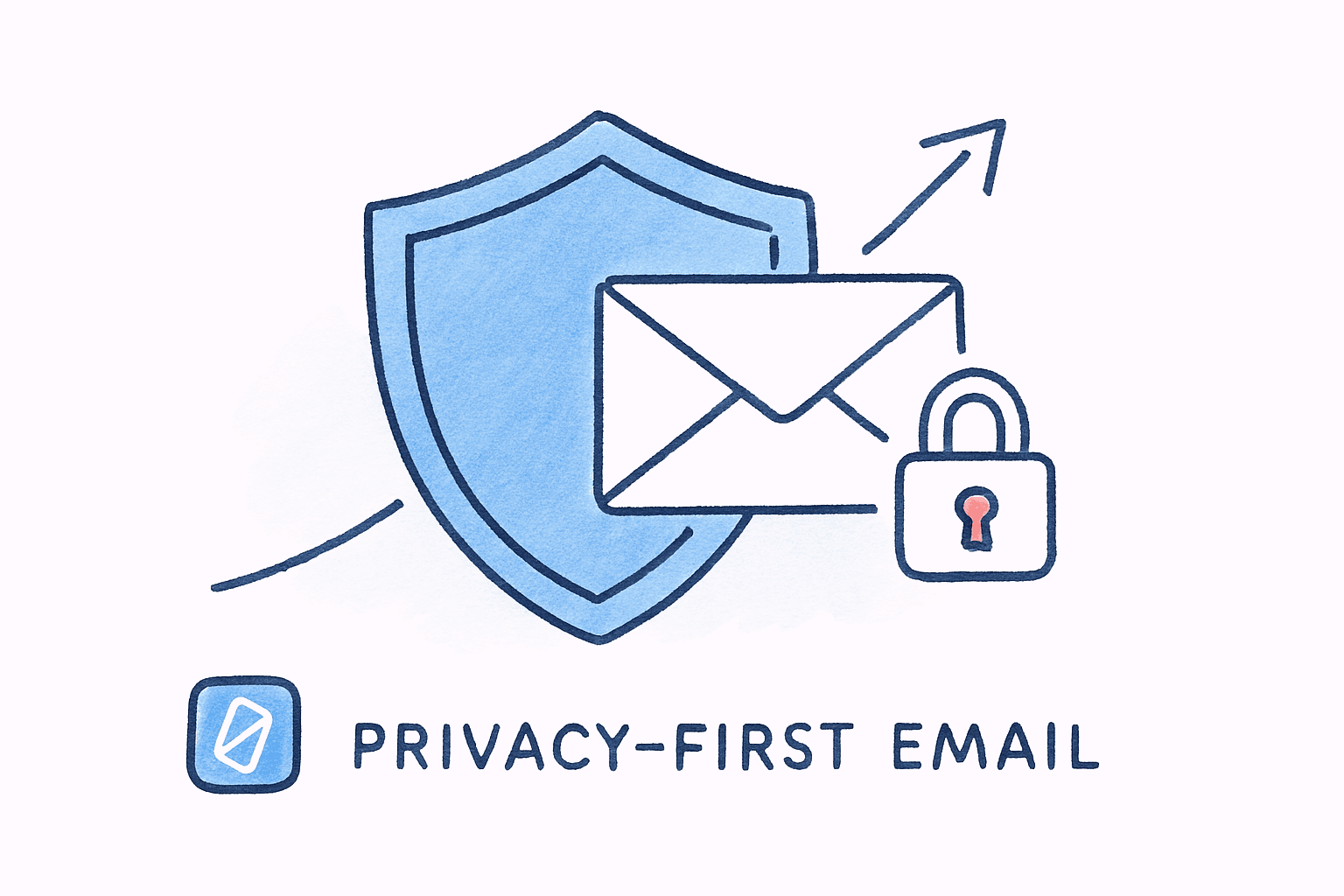
The privacy-first email market is growing at 20.2% per year. Not the broader SaaS market. Not cloud infrastructure. The specific category of email encryption and privacy-preserving email services, which MarketsandMarkets’ 2025 Email Encryption Market report projects will reach $23.33 billion by 2030, up from $9.3 billion in 2025. Proton Mail crossed 100 million accounts in 2024. France is moving to regulate tracking pixels under explicit consent rules. Apple Mail, commanding 58% of email opens globally, now blocks tracking by default.
This is not niche. Privacy-first email is becoming the market’s center of gravity, driven by consumer distrust, regulatory enforcement, and mobile hardware capable of running AI models locally. The email apps that win the next five years will be the ones that treat your data as something that stays on your device, not something shipped to a cloud server so an AI can read it.
Key Takeaway
The privacy-first email sector is undergoing a structural shift. Email encryption is growing at a 20.2% CAGR, Proton Mail has crossed 100 million accounts, GDPR fines surpassed EUR 7.1 billion, and regulators are targeting email tracking pixels specifically. For AI-powered email apps, the critical differentiator is what happens to your data after processing: does the provider retain your emails on cloud servers, or is content processed ephemerally and immediately discarded with no logs, no training use, and no persistent copies?
How Big Is the Privacy-First Email Market in 2026?#
Big, and accelerating. The global email encryption market was valued at $9.3 billion in 2025 and is projected to grow at a compound annual growth rate of 20.2% through 2030, according to MarketsandMarkets’ Email Encryption Market forecast. That trajectory puts the market at $23.33 billion within five years.
The broader email security market (which includes encryption, anti-phishing, and authentication) is even larger. Mordor Intelligence estimates it at $5.89 billion in 2026 alone, growing to $10.64 billion by 2031 at a 12.57% CAGR. Fortune Business Insights projects the encryption segment alone will hit $49.6 billion by 2034.
Three forces are driving this simultaneously:
-
Regulatory pressure. GDPR fines have exceeded EUR 7.1 billion cumulative, with EUR 1.2 billion issued in 2025 alone. Finance, healthcare, and telecommunications companies are migrating to encrypted email because the cost of non-compliance has become existential.
-
Enterprise migration. Businesses in the EU are increasingly seeking GDPR-compliant email alternatives to U.S. hyperscalers. Over 50,000 organizations now use Proton for Business, driven by demand from German, French, and Dutch enterprises needing data sovereignty.
-
Consumer demand. The Cisco 2025 Data Privacy Benchmark Study, surveying 2,600 security and privacy professionals across 12 countries, found that 96% of organizations believe privacy investment benefits outweigh costs, with a median 1.6x return on investment.
Email Encryption Market Growth (USD Billions)
Source: MarketsandMarkets, Email Encryption Market Report 2025. Published endpoints are 2025 ($9.30B) and 2030 ($23.33B); intermediate years are interpolated at the report stated 20.2% CAGR.
Honestly, I expected the growth curve to be strong, but 20% annually in a category most people think of as boring infrastructure genuinely surprised me. Email encryption is not growing because it is trendy. It is growing because not encrypting email is becoming a liability.
What Does 100 Million Proton Mail Accounts Tell Us?#
Proton Mail reached 100 million accounts in late 2024, up from 50 million in 2021 and just 2 million in 2017. That is a 50x increase in seven years. Proton AG’s total revenue reached $97.5 million in 2024, proving that privacy-first email is not just an ideological project; it is a viable business.
Tuta (formerly Tutanota) surpassed 10 million users in 2025 and became the first major provider to implement post-quantum cryptography. The combined user base of privacy-first email providers is still small in absolute terms (Proton holds roughly 0.28% of global email server market share versus Gmail’s 39%), but the growth rate tells a different story. When a category grows 50x in seven years while dominant players are hemorrhaging trust, the trajectory matters more than the snapshot.
Andy Yen, Proton’s CEO and a former CERN physicist, articulated the structural argument in a 2025 Bankless podcast interview: “AI is becoming the most powerful surveillance machine ever built and most people are feeding it their deepest secrets without realizing who can read them.” That observation applies directly to the email market: every AI email feature that processes your inbox on a cloud server is, architecturally, a surveillance pipeline with a productivity label on it.
Bruce Schneier, security technologist and author of Data and Goliath, captured the complementary technical angle in a 2025 interview: “It won’t matter if our WhatsApp messages are end-to-end encrypted if we just hand the plaintext over to whatever tech company hosts our AI assistant.” His point is precise: encryption in transit is meaningless if the AI processing your inbox requires decrypting everything on a third-party server.
This is where Swizero’s architecture diverges. Most AI email apps process your messages on cloud servers to power their AI features. Swizero uses cloud AI providers that contractually do not store or train on your emails, and processes email triage within a privacy-preserving framework. Your email content is not retained, sold, or used as training data.
What Are Regulators Doing About Email Privacy?#
Enforcement has changed shape. It started with a handful of headline penalties and has settled into sustained, high-volume routine work. The DLA Piper GDPR Fines Survey (January 2026) reports that European data protection authorities now receive 443 breach notifications per day, a 22% year-over-year increase.
The annual fine totals tell a subtler story than the cumulative headline. The €7.1 billion figure is dominated by a few enormous penalties, chiefly the €1.2 billion Meta fine in 2023 and the €746 million Amazon fine in 2021. Strip those out and what remains is a steady baseline of roughly €1.2 billion a year, spread across far more cases.
Major 2025 fines included TikTok’s EUR 530 million penalty for illegal data transfers to China and Google’s EUR 125 million fine from France’s CNIL for cookie consent violations.
The most consequential regulatory move for email specifically happened in June 2025, when France’s CNIL launched a public consultation on tracking pixels. The draft recommendation classifies tracking pixels (invisible one-pixel images embedded in HTML emails) as cookies under the ePrivacy Directive. If finalized (expected early 2026), senders would need explicit, separate consent before deploying any tracking pixel. Not just consent to receive the email. A second, distinct consent specifically for tracking.
Meanwhile, in the United States, 20 states now have comprehensive privacy laws on the books as of 2026, with Indiana, Kentucky, and Rhode Island taking effect this year. Nine existing state privacy laws were amended in 2025 to add additional provisions. The absence of a federal privacy law means a patchwork of obligations, but the direction is uniformly toward stricter consent requirements and stronger user rights.
Max Schrems, the privacy advocate whose legal challenges reshaped European data protection, has been critical of attempts to weaken GDPR for AI companies: “What these changes seem to overlook is that most data processing is not AI-based. The potential change that would ‘liberate’ AI would have massive unintended consequences for many other areas of the GDPR.”
GDPR Fines Issued Each Year (EUR Billions)
Source: DLA Piper GDPR Fines and Data Breach Survey, January 2026. Annual totals, not cumulative.
For email apps that rely on cloud processing of user data, every new regulation adds compliance cost. For apps that keep data on-device or use providers that never retain content, these regulations are simply less relevant: there is nothing to regulate when the data never persists beyond the processing moment.
How Is Apple Reshaping Email Privacy at Scale?#
Apple Mail accounts for roughly 58% of all email opens globally as of 2025, making Apple’s privacy decisions de facto industry standards. When Apple introduced Mail Privacy Protection (MPP) in iOS 15 in 2021, it broke email tracking by preloading all images through proxy servers, blocking sender IP collection, and marking emails as “opened” regardless of whether users actually read them.
The impact on the email industry has been enormous. A 2024 Validity study found that senders with Apple Mail-dominant audiences saw reported open rates climb 18-32 percentage points above verified engagement benchmarks. Open rates, the metric email marketers relied on for decades, became functionally unreliable for the majority of email recipients. Apple has since gone further, stripping UTM tracking parameters from links in Mail and Safari.
I could write a whole post about the downstream effects on email marketing alone, but the key insight for consumer email is this: Apple proved that privacy features do not require user sacrifice. MPP does not make email slower or less functional. Users do not notice it running. That normalized the expectation that email should be private by default. Every new email app now has to meet that expectation or explain why it cannot.
If the idea of your email data being processed and retained by third parties concerns you, Swizero uses AI providers that contractually cannot store or train on your email content. Your messages are processed, summarized, and forgotten.
Do Consumers Actually Care About Email Privacy?#
The survey data is unambiguous: they care deeply, and the gap between concern and action is narrowing.
Pew Research Center’s 2023 survey found that 81% of Americans feel concerned about how companies use their collected data, and 67% say they understand little to nothing about what companies actually do with their information. Those numbers represent an increase from 2019 levels, indicating the concern is growing rather than stabilizing.
The Thales 2025 Digital Trust Index, surveying over 14,000 consumers across 14 countries, found that 82% abandoned a brand in the past 12 months specifically over concerns about personal data handling. Not a stated preference; an action already taken.
That distrust is especially acute around AI. A March 2026 Malwarebytes survey found that 90% of people do not trust AI companies with their personal data.
| Survey | Year | Key Finding |
|---|---|---|
| Pew Research Center | 2023 | 81% concerned about company data use |
| Cisco Privacy Benchmark | 2025 | 96% say privacy ROI exceeds cost |
| Thales Digital Trust Index | 2025 | 82% abandoned a brand over data |
| Malwarebytes AI Trust | 2026 | 90% don’t trust AI with personal data |
| IAPP Consumer AI Perspectives | 2025 | 70% distrust corporate AI practices |
Sources: Pew Research, Cisco, Thales, Malwarebytes, IAPP
One caveat worth acknowledging: there is a well-documented gap between stated privacy preferences and actual behavior (the “privacy paradox”). People say they care about privacy but still use Gmail. That gap is real. But the paradox shrinks when privacy-first alternatives become genuinely competitive on features and usability. When the private option is also the better-designed option, the paradox dissolves. We have seen this already with messaging apps moving to end-to-end encryption as a competitive necessity, not a philosophical choice.
What Does This Mean for AI Email Apps?#
Here is where the data converges into a single, uncomfortable conclusion for most AI email companies: the market is moving toward privacy, but most AI email architectures move away from it.
The standard AI email pipeline works like this: your email text gets extracted, sent to a cloud server, processed by a large language model (GPT-4, Gemini, Claude), and the result gets returned to your device. This is how most major AI email clients operate. Even with zero-retention agreements and encryption in transit, the email content still gets decrypted and processed on infrastructure you do not control.
Privacy-preserving AI approaches eliminate the retention risk. When AI providers contractually cannot store, log, or train on email content, and processing happens in ephemeral contexts that are discarded immediately after generating a response, the data exposure shrinks to milliseconds rather than persisting indefinitely. This is architecturally different from apps that route your email through persistent cloud processing.
Swizero was built around this principle from day one. The finish-line philosophy (email with a fixed card limit, designed to be completed rather than endlessly scrolled) only works if users trust the system enough to let it prioritize on their behalf. That trust requires guaranteeing their data is not retained or repurposed. It is not a feature bolted on after the fact. It is the architectural foundation that makes the entire product concept possible.
Frequently Asked Questions#
What is a privacy-first email app?#
A privacy-first email app is one where the architecture minimizes data exposure by design. Key attributes include AI providers that cannot store or train on your content, zero data sharing with advertisers, no ad-based business model, and end-to-end encryption where technically feasible. The distinction from traditional email apps is not a feature toggle; it is a fundamentally different engineering approach to where and how your data gets processed and whether it persists after processing.
Are privacy email apps as good as Gmail?#
For core email functionality (reading, replying, organizing), the gap has narrowed significantly. Proton Mail, Tuta, and newer entrants offer feature sets that compete with mainstream clients. Where cloud-based apps retain an advantage is in complex, multi-step AI tasks that require the largest language models. For daily email triage and management, privacy-first apps are fully competitive, and growing more capable as mobile hardware improves.
Is email tracking legal in 2026?#
It depends on jurisdiction. In the EU, GDPR already requires consent for tracking that constitutes personal data processing. France’s CNIL has proposed explicit consent requirements specifically for tracking pixels, expected to finalize in early 2026. In the U.S., 20 states now have comprehensive privacy laws, though tracking remains largely unregulated at the federal level. The global trend is toward stricter regulation.
How does privacy-preserving AI processing work for email?#
Privacy-preserving AI email processing uses providers that contractually cannot retain, store, or train on the content they process. Your email text is sent in an ephemeral context, analyzed to generate summaries or priority scores, and the content is discarded immediately after the response is generated. No logs, no training sets, no persistent copies. Some approaches also use smaller on-device models running on the phone’s neural processor for certain tasks, keeping that data entirely local.
Will Gmail and Outlook become more private?#
Slowly, and with structural constraints. Google has introduced some privacy controls for Gemini in Gmail, and Apple’s Mail Privacy Protection sets a strong baseline. But the fundamental business models of Gmail (advertising-adjacent) and Outlook (enterprise cloud licensing) create incentives to keep data centralized. Meaningful privacy improvements are more likely to come from competitive pressure (users migrating to privacy-first alternatives) than from voluntary changes by incumbents with misaligned incentives.
Sources#
- Email Encryption Market worth $23.33 billion by 2030 - MarketsandMarkets, 2025. CAGR of 20.2% from $9.3B (2025) to $23.33B (2030).
- There are now over 100 million Proton Accounts - Proton, 2024. Milestone of 100M accounts across Proton services.
- GDPR Fines Hit EUR 7.1 Billion - Kiteworks, 2026. Cumulative GDPR enforcement penalties since 2018.
- DLA Piper GDPR Fines and Data Breach Survey - DLA Piper, January 2026. 443 breach notifications per day, 22% YoY increase.
- Cisco 2025 Data Privacy Benchmark Study - Cisco, 2025. 96% of organizations believe privacy investment benefits outweigh costs.
- 2025 Consumer Digital Trust Index - Thales Group, 2025. 82% of consumers abandoned a brand over data concerns.
- 90% of People Don’t Trust AI With Their Data - Malwarebytes, March 2026. Consumer trust survey on AI data handling.
- Consumer Perspectives of Privacy and AI - IAPP, 2025. 70% of AI-aware U.S. consumers distrust corporate AI data practices.
- CNIL Public Consultation on Tracking Pixels - Hogan Lovells, June 2025. CNIL proposes explicit consent for email tracking pixels under ePrivacy Directive.
- Nearly 10 Years After Data and Goliath - Schneier on Security, 2025. Quote on AI assistants and plaintext data.
- EU Commission About to Wreck Core Principles of the GDPR - noyb (Max Schrems), 2025. On AI exemptions weakening GDPR protections.
- Email Client Market Share - Litmus, 2025-2026. Apple Mail holds 58% of global email opens.
- How Americans View Data Privacy - Pew Research Center, 2023. 81% concerned about company data use; 67% understand little about data practices.
- ProtonMail Revenue and Growth - Latka, 2024. Proton AG at $97.5M revenue.
- 20 State Privacy Laws in Effect in 2026 - MultiState, 2026. Comprehensive privacy legislation tracker.
- Tuta User Survey 2025 - Tuta, 2025. 10 million user milestone and post-quantum cryptography implementation.
- Is Privacy A Winnable Battle? Andy Yen on Bankless - Bankless podcast, 2025. Proton CEO on AI as surveillance infrastructure.
Your inbox doesn't have to feel like this.
Be among the first to experience a finished inbox.
Join the finite inbox beta