Email Tone Misinterpretation: Why Half Your Messages Land Wrong
By Chris Stefaner, Co-founder of Swizero
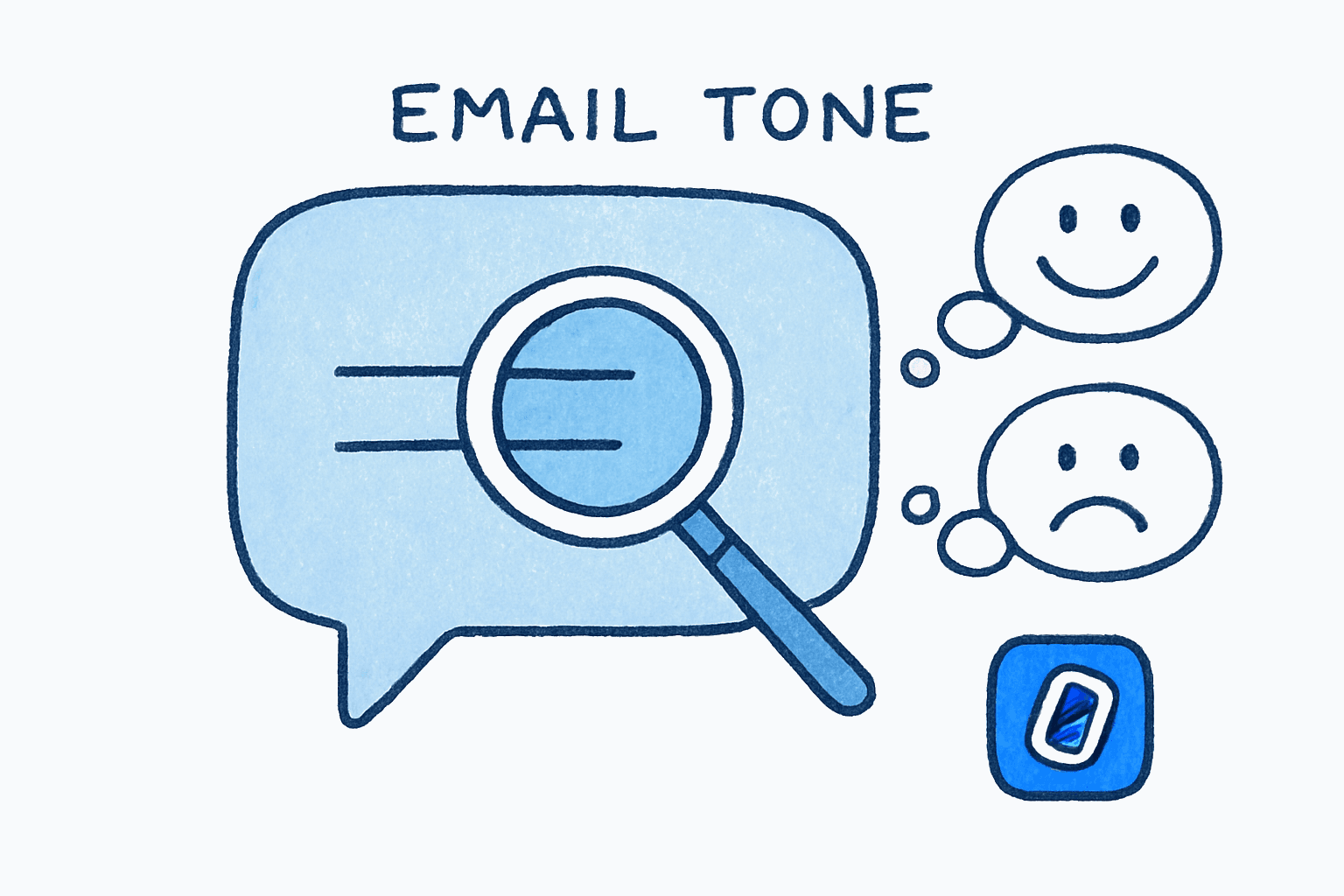
You wrote a perfectly reasonable email. Clear, concise, maybe even friendly. The recipient read it as cold, passive-aggressive, or outright rude. This is not a personality conflict. It is email tone misinterpretation, a predictable failure of the medium itself, and it happens roughly half the time.
In their landmark 2005 study published in the Journal of Personality and Social Psychology, researchers Justin Kruger, Nicholas Epley, Jason Parker, and Zhi-Wen Ng asked participants to send emails using either a sarcastic or serious tone. Senders predicted that 78% of recipients would correctly identify the intended tone. The actual accuracy rate was 56%, barely better than flipping a coin. The gap between what we think we communicate and what actually lands is not a matter of carelessness. It is built into the architecture of text-based messaging.
Here is the uncomfortable editorial position: most advice about “writing better emails” treats tone problems as a skill deficit. Write more clearly. Use exclamation points. Add emojis. But the research points somewhere different. The problem is not that we write badly. The problem is that email is structurally incapable of carrying the emotional payload we load onto it, and no amount of careful word choice fully compensates for what the medium strips away.
Key Takeaway
Email tone misinterpretation is not a writing problem; it is a medium problem. Senders overestimate how well their tone comes across by 22 percentage points, and recipients default to reading neutral messages as negative. Understanding this egocentric bias is the first step toward reducing costly workplace miscommunication.
Why Does Email Tone Misinterpretation Happen So Often?#
Egocentric bias is the core mechanism. When you write “Sure, I can handle that,” you hear your own cooperative, upbeat inflection in your head. You might even smile while typing. But none of that transfers to the screen. The recipient sees seven flat words and fills in the emotional subtext from their own mood, their relationship with you, and whatever happened in the meeting they just left.
Nicholas Epley, now John Templeton Keller Professor of Behavioral Science at the University of Chicago Booth School of Business, has spent two decades studying this phenomenon. He describes the core problem this way: “People hear their own voice when they write, but the reader doesn’t.” The sender is anchored to their intention. The reader is anchored to the text. Those are two different messages.
Kruger and Epley’s experiments demonstrated this with elegant simplicity. In one condition, participants who read their own statements using the intended tone still overestimated how accurately receivers would decode the email. But participants who re-read their statements using the opposite tone suddenly recognized the ambiguity. The illusion of communication broke the moment the sender’s internal voice was disrupted.
This isn’t limited to sarcasm or humor. Kristin Byron’s 2008 theoretical framework published in the Academy of Management Review argued that email receivers systematically interpret workplace messages as more emotionally negative or neutral than the sender intended. Byron called this pattern a structural feature of the medium, not a failure of individual writers. The absence of vocal warmth, facial reassurance, and gestural softening leaves a void that negativity bias reliably fills.
What Happens When Vocal Cues Disappear?#
Face-to-face conversation is rich with signals that never appear in an email. Pitch, tempo, volume, pauses, emphasis on specific syllables: these prosodic cues carry enormous communicative weight. The sentence “I didn’t say you were wrong” has seven different meanings depending on which word receives vocal stress. In an email, it has one meaning at most, and the reader picks it.
Albert Mehrabian’s frequently misapplied 7-38-55 rule claimed that only 7% of emotional meaning comes from words, with 38% from vocal tone and 55% from body language. Mehrabian himself has cautioned that this ratio applies only to the communication of feelings and attitudes using single words in lab conditions, not to everyday communication. But even stripped of its inflated claims, the underlying observation holds: when the subject is emotional intent, words alone carry a fraction of the signal.
Riordan and Kreuz’s 2010 corpus analysis in Computers in Human Behavior examined how people attempt to compensate for this loss. They catalogued four categories of textual paralanguage: vocal spelling (“weeeeelll”), lexical surrogates (“mhmm”), emoticons, and manipulated punctuation (multiple exclamation points, ellipses). Their analysis found that these cues cluster around two functions: expressing affect and disambiguating message content. People instinctively try to inject prosody back into text. The tools are just crude approximations of what the voice does naturally.
I could write a whole post about textual paralanguage alone, but the key point here is that these workarounds have limits. An exclamation point after “Thanks!” might signal enthusiasm or might read as performative. A period after “Fine.” might signal neutrality or thinly veiled irritation. The same punctuation mark carries opposite emotional valences depending on context the reader supplies.
How Does Negativity Bias Distort Email Interpretation?#
Neutral emails get read as negative. This is one of the most consistent findings in the email communication literature, and it has direct consequences for workplace stress and anxiety.
Alan Sillars and Theodore E. Zorn’s 2021 study in Management Communication Quarterly introduced the concept of “hypernegative interpretation.” They found that email receivers perceived messages more negatively than independent observers did, and that receiver negativity ratings had only weak relationships to the actual language of the messages. In other words, people weren’t reacting to what was written. They were reacting to what they projected onto what was written.
Several factors amplify this negative bias:
| Factor | Effect on Tone Perception | Source |
|---|---|---|
| Sender is higher-ranking | Short messages read as curt or demanding | Byron, Academy of Management Review, 2008 |
| Message contains a request | Perceived as more imposing than intended | Sillars & Zorn, Management Communication Quarterly, 2021 |
| Recipient is already stressed | Neutral messages absorb ambient negativity | He et al., PsyCh Journal, 2024 |
| No prior warm interaction | Absence of relational context defaults to formal/cold | Blunden & Brodsky, PSPB, 2021 |
| Short message length | Brevity interpreted as dismissiveness | Byron, 2008 |
Hayley Blunden, then at Harvard Business School, and Andrew Brodsky at UT Austin McCombs published a fascinating finding in Personality and Social Psychology Bulletin in 2021: typos and grammatical errors in emails amplify perceived emotion, both negative and positive. When a message contains errors, readers infer that the sender’s emotions overwhelmed their ability to proofread. A typo in an angry-seeming email makes it seem angrier. A typo in a friendly email makes it seem more genuine. These unintentional cues create emotional signal from noise, and the sender has no idea it’s happening.
Email Tone Accuracy: Sender Confidence vs. Actual Interpretation
Source: Kruger, Epley, Parker & Ng, Journal of Personality and Social Psychology, 2005
Does Culture Change How Email Tone Lands?#
Cross-cultural email creates a second layer of misinterpretation on top of the baseline egocentric bias. What reads as professional directness in one culture reads as rudeness in another, and neither party realizes the disconnect is cultural rather than personal.
Holtbrugge, Weldon, and Rogers published a study in International Journal of Cross Cultural Management in 2013 examining how cultural background shapes email communication preferences. They found significant cultural variation across five dimensions: formality, promptness, preciseness, task-relatedness, and relationship-relatedness.
East Asian communication styles tend toward high-context indirectness. A Japanese colleague writing “It might be worth considering an alternative approach” is likely communicating strong disagreement. An American reader may process the same sentence as a mild, easily dismissed suggestion. Research on cross-cultural politeness strategies in email shows that English speakers tend to use negative politeness (protecting autonomy), while Chinese speakers tend to use positive politeness (emphasizing connection). Neither approach is wrong, but each can read as inappropriate through the other cultural lens.
One caveat worth flagging: most cross-cultural email research has small sample sizes and focuses on academic rather than professional settings. The directional findings are solid, but the specific effect sizes should be held loosely. What is clear is that tone misinterpretation rates climb when sender and receiver come from different cultural communication norms.
If the gap between intended and perceived tone in your emails resonates, Swizero uses AI to surface the emotional weight of incoming messages, helping you read what matters and respond with context rather than guesswork.
Can AI Actually Detect Email Tone?#
This is where the story gets both promising and treacherous.
Modern large language models fine-tuned for sentiment analysis now outperform traditional rule-based approaches by 15 to 25 percentage points on nuanced benchmarks, including sarcasm, irony, and code-switched multilingual text. Enterprise-grade tools report accuracy rates exceeding 90% on straightforward English-language sentiment classification. MIT Media Lab research from 2024-2025 shows that multimodal approaches (combining text with vocal and visual cues) reduce sentiment misclassification by up to 30% compared to text-only analysis.
Those numbers sound impressive until you examine what “accuracy” means in practice. Most sentiment benchmarks test three-class classification: positive, negative, neutral. That is a coarse instrument when the real-world question is whether “Per my last email” is irritated, playful, or genuinely referential. The gap between benchmark accuracy and real-world utility is where organizations discover that high reported accuracy does not translate into dependable business outcomes.
The deeper risk is more subtle. If AI tells you an email “sounds angry” and you adjust your response accordingly, but the sender was not angry, you have introduced a new layer of miscommunication mediated by a machine. The AI becomes a third party in a two-person conversation, and its interpretation carries the false authority of data.
This is why Swizero’s approach to AI in email processing focuses on surfacing patterns rather than dictating interpretations. The system helps you understand how AI email assistants actually work at the processing level: ranking what needs attention, summarizing content for faster triage, and drafting responses in your voice. Tone-awareness in this model means giving you better context for your own judgment, not replacing that judgment with a sentiment score.
Honestly, the AI tone detection space worries me. The technology is improving fast, but it is being deployed faster than the research on its failure modes. Telling someone their email “sounds passive-aggressive” when it does not is a social harm that scales with adoption.
What Does Email Miscommunication Actually Cost?#
The financial damage is not hypothetical. According to Grammarly’s 2024 State of Business Communication report, businesses lose an estimated $9,284 per employee per year due to poor communication, with 100% of knowledge workers surveyed reporting miscommunication at least weekly. One in four reported miscommunications multiple times per day.
Those numbers compound. A company with 1,000 employees is losing roughly $9.3 million annually to communication failures, and email remains the primary written channel where these failures occur. Thirty-six percent of employees say email is their primary tool for internal communication, more than any other method.
But the cost is not only financial. Email tone misinterpretation corrodes trust, creates phantom conflicts, and generates the kind of ambient anxiety that makes people dread opening their inbox. When you receive an email you perceive as hostile, you carry that tension into your reply, into your next meeting, into your evening. The original sender, who wrote something they considered perfectly neutral, has no idea they detonated a small emotional bomb.
How Often Knowledge Workers Experience Miscommunication
Source: Grammarly, 2024 State of Business Communication Report
This pattern connects directly to the science of inbox stress. Anticipatory anxiety about what an email might mean creates a background hum of tension that persists even when you are not reading email. The possibility that you have misread tone, or that someone has misread yours, becomes one more unresolved thread occupying cognitive bandwidth.
Reducing Misinterpretation Without Rewriting Your Personality#
The standard advice is to write more clearly, which is true but insufficient. Here is what the research actually supports:
Re-read as your reader, not as yourself. Kruger and Epley’s most actionable finding was that senders who re-read their own emails imagining the opposite tone suddenly recognized ambiguity they had missed. Before sending anything that matters, read it as if you are in a bad mood and have no context about the sender’s intent. If it could be read as cold, it probably will be.
Add relational cues before requests. Byron’s research shows that emails containing requests are especially prone to negative interpretation. A single sentence of human connection before the ask (“Hope the product launch is going well”) is not filler. It provides the relational context that prevents the request from reading as a demand.
Match the medium to the message. When the subject involves emotion, criticism, or nuance, email is the wrong tool. A two-minute phone call transmits more emotional information than a carefully drafted paragraph. This is not a communication failure; it is a rational response to the medium’s limitations.
Use constraints to reduce exposure. The more emails you process, the more opportunities for misinterpretation exist. Swizero’s fixed card limit reduces your inbox to a handful of AI-ranked cards per run, which means you engage with fewer messages more carefully rather than scanning dozens while your attention fractures. Fewer rushed readings means fewer misread tones.
The deeper fix is not a writing technique. It is accepting that email will always be a lossy medium for emotional communication, and building systems that account for that loss rather than pretending you can write your way around it. Your inbox is not a conversation. It is a transcript with the stage directions removed. Reading it requires a different kind of attention, and processing it requires knowing when to stop.
Frequently Asked Questions#
Why are my emails misinterpreted so often?#
Email strips vocal tone, facial expressions, and body language from your message, leaving readers to infer your emotional intent from text alone. Research by Kruger and Epley (2005) found that senders correctly predict recipient interpretation only 56% of the time, despite believing they will be understood 78% of the time. This gap is driven by egocentric bias: you hear your intended tone in your head, but the reader does not.
Is there a negativity bias in how people read emails?#
Yes. Multiple studies confirm that email recipients interpret neutral or ambiguous messages as more negative than the sender intended. Byron’s 2008 framework in the Academy of Management Review identified this as a structural feature of text-based communication. Sillars and Zorn (2021) found that receivers rated emails more negatively than independent observers, regardless of the actual language used.
Can emojis help prevent email tone misinterpretation?#
Emojis can reduce ambiguity in some contexts, and 55% of people report they help avoid conflict or misunderstanding. However, emojis carry their own interpretation risks: a smiley face from a manager after critical feedback can read as either softening or condescension depending on the reader’s relationship with the sender and cultural context.
How accurate is AI at detecting email tone?#
Enterprise sentiment analysis tools report 90%+ accuracy on basic positive/negative/neutral classification. However, real-world tone nuance (sarcasm, gentle criticism, dry humor) remains significantly harder to detect. LLMs fine-tuned for sentiment outperform older models by 15-25 percentage points, but high benchmark accuracy does not always translate to reliable real-world performance, particularly in cross-cultural communication.
Does email miscommunication affect workplace relationships?#
Significantly. Grammarly’s 2024 report found that businesses lose $9,284 per employee annually due to poor communication. One in five business leaders report losing business due to communication failures, and workplace email remains the primary written channel where these misunderstandings occur and compound.
Sources#
- Egocentrism Over E-Mail: Can We Communicate as Well as We Think? · Kruger, Epley, Parker & Ng, Journal of Personality and Social Psychology, 2005. Senders predicted 78% tone accuracy; actual was 56%.
- Carrying Too Heavy a Load? The Communication and Miscommunication of Emotion by Email · Kristin Byron, Academy of Management Review, 2008. Theoretical framework on negativity bias in email emotion perception.
- Hypernegative Interpretation of Negatively Perceived Email at Work · Alan Sillars & Theodore E. Zorn, Management Communication Quarterly, 2021. Receivers perceived emails more negatively than observers.
- Beyond the Emoticon: Are There Unintentional Cues of Emotion in Email? · Hayley Blunden & Andrew Brodsky, Personality and Social Psychology Bulletin, 2021. Typos amplify perceived emotion in emails.
- Cues in Computer-Mediated Communication: A Corpus Analysis · Riordan & Kreuz, Computers in Human Behavior, 2010. Catalogued four types of textual paralanguage used to compensate for absent prosody.
- Cultural Determinants of Email Communication Styles · Holtbrugge, Weldon & Rogers, International Journal of Cross Cultural Management, 2013. Cultural background shapes email formality, directness, and relationship cues.
- Sentiment Analysis in 2026: Accuracy, Cost, Architecture, and Real-World Performance · Edge Delta, 2026. Enterprise accuracy exceeds 90% on basic classification but gaps remain in real-world deployment.
- The 2024 State of Business Communication Report · Grammarly, 2024. $9,284 per employee annual cost of miscommunication; 100% of knowledge workers experience weekly miscommunication.
- Albert Mehrabian: Communication Model · Wikipedia overview of Mehrabian’s 7-38-55 rule limitations and self-corrections.
Your inbox doesn't have to feel like this.
Be among the first to experience a finished inbox.
Join the finite inbox beta