Email Parkinson's Law: Work Expands to Fill Your Inbox
By Chris Stefaner, Co-founder of Swizero
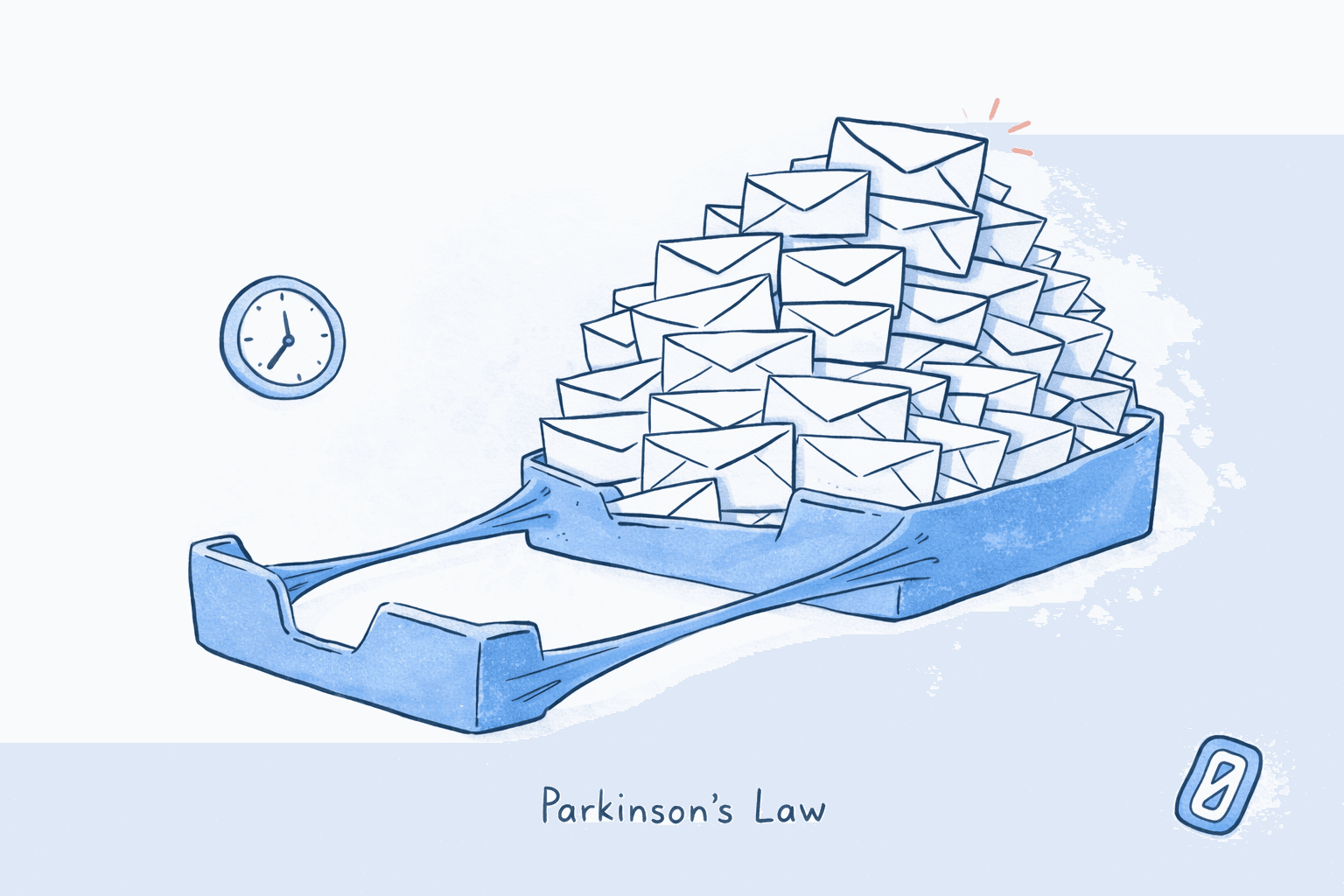
In 1955, a British naval historian named Cyril Northcote Parkinson opened an essay in The Economist with a sentence that would outlive almost everything else published that year: “Work expands so as to fill the time available for its completion.” He was writing about bureaucracy. He could have been writing about your inbox.
Parkinson’s observation was satirical, rooted in the absurdity of the British Admiralty employing more administrators to manage fewer ships. But the underlying mechanism is dead serious, and email time management psychology has largely failed to account for it. The Parkinson’s Law email problem is not theoretical. The reason most people spend two to three hours a day on email is not that they receive too many messages. It is that email provides no natural stopping point, no finish line. And without a finish line, work fills every available minute.
Here is the position this article takes, and it is one that most productivity advice quietly ignores: the problem with email is not volume. It is the absence of constraint. Every other professional task has a scope, a deadline, or a deliverable that signals “done.” Email has none of these. It is the only work activity where the container is infinite and the completion criteria is zero unread messages, a target that resets every time someone hits Send.
Key Takeaway
Parkinson’s Law predicts that email processing expands to fill whatever time you give it. Research on artificial deadlines, time-boxing, and task constraints consistently shows that imposing a boundary on time or volume improves both speed and satisfaction. The fix for email bloat is not better habits. It is structural constraint: a fixed amount of time, a fixed number of messages, or both. Better inbox time management starts with constraint, not motivation.
What Did Parkinson Actually Observe in 1955?#
Parkinson’s original essay, published on November 19, 1955, was not a research paper. It was a devastatingly precise satire of organizational bloat. His central example: the British Admiralty. Between 1914 and 1928, the Royal Navy shrank from 62 capital ships to 20, and its active personnel dropped from 146,000 to 100,000. The number of Admiralty officials, however, grew from 2,000 to 3,569, an increase of 78%. Fewer ships, fewer sailors, more paperwork.
Parkinson attributed this to two forces. First, officials want to multiply subordinates, not rivals. Second, officials make work for each other. The combination produces an administrative growth rate of roughly 5.6% per year, independent of actual workload. He later expanded the essay into a 1958 book, Parkinson’s Law: The Pursuit of Progress, which became an unexpected bestseller.
The satirical tone obscured a genuine insight that email time management psychology would later rediscover: when there is no external constraint on how long a task should take, the task expands to absorb all available time. Not because the work demands it, but because humans are remarkably good at filling empty time with activity that feels productive.
This principle has since been tested in controlled experiments. In a series of studies published in Psychonomic Bulletin & Review, researchers Brannon, Hershberger, and Brock (1999) asked participants to judge four sets of photographs. When told the fourth set was canceled, subjects spent significantly longer on the third set than controls did. They “dallied.” The effect replicated across four experiments, the degree of dalliance was proportional to the spare time created, and it produced no improvement in performance.
Spending more time did not mean doing better work. It just meant spending more time. This is the core lesson of email time management psychology: additional time investment does not produce proportional returns.
Why Does Email Parkinson’s Law Mean Your Inbox Expands to Fill All Available Time?#
Email expands to fill time because it is structurally designed to be unbounded. Three features of email make it uniquely vulnerable to Parkinson’s Law.
First, email has no completion state. Unlike a project that ships or a meeting that ends, an inbox never reaches “done.” According to Radicati Group’s 2025 forecast, global email volume will reach 392.5 billion messages per day by the end of 2026. The input stream never stops, so the processing task never stops either.
Second, email rewards attention without requiring urgency. Microsoft’s 2025 Work Trend Index found that the average employee is interrupted 275 times per day by meetings, emails, and chats, and that 40% of employees check email before 6 a.m. There is no penalty for checking one more time.
Third, the perceived cost of leaving email unprocessed is high. Gloria Mark, Professor of Informatics at UC Irvine and author of Attention Span, has documented that 67% of knowledge workers self-interrupt to check email rather than being interrupted by a notification. Mark’s research shows that attention spans on any screen have declined from 2.5 minutes in 2003 to just 47 seconds in recent years.
The combination is a Parkinson’s Law amplifier, and it explains why email time management psychology consistently identifies the inbox as the most time-consuming knowledge work activity. Give someone an hour for email and they will use the hour. Give them three hours and they will use three. The work expands not because there is more to do, but because there is no signal to stop.
Daily Time Spent on Email vs. Actionable Messages
Source: McKinsey Global Institute (2012); Email Analytics (12% actionable rate)
Does Imposing Time Constraints Actually Improve Performance?#
Yes, and the evidence is stronger than most people realize. Email time management psychology research has repeatedly shown that artificial deadlines compress work without sacrificing quality.
Dan Ariely and Klaus Wertenbroch’s 2002 paper Procrastination, Deadlines, and Performance: Self-Control by Precommitment, published in Psychological Science, tested this directly. Across multiple experiments with MIT students, participants who set their own deadlines performed significantly better than those given no deadlines. But externally imposed deadlines (evenly distributed across a semester) produced the best performance. The lesson: constraints work, and externally enforced constraints work best.
Connie Gersick’s 1988 study Time and Transition in Work Teams, published in the Academy of Management Journal, extended this finding. Gersick observed eight project teams with deadlines ranging from one week to six months. Every team underwent a major behavioral transition at precisely the midpoint between its first meeting and its deadline. Groups did not progress steadily. They drifted, then snapped to attention when time became finite.
Gersick’s conclusion: “A group’s progress is triggered more by members’ awareness of time and deadlines than by completion of an absolute amount of work.” When people become aware that time is scarce, they stop expanding work and start compressing it.
Honestly, this midpoint finding changed how I think about email time management psychology and my own email behavior. I used to leave email processing open-ended, revisiting it throughout the day. I was drifting through Gersick’s first phase without ever reaching the snap.
Cal Newport, Professor of Computer Science at Georgetown University and author of Deep Work, applies Parkinson’s Law to knowledge work through “fixed-schedule productivity.” In a blog post revisiting the principle, Newport writes: “I began to work backwards from a constrained schedule, forcing my professional efforts to fit within these tight confines. As predicted by Parkinson’s Law, these restrictions don’t seem to decrease the quantity of projects on which I make progress.”
If open-ended email sessions are eating your day, Swizero applies structural constraint directly to your inbox. Instead of processing an infinite stream, you work through a fixed card limit of AI-ranked messages per run. The constraint is built in, not bolted on.
What Does the Time-Boxing Research Actually Show?#
Time-boxing is the practice of allocating a fixed period to a task before beginning, then stopping when the period ends regardless of completion. It is, in effect, Parkinson’s Law weaponized in your favor. And within email time management psychology, time-boxing is the most-studied intervention.
A 2018 analysis covered by Harvard Business Review evaluated 100 productivity methods and identified timeboxing as the single most effective approach, outperforming to-do lists, prioritization frameworks, and calendar blocking.
The Pomodoro Technique, which uses 25-minute work intervals, has been studied more formally. A 2025 scoping review published in BMC Medical Education found “positive associations between the Pomodoro Technique and improved cognitive outcomes, such as enhanced task focus and time management and reduced cognitive fatigue.”
But a nuanced 2025 study in Behavioral Sciences comparing Pomodoro, Flowtime, and self-regulated break strategies found that Pomodoro breaks led to faster fatigue increases, though overall productivity did not differ between conditions. The time-box creates urgency, which boosts output in the short term, but the enforced stopping can feel arbitrary.
I could write a whole post on how often you should actually check email. The key point for Parkinson’s Law is simpler: any constraint on time, even an imperfect one, outperforms no constraint. The Pomodoro’s 25-minute window is not magic. The existence of a window is.
| Approach | Constraint Type | Parkinson’s Law Effect | Evidence Quality |
|---|---|---|---|
| Open-ended email checking (no email time management psychology applied) | None | Maximum expansion | Brannon et al., 1999 |
| Self-imposed time limit | Voluntary deadline | Moderate compression | Ariely & Wertenbroch, 2002 |
| External time limit (Pomodoro) | Enforced deadline | Strong compression | BMC Medical Education, 2025 |
| Fixed volume limit (card cap) | Structural constraint | Eliminates expansion | Gersick, 1988 (deadline awareness) |
What Does Email Time Management Psychology Tell Us About Open-Ended Inbox Sessions?#
Email time management psychology identifies two psychological forces that conspire to extend every inbox session: attention residue and the Zeigarnik effect.
Sophie Leroy, at the University of Washington’s Foster School of Business, coined “attention residue” in her 2009 paper in Organizational Behavior and Human Decision Processes. When people switch from Task A to Task B before finishing Task A, their performance on Task B suffers because part of their attention remains stuck on the unfinished work. Email, which is by definition never finished, generates continuous attention residue.
The Zeigarnik effect, from psychologist Bluma Zeigarnik’s 1927 experiments, describes the tendency for uncompleted tasks to occupy mental bandwidth disproportionately. Zeigarnik found that participants recalled interrupted tasks approximately 90% more accurately than completed ones. Unfinished work is stickier than finished work.
Together, these create a compounding loop that email time management psychology researchers call the “re-entry cycle.” You process some messages, leave with others unfinished, carry the residue into your next task, feel the nag of the Zeigarnik effect, and return to your inbox earlier than planned. A 2023 study in Frontiers in Psychology found that proximity to deadlines increases effort but simultaneously degrades motivation quality. For email, this means late-afternoon inbox sessions become increasingly reactive and lower quality.
One caveat: Leroy’s research was conducted with task-switching between discrete projects, not specifically email. But given that email decision fatigue is a documented phenomenon and Microsoft’s data shows 275 daily interruptions, the extrapolation to email time management psychology is reasonable.
How Constraints Fix What Willpower Cannot: The Central Lesson of Email Time Management Psychology#
The antidote to Parkinson’s Law is not discipline. It is structure.
Ariely showed externally imposed deadlines outperform self-imposed ones. Gersick showed groups only mobilize when they sense a temporal boundary. Brannon showed spare time produces dalliance, not quality. The pattern: constraints compress work, and the more external the constraint, the more effective the compression.
This is why Swizero is built around a structural constraint rather than a behavioral recommendation. Instead of telling you to check email fewer times per day (a strategy research supports but most people fail to sustain), Swizero caps each email session at a fixed card limit of AI-ranked messages. You process those cards, you are done. The finish line is built into the product.
The difference between “try to spend less time on email” and “here are the only messages you need to process right now” is the difference between a self-imposed and an externally imposed deadline. Anyone who has studied email time management psychology can predict which one works better, and Ariely’s data confirms it.
The Inbox Is Not a To-Do List. It Is a Gas. Email Time Management Psychology in One Metaphor#
Email behaves like a gas, not a liquid. A liquid has a fixed volume. A gas expands to fill whatever space is available. Pour 50 emails into a 30-minute window and you will process them in 30 minutes. Pour the same 50 into an open-ended afternoon and you will somehow spend three hours.
This is not laziness. It is the cognitive physics of how humans allocate attention when no external boundary forces prioritization, and it is exactly what email time management psychology predicts.
The solution is to give the gas a container. Time-boxing gives it a temporal container. A fixed card limit gives it a volume container. Both outperform the default, which is no container at all.
Most email clients are built to show you everything, all the time, in an infinite scroll that has no bottom. That design choice is Parkinson’s Law made manifest. It assumes the way to handle more email is to make email processing faster, when the research suggests the opposite: process less of it, more deliberately, within a constraint that forces decisions instead of deferral.
Frequently Asked Questions#
Does Parkinson’s Law apply to all types of work, or just email?#
Parkinson’s Law applies broadly to any task without a firm deadline or completion boundary, which is why email time management psychology treats it as a foundational principle. The original 1955 observation concerned bureaucratic administration, and Brannon, Hershberger, and Brock’s 1999 experiments confirmed the effect across photo-judging and phrase-processing tasks. Email is particularly susceptible because it lacks a natural completion state, but the principle holds for meetings, report writing, and any open-ended knowledge work.
Can you beat Parkinson’s Law with willpower alone?#
Research from Ariely and Wertenbroch’s 2002 study in Psychological Science suggests willpower helps but is not optimal. Self-imposed deadlines improved performance compared to no deadlines, but externally imposed deadlines produced the best results. The gap between self-imposed and external constraints suggests that willpower is a weaker form of the same mechanism, and structural constraints outperform it consistently.
How much time do knowledge workers actually spend on email each day?#
McKinsey Global Institute’s research puts the figure at 28% of the workweek, roughly 2.6 hours per day. Microsoft’s 2025 Work Trend Index found that the heaviest email users (top 25%) spend 8.8 hours per week on email alone. The exact number varies by role and industry, but the consistent finding is that email consumes a quarter to a third of most knowledge workers’ productive time.
What is the best time-boxing method for email?#
Email time management psychology points to the Harvard Business Review’s analysis of 100 productivity techniques, which identified timeboxing as the most effective approach overall. For email specifically, a fixed time window of 20 to 30 minutes, combined with a volume constraint such as processing only the most important messages, produces the strongest results. The specific method matters less than the existence of any constraint at all.
Is inbox zero a form of Parkinson’s Law constraint?#
Inbox zero, as originally described by Merlin Mann in 2007, was meant to be a constraint: process each message to zero cognitive weight by deciding on it once. In practice, however, most people interpret inbox zero as “get to zero unread messages,” which creates an open-ended goal that actually enables Parkinson’s Law rather than constraining it. A volume limit, where you process a fixed number of messages and stop, is a more effective structural constraint.
Sources#
- Parkinson’s Law. C. Northcote Parkinson, The Economist, November 19, 1955. “Work expands so as to fill the time available for its completion.”
- Timeless Demonstrations of Parkinson’s First Law. Brannon, Hershberger, and Brock, Psychonomic Bulletin & Review, 1999. Experimental confirmation that spare time produces dalliance without performance improvement.
- Procrastination, Deadlines, and Performance: Self-Control by Precommitment. Dan Ariely and Klaus Wertenbroch, Psychological Science, 2002. Self-imposed deadlines improve performance; externally imposed deadlines work best.
- Time and Transition in Work Teams. Connie Gersick, Academy of Management Journal, 1988. Groups undergo midpoint transitions triggered by deadline awareness, not task completion.
- Attention Span. Gloria Mark, UC Irvine, 2023. Knowledge workers’ attention spans have declined to 47 seconds per screen; 67% self-interrupt to check email.
- Why Is It So Hard to Do My Work?. Sophie Leroy, Organizational Behavior and Human Decision Processes, 2009. Attention residue from unfinished tasks impairs performance on subsequent work.
- Breaking Down the Infinite Workday. Microsoft Work Trend Index, 2025. Employees interrupted 275 times daily; top email users spend 8.8 hours per week on email.
- Assessing the Efficacy of the Pomodoro Technique. BMC Medical Education, 2025. Scoping review finds positive associations between Pomodoro Technique and improved task focus.
- Investigating Break-Taking Techniques Among Students. Behavioral Sciences, 2025. Pomodoro breaks increase fatigue faster than self-regulated breaks but maintain equivalent productivity.
- Deadlines and Motivation Trajectories. Frontiers in Psychology, 2023. Proximity to deadlines increases effort but degrades motivation quality.
- How Timeboxing Works and Why It Will Make You More Productive. Harvard Business Review, 2018. Analysis of 100 productivity techniques rated timeboxing as the most effective.
- Revisiting Parkinson’s Law. Cal Newport, 2007. Fixed-schedule productivity applies constraint to prevent work expansion.
Your inbox doesn't have to feel like this.
Be among the first to experience a finished inbox.
Join the finite inbox beta