The Hidden Cost of CC Email Productivity: Why Group Emails Are a Trap
By Chris Stefaner, Co-founder of Swizero
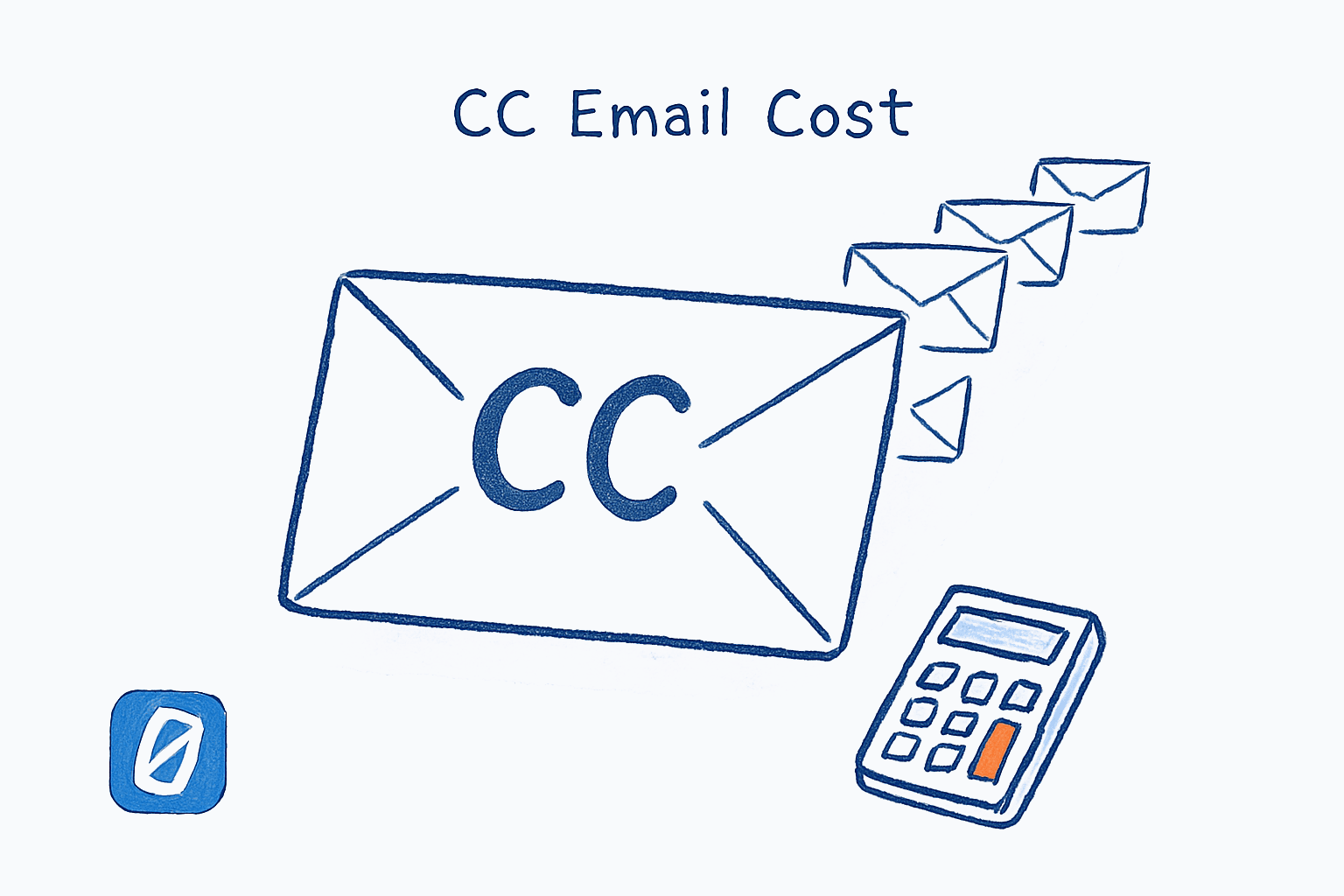
The CC field is the most destructive feature in email. Not spam filters, not promotional tabs, not even the infinite scroll of an unsorted inbox. The humble carbon copy line, sitting quietly beneath every “To:” field, costs organizations more productive time than any other single email behavior. CC email productivity losses are real, measurable, and growing every year.
That claim sounds dramatic until you look at the numbers. Microsoft’s 2025 Work Trend Index found that mass emails sent to dozens or hundreds of colleagues increased 7% year-over-year, with no sign of slowing. Each of those messages lands in inboxes that are already overflowing: the average knowledge worker receives 121 emails per day, according to the Radicati Group’s 2023-2027 Email Statistics Report. A significant percentage of those emails require no action from the recipient at all. They’re CC’d messages, reply-all chains, and “just keeping you in the loop” threads that create noise without value.
Here is the point of view most people avoid stating plainly: CC culture isn’t just annoying. It’s a systemic failure of organizational communication, and it actively makes teams worse at their jobs. The CC field exists because email was designed for broadcasting, not for targeted collaboration. Every time someone adds three extra names to the CC line “just in case,” they’re not being thorough. They’re offloading cognitive work onto other people’s inboxes.
Key Takeaway
CC email productivity losses stem from a multiplication effect: each unnecessary recipient generates follow-up replies, fragments attention, and erodes trust within teams. Research across six experimental studies shows that frequent CC use reduces felt trust and psychological safety, while Microsoft data confirms mass emails are growing 7% annually with no end in sight.
How Does One CC Create a Chain Reaction of Wasted Time?#
One CC doesn’t just add one reader. It adds a potential replier, a potential reply-all participant, and a potential forwarder. The math compounds quickly.
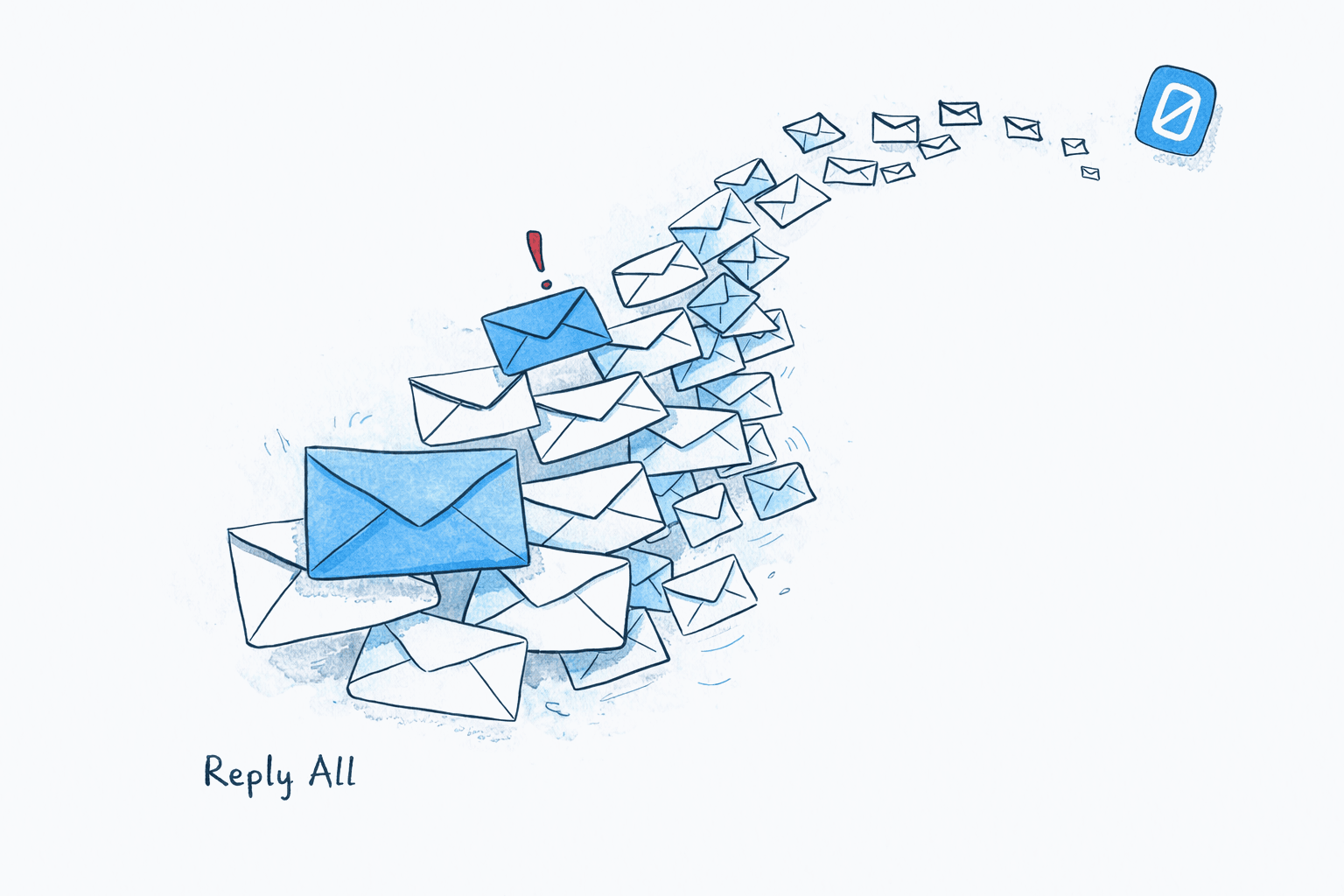
Consider a simple scenario. A project lead sends an update to two stakeholders and CCs four colleagues “for visibility.” Those four people now face a choice: read, ignore, or respond. If even two of them reply-all with a question, the original two stakeholders plus the project lead must now read those replies. If the lead answers both questions via reply-all, every recipient gets two more messages. A six-person thread can generate 15-20 messages from what should have been a two-person exchange.
This isn’t hypothetical. In September 2013, a single Cisco employee sent an email to a training distribution list of 23,570 members. The resulting reply-all storm generated over 4 million emails, consumed 375 GB of network traffic, and cost an estimated $600,000 in lost productivity. The following month, it happened again on a list of 34,562 people. Both storms started the same way: one message, sent to too many recipients.
The Cisco example is extreme, but the pattern plays out at smaller scales every day in every organization. Cal Newport, Georgetown University computer science professor and author of A World Without Email, calls this the “hyperactive hive mind” workflow: “a workflow centered on ongoing, unstructured conversation through digital communication tools.” CC is the engine of that hive mind. It pulls people into conversations they didn’t start, didn’t ask for, and often can’t contribute to meaningfully.
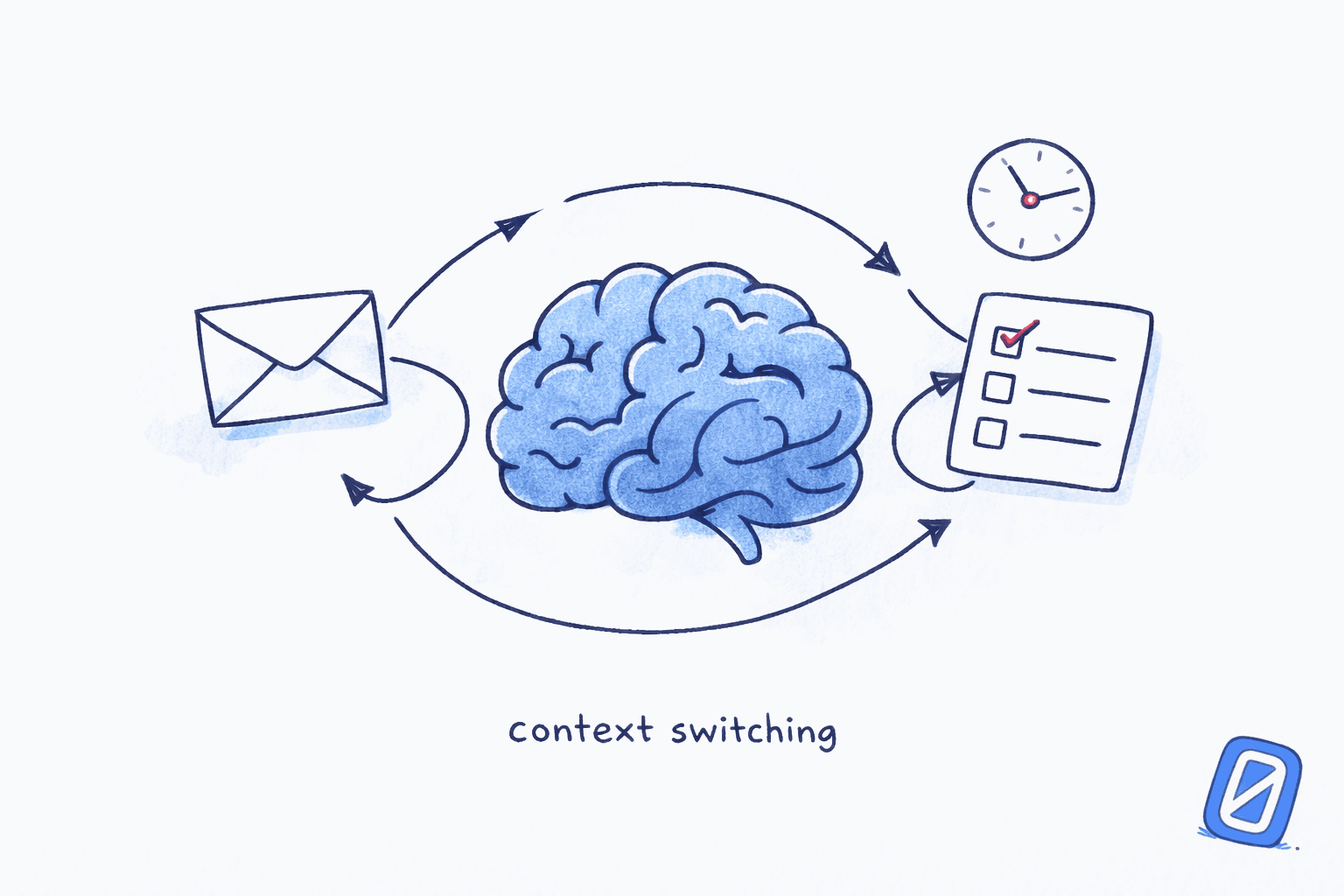
Gloria Mark, Professor of Informatics at UC Irvine and author of Attention Span, has documented the cost of each interruption. Her research shows the average person’s attention on a single screen has collapsed to just 47 seconds, down from two and a half minutes in 2004. Every CC’d email that pings your inbox resets that fragile attention window. “There is a strong correlation between shifting attention and stress,” Mark writes, based on heart-rate variability measurements taken during workplace studies.
What Does CC Email Productivity Loss Actually Cost Your Organization?#
CC email productivity losses aren’t just about time. They erode something harder to measure: trust.
David De Cremer, then KPMG Professor of Management Studies at Cambridge Judge Business School, led a series of six experimental studies with 594 working adults, published in the Journal of Business Ethics. The findings were striking. When supervisors were “always” CC’d on emails, recipients felt significantly less trusted compared to those in the “sometimes” or “almost never” conditions. The effect cascaded: lower felt trust led employees to infer that the entire organizational culture was low-trust, fostering what the researchers called “a culture of fear and low psychological safety.”
The statistical relationship was clear. The degree to which supervisors were CC’d was negatively correlated with psychological safety (b = −0.14, SE = 0.06, p = 0.02). Felt trust mediated the entire effect. In plain language: CC your boss on every email and your coworkers will trust you less, trust the organization less, and feel less safe speaking up.
That is the CYA problem in one paragraph. “Cover your ass” emailing, where people CC managers and stakeholders as insurance against blame, doesn’t actually protect anyone. It signals distrust, and the recipients interpret it exactly that way. As management researchers have documented, “When we don’t trust our teams, we write more emails, read more emails, and attend more meetings than necessary. We include far more people than required to make a decision.”
Honestly, I expected the trust research to show a mild effect. The strength of the finding surprised me. CC isn’t a neutral act. It’s an organizational signal, and the signal it sends is: “I don’t trust this to resolve without a witness.”
The Financial Arithmetic#
The time cost is measurable, even if the trust cost isn’t. Microsoft’s Work Trend Index reports that communication now consumes 60% of the average workday through emails, chats, and meetings, leaving only 40% for creative work. Asana’s Anatomy of Work Index puts a finer point on it: knowledge workers spend just 27% of their time on skilled work, with the remaining 60% lost to “work about work,” which includes communicating about tasks, searching for information, and chasing status updates.
| Cost Category | Impact | Source |
|---|---|---|
| Time lost to unnecessary email threads | 60% of workday spent on communication | Microsoft Work Trend Index, 2025 |
| Attention recovery after each interruption | 25 minutes to refocus after a single email check | Gloria Mark, UC Irvine, 2005 |
| Mass email growth rate | 7% year-over-year increase | Microsoft Work Trend Index, 2025 |
| Trust erosion from supervisor CC | Significant reduction in felt trust (p = 0.02) | De Cremer et al., Journal of Business Ethics, 2019 |
| Reply-all storm cost (Cisco, 2013) | $600,000 in lost productivity from one email | The Register, 2013 |
If drowning in CC’d threads that don’t require your attention resonates, Swizero reduces your inbox to a fixed card limit, so AI-prioritized emails surface first and low-priority CC chains never crowd out what matters.
The Hyperactive Hive Mind: Why CC Persists Despite the Evidence#
If CC culture is so costly, why does it persist? The answer is structural, not personal.
Cal Newport argues in A World Without Email that the problem is the workflow itself, not individual behavior. “The issue isn’t that people are bad at email,” Newport has said. “It’s that email encourages a workflow where ongoing, unstructured conversation becomes the default way to coordinate.” CC is a natural outgrowth of that workflow. When there’s no defined process for who needs to know what, the safest default is to include everyone.
This creates a self-reinforcing cycle. People CC broadly because they’re afraid of leaving someone out. Recipients learn to skim or ignore CC’d messages because most aren’t relevant. Senders, noticing low response rates, start adding even more people to compensate. The thread grows. The signal-to-noise ratio deteriorates. Nobody wants to be the person who says, “Please remove me from this thread,” because that feels rude or disengaged.
I could write an entire post about the social dynamics of reply-all (the performative responses, the one-word “Thanks!” that goes to 14 people), but the key insight is simpler: CC culture is a coordination failure disguised as communication. Organizations use email to solve problems that email isn’t designed to solve, and CC is the pressure valve.
The best-performing organizations seem to understand this intuitively. Microsoft’s data shows that top-performing firms keep communication “twice as streamlined”, avoiding unnecessary CC emails and reducing email read time to under 15 seconds for 85% of messages. Those companies aren’t just writing better emails. They’ve built systems where fewer emails need to be written at all.
What Actually Reduces CC Overload?#
Four evidence-based approaches work. None of them involve asking people to “be more mindful” about who they CC.
Set explicit CC policies#
De Cremer’s research suggests managers should set clear rules about when to include supervisors in emails, and actively intervene when employees overuse CC. This sounds bureaucratic, but it works because it replaces implicit norms (CC everyone to be safe) with explicit ones (CC only when the recipient needs to act).
Replace CC threads with structured updates#
Newport’s core prescription is to move recurring updates out of email entirely and into structured channels: weekly status documents, shared dashboards, or designated update windows. When everyone can check a single source of truth, nobody needs to be CC’d on individual exchanges.
Embrace a fixed card limit for email triage#
One reason CC threads consume disproportionate attention is that they sit alongside genuinely important messages in an undifferentiated stream. Apps that cap your visible inbox, like Swizero, solve this by design. When your inbox shows a fixed number of cards ranked by relevance, a CC thread you don’t need never displaces the message you do. The constraint itself acts as a filter.
Batch email processing#
Research from Kushlev and Dunn’s 2015 study at the University of British Columbia demonstrated that checking email in batches rather than continuously reduces stress significantly. For CC overload specifically, batching means those 12 reply-all messages accumulate into a single review session rather than 12 separate interruptions across your morning.
One caveat worth noting: none of these strategies works in isolation. A team that batches email but still CCs 15 people on every thread has swapped 12 small interruptions for one large, overwhelming batch. The CC problem and the processing problem need to be solved together.
Why Reply-All Etiquette Guides Miss the Point#
Most reply-all etiquette advice focuses on individual behavior: think before you reply-all, ask if everyone needs to see your response, trim the recipient list. That advice isn’t wrong, but it treats the symptom.
The real problem is that email lacks a built-in mechanism for deciding who needs what information. Every other communication tool has evolved some version of this. Slack has channels. Project management tools have task assignments. Even group texts let you mute conversations. Email gives you a CC field and says, “Figure it out yourself.”
This is why writing better emails only gets you partway there. You can craft the most concise, well-structured message imaginable, and it still ends up in 14 inboxes if the sender doesn’t think carefully about the CC line. The structural solution is to give inboxes a natural boundary, a finish line where less-important threads simply don’t make the cut.
The philosophy behind Swizero’s fixed card limit addresses this directly. Instead of trying to change how people send email (a losing battle, as decades of etiquette guides prove), it changes how you receive it. AI prioritization surfaces messages that need your attention and filters out the CC noise that doesn’t. You still get every email. But your daily processing load stays bounded.
The CC Field Was Designed for Paper#
One detail that rarely comes up in discussions about CC email productivity: the CC field is a holdover from typewriter-era office memos. “Carbon copy” literally referred to the thin carbon paper placed between sheets to create a duplicate. In that physical world, making a carbon copy cost effort, materials, and time. You had to actively choose to create one.
Digital CC costs nothing to send and everything to receive. That asymmetry is the root of the problem. The sender pays zero cost to add a name; the recipient pays the full cost of reading, processing, and deciding whether to act. There’s no friction, no feedback loop, no signal that says “this CC wasn’t worth the interruption.”
Until email tools build that friction back in, the CC field will continue to function as an attention tax on every person added to every thread. The organizations that thrive will be the ones that find ways to re-impose constraints on what was designed to be unconstrained. The individuals who thrive will be the ones who stop treating their inbox as an open-ended obligation and start treating it as a finite set of decisions to complete.
That might sound like a small shift. But the research says otherwise.
Frequently Asked Questions#
Is CC’ing your boss on emails a good practice?#
Research from David De Cremer and colleagues published in the Journal of Business Ethics found that frequently CC’ing supervisors significantly reduces felt trust among colleagues. Recipients interpret the CC as a control mechanism rather than transparency, and the practice correlates with lower psychological safety across teams. Reserve supervisor CC for genuinely relevant decisions, not routine updates.
How many emails per day are unnecessary CC messages?#
Precise percentages vary by organization, but Microsoft’s 2025 Work Trend Index reports that mass emails have grown 7% year-over-year, and 85% of all emails are read in under 15 seconds, suggesting most don’t require deep engagement. Studies of enterprise email patterns consistently find that a substantial portion of received messages require no action from the recipient, with CC’d threads being a primary driver.
What is the difference between CC and BCC in email?#
CC (carbon copy) shows all recipients who received the message, while BCC (blind carbon copy) hides the additional recipients from everyone else on the thread. CC invites reply-all responses from every listed person, which compounds thread growth. BCC prevents that multiplication but raises its own trust concerns: De Cremer’s research found that BCC use makes senders appear less moral and more secretive to recipients who discover it.
How can teams reduce reply-all email chains?#
Effective strategies include setting explicit policies about when reply-all is appropriate, moving recurring updates to structured channels like shared dashboards, and using email tools with built-in prioritization. Individual etiquette advice alone doesn’t work because it relies on every sender independently making good decisions. Structural solutions (fewer recipients, fewer threads, bounded inboxes) outperform behavioral appeals consistently.
Does CC culture indicate a low-trust organization?#
Yes, according to the experimental evidence. De Cremer’s six studies with 594 working adults found a direct pathway: frequent CC use reduces felt trust, which lowers perceptions of psychological safety, which fosters what the researchers described as “a culture of fear.” Excessive CC behavior often signals CYA (cover your ass) dynamics, where employees use the CC field as documentation against potential blame rather than as a genuine communication tool.
Sources#
- Breaking Down the Infinite Workday. Microsoft Work Trend Index, 2025. Mass emails growing 7% year-over-year; communication consumes 60% of the workday; 85% of emails read in under 15 seconds.
- Email Statistics Report, 2023-2027. Radicati Group. Average office worker receives 121 emails per day.
- Transparency and Control in Email Communication: The More the Supervisor is Put in cc the Less Trust is Felt. De Cremer et al., Journal of Business Ethics, 2019. Six studies with 594 participants showing CC reduces felt trust and psychological safety.
- Attention Span: A Groundbreaking Way to Restore Balance, Happiness and Productivity. Gloria Mark, UC Irvine, 2023. Average screen attention span has collapsed to 47 seconds; strong correlation between attention switching and stress.
- Cisco Reply-All Email Storm. The Register, 2013. Single email to 23,570 recipients generated 4 million replies and $600,000 in lost productivity.
- A World Without Email: Reimagining Work in an Age of Communication Overload. Cal Newport, 2021. Coined “hyperactive hive mind” to describe unstructured email-driven workflows.
- Anatomy of Work Index. Asana. Knowledge workers spend 60% of time on coordination, 27% on skilled work.
- Why the “Cover Your Ass” Phenomenon Is a Warning Sign. CQ Net. Low trust drives excessive CC use, more emails, and more meetings.
- For Whom and Under What Circumstances Does Email Message Batching Work?. PMC/Kushlev & Dunn, 2015. Batched email checking significantly reduces stress.
Your inbox doesn't have to feel like this.
Swizero finishes your email in minutes, not hours.
Give your inbox a finish line