Email Response Time: What the Research Says About How Fast You Should Reply
By Chris Stefaner, Co-founder of Swizero
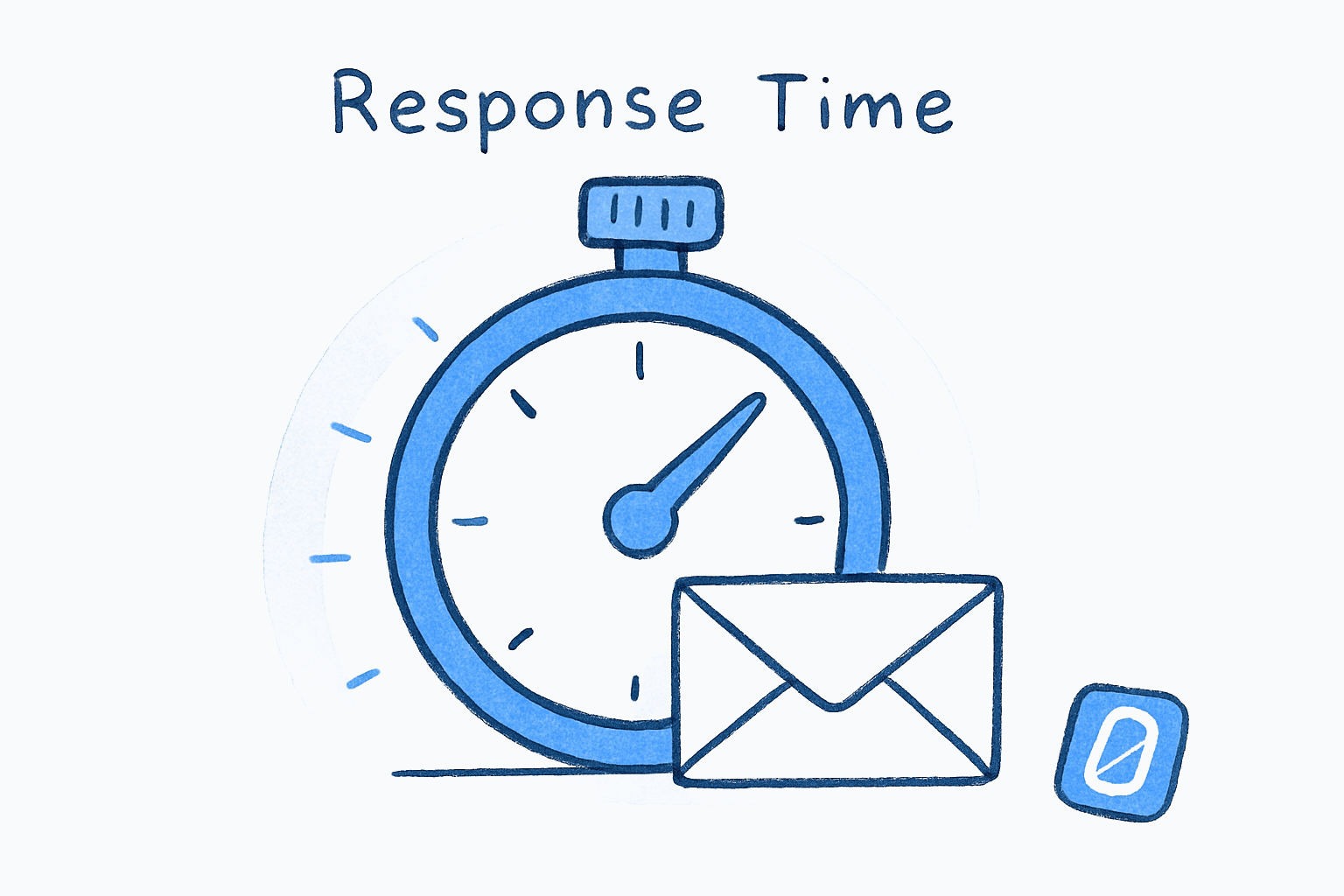
The research consensus: replying to most emails within 24 hours is fast enough. Most people reply far faster than they need to.
A landmark study by researchers Farshad Kooti and Kristina Lerman at USC Viterbi School of Engineering analyzed 16 billion emails from over 2 million users and found the most common email response time was just two minutes. Half of all replies arrived within an hour. We have collectively trained ourselves to treat every incoming message like a fire alarm, even though fewer than 5% of emails actually require an immediate response.
The pressure to respond instantly isn’t a sign of professionalism. It’s a sign that email has no rules. No one agreed on how fast “fast enough” is, so we default to “as fast as possible,” which means we never stop checking.
Key Takeaway
For 95% of workplace emails, replying within 24 hours meets or exceeds the sender’s actual expectations. The urgency you feel is largely self-imposed: research shows receivers consistently overestimate how fast senders expect a reply. Slowing down your response time doesn’t hurt your reputation; it protects your focus.
How Fast Do People Actually Reply to Email?#
Faster than you’d guess, and faster than they need to. The USC Viterbi study, presented at the World Wide Web Conference, is one of the largest email behavior analyses ever conducted. The researchers found that 90% of people who reply to an email do so within a day or two. But the distribution is sharply skewed toward speed: the median reply time clusters around just a few minutes for active users.
Age matters. Teenagers replied in an average of 13 minutes. Adults aged 20 to 35 averaged 16 minutes. Those over 51 took 47 minutes. Younger users typed shorter replies; older users wrote longer ones. Speed and depth appear to trade off.
This pattern suggests that the cultural norm for email response time has little to do with professional standards and everything to do with notification habits. When your phone buzzes, you respond. The content of the email barely factors into the equation.
What Do Senders Actually Expect?#
Here’s the finding that should change how you think about email response time: senders don’t expect replies nearly as fast as receivers think they do.
A 2021 study published in Organizational Behavior and Human Decision Processes by Laura M. Giurge (London School of Economics) and Vanessa K. Bohns (Cornell University) documented what they call the “email urgency bias.” Across eight pre-registered experiments with 4,004 participants, receivers consistently overestimated how quickly senders expected a response to non-urgent emails. The effect size was medium to large (Cohen’s d = 0.54).
The bias was especially pronounced for emails received outside normal working hours. When a colleague sends you something at 9 PM on a Sunday, your brain reads urgency into the timing. But the sender often chose that time precisely because it was convenient for them, not because they expected an immediate reply.
Giurge and Bohns found that a simple intervention solved the problem: when senders added a brief note clarifying their response expectations (“No rush on this”), the urgency bias disappeared. The anxiety wasn’t coming from the sender. It was coming from the silence around expectations.
I could write an entire post about the psychological mechanisms behind this bias alone, but the practical takeaway is straightforward: the person who sent you that email is probably not refreshing their inbox waiting for your reply. You invented that pressure yourself.
Does Email Response Time Vary by Role and Industry?#
Yes, significantly. But not always in the direction you’d expect.
Sam Altman, during his time as president of Y Combinator, observed “mind-blowingly different” response patterns between successful founders and less successful ones, with the gap measured in “minutes versus days.” Eric Schmidt, former CEO of Google, wrote that “most of the best, and busiest, people we know act quickly on their emails, not just to us or to a select few senders, but to everyone.”
That seems to contradict the “slow down” message. But there’s a nuance here that matters: the fastest-responding executives aren’t spending more total time on email. They process messages in short, decisive bursts, then return to focused work. Their speed reflects efficient triage, not constant monitoring.
For most professionals, the realistic benchmarks look like this:
| Context | Expected Response Time | Source |
|---|---|---|
| Customer-facing email | 1-4 hours | Zendesk CX Trends, 2025 |
| Internal team communication | 12-24 hours | SuperOffice, 2023 |
| B2B partner correspondence | 24-48 hours | Industry standard |
| Academic or government | 1-2 business days | Sector norms |
| Sales lead inquiry | Under 1 hour | Revenue.io, 2025 |
The sharpest gap appears in customer service. A SuperOffice study of 1,000 companies found that 62% of businesses never respond to customer service emails at all. Among those that do reply, the average response time exceeds 12 hours. Meanwhile, 89% of customers expect a reply within one hour. That’s not a gap; it’s a canyon.
If the pressure to reply instantly is eating into your focus time, Swizero gives your inbox a daily finish line. A fixed card limit means you process what matters and move on, instead of monitoring an endless stream.
The Psychology of Response Time Pressure#
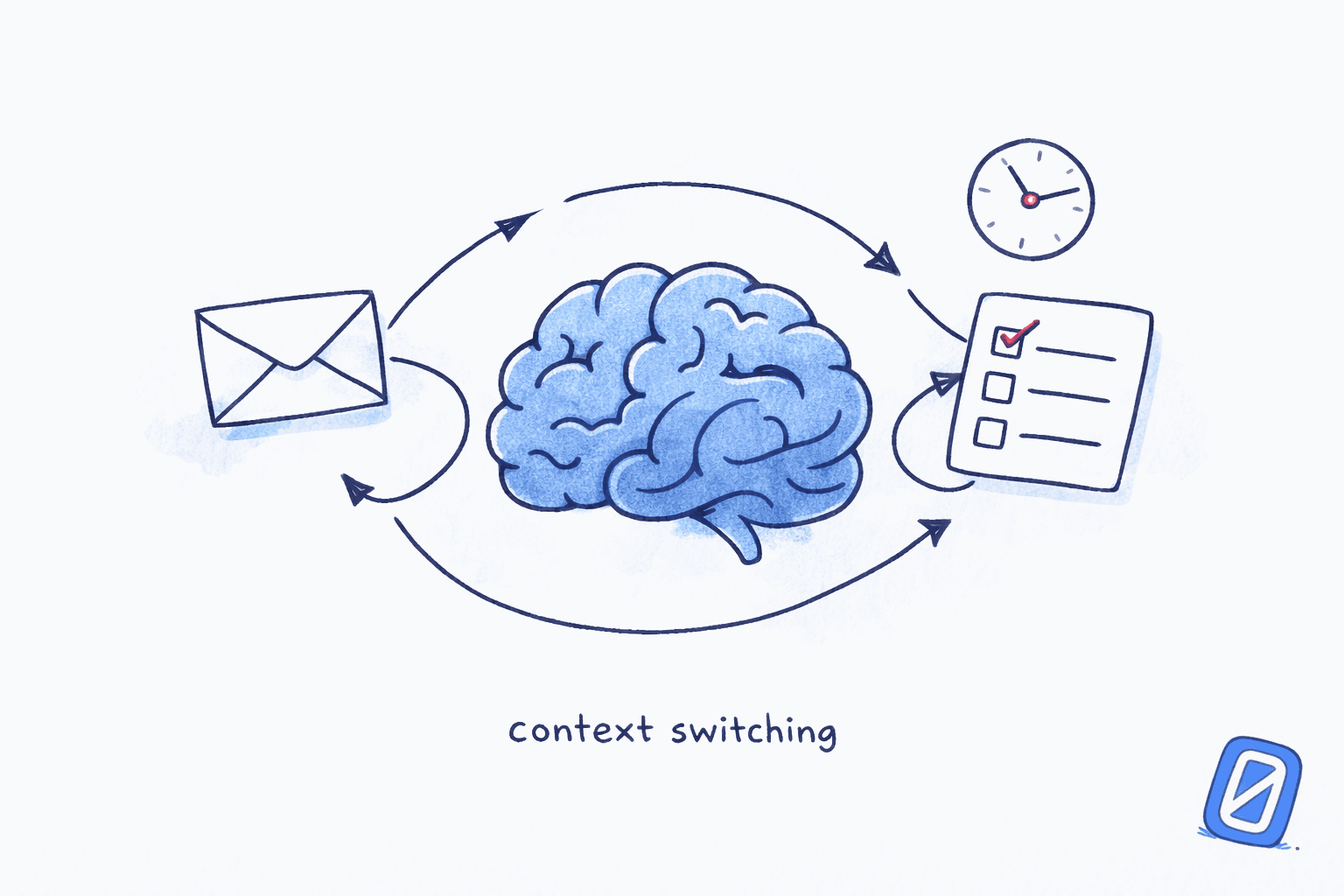
The compulsion to reply immediately has a name: workplace telepressure. Psychologists Larissa K. Barber and Alecia M. Santuzzi defined it as a strong urge to respond quickly to message-based communications, combined with a preoccupation with response speed. Their foundational research, published in the Journal of Occupational Health Psychology, found that telepressure predicted burnout, poor sleep quality, and increased absenteeism, even after controlling for general workload.
Cal Newport, Georgetown CS professor and author of A World Without Email, describes the inbox as “a social torture machine” that maintains what he calls a low-level but consistent hum of anxiety. Our brains are wired to interpret incoming messages as social demands, and every unanswered email feels like a small broken promise.
Honestly, reading through the telepressure literature was one of those moments where research confirmed something I’d felt for years but couldn’t articulate. The anxiety isn’t about any single email. It’s about the ambient weight of an inbox with no defined endpoint.
The core finding from Giurge and Bohns is that senders are consistently more relaxed about response timing than receivers assume, and the gap widens for emails sent outside work hours. The weekend email you’re stressing over at 10 PM? The sender probably doesn’t expect a reply until Monday.
Do Disconnection Policies Actually Help?#
One caveat worth acknowledging: the most intuitive solution, formal policies telling employees to disconnect, doesn’t work as well as you’d hope.
A 2026 study by Barber, Santuzzi, and Hu, published in Group & Organization Management, surveyed two samples totaling 717 workers. They found that the presence of disconnection policies was not associated with lower telepressure among employees. Only implicit norms, the unwritten rules about after-hours availability and whether your organization genuinely supports work-life boundaries, predicted whether employees felt the compulsion to respond immediately.
Most employees in the study didn’t think a formal policy would be beneficial and anticipated that it would create problems with flexibility. The issue isn’t rules. It’s culture.
This finding matters because it shifts the question from “what should the policy be?” to “what does your environment actually reward?” If your manager emails at midnight and expects a reply by 7 AM, no policy manual will override that signal.
What Does This Mean for Your Email Habits?#
The research points to a clear set of principles for setting your own professional email response time:
Match your response speed to actual urgency, not perceived urgency. The Giurge and Bohns study shows that your instinct about how fast someone needs a reply is systematically wrong. For non-urgent emails, 24 hours is fine. For genuinely urgent matters, most people use a different channel anyway (phone, Slack, walking over to your desk).
Batch your responses. The USC Viterbi data shows that most people reply within two minutes, meaning they’re essentially monitoring their inbox in real time. Research on how often you should check email consistently shows that checking two to three times per day reduces stress without harming responsiveness.
Set explicit expectations with your team. The single most effective intervention from the urgency bias research was a brief note from the sender: “No rush.” If you’re in a position to set norms, normalize this. Add response-time expectations to your email signature or team charter. (If you’re wondering how to phrase that note effectively, our guide on how to write a follow-up email covers the timing and tone.)
Create a stopping point. The link between telepressure and burnout runs through one mechanism: the absence of psychological detachment from work. When there’s no finish line for your inbox, there’s no point at which your brain can stop scanning for new messages. That’s why Swizero caps your inbox at a fixed card limit. Not because faster email processing is the goal, but because “done for today” is a concept that email desperately needs.
Accept that some emails don’t need replies at all. The SuperOffice data showing 62% of companies don’t respond to customer emails is appalling for customer service, but it reflects a broader truth about internal email: many messages are informational, not action-requiring. Not every email deserves a response. Learning to distinguish between the two is one of the most productive email habits you can build.
Frequently Asked Questions#
What is a good email response time for work?#
For most professional contexts, responding within 24 hours on business days meets the widely accepted standard. Research by Giurge and Bohns (2021) found that senders’ actual expectations are significantly more relaxed than receivers assume. Customer-facing roles have tighter benchmarks, typically one to four hours, but internal team communications are well-served by a same-day reply.
Is it unprofessional to take a day to respond to an email?#
No. A same-day or next-business-day response falls within professional norms across most industries. The USC Viterbi study of 16 billion emails found that 90% of replies arrive within a day or two. Responding thoughtfully within 24 hours is almost always preferable to sending a hasty reply within minutes.
How do I stop feeling anxious about slow email replies?#
The anxiety typically stems from what psychologists call workplace telepressure, a preoccupation with response speed. Two evidence-based approaches help: first, batch your email checking to two or three defined times per day rather than monitoring continuously. Second, ask senders to clarify urgency when it’s ambiguous. Research shows that email anxiety decreases when response expectations are made explicit.
Does responding to email quickly make you more successful?#
The relationship is more nuanced than it appears. While Sam Altman observed that successful founders tend to reply faster, their speed reflects decisive email processing habits, not constant inbox monitoring. Responding quickly to genuinely important messages while batching routine replies is the pattern the research supports.
How can I manage email response time expectations with my team?#
Start by making implicit expectations explicit. The Giurge and Bohns research found that a simple note like “no rush on this” eliminated the urgency bias entirely. Consider adding response-time norms to your team charter: same-day for action items, 48 hours for FYI messages, and use a different channel for anything truly urgent. When teams agree on clear email boundaries, telepressure drops and focus time increases.
Sources#
- Evolution of Conversations in the Age of Email Overload. Kooti, Aiello, Grbovic, Lerman, Mantrach, USC Viterbi / Yahoo Labs, 2015. Analyzed 16 billion emails from 2 million users; median reply time is 2 minutes.
- You Don’t Need to Answer Right Away! Receivers Overestimate How Quickly Senders Expect Responses to Non-Urgent Work Emails. Giurge & Bohns, Organizational Behavior and Human Decision Processes, 2021. Documented the “email urgency bias” across 4,004 participants.
- Please Respond ASAP: Workplace Telepressure and Employee Recovery. Barber & Santuzzi, Journal of Occupational Health Psychology, 2015. Defined telepressure and linked it to burnout, sleep disruption, and absenteeism.
- Tackling the Problem of Workplace Telepressure: Are Disconnection Policies Helpful?. Barber, Santuzzi, & Hu, Group & Organization Management, 2026. Found disconnection policies alone don’t reduce telepressure.
- Customer Service Response Times. SuperOffice, 2023. 62% of companies don’t respond to customer emails; average response time exceeds 12 hours.
- CX Trends 2025: Unlock the Power of Intelligent CX. Zendesk, 2025. 89% of customers expect a reply within one hour.
- How Long Should It Take to Respond to an Email?. Inc., 2016. Altman and Schmidt quotes on CEO response speed patterns.
Your inbox doesn't have to feel like this.
Swizero finishes your email in minutes, not hours.
Give your inbox a finish line