Email Was Never Meant to Be a To-Do List
By Chris Stefaner, Co-founder of Swizero
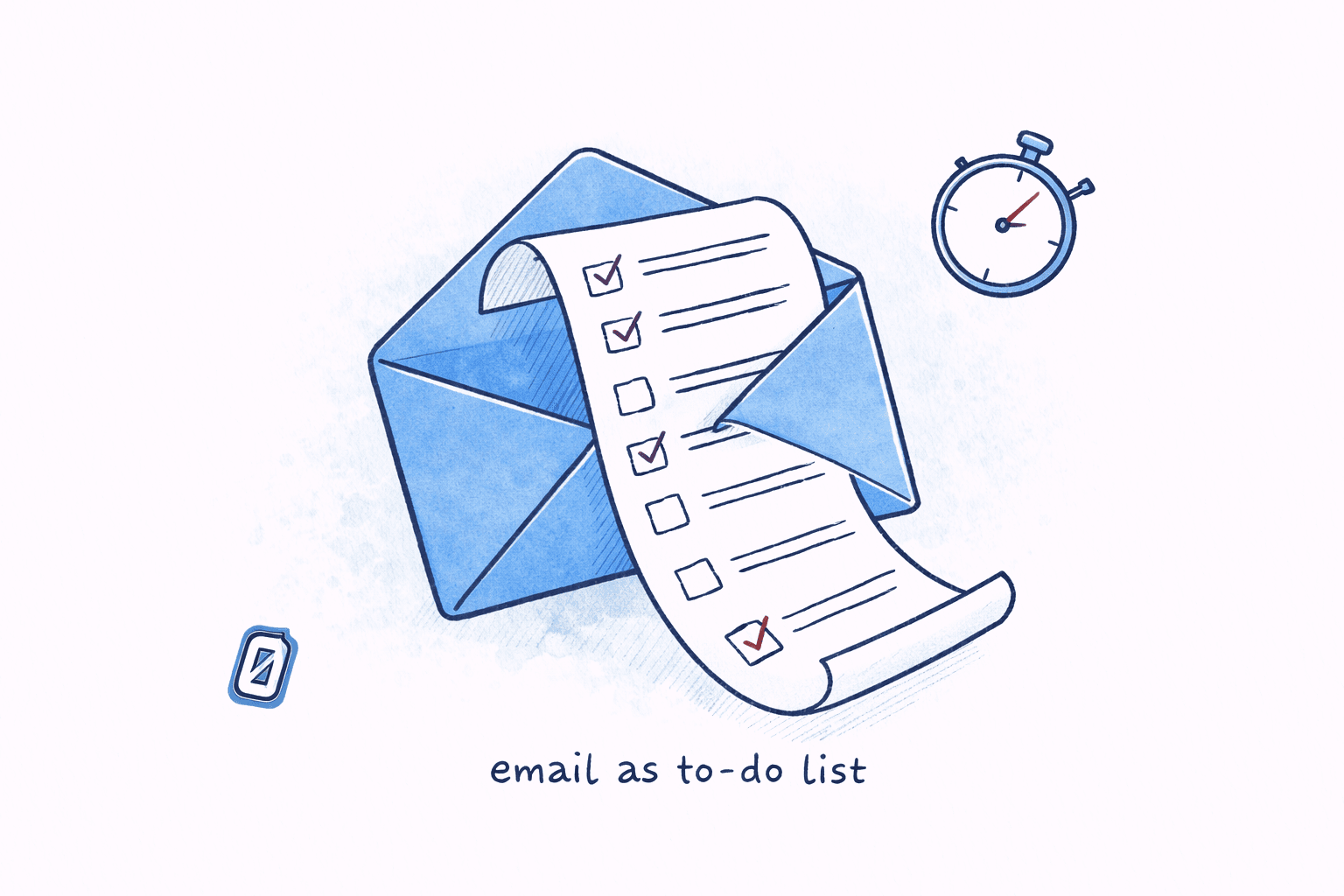
Open your inbox right now. Count how many messages are actually messages (someone communicating something to you) and how many are tasks wearing the disguise of a message. The contract that needs signing. The meeting that needs confirming. The feedback that needs giving. The invoice that needs approving. None of these are communication. They are work, delivered through a communication channel. That conflation is the root of almost everything wrong with modern email.
This is the argument nobody in the email industry wants to make: your inbox is not overloaded because you get too many emails. It is overloaded because email has become a to-do list that you never agreed to, that anyone can add to, and that has no mechanism for completion. This is not a habits problem or a willpower problem. It is an architecture problem, baked into the medium since the day we started using it for work we were never supposed to do inside it.
Key Takeaway
Email was invented in 1971 as a way to send short messages between researchers. Over five decades, it mutated into the default task management system for knowledge work, a role it was never designed for. The cognitive cost of mixing communication with task execution is enormous: open loops, context switching, and decision fatigue compound inside an interface that offers no way to distinguish “read this” from “do this.” Separating the decision layer (keep, clear, reply) from task execution is the structural fix the inbox has always needed.
How Did Email Become the World’s Worst To-Do List?#
In 1971, Ray Tomlinson was a programmer at Bolt Beranek and Newman, a company contracted by the U.S. Department of Defense to build ARPANET. He adapted a program called SNDMSG (which let users leave notes for each other on the same time-sharing computer) so that it could send messages between different machines on the network. The first email was a test string, probably “QWERTYUIOP.” It was not an action item. It was not a deliverable. It was not CC’d to six people who didn’t need it.
Tomlinson wasn’t even assigned the project. A BBN company spokesperson later said he “was just fooling around; he was looking for something to do with ARPANET.” Email was born as a casual experiment in person-to-person messaging. For the next two decades, it stayed that way: a channel for researchers and engineers to exchange notes.
Then businesses adopted it in the 1990s, and something shifted. Email became the default interface for everything. Not just messages, but approvals, task assignments, file transfers, scheduling, status updates, and project management. By the time David Allen published Getting Things Done in 2001 (a system that explicitly taught people to treat their inbox as a task capture tool), the transformation was complete. Email was no longer a communication medium. It was the operating system for knowledge work.
I could write a whole post about why GTD, for all its brilliance, may have cemented the very problem it tried to solve. But the key point is this: Allen’s system acknowledged a reality that already existed. People were already drowning in email-as-tasks. GTD gave them a framework for processing that flood. It did not question whether the flood should exist in the first place.
Why Does Mixing Communication and Tasks Cause So Much Damage?#
The damage is cognitive, and it operates through three distinct mechanisms that compound inside your inbox.
Open Loops and the Zeigarnik Effect#
Psychologist Bluma Zeigarnik discovered in the 1920s that unfinished tasks create persistent cognitive tension: the brain keeps an “open loop” running for every incomplete item, consuming working memory until the task is resolved. Research by Weigelt and Syrek extended this finding, showing that unfinished work tasks over the weekend led to rumination and difficulty psychologically detaching from work.
Every email that implies a task (“Can you review this?” or “Let me know your thoughts”) opens one of these loops. A pure communication channel would not create this burden. You read a message, you understand it, loop closed. But when the message is also a task, the loop stays open until the task is done. An inbox with 47 unread task-emails is an inbox with 47 open loops running in the background of your mind, each one bleeding small amounts of attention and cognitive capacity.
If you’ve read our analysis of how email drives decision fatigue through unbounded choice, you already know the cost of open loops at scale. The problem compounds: each new task-email doesn’t just add one loop; it forces you to re-evaluate the priority of every existing loop.
Attention Residue From Mode-Switching#
Sophie Leroy, a professor at the University of Washington, coined the term “attention residue” to describe what happens when you switch between tasks: part of your cognition remains stuck on the previous task. When your inbox alternates between messages (read and respond) and tasks (do something in the external world), you are not just switching between emails. You are switching between two fundamentally different cognitive modes (receptive processing and executive action) dozens of times per session.
Gloria Mark, Professor of Informatics at UC Irvine and author of Attention Span, has tracked this phenomenon for two decades. Her research shows that the average person now spends just 47 seconds on any screen before shifting attention, down from two and a half minutes when she began measuring in 2004. The acceleration maps precisely onto the period when email became the default task management tool for most knowledge workers.
“People don’t just get distracted by external things. We self-interrupt 49 percent of the time.”
Gloria Mark, Professor of Informatics, UC Irvine, author of Attention Span (2023)
Decision Fatigue Without a Decision Framework#
A pure message requires one decision: did I understand it? A task-email requires multiple: What does this require? How urgent is it? Should I do it now or later? Do I need information from someone else? Where do I track it once I leave my inbox?
Asana’s Anatomy of Work Index found that knowledge workers spend 60% of their time on “work about work”: organizing, clarifying, chasing updates, switching between tools. Email is the primary intake channel for this meta-work. Every task-email that lands in your inbox generates a cascade of micro-decisions that have nothing to do with the actual work and everything to do with the fact that a communication tool is being forced to function as a task manager.
The research on email notification addiction and compulsive checking shows the downstream effect: when every inbox visit might contain urgent tasks, the brain develops a hyper-vigilant scanning behavior that persists even outside of email. The to-do list problem does not stay contained inside the inbox.
How Knowledge Workers Actually Spend Their Day
Source: Asana, Anatomy of Work Index 2021 (13,000+ knowledge workers across 8 countries)
What Happens When Every Message Is Also a Decision?#
Reclaim.ai’s Task Management Trends Report surveyed over 2,000 professionals and found that the average individual contributor completes only 53.5% of their weekly planned tasks. More striking: only 53.3% of time spent “working on tasks” is actually productive. The rest is overhead, and email is the primary source of that overhead when it doubles as the task management layer.
Microsoft’s 2024 Work Trend Index paints a sharper picture: employees using Microsoft 365 are interrupted by a meeting, email, or notification every 2 minutes, totaling roughly 275 interruptions during core work hours. The broader email statistics for 2026 show this is part of a systemic pattern: volume is up 28% since 2020, time spent on email has barely moved despite a decade of AI tools, and burnout attributed to email keeps climbing. Communication (email, chat, and meetings) consumes 60% of user time, leaving only 40% for creative work. These are not communication problems. They are task-management problems, leaking through communication channels.
A 2024 paper in Frontiers in Psychology found that chronic digital multitasking (the kind that occurs when you bounce between reading messages and executing tasks in the same interface) leads to measurably impaired working memory, difficulty filtering irrelevant information, and elevated cortisol levels. Heavy multitaskers performed worse on cognitive tests than light multitaskers, even when they were not actively multitasking. The damage persists beyond the inbox session itself.
Linda Stone, a former executive at Apple and Microsoft who coined the term “continuous partial attention” in 1998, identified the behavioral pattern that email-as-task-manager creates:
“To pay continuous partial attention is to keep a top-level item in focus and constantly scan the periphery in case something more important emerges. It is an always-on, anywhere, anytime, any place behavior that involves an artificial sense of constant crisis.”
Linda Stone, former VP at Microsoft, lindastone.net
That “artificial sense of constant crisis” is precisely what an inbox full of task-emails generates. The research on how email affects mental health and sleep quality confirms that this feeling does not switch off when you close the app.
If the problem of open loops and mixed-mode processing resonates, Swizero separates the decision from the task. You swipe through a handful of cards (left to clear, down to archive, right to flag, up to reply) and the session ends. The inbox becomes a decision interface, not a task manager.
What Would Email Look Like If It Stayed a Communication Tool?#
This is the thought experiment that led to Swizero, and honestly, it is simpler than it sounds.
A communication tool does three things: it delivers a message, it lets you acknowledge the message, and it lets you respond. That is it. It does not ask you to decide urgency, assign priority, schedule follow-ups, or maintain a running archive of incomplete obligations. Those are task management functions, and they belong in a task manager.
Cal Newport, Professor of Computer Science at Georgetown University and author of A World Without Email, named the broader dysfunction: the “hyperactive hive mind.” In a 2021 interview with WBUR, he described the effect bluntly:
“The hyperactive hive mind workflow is a productivity disaster, reducing profitability and perhaps even slowing overall economic growth.”
Cal Newport, Professor of Computer Science, Georgetown University, WBUR interview, 2021
Newport’s argument is not that email technology is bad. It is that email-as-workflow (the practice of coordinating actual work through unstructured messages) is cognitively catastrophic. The fix is structural: move tasks into systems designed for tasks, and let email go back to being what Ray Tomlinson built in 1971.
If you have explored why constraints outperform infinite choice in email, you know the research on choice overload. A fixed card limit is the structural enforcement of that principle. Your session ends. The open loops close. Email stops being an ambient, never-ending obligation and becomes a bounded activity with a clear beginning, middle, and end.
The GTD Trap: When the Fix Reinforces the Problem#
One caveat worth acknowledging: GTD is a legitimately useful system, and millions of people have benefited from it. The criticism here is not that GTD is wrong. It is that GTD accepted a broken premise (that the inbox should be a task capture tool) and built a brilliant system on top of that premise.
The GTD core rule (anything you can deal with in less than two minutes, do it immediately) is sound advice for processing a task queue. But it also means that every time you open your inbox, you are committing to executing tasks on the spot. The inbox is no longer a place you visit to read messages. It is a place you visit to work, and the work is unbounded, unstructured, and controlled entirely by other people’s priorities.
Oliver Burkeman, author of Four Thousand Weeks: Time Management for Mortals, identified the deeper trap in this kind of productivity thinking:
“Productivity is a trap. Becoming more efficient just makes you more rushed, and trying to clear the decks simply makes them fill up again faster.”
Oliver Burkeman, Four Thousand Weeks (2021)
Burkeman’s insight applies directly to the inbox-as-task-queue model. The more efficiently you process task-emails, the more task-emails you attract, because senders learn you are responsive. For knowledge workers whose real work requires sustained focus (and research consistently favors batched processing over continuous monitoring), treating the inbox as a task queue is actively hostile to their most valuable output.
How Do You Separate Communication From Task Management?#
The separation requires three things, and none of them are complicated in principle. They have just never been prioritized by email clients.
First, the decision about an email must be decoupled from the execution of its implied task. When you see a card that says “Contract from legal: signature required by Friday,” your decision is simple: keep it. The task (reading and signing the contract) happens later, in a different context, with the focused attention it deserves. The inbox does not try to be your PDF viewer, your e-signature tool, and your deadline tracker all at once.
Second, the inbox must have a defined end state. The Zeigarnik effect research is clear: open loops create persistent cognitive load. A fixed card limit means the session closes. You processed your cards, you made your decisions, and the tool tells you that you are done. Not “done for now.” Done. This is the finish line philosophy applied structurally.
Third, prioritization must happen before you arrive. When every email competes equally for your attention, the act of scanning and evaluating is itself a form of task management. AI-driven prioritization means the most important messages surface as cards first. You do not spend cognitive resources on triage; the system already did it. (If you are curious about how that works under the hood, see our breakdown of how AI email assistants actually rank and surface messages.)
| Problem | Traditional Inbox | Decision-First Model |
|---|---|---|
| Every email is a potential task | You decide + execute in the same place | You decide (swipe); execute elsewhere |
| No defined end point | Infinite scroll, always more | Fixed card limit per session |
| No pre-sorted priority | You scan and triage manually | AI ranks cards before you arrive |
| Open loops persist | Unread count follows you | Session ends; cards are processed |
Frequently Asked Questions#
Why is using email as a to-do list so stressful?#
The stress comes from the Zeigarnik effect: unfinished tasks create persistent mental tension until resolved. Every task-email in your inbox is an open loop. Unlike a purpose-built task manager where items are explicit and ordered, your inbox mixes tasks with messages, offers no priority structure, and has no completion state. The result is a background hum of cognitive load that persists even when you are not actively checking email.
Can I use GTD principles without treating my inbox as a task list?#
Yes, and many productivity experts now recommend exactly that. The core GTD principle (capture everything, then process) works better when “capture” happens outside the inbox. Use your email client to make quick decisions (respond, delegate, archive), then move actionable items to a dedicated task manager. The inbox becomes a triage point, not a holding pen.
How many hours a day do knowledge workers spend on email?#
Microsoft’s 2024 Work Trend Index found that communication (email, chat, meetings) consumes 60% of user time. Reclaim.ai’s research puts email-specific processing at roughly 11-12 hours per week (approximately 2.3 hours per day). When combined with app switching and focus recovery time, the total impact rises to roughly 17-18 hours per week spent on communication overhead rather than substantive work.
Is there research showing that separating communication from tasks improves productivity?#
Yes. Bellotti and Ducheneaut’s influential 2005 study Quality Versus Quantity in the Human-Computer Interaction journal found that email overload was driven not by volume but by the collaborative quality of task management conducted through email. Tasks that required responses from others became “interleaved,” forcing users to track multiple incomplete items simultaneously. Structured workflows (where tasks are tracked in purpose-built systems rather than unstructured threads) dramatically reduce this overhead.
Sources#
- Ray Tomlinson. Wikipedia. History of email invention at BBN/ARPANET, 1971.
- Ray Tomlinson. Lemelson-MIT Program. Background on email’s casual, experimental origins.
- Getting Things Done. David Allen. The GTD methodology and its relationship to email processing.
- Getting Email Under Control (PDF). David Allen, 2008. The two-minute rule and inbox-as-task-queue approach.
- A World Without Email. Cal Newport, Georgetown University, 2021. The “hyperactive hive mind” and its cognitive costs.
- Cal Newport on A World Without Email. WBUR, 2021. Interview describing the “productivity disaster” of email-as-workflow.
- Attention Span. Gloria Mark, UC Irvine, 2023. Average screen attention now 47 seconds; 49% of interruptions are self-generated.
- Beyond Simple Multi-Tasking: Continuous Partial Attention. Linda Stone, 2009. The concept of continuous partial attention and its “artificial sense of constant crisis.”
- Four Thousand Weeks: Time Management for Mortals. Oliver Burkeman, 2021. Why productivity optimization is a trap that makes the inbox problem worse.
- Anatomy of Work Index. Asana, 2023. 60% of knowledge worker time spent on “work about work.”
- Breaking Down the Infinite Workday. Microsoft Work Trend Index, 2024. 275 interruptions/day; communication consumes 60% of work time.
- Task Management Trends Report. Reclaim.ai, 2024. Only 53.5% of planned tasks completed weekly; 53.3% of task time is productive.
- Why Is It So Hard to Do My Work? (PDF). Sophie Leroy, University of Washington, 2009. Foundational paper on “attention residue” from task-switching.
- Digital Multitasking and Hyperactivity: Unveiling the Hidden Costs to Brain Health. Frontiers in Psychology, 2024. Chronic multitasking impairs working memory and elevates cortisol.
- Quality Versus Quantity: E-Mail-Centric Task Management and Its Relation With Overload. Bellotti & Ducheneaut, Human-Computer Interaction, 2005. Email overload driven by collaborative task interleaving, not volume alone.
- Zeigarnik Effect. Psychology Today. Unfinished tasks create persistent cognitive tension and impair focus.
- The Zeigarnik Effect: How Unfinished Tasks Hijack Your Productivity. Square Holes, 2025. Weigelt and Syrek research on rumination from open work tasks.
Your inbox doesn't have to feel like this.
Be among the first to experience a finished inbox.
Join the finite inbox beta