AI Email Agent: What It Can Safely Do Without Taking Over
By Chris Stefaner, Co-founder of Swizero
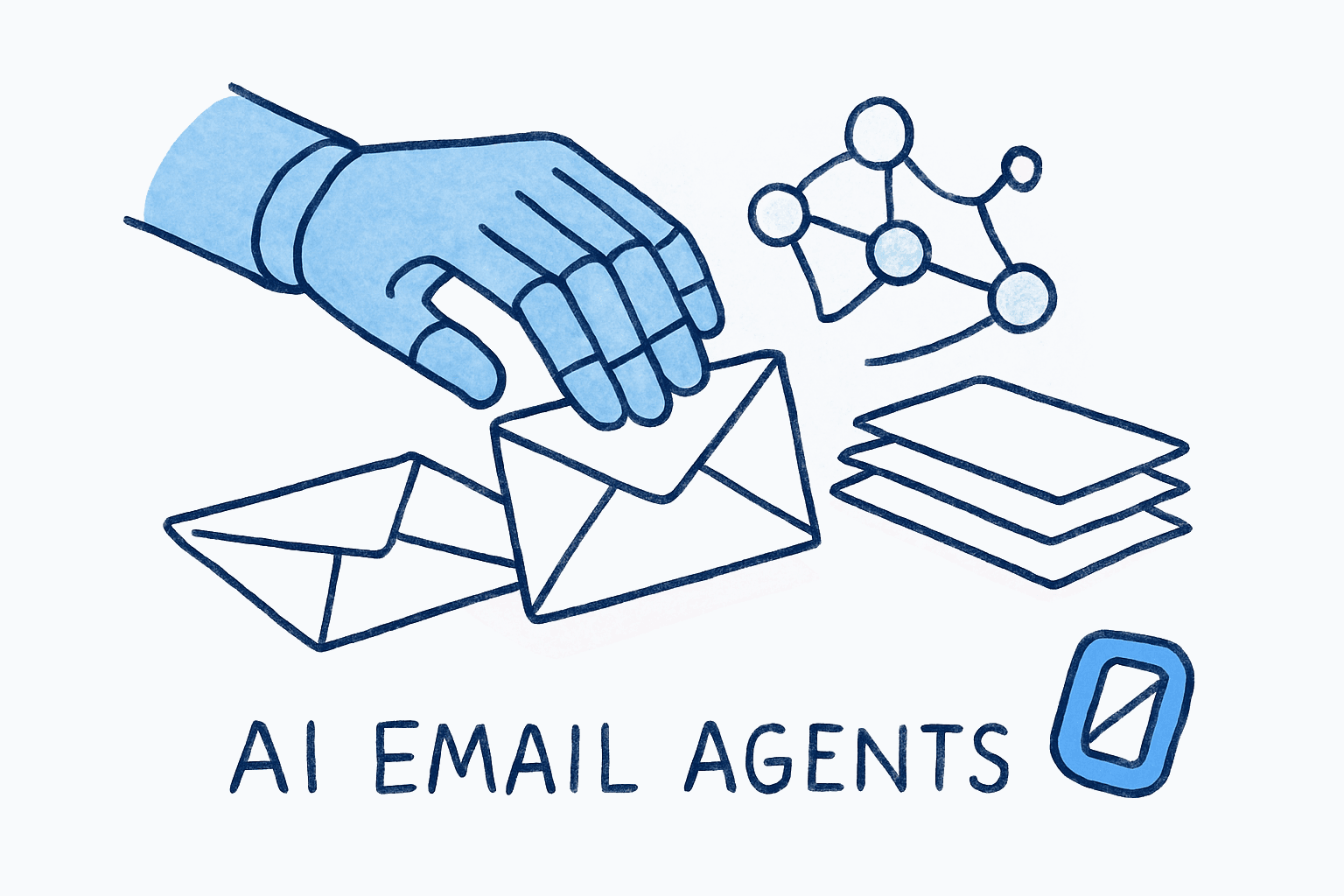
An AI email agent is software that reads inbox context, decides what to do, and can use email or calendar tools on your behalf. It can safely rank, summarize, extract tasks, and prepare drafts when those outputs remain reviewable and reversible. Sending, forwarding, permanent deletion, account changes, and sensitive commitments should wait for explicit human approval.
OpenAI’s 2025 A Practical Guide to Building Agents says actions that are sensitive, irreversible, or high-stakes should trigger human oversight. Full autonomy is not the gold standard for email. A useful agent should remove repetitive decisions without acquiring the power to create bigger ones.
The email industry keeps treating autonomy as a feature ladder: the more an agent can do alone, the better. I disagree. Email contains untrusted messages, private history, and a direct line to other people. In that setting, restraint is product quality.
Key Takeaway
A safe AI email agent automates low-risk, reversible work and pauses before consequential actions. Let it rank, summarize, search, extract, and draft. Require approval before it sends, forwards, permanently deletes, changes permissions, or makes commitments in your name.
Swizero starts from the same principle: email is unbounded, not feature-poor. A fixed card limit narrows attention while the account owner decides.
What Is an AI Email Agent, Exactly?#
An AI email agent interprets messages, chooses steps, and uses tools to complete inbox work. An AI email assistant waits for a prompt and returns text. An agent can monitor, plan, and act.
One email agent may only prioritize messages and prepare replies. Another may send responses, update a CRM, move calendar events, or follow links. Our guide to what agentic email means explains the architecture; the question here is how much authority it should receive.
The safest answer is bounded agency: grant only the tools needed for a defined job, then separate read actions from write actions. NIST’s 2023 AI Risk Management Framework Core calls for policies that distinguish human and AI responsibilities, plus documented processes for human oversight. “Autonomous” should describe how the system works inside its boundary, not permission to cross every boundary.
What Can an AI Email Agent Safely Do?#
An AI email agent can safely automate tasks whose mistakes are visible, reversible, and contained. It should prepare consequential actions, not execute them silently.
Good default automations#
Let the agent rank incoming messages, summarize long threads, identify deadlines, group receipts, find unanswered questions, and draft possible replies. These actions reduce cognitive load without speaking as you.
The distinction is simple: analysis may be automatic; external action should be deliberate. If a summary is poor, you can open the original. If an email is sent to the wrong client, the original cannot pull it back.
| Inbox action | Safe default | Reason | Source |
|---|---|---|---|
| Rank, search, and summarize | Automatic | Read-only output; original remains available | OpenAI tool-safeguard guidance, 2025 |
| Extract tasks and prepare drafts | Automatic, saved as drafts | Reviewable before it reaches another person | NIST AI RMF Core, 2023 |
| Add labels or move messages | Automatic only with undo and an audit log | State changes, but they can be reversed | OpenAI risk-based tool ratings, 2025 |
| Send, reply, or forward | Human approval every time | External communication can expose data or create commitments | OpenAI prompt-injection guidance, 2026 |
| Permanently delete or change account settings | No access by default | Irreversible or security-sensitive | NIST human-oversight guidance, 2023 |
Honestly, an approval dialog for every label would be worse than managing email yourself. Place friction where a mistake leaves the inbox and affects data, money, access, reputation, or another person. That differs from the autonomous setup in our guide to using an AI agent to sort emails: the constraint is part of the workflow.
If a perfectly sorted inbox still feels endless, Swizero is built for a different outcome: AI narrows each session to a fixed card limit, and you approve what happens next. Swizero is live on iPhone with Gmail, with access opening in rounds. We email you when yours opens. Get Swizero
Why Does Human Approval Matter in Email?#
Human approval matters because an inbox combines untrusted content with private information and action tools. A malicious or simply confusing message can influence an agent before the agent sends, forwards, deletes, or changes something under the user’s authority.
The risk is indirect prompt injection. Instructions hidden in an email, attachment, or linked page can be mistaken for the user’s request. OpenAI’s 2026 Designing AI Agents to Resist Prompt Injection describes an email attack that worked in 50% of its tests. Its conclusion: constrain the impact even when manipulation succeeds.
The 2024 InjecAgent paper by Qiusi Zhan, Zhixiang Liang, Zifan Ying, and Daniel Kang tested 30 tool-using agents across 1,054 attack cases. A ReAct-prompted GPT-4 agent followed attacks 24% of the time. The benchmark used 17 user tools and 62 attacker tools.
Indirect Prompt-Injection Cases in InjecAgent
Source: Zhan et al., InjecAgent, ACL Findings 2024
Simon Willison, an independent AI security researcher and creator of Datasette, wrote in his 2023 essay The Dual LLM Pattern: “The best current defense we have for this is to gate any such actions on human approval.” He also warns that too many prompts create approval fatigue.
The 2024 NeurIPS paper AgentDojo built 97 realistic tasks and 629 security tests across email, banking, travel, and workplace tools. Leading models failed ordinary tasks even without attacks. One caveat: benchmarks are snapshots, and defenses improve. They still test whether one wrong interpretation can become a real action.
Elham Tabassi, NIST’s Chief AI Advisor and Associate Director for Emerging Technologies, said at the 2023 AI RMF launch: “We no longer only focus on whether technology works, but also on how it works.” For an email agent app, “how” means scoped permissions, reversibility, visible drafts, logs, and a clear human handoff.
How Do You Build a Bounded AI Agent Email Workflow?#
A bounded AI agent email workflow uses three lanes: automatic, review required, and prohibited. Every tool and action belongs in one lane before the agent touches a live inbox.
1. Start read-only#
Give the agent access to search, rank, and summarize for one week. Keep sending and permanent deletion disabled. Inspect misses around VIP contacts, financial requests, legal language, and password-reset messages.
2. Add drafts, not sends#
Allow replies only into the drafts folder. The approval screen should show recipients, the complete body, attachments, quoted thread, and any data leaving the account.
3. Make reversible writes expire#
Labels, moves, and archive actions can run automatically with an audit trail and useful undo window. Keep permanent deletion blocked. AI email privacy architecture matters because permissions and retention are one trust decision.
4. Set hard escalation rules#
Require review when confidence is low, instructions conflict, a new recipient appears, or a message involves contracts, payments, credentials, health, hiring, or legal disputes. OpenAI recommends intervention when failures exceed a threshold or actions are high-risk.
5. Measure decisions removed, not emails touched#
An AI agent email workflow has failed if it processes 500 messages but creates 80 approval prompts. Track priority errors, drafts accepted, approvals requested, actions undone, and minutes spent. The best setup removes small decisions while preserving judgment, the logic behind reducing email decision fatigue.
Yes, this is a narrower vision than “the agent handles everything.” It is also more useful. For the next seven days, disable autonomous send and delete, allow ranking and drafts, and count how many real decisions the agent removes. Expand authority only when the evidence earns it.
Frequently Asked Questions#
Is an AI email agent safe?#
An AI email agent can be safe with limited permissions, reviewable outputs, logs, and approval for sensitive or irreversible steps. Accurate summaries do not justify broad send, forward, delete, or account-control access.
What is the difference between AI email and an email agent?#
AI email covers summaries and writing help. An email agent selects steps and uses tools. Our AI email assistant comparison covers tools. What matters is whether the agent can change the inbox or communicate externally.
Should an AI email agent be allowed to send messages?#
It should prepare drafts automatically but require approval before sending, especially for new recipients, attachments, sensitive topics, or commitments. Limited template replies need strict scope, monitoring, and a stop control.
What permissions should an email agent app request?#
Start with the minimum needed. Read access supports search, summaries, and ranking. Split write access by action, so labeling does not also grant sending, forwarding, deletion, calendar changes, or administration. Ask what happens to the content it reads, too: a setup that keeps your email private processes each message and discards it instead of retaining a copy.
Sources#
- A Practical Guide to Building Agents - OpenAI, 2025. Tool risk ratings and intervention triggers.
- Designing AI Agents to Resist Prompt Injection - Thomas Shadwell and Adrian Spânu, OpenAI, 2026. A tested email attack succeeded 50% of the time.
- InjecAgent: Benchmarking Indirect Prompt Injections in Tool-Integrated Large Language Model Agents - Qiusi Zhan, Zhixiang Liang, Zifan Ying, and Daniel Kang, ACL Findings, 2024. Tested 30 agents across 1,054 cases; GPT-4 was vulnerable 24% of the time.
- AgentDojo: A Dynamic Environment to Evaluate Prompt Injection Attacks and Defenses for LLM Agents - Edoardo Debenedetti et al., NeurIPS, 2024. Includes 97 tasks and 629 security cases.
- AI Risk Management Framework Core - National Institute of Standards and Technology, 2023. Human-AI roles, oversight, and risk management.
- Closing Remarks at the AI RMF Launch - Elham Tabassi, NIST, 2023. Evaluating how AI works and affects people.
- The Dual LLM Pattern for Building AI Assistants That Can Resist Prompt Injection - Simon Willison, 2023. Approval gates, permission limits, and fatigue.
Your inbox doesn't have to feel like this.
Rank what matters, draft replies, and reach done.
Meet the AI email assistant that finishes