Email Decision Fatigue: 600 Choices Before Lunch (Study Data)
By Chris Stefaner, Co-founder of Swizero
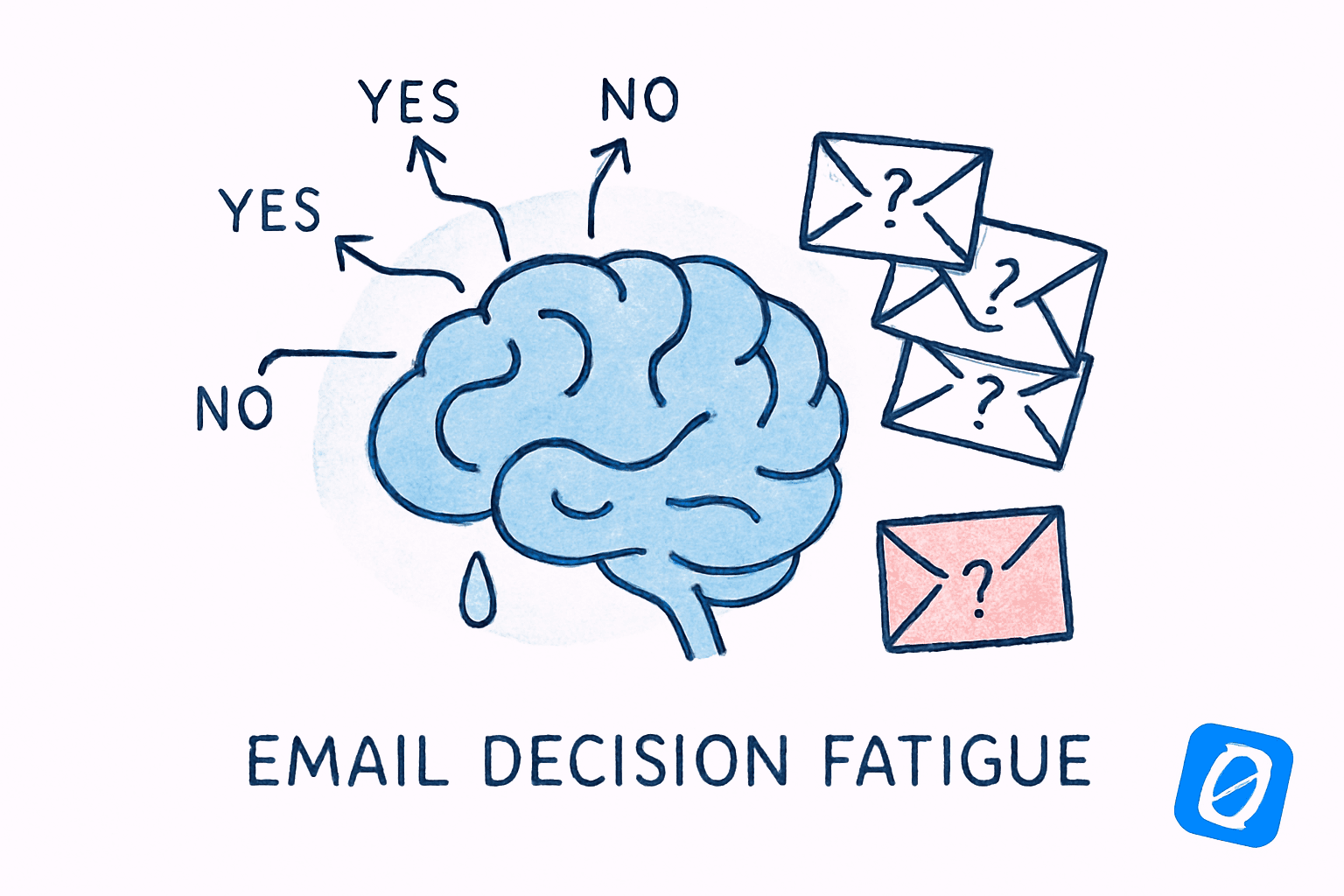
Open your inbox right now and look at the unread count. That number isn’t a list of messages. It’s a queue of decisions you haven’t made yet, and the cost of leaving them open is measurable, even when you’re not looking at the screen.
This is email decision fatigue: the cumulative cognitive tax of an inbox that asks you, hundreds of times a day, to choose. Reply now or later? Archive or flag? Important or noise? Most email advice tries to make these decisions faster. The Swizero argument is different: the problem isn’t decision speed, it’s decision count. An unbounded inbox guarantees that count is unbounded too.
Key Takeaway
Email decision fatigue isn’t caused by hard emails. It’s caused by the sheer number of micro-decisions an unbounded inbox forces on you, each one a small but real cognitive cost. The fix isn’t faster sorting. It’s a hard cap on how many decisions you have to make in a session, before fatigue compounds and your judgment degrades.
I’ll lay out the research below, including the parts where the science is contested. Honest disclosure up front: the original “ego depletion” framing of decision fatigue has taken hits in the replication crisis. But the related, better-supported finding (that decision quality declines as choice volume rises) is exactly the lever that matters for inbox design.
Contents#
- Every Email Is a Decision You Haven’t Made Yet
- What the Research Actually Says About Decision Fatigue
- How Many Daily Decisions Does Your Inbox Add?
- Why Choice Overload Hits Email Especially Hard
- Can a Hard Cap Fix Email Decision Fatigue?
- How to Reduce Email Decision Load Today
- Frequently Asked Questions
- Sources
Every Email Is a Decision You Haven’t Made Yet#
A subject line in your inbox is a decision in three parts. Is this worth opening? If I open it, what do I do? If I do nothing, when do I revisit? Even the act of deferring (the most common email behavior) is a choice that consumes a small amount of working memory. Productivity researchers call these unresolved items “open loops,” a term popularized by David Allen in Getting Things Done and grounded in 1920s research from psychologist Bluma Zeigarnik, who found people remember interrupted tasks better than completed ones. Open loops don’t sit quietly. They run a low-priority background process that taxes attention.
A 2026 productivity analysis described the dynamic plainly: every unread email is an open loop, every saved-for-later message is a pending decision, and these accumulate into substantial cognitive load even when you’re not actively reading them. Working memory can hold roughly four to seven items at once. A typical inbox holds hundreds.
Here’s the part that doesn’t get said often enough: the cognitive cost of an inbox is not mostly inside your inbox. It’s in the rest of your day, when you’re trying to think about something else and your brain keeps reminding you about that flagged thread from Tuesday.
What the Research Actually Says About Decision Fatigue#
The honest answer: decision fatigue is real but contested, and the version of it you see in productivity blogs is usually overstated. Here’s what holds up.
The classic study. In 2011, researchers Shai Danziger, Jonathan Levav, and Liora Avnaim-Pesso analyzed 1,112 parole rulings from Israeli judges and published the results in PNAS. They found favorable rulings dropped from about 65% at the start of a session to nearly zero before a meal break, then jumped back up to 65% after the judges rested. The paper has been cited over 1,380 times and became the foundational reference for “decision fatigue.”
The critique. Statistician Daniël Lakens and others have argued the effect size is implausibly large, and that case ordering by complexity may explain part of the pattern. A 2025 study in Communications Psychology using large-scale healthcare field data found no credible evidence for decision fatigue in physicians making sequential medical judgments. The phenomenon may be more context-dependent than the popular framing suggests.
The replicated parts. Where the evidence holds up best is in studies that directly track decision quality over time within a single workday:
- A 2024 study in Medical Decision Making using Australian general practice data found GPs were increasingly likely to prescribe antibiotics (and less likely to prescribe statins or osteoporosis medications) as their workdays progressed, consistent with a shift toward easier, more heuristic choices.
- A 2019 study in the Journal of Financial Economics showed financial analysts who issued multiple forecasts per day produced less accurate forecasts later in the day, relying more on heuristics than evidence.
- Colonoscopy polyp detection rates decline during afternoon shifts, even when the procedure itself is identical.
What ties these together isn’t “willpower depletion” in the original Baumeister sense. It’s something simpler: as you make more sequential judgments, you increasingly default to lower-effort patterns. Cognitive psychologist Michael Inzlicht of the University of Toronto, one of the field’s most prominent skeptics of the original ego-depletion model, has argued that what we call “fatigue” is better understood as a shift in motivation and attention. Either way, the practical consequence is the same: the more decisions you’ve made, the less careful the next one is likely to be.
If your inbox is the first thing you open in the morning, the first 50 micro-decisions of your day are spent on triage. By the time you get to the work that actually matters, you’ve already spent the most expensive part of your decision budget.
How Many Daily Decisions Does Your Inbox Add?#
You may have seen the claim that adults make 35,000 decisions a day. That number is widely cited but traces back to a book by Sahakian and Labuzetta with no original empirical source. Treat it as a directional guess, not a fact. A more defensible figure comes from Cornell researchers Brian Wansink and Jeffery Sobal, who documented in 2007 that adults make at least 226.7 decisions about food alone per day.
Email contributes its own meaningful slice. The average professional receives 121 emails per day according to the Radicati Group, but the decision count is not just 121. Each message can trigger a chain: open or skip, read fully or skim, reply now, defer, archive, flag, forward, search for context. A reasonable rough estimate is 3 to 5 micro-decisions per email, which means a typical professional inbox imposes 360 to 600 small choices per day.
This is the part of email cost that productivity dashboards don’t measure. They count time spent. They don’t count choices made.
If processing several hundred email decisions before lunch sounds exhausting, Swizero caps your inbox at a handful of cards per session. The AI does the first-pass triage, so your decision budget gets spent on emails that actually need your judgment, not the chaff.
Why Choice Overload Hits Email Especially Hard#
Most environments where we make a lot of choices have built-in structure: menus group items, stores arrange shelves by category, calendars sort by time. The inbox does almost none of this. It presents an undifferentiated list ordered only by arrival time, with no inherent priority and no fixed end.
This is why Sheena Iyengar’s classic jam study is the right mental model for the inbox, not the wrong one. Iyengar, a Columbia Business School professor, found that shoppers presented with 24 jam varieties were ten times less likely to buy than shoppers presented with six. In a separate 401(k) study with Vanguard, every additional 10 fund options dropped enrollment by about 2 percentage points. The inbox is the jam shelf, every day, except the jars get refilled while you’re standing there.
Choice overload manifests three ways in email:
| Symptom | What it looks like in your inbox | Source |
|---|---|---|
| Decision avoidance | Email goes unanswered for days; “I’ll get to it later” becomes never | Iyengar & Lepper, 2000 |
| Default to low-effort | Quick “Sounds good” replies, archive without reading, mass-delete sprees | Maier et al., Medical Decision Making, 2024 |
| Reduced satisfaction | The “inbox zero high” fades within hours; you feel behind even when caught up | Iyengar, 2010 |
The third one is worth sitting with. Even when you process the inbox successfully, the satisfaction is brittle. New mail starts arriving immediately. The finish line moves before you cross it. If you’ve ever cleared your inbox at 5pm and felt no relief, that’s not a personal failing. That’s the predictable outcome of an unbounded choice environment.
Can a Hard Cap Fix Email Decision Fatigue?#
Here is where Swizero’s premise meets the science. If decision quality degrades over a long sequence of sequential choices, then the design question is not “how do we help users make 400 inbox decisions faster?” It’s “how do we make sure they don’t have to make 400 in a row?”
That’s the entire point of a card limit. You don’t get to see 200 emails this morning. You get a handful, pre-filtered by AI, presented one at a time. You make the decisions. You stop. You walk away. The inbox isn’t an unbounded pool draining your attention all day; it’s a discrete task with a defined end. We’ve made the case for why an inbox without a finish line breaks human attention elsewhere, and for why “inbox finite” beats “inbox zero” on stability. Both arguments rest on this same decision-budget logic.
This is also why batched email checking works in studies even when individual emails take just as long to process. The classic Kushlev & Dunn study at UBC found that limiting email checks to three times a day reduced stress significantly, but the most underrated finding was that subjects didn’t get less email done. They made the same number of decisions, just bundled. The cognitive benefit came from not interleaving inbox decisions with everything else.
Honest caveat: a card limit alone doesn’t fix decision fatigue if the cards still contain the hardest decisions of your day. It works because (a) AI summarization makes each card-level decision cheaper, (b) the limit prevents you from spending your decision budget on chaff, and (c) the visible end-point reduces the anticipatory anxiety that itself burns cognitive resources.
How to Reduce Email Decision Load Today#
You don’t need new software to start cutting decision count. Some things that work, ranked roughly by effect size in the research:
- Unsubscribe ruthlessly, weekly. Every promotional email you don’t subscribe to is a decision you don’t have to make. The first time you do this it’ll take 30 minutes. After that, 5 minutes a week. For the emails that remain, a triage system borrowed from military decision-making gives you a repeatable framework for sorting by urgency before you spend any cognitive budget on responses.
- Process in 2-3 sessions, not continuously. The batching effect is the most replicated email-productivity finding in the literature. Three sessions of 20 minutes beats 50 sessions of 90 seconds.
- Standardize default actions. Decide once: “anything from this newsletter gets archived without reading.” That’s a meta-decision that prevents 200 future micro-decisions.
- Defer “maybe” emails to a single review slot. Don’t keep them in your decision space all day. Star them, ignore them until your review block. This closes the open loop temporarily.
- End each session at empty, not at zero. Inbox zero is unstable. A session-end with all visible items processed is sufficient; the rest can wait until the next session. We’ve explored why a session-based approach beats compulsive checking at length.
I’ll be honest: I find #3 the hardest. There’s a small voice that insists “but what if this newsletter has something important?” Almost always, it doesn’t. And even if it occasionally does, the cost of one missed insight is dwarfed by the cumulative cost of 200 unmade decisions.
Frequently Asked Questions#
Does email really cause decision fatigue, or am I just tired?#
Both, probably. The strongest version of decision fatigue (ego depletion) is contested, but the weaker, better-replicated finding (that decision quality declines across a long sequence of choices) is solid. Email contributes specifically because it forces hundreds of low-stakes choices into the highest-value cognitive hours of your day. If your judgment feels worse by 4pm, your inbox is a likely contributor, even if it’s not the only one.
Why do I open my inbox and just stare?#
This is a textbook choice-overload response. Sheena Iyengar’s research found that more options doesn’t just slow people down; it makes them more likely to disengage entirely. Your brain is doing what shoppers do at the 24-jam display: refusing to choose anything because the alternatives can’t be quickly compared.
Can AI actually fix this, or is it just hiding the decisions?#
AI does both, depending on how it’s used. AI that makes the decision for you (auto-archiving, auto-replying) hides decisions, which can be useful for low-stakes items but risky for important ones. AI that summarizes and surfaces helps you make decisions faster without removing your agency. The combination of AI summarization plus a hard card limit is what makes a finite inbox cognitively cheap, rather than just a different shape of overwhelm.
Is checking email less often actually a productivity hack?#
Yes, and the evidence is unusually strong for this one. The 2015 Kushlev & Dunn UBC study found significantly lower stress in participants who checked email three times a day versus on demand, with no loss in throughput. Most other email “hacks” have weak or contested evidence. Batching is the exception.
What’s the difference between decision fatigue and email anxiety?#
Decision fatigue is a degradation in judgment across a long sequence of choices. Email anxiety is the anticipatory stress of an inbox you haven’t checked yet. They’re related but distinct: a single email you haven’t opened can cause anxiety without forcing a decision. We covered the anxiety side of the equation in detail. This post is specifically about the decision-count side.
Sources#
- Extraneous factors in judicial decisions. Danziger, Levav & Avnaim-Pesso, PNAS, 2011. The original parole-board decision-fatigue study.
- No evidence for decision fatigue using large-scale field data from healthcare. Communications Psychology, 2025. Major recent challenge to the strong version of decision fatigue.
- Assessing Decision Fatigue in General Practitioners’ Prescribing Decisions. Maier, Powell, Harrison, Gordon, Murchie & Allan, Medical Decision Making, 2024. Replicates decision-quality decline in real-world clinical workflows.
- Decision fatigue and heuristic analyst forecasts. Journal of Financial Economics, 2019. Multi-forecast analysts produce less accurate later-day forecasts.
- The Collapse of Ego Depletion. Michael Inzlicht, University of Toronto. Critical review of the replication failures.
- When Choice Is Demotivating: Can One Desire Too Much of a Good Thing?. Iyengar & Lepper, JPSP, 2000. The 24-jam study.
- Checking email less frequently reduces stress. Kushlev & Dunn, Computers in Human Behavior, 2015. The UBC batched-email study.
- Mindless eating: a manuscript on decision-making. Wansink & Sobal, Cornell University, 2007. The 226.7 daily food decisions figure.
- Do We Really Make 35,000 Decisions a Day?. Did The Research, 2023. Source-tracing for the widely-cited 35,000 number.
Your inbox doesn't have to feel like this.
Email with a beginning, middle, and end.
Make email a bounded session