Email Writing Anxiety: Why You Redraft but Never Send
By Chris Stefaner, Co-founder of Swizero
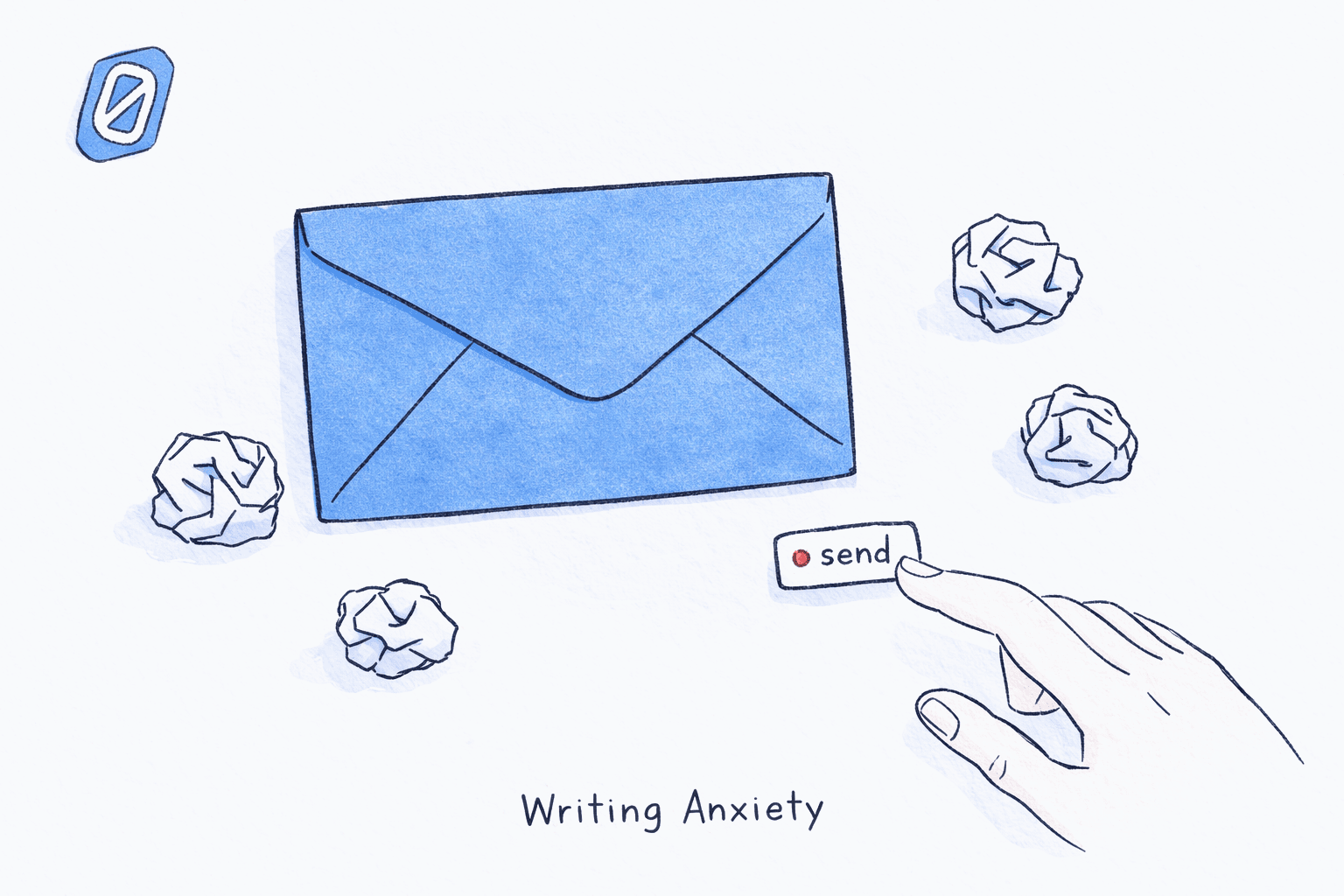
Eighty-eight percent of workers have sent an email they immediately regretted, according to a 2024 Babbel survey of 2,000 U.S. office workers. That number explains something beyond carelessness. It explains why so many people now agonize over every email before sending it. The fear is not irrational. It is learned. You got burned once, and now your brain treats the send button like a loaded weapon.
Email writing anxiety is the specific dread that accompanies composing, editing, and (often failing to) send a message. It is distinct from the inbox stress caused by receiving too many emails. Receiving anxiety is about volume. Writing anxiety is about judgment: the conviction that your words will be misread, your tone will land wrong, or your message will reveal something about you that you cannot take back.
Here is the editorial position that will frame this piece, and it is one the email productivity industry does not want to hear: the problem is not that you are bad at writing emails. The problem is that email asks you to perform socially in a medium stripped of every social cue that makes performance safe. No facial expressions. No vocal tone. No real-time correction. Just text, forever searchable, sent into a void of uncertain interpretation. Of course your drafts folder is a graveyard.
Key Takeaway
Email writing anxiety is driven by a measurable gap between how well you think your tone will land and how well it actually does. Research shows senders overestimate tone accuracy by 25 percentage points. The fix is structural, not motivational: reduce the number of messages that demand careful composition, and the paralysis dissolves.
The idea that email needs a finish line, not just better writing advice, is the lens Swizero was built around. When your inbox surfaces a handful of cards instead of an endless scroll, you are not staring down 40 replies. You are handling a finite set. That constraint matters more than any “tips for better emails” listicle, because the real driver of email writing anxiety is not poor skill. It is unbounded obligation.
Why Do People Overthink Email Replies?#
People overthink email replies because email strips away the nonverbal feedback loops that normally regulate social communication, forcing writers to simulate the reader’s reaction without any data. Overthinking email replies is one of the most visible symptoms of email writing anxiety, and the research explains exactly why it happens. The technical term for this failure is egocentrism over email, and the landmark study on it was published in 2005 by Justin Kruger, Nicholas Epley, Jason Parker, and Zhi-Wen Ng in the Journal of Personality and Social Psychology.
Across five experiments, Kruger and Epley found that email senders believed recipients would correctly interpret their intended tone (sarcastic, serious, funny) about 78% of the time. The actual accuracy rate was 56%. Senders were not slightly optimistic. They were delusional by a margin of 22 percentage points. For context, the same experiments tested voice communication and found a much smaller gap, because vocal inflection carries information that text simply cannot.
“Because e-mail communicators ‘hear’ a statement differently depending on whether they intend to be, say, sarcastic or funny, it can be difficult to appreciate that their electronic audience may not.”
— Justin Kruger, Professor of Marketing, New York University Stern School of Business (Journal of Personality and Social Psychology, 2005)
This gap is the engine of email writing anxiety. You know your tone might be misread. You have experienced it before. So you re-read, revise, agonize, and sometimes abandon the draft entirely. The overthinking is not a personality flaw. It is a rational response to a communication medium that research confirms is unreliable at conveying emotional nuance. If you find yourself overthinking email replies for ten or twenty minutes at a stretch, the Kruger and Epley data suggests you are reacting to a real problem, not an imagined one.
One caveat: the Kruger and Epley study used university students in controlled lab conditions, not professionals in workplace contexts. Real-world email may perform slightly better because of shared context between sender and recipient. But the core finding, that we overestimate how clearly our tone reads in text, has been replicated in multiple studies since.
Perceived vs. Actual Tone Accuracy in Email
Source: Kruger, Epley, Parker & Ng, Journal of Personality and Social Psychology, 2005 (Study 5)
Your brain tells you the message is obviously fine. Research tells you the reader has roughly a coin-flip chance of catching your intended tone. That gap between “it’s clear to me” and “it might not be clear to them” is what keeps the cursor blinking on an unsent draft.
What Is Email Draft Paralysis?#
Email draft paralysis is the inability to finalize and send a composed message, driven by perfectionism, fear of social evaluation, or both. It is what happens when the stakes of sending feel higher than the cost of not sending.
The psychological machinery maps onto a model that Paul Hewitt, Professor of Psychology at the University of British Columbia, and Gordon Flett, Professor of Psychology at York University, have studied for over three decades. Their Multidimensional Perfectionism Scale (1991) distinguishes three types: self-oriented (I demand perfection of myself), other-oriented (I demand it of others), and socially prescribed (I believe others demand it of me).
Socially prescribed perfectionism is the variety most relevant to email writing anxiety. It is the belief that your colleagues, your boss, your clients will judge you harshly for an imperfect message. A meta-analysis by Thomas Curran and Andrew Hill published in Psychological Bulletin in 2019 analyzed data from 41,641 college students between 1989 and 2016 and found that socially prescribed perfectionism has increased by 32% across that period. The generation now entering the workforce believes, more than any previous cohort, that others expect flawlessness from them.
I could write a whole post about the generational angle alone, but the key point here is this: when you stare at a draft for twenty minutes wondering if “Best” or “Thanks” is the right sign-off, you are not being neurotic. You are expressing a culturally reinforced belief that small textual choices carry outsized social consequences. And in an era where emails are forwarded, screenshot-shared, and used as evidence in disputes, that belief is not entirely wrong.
Does Email Writing Anxiety Affect Everyone Equally?#
No. Email writing anxiety disproportionately affects people with higher socially prescribed perfectionism, and generational data shows the gap is widening. Younger workers report the highest rates of email-related stress.
Email composition anxiety, or what researchers call writing apprehension, has been studied for decades. The writing apprehension research tradition began with John Daly and Michael Miller’s 1975 Writing Apprehension Test, which measures a person’s tendency to approach or avoid writing situations accompanied by evaluation. The construct maps directly onto email: every sent message is a written artifact subject to judgment. High-apprehension writers produce shorter texts, avoid writing tasks, and report elevated anxiety when writing is unavoidable.
| Group | Key finding | Source |
|---|---|---|
| Gen Z workers | 53% say email actively stresses them out | ZeroBounce Gen Z Work Report, 2025 |
| Gen Z workers | 1 in 5 “very often” regret emails they send | CNBC / Babbel survey, 2024 |
| Gen Z workers | 60% use email to avoid in-person conflict | ZeroBounce, 2025 |
| All workers | 88% have sent an email they regret | Babbel survey, 2024 |
| High-SPP individuals | 32% increase in socially prescribed perfectionism since 1989 | Curran & Hill, Psychological Bulletin, 2019 |
These numbers paint a clear demographic picture of email writing anxiety. The combination of rising socially prescribed perfectionism and a generation that grew up on instant messaging (where communication is ephemeral and low-stakes) helps explain why email-specific anxiety is rising even as overall email volume has plateaued. The medium itself feels foreign and high-stakes to people who learned to communicate in Snapchat threads.
If email draft paralysis is eating your mornings, Swizero reduces the number of emails competing for your attention to a fixed card limit. Fewer messages demanding replies means fewer drafts to agonize over.
How Do Unsent Drafts Affect Your Mental Load?#
Every unsent draft occupies working memory through the Zeigarnik effect, the well-documented tendency for incomplete tasks to produce intrusive thoughts and cognitive interference. Your drafts folder is not inert storage. It is an active cognitive tax.
Bluma Zeigarnik’s original 1927 experiments showed that subjects remembered interrupted tasks with roughly 90% greater recall than completed ones. Your brain maintains a monitoring process for unfinished goals, keeping them accessible in working memory until resolution. An email you started writing but did not send is, to your brain, an open loop.
E.J. Masicampo, now Associate Professor of Psychology at Wake Forest University, and Roy Baumeister extended this in a 2011 Journal of Personality and Social Psychology paper titled “Consider It Done! Plan Making Can Eliminate the Cognitive Effects of Unfulfilled Goals.” Across five experiments, they showed that specific planning (not vague intention, but concrete plans) eliminates the intrusive thought patterns produced by unfulfilled goals. A draft sitting in your folder without a plan for when you will finalize it will continue to nag your working memory indefinitely.
“The Zeigarnik effect is not just about memory. It is about attentional hijacking. Unfulfilled goals intrude on subsequent cognitive tasks, degrading performance on things that have nothing to do with the original goal.”
— E.J. Masicampo, Associate Professor of Psychology, Wake Forest University (Journal of Personality and Social Psychology, 2011)
Honestly, this is the part of email writing anxiety that nobody talks about. The drafts you abandon do not disappear. They join the background noise of your cognitive life, alongside the 121 other daily emails you are already struggling to decide about. The Zeigarnik load from unsent messages stacks on top of the decision fatigue from triaging incoming ones, creating a compound burden that no amount of “inbox tips” will address.
A longitudinal study by Weigelt and Syrek tracked 59 employees across 12 weeks and found that unfinished tasks at week’s end significantly impaired weekend sleep quality through affective rumination. Incomplete goals maintain elevated cortisol and prevent psychological detachment. Your three unsent drafts from Friday are literally keeping you up on Saturday night.
Can AI Writing Tools Make Email Perfectionism Worse?#
Yes. AI-assisted composition can amplify perfectionism by creating a new comparison target: the polished, fluent draft that AI generates in seconds, which the writer then compulsively edits to make “more human.”
This is the paradox that our testing of AI email writing tools uncovered. A January 2026 Workday study of 3,200 employees found that 37% of AI time savings are consumed by correcting, clarifying, or rewriting AI-generated content. But for people with email writing anxiety, the problem is not just correction. It is comparison.
When AI generates a fluent draft instantly, the perfectionist writer now has two versions to agonize over: their own (which feels inadequate) and the AI’s (which feels impersonal). The editing loop becomes: “This sounds too robotic… but my version sounds worse… but if I edit it too much, why did I use it?”
Peter Cardon, Professor of Business Communication at USC Marshall, found in a 2025 study of 1,100 professionals that supervisors using high levels of AI assistance were perceived as sincere by only 40-52% of recipients, compared to 83% for low-assistance messages. That trust penalty gives the anxious writer one more thing to worry about: not just “Does this sound right?” but “Can they tell a machine wrote this?”
The irony is thick. Tools designed to reduce email writing anxiety can, for anxiety-prone writers, multiply it. The solution is not better AI. It is fewer messages that require agonized composition in the first place. When email notification habits keep pulling you back to draft after draft, the tool amplifying your output also amplifies your anxiety.
What Actually Breaks the Email Writing Anxiety Cycle?#
The evidence points to two interventions: structural constraints that reduce the total number of messages requiring careful composition, and implementation intentions that close the cognitive loops created by unfinished drafts.
The first intervention is the one the productivity industry ignores because it cannot be sold as a feature. If your inbox shows you fewer emails that demand replies, you write fewer replies, and the total surface area for writing anxiety shrinks. This is not avoidance; it is triage. Writing better emails and knowing how to end an email are genuine skills, but skills do not help when the volume of required messages exceeds your cognitive capacity.
The second intervention comes from Masicampo and Baumeister’s research. If you cannot send a draft right now, make a concrete plan: “I will revise this Tuesday at 10am and send it by 10:15.” The plan, not the completion, satisfies the brain’s monitoring system. The Zeigarnik intrusions quiet down.
A practical three-step protocol:
-
Set a composition time limit. The average email takes 5.5 minutes to compose. Give yourself a ceiling of 8 minutes for important messages. When the timer expires, the draft is done. Perfectionism thrives on unlimited revision time. Remove the runway and the plane still lands.
-
Name the fear explicitly. If you are afraid to send email because of past tone misreads or social consequences, cognitive behavioral therapy research can help. NICE recommends CBT as a first-line treatment for anxiety disorders, and the approach works here too: labeling the specific worry (“I’m afraid they’ll think I’m incompetent”) reduces its emotional charge. The fear becomes a thought to examine rather than a feeling to obey.
-
Reduce the reply surface. This is where structural design matters more than self-discipline. An inbox that surfaces a fixed card limit of prioritized messages means you reply to what matters and clear the rest. You do not compose 40 carefully worded messages. You compose a handful. The constraint does the work that willpower cannot.
Frequently Asked Questions#
Below are the questions people most often ask about email writing anxiety, answered with the research cited in this article.
Is email writing anxiety the same as email anxiety?#
Email writing anxiety is a subset of broader email anxiety. General email anxiety, also called workplace telepressure, encompasses stress from receiving, monitoring, and responding to email. Email writing anxiety refers specifically to the fear, perfectionism, and avoidance associated with composing and sending messages. A person can experience one without the other: some people feel calm about writing but dread the incoming flood, while others handle high volume fine but freeze when drafting important replies.
Why do I keep re-reading emails before I send them?#
Re-reading before sending is a compensatory behavior driven by the awareness, often unconscious, that email tone is unreliable. The Kruger and Epley 2005 study showed that senders overestimate how accurately recipients will interpret their intended tone by roughly 22 percentage points. Re-reading is your brain’s attempt to close that accuracy gap. The problem is that you cannot hear what your reader will hear, so additional re-reads produce diminishing returns after the first or second pass.
Can perfectionism cause email procrastination?#
Yes. Research by Hewitt and Flett on multidimensional perfectionism shows that socially prescribed perfectionism, the belief that others demand flawlessness from you, predicts both procrastination and avoidance behavior. When applied to email, this manifests as delaying replies, over-editing drafts, and in severe cases, abandoning messages entirely. The Curran and Hill 2019 meta-analysis found that socially prescribed perfectionism rose 32% between 1989 and 2016.
Do unsent email drafts cause stress?#
Yes. The Zeigarnik effect, first documented in 1927, demonstrates that incomplete tasks occupy working memory and produce intrusive thoughts. An unsent draft functions as an open cognitive loop. Research by Masicampo and Baumeister (2011) showed that making a specific plan for when to complete the task eliminates these intrusions, even without actually finishing the task. The practical implication: schedule a send time for your draft, and your brain will treat it as resolved.
Does AI make email writing anxiety better or worse?#
It depends on the person. For routine messages (confirmations, scheduling, acknowledgments), AI tools reduce writing friction. For anxious writers composing important messages, AI can worsen perfectionism by creating a comparison target: the AI draft versus their own voice. A 2025 USC Marshall study found that high AI assistance reduced perceived sincerity to 40-52%, giving anxious writers an additional worry about whether recipients can detect machine authorship.
Sources#
- Egocentrism Over E-Mail: Can We Communicate as Well as We Think?. Kruger, Epley, Parker & Ng, Journal of Personality and Social Psychology, 2005. Senders overestimated tone accuracy by 22 percentage points.
- Perfectionism Is Increasing Over Time: A Meta-Analysis of Birth Cohort Differences from 1989 to 2016. Curran & Hill, Psychological Bulletin, 2019. Socially prescribed perfectionism increased 32% across 41,641 students.
- Consider It Done! Plan Making Can Eliminate the Cognitive Effects of Unfulfilled Goals. Masicampo & Baumeister, Journal of Personality and Social Psychology, 2011. Concrete planning eliminates Zeigarnik intrusions.
- 88% of Workers Have Sent an Email They Regret. CNBC / Babbel survey of 2,000 U.S. office workers, 2024.
- Gen Z at Work Report. ZeroBounce, 2025. 53% of Gen Z say email stresses them out; 60% use email to avoid conflict.
- The Empirical Development of an Instrument to Measure Writing Apprehension. Daly & Miller, 1975. The Writing Apprehension Test established writing anxiety as a measurable construct.
- AI-Assisted Emails May Put Trustworthiness at Risk in Workplace Communications. Cardon & Coman, International Journal of Business Communication, 2025. High AI usage reduced perceived sincerity to 40-52%.
- New Workday Research: Companies Are Leaving AI Gains on the Table. Workday, 2026. 37% of AI time savings lost to rework.
- Multidimensional Perfectionism Scale. Hewitt & Flett, 1991. Three-factor model of perfectionism: self-oriented, other-oriented, socially prescribed.
- Perfectionism and Maladjustment. Hewitt & Flett. Overview of perfectionism’s link to procrastination, anxiety, and avoidance.
Your inbox doesn't have to feel like this.
Email with a beginning, middle, and end.
Make email a bounded session