Email Anxiety Raises Your Cortisol. Here's What Actually Works
By Chris Stefaner, Co-founder of Swizero
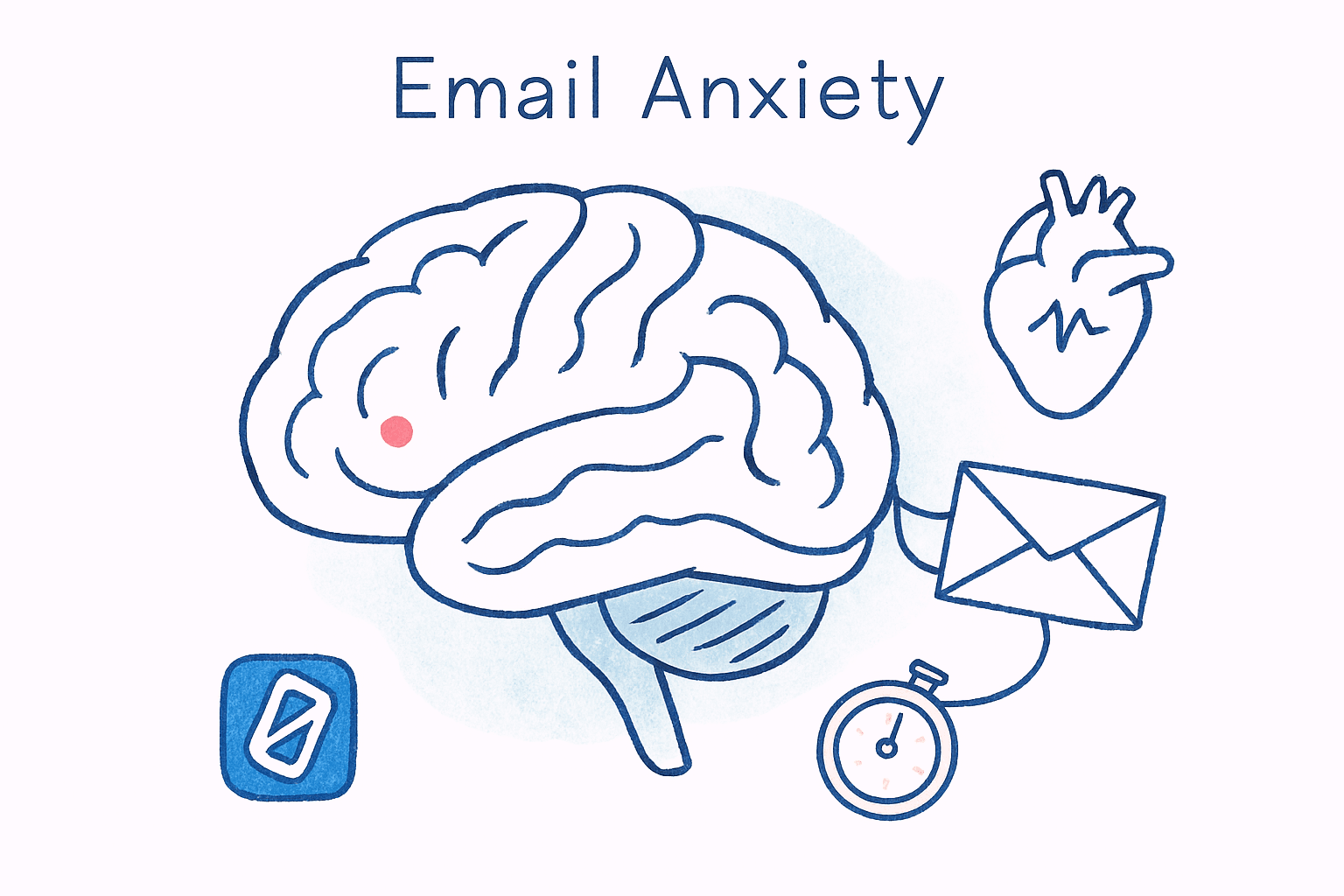
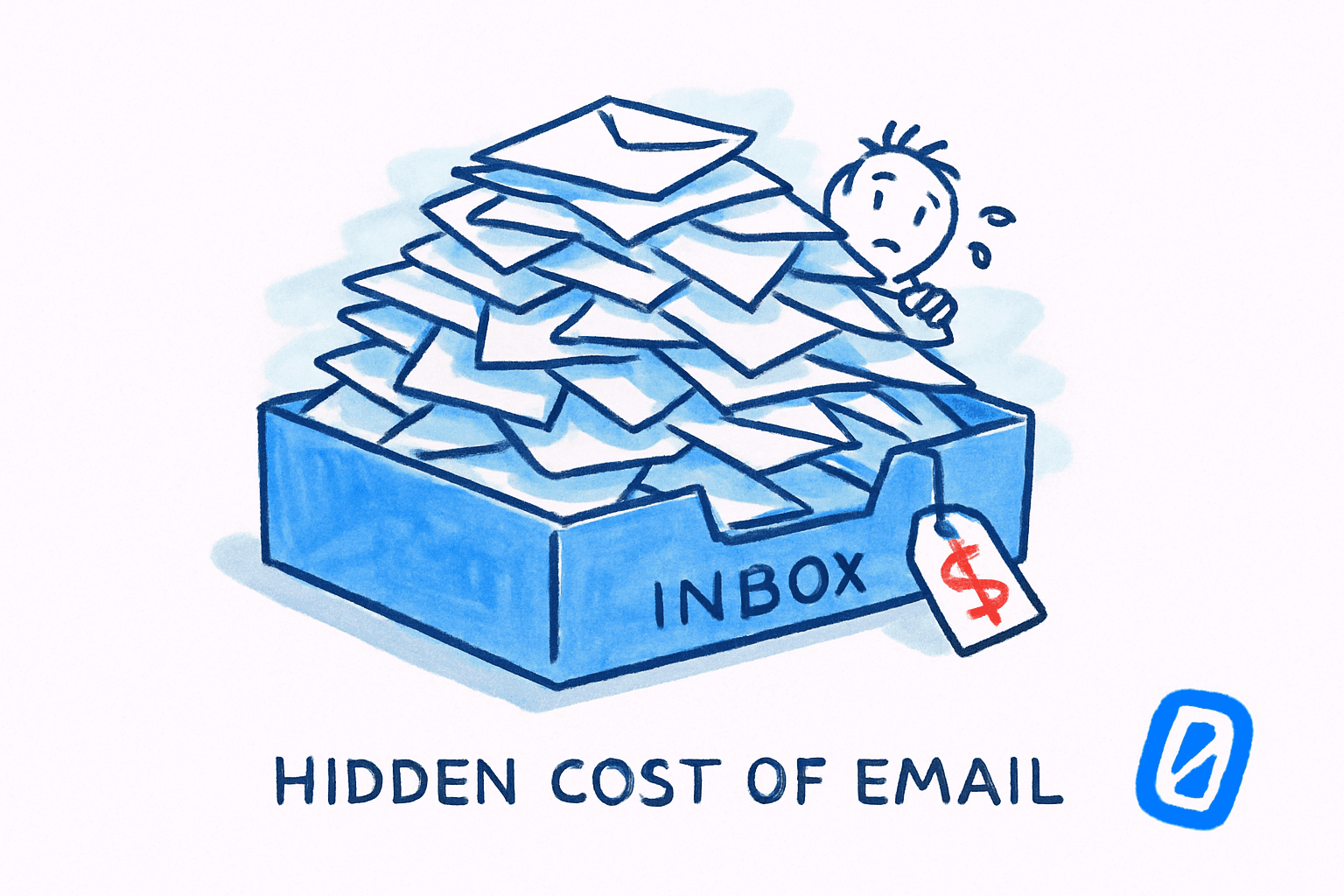
There is a clinical name for what happens to your body when you see “247 unread” at the top of your inbox, and it has nothing to do with your to-do list. It is workplace telepressure, the urge to respond promptly to message-based communications, and a 2015 study published in the Journal of Occupational Health Psychology by Larissa Barber and Alecia Santuzzi found that it independently predicts burnout, sleep disruption, and absenteeism, even after controlling for workload, job involvement, and personality.
Most articles about email anxiety treat it as an attitude problem: be calmer, set boundaries, log off. The research treats it as a physiological state with a measurable signature. Cortisol rises. Heart rate variability flattens. The amygdala learns to scan the inbox the way a deer scans a treeline.
Key Takeaway
Email anxiety is best understood as a subclinical stress disorder driven by workplace telepressure (a measurable construct linked to burnout, insomnia, and chronic cortisol elevation). The most evidence-based interventions are not “turn off notifications” but structural: completion intentions, psychological detachment, and inboxes that signal “done” by design.
This post takes email anxiety seriously as a health issue, not a vibe. The fix has very little to do with willpower and almost everything to do with whether your inbox has a finish line.
Is Email Anxiety a Real Clinical Construct?#
Email anxiety is not a formal DSM-5 diagnosis, but it maps cleanly onto a validated occupational psychology construct called workplace telepressure, with measurable effects on burnout, sleep, and absenteeism. The casual way people use the phrase “email anxiety” hides a more rigorous reality. The construct that researchers actually study is workplace telepressure, formalized by Larissa Barber, Professor of Psychology at San Diego State University, and Alecia Santuzzi, Professor at Northern Illinois University, in their 2015 Journal of Occupational Health Psychology paper. They defined it as “a strong urge to be responsive to others through message-based communications, combined with a preoccupation with fast response times.”
This is not the same as having a lot of work. The Barber and Santuzzi scale isolates the urge itself: the compulsive checking, the mental rehearsal of replies, the inability to let an unread message rest. In their original validation studies, telepressure predicted physical and cognitive burnout, poorer sleep quality, and higher absenteeism over and above job involvement, affective commitment, and general technology overload.
“Workplace telepressure is qualitatively different from working long hours. It is a preoccupation, a kind of mental hijacking by the inbox even when you are not actively working.”
— Larissa Barber, Professor of Psychology, San Diego State University (Journal of Occupational Health Psychology, 2015)
A 2025 ZeroBounce Gen Z workplace report surveying workers in the U.S. and U.K. found that 53% of Gen Z respondents say email actively stresses them out, with British Gen Z workers reporting higher email-driven stress (61%) than American counterparts (50%). This aligns with the broader data in our 2026 email statistics roundup, which shows 68% of all knowledge workers now cite email as a burnout contributor. This sits inside a broader pattern documented in our analysis of how often you should actually check email: the volume of email people receive has decoupled from the cognitive bandwidth they have to process it. The same survey found that 60% of Gen Z workers admit using email specifically to avoid in-person conversations they find anxiety-provoking, a coping pattern that resembles avoidance behaviors documented in social anxiety research.
Honestly, the most striking thing about that statistic is not the percentage. It is the fact that a generation raised on instant messaging finds asynchronous text more stressful than synchronous voice. The inbox is doing something to people that other channels are not.
What Does Workplace Telepressure Actually Do to Your Body?#
Workplace telepressure produces measurable physiological changes (flattened heart rate variability, elevated cortisol, and disrupted sleep architecture) that mirror the early stages of chronic stress disorders. It is not a metaphor.
Field studies have used physiological monitoring to confirm this. The most cited evidence comes from a 2012 UC Irvine field study led by Gloria Mark, Professor of Informatics at UC Irvine, in collaboration with Stephen Voida (then at UCI) and Armand Cardello of the U.S. Army Research Center. The team attached heart rate monitors to office workers and tracked window-switching behavior with software sensors. Workers who used email throughout the day showed flattened heart rate variability, a “high alert” steady state associated with elevated cortisol. Workers who were cut off from email for five business days showed natural, variable heart rates within days. The vacation worked at the level of the autonomic nervous system, not just self-report.
The most rigorous extension of this work is a 2024 study in the Journal of Personnel Psychology that surveyed 158 onsite and 284 remote workers. Telepressure was negatively related to all four recovery experiences identified by Sabine Sonnentag’s well-known recovery model: psychological detachment, relaxation, mastery, and control. In other words, the more telepressure a worker reported, the less able they were to experience rest, even when nominally not working. Recovery is not what happens when you stop typing. Recovery is what happens when your nervous system stops monitoring.
A 2024 paper in PsyCh Journal by He and colleagues went further: it found that dispositional workplace anxiety amplifies after-hours telepressure specifically in workers whose self-worth is tied to others’ approval. The vulnerability factor is not your job. It is the intersection of an anxious temperament and a workplace that codes responsiveness as virtue.
Why Does “Just Turn Off Notifications” Fail as a Treatment?#
Notification suppression targets the alert layer of the problem, not the underlying monitoring state. Removing the buzz does not remove the brain’s anticipatory scanning, which is the actual driver of anxiety. Understanding how AI email assistants actually work under the hood reveals why most AI features share the same blind spot: they optimize individual message handling without addressing the monitoring state that makes the inbox stressful in the first place. The standard internet advice for email anxiety is to disable notifications, batch-check, and “log off” after work. This advice is not wrong. It is just hopelessly incomplete, because it targets the wrong layer of the problem.
Notifications are the surface symptom. The deeper mechanism is what psychologists call anticipatory anxiety: the brain’s response not to a threat that has arrived, but to a threat that might arrive. Removing notifications removes the alert. It does not remove the monitoring state. A person who knows their inbox contains 200 unread items will mentally check it whether or not their phone buzzes. The buzz is just the part you can see.
Interventions framed as “habits” tend to relapse for the same reason, a point we have made in our piece on breaking the email notification addiction. They ask the prefrontal cortex to override a limbic system that has been trained to associate the inbox with uncertainty. Anyone who has tried to “just stop checking” knows how that ends. The inbox wins because the inbox has structural advantages: it is infinite, it is unpredictable, and its rewards are intermittent. That is the exact recipe behavioral psychology identifies as the most addictive reinforcement schedule there is.
If you have read our piece on the cognitive cost of an endless inbox, you already know about the chronic stress profile. The part that essay did not cover, and that the rest of this article will, is the specific cognitive mechanism that makes email a uniquely sticky stressor: it is a goal that never reaches completion.
If your nervous system has been on inbox-watch for years, Swizero is built around a different premise: a fixed card limit per session means email actually ends. Your amygdala stops scanning because there is nothing left to scan.
The Cognitive Mechanism: Open Loops and Completion Intentions#
The reason your inbox occupies mental bandwidth even when you are not looking at it traces back to a finding from 1927, and an extension from 2011 that almost nobody references in productivity writing.
The 1927 finding is the Zeigarnik effect, named after Soviet psychologist Bluma Zeigarnik, who observed that her colleagues remembered the orders of customers they had not yet served far better than orders they had completed. Unfinished tasks lodge in working memory and stay there. Email is, structurally, an unbounded set of unfinished tasks.
The 2011 extension is more interesting. E.J. Masicampo, then at Florida State University, and Roy Baumeister published a paper in the Journal of Personality and Social Psychology titled “Consider it done! Plan making can eliminate the cognitive effects of unfulfilled goals.” Across five experiments, they showed that participants with unfinished goals exhibited the classic Zeigarnik intrusions, but those intrusions disappeared when participants made a specific implementation plan, even if the goal itself remained incomplete.
“The plan, not the completion, was sufficient to satisfy the monitoring process. The brain treats an anchored intention nearly the same as a resolved one.”
— E.J. Masicampo, Associate Professor of Psychology, Wake Forest University (Journal of Personality and Social Psychology, 2011)
This is the most important under-cited finding in the email anxiety literature. The brain does not need an empty inbox to stop ruminating. It needs a credible signal that the open loop has been closed, whether through completion or through a concrete plan that the loop is being managed.
This is also why “I’ll get to it later” does not work, but “I will process the next batch tomorrow at 9 a.m.” does. The first is avoidance. The second is what Masicampo calls a completion intention, and it has measurable effects on intrusive thought frequency.
What Actually Reduces Email Anxiety: Four Evidence-Based Interventions#
The research-backed interventions for email anxiety cluster into four categories. Notice that “checking less often” is a feature of all of them but is never the active ingredient on its own.
1. Build a Completion Signal Into Your Workflow#
Masicampo and Baumeister’s research suggests the highest-leverage intervention is creating a credible “done” signal. Practically: define what counts as a finished email session before you open your inbox. A fixed time window works (“30 minutes, then I close the app”). A fixed batch size works better (“clear this stack of cards, then I am done”). The vague intention “I’ll handle email today” does not work, because it never produces a completion event the brain can register.
This is why fixed-quantity systems outperform time-based ones in practice. A 30-minute timer can end with the inbox in any state. A finite stack of cards ends in exactly one state: empty. The closure is built into the geometry of the task.
2. Engineer Psychological Detachment, Not Just Disconnection#
Sabine Sonnentag, Professor of Work and Organizational Psychology at the University of Mannheim, has spent two decades documenting what she calls the four recovery experiences: psychological detachment, relaxation, mastery, and control. The 2024 Journal of Personnel Psychology study found that telepressure undermines all four, but psychological detachment is the one that mediates most strongly toward burnout outcomes.
Detachment is not the same as not checking. Detachment means your brain has actually relinquished the monitoring state. The most effective tactic for engineering detachment, per Sonnentag’s research, is a transition ritual: a specific physical or cognitive action that reliably ends the work mode. A walk. Closing the laptop with intent. A handover note to your future self. This is not woo. It is a signal to your nervous system that the watch shift is over.
3. Decouple Your Self-Worth From Response Speed#
The 2024 PsyCh Journal study found that telepressure after hours is amplified specifically in workers whose self-worth depends on others’ approval. This is not a moral failing. It is a measurable cognitive style, and the same study found that interventions targeting response norms at the team level (rather than individual willpower) reduced telepressure even in high-vulnerability employees.
The practical translation: a private rule like “I will not reply after 7 p.m.” rarely sticks because it leaves the social pressure intact. A team-level norm like “we don’t expect responses outside business hours and we model it from the top” works because it removes the perceived audience. If you cannot change team norms, the next best lever is replacing self-imposed urgency with explicit response time agreements (“I reply to non-urgent email within 24 hours”).
4. Use Asymmetric Channel Design#
A pattern in the after-hours email research, including the work we summarized on after-hours email boundaries, is that mixing urgent and non-urgent traffic on a single channel keeps the entire channel in high-alert mode. The fix is structural: assign a different channel (a phone call, a dedicated emergency thread) for genuine urgencies, and let email lose its urgency status entirely. Once email is not the emergency channel, the compulsion to monitor it relaxes. Not because you decided to relax, but because your threat-detection system has been given accurate information.
| Intervention | Mechanism | Evidence Strength | Common Failure Mode |
|---|---|---|---|
| Notification suppression | Removes alert | Moderate | Ignores anticipatory anxiety |
| Batched checking | Limits exposure | Strong (Kushlev & Dunn, 2015) | Doesn’t close loops |
| Completion intentions | Closes Zeigarnik loops | Strong (Masicampo & Baumeister, 2011) | Requires structural support |
| Transition rituals | Engineers detachment | Strong (Sonnentag program of research) | Easy to skip |
| Team-level norms | Removes social audience | Moderate (He et al., 2024) | Requires leadership buy-in |
| Channel separation | Removes urgency status | Anecdotal/practitioner | Hard to enforce |
I want to flag a limitation here. The recovery experiences literature is dominated by self-report measures, and the physiological work (Mark et al., HRV studies) tends to use small samples in laboratory or short-term field settings. We have strong convergent evidence across methods, but no single trial that ties together telepressure, cortisol, sleep architecture, and clinical anxiety scores in a longitudinal cohort. That study is overdue.
Where Swizero Fits Into This#
The Swizero thesis on email is not that you need better notifications, smarter sorting, or AI replies (though we have those). It is that email needs a finish line: a structural completion signal that lets your nervous system actually power down.
A fixed card limit per session is, in Masicampo’s language, a built-in completion intention. The inbox does not just have an arbitrary stopping point. It has an architectural one. You process a handful of cards. You finish. The session ends. The Zeigarnik loop closes. This is not a behavioral hack you have to maintain through willpower; it is a property of the tool.
We have written elsewhere about why every email app is solving the wrong problem. The industry has spent two decades building faster ways to manage infinity. The right intervention, as the anxiety research keeps showing, is not faster infinity. It is a smaller, completable shape.
Frequently Asked Questions#
Is email anxiety a real diagnosable condition?#
Email anxiety is not a standalone DSM-5 diagnosis. It is best understood as a workplace-specific manifestation of subclinical anxiety, formally measured through the workplace telepressure scale developed by Barber and Santuzzi in 2015. Telepressure has been validated as a predictor of burnout, sleep disruption, and absenteeism distinct from general workload.
Can email cause clinical anxiety disorders?#
The evidence is correlational, not causal. Studies show strong associations between high telepressure and elevated cortisol, reduced heart rate variability, and burnout symptoms. For workers with predisposing factors (dispositional workplace anxiety, approval-contingent self-worth), chronic telepressure can plausibly contribute to clinical anxiety, though no longitudinal study has yet demonstrated direct causation.
Why does email feel more stressful than other forms of communication?#
Email combines three properties that maximize anticipatory anxiety: it is asynchronous (so threats can arrive at any time), it is unbounded (no natural endpoint), and its rewards are intermittent (most messages are routine, but some are critical). This matches the reinforcement schedule that behavioral research identifies as the most psychologically sticky.
Does turning off notifications actually reduce email anxiety?#
Modestly. A 2024 study in the Journal of Personnel Psychology found that notification suppression helps but does not address the underlying monitoring state. The intervention with the strongest evidence is creating a clear completion signal (a fixed end to email sessions) combined with psychological detachment rituals afterward.
Is email anxiety worse for remote or in-office workers?#
A 2024 study comparing 158 onsite and 284 remote workers found that telepressure undermined recovery experiences for both groups, but the effect was stronger among onsite workers. Remote work appears to provide some buffer, possibly through environmental separation. However, remote workers also report higher overall after-hours email volume.
Sources#
- Please Respond ASAP: Workplace Telepressure and Employee Recovery. Barber, L.K. & Santuzzi, A.M., Journal of Occupational Health Psychology, 2015. Original validation of the workplace telepressure construct and scale.
- Consider It Done! Plan Making Can Eliminate the Cognitive Effects of Unfulfilled Goals. Masicampo, E.J. & Baumeister, R.F., Journal of Personality and Social Psychology, 2011. Completion intentions eliminate Zeigarnik intrusions.
- “Always Online”: How and When Task Interdependence and Dispositional Workplace Anxiety Affect Workplace Telepressure After Hours. He et al., PsyCh Journal, 2024. Approval-contingent self-worth amplifies after-hours telepressure.
- Telepressure and Recovery Experiences Among Remote and Onsite Workers. Journal of Personnel Psychology, 2024. Survey of 442 workers; telepressure negatively related to all four Sonnentag recovery experiences.
- Jettisoning Work Email Reduces Stress. Mark, G., Voida, S. & Cardello, A., UC Irvine, 2012. Heart rate variability flattens with email exposure; recovers without it.
- Gen Z at Work: The 2025 ZeroBounce Report. ZeroBounce, 2025. 53% of Gen Z workers say email stresses them out; 60% use email to avoid in-person conversations.
- Workplace Telepressure and Worker Well-Being: The Intervening Role of Psychological Detachment. Santuzzi, A.M. & Barber, L.K., 2018. Detachment as the key mediator from telepressure to burnout.
Your inbox doesn't have to feel like this.
Email with a beginning, middle, and end.
Make email a bounded session