Email Multitasking Is a Myth: Your Brain Proves It
By Chris Stefaner, Co-founder of Swizero
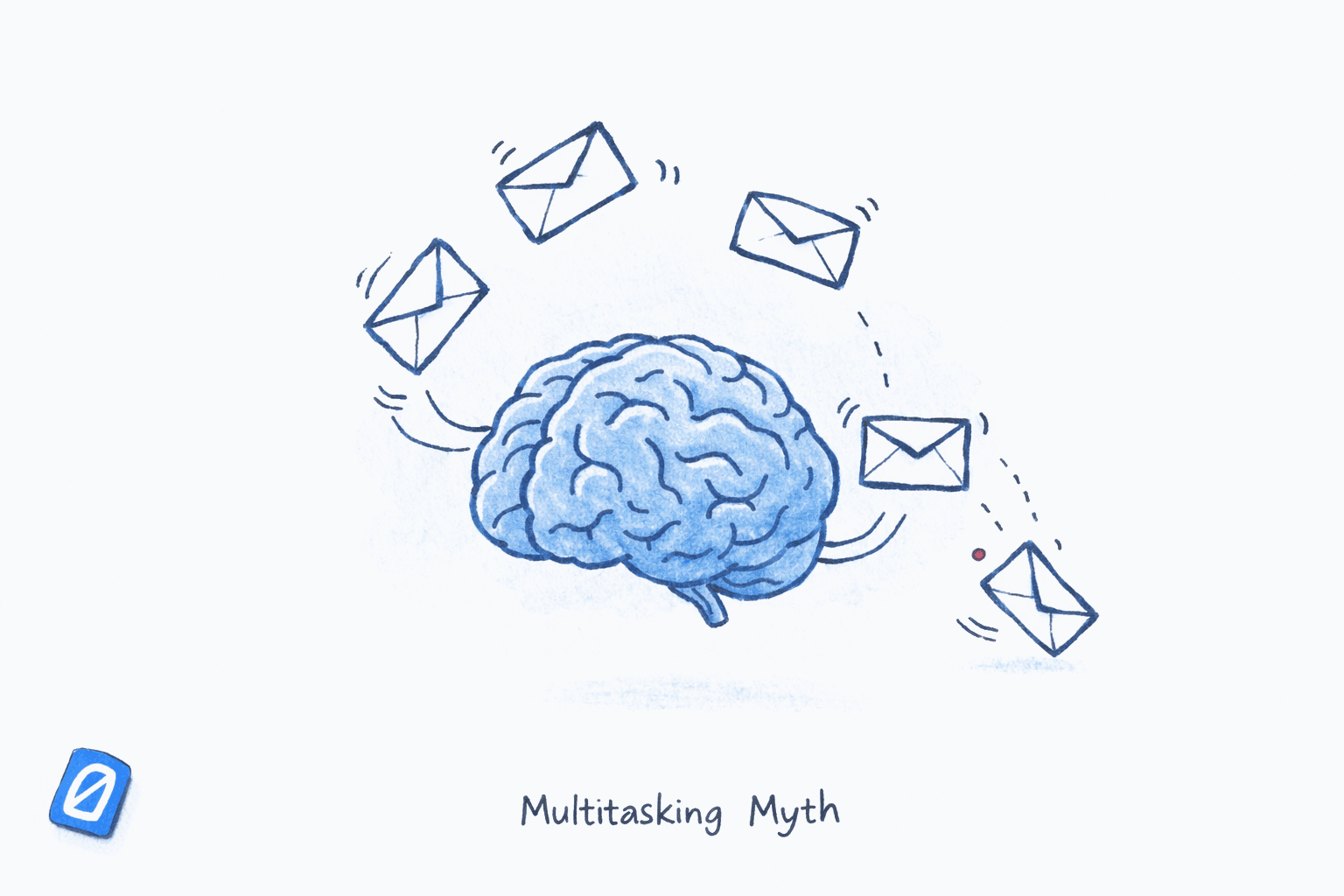
You cannot read an email and think about your project at the same time. Not poorly, not partially. You literally cannot do it. The email multitasking myth persists because the switching happens so fast that it feels simultaneous, like a film projector flipping between frames quickly enough to simulate motion. But your prefrontal cortex isn’t projecting a movie. It’s running one task, stopping, reconfiguring, and then running the next. Every toggle between your inbox and your work carries a measurable cost in time, accuracy, and cognitive capacity.
This is not the same as the ambient cognitive weight of leaving email open in a background tab. That’s a different problem (cognitive load). And it’s not the same as being worn down by 121 reply-or-delete choices per day. That’s decision fatigue. The email multitasking myth is something more specific and more damaging: the belief that you can process email and do focused work in parallel, when your brain is physically incapable of parallel processing for tasks that require attention.
Key Takeaway
The email multitasking myth is disproven by neuroscience: toggling between email and focused work triggers “dual-task interference,” a bottleneck in your prefrontal cortex that forces serial processing. Research by Rubinstein, Meyer, and Evans found that task switching can cost up to 40% of productive time, and the penalty grows with task complexity.
Why Can’t You Actually Multitask Email?#
The short answer, and the reason the email multitasking myth falls apart under scrutiny: your brain has a bottleneck, and email sits right in it.
In 2001, researchers Joshua Rubinstein, David Meyer, and Jeffrey Evans published a landmark study in the Journal of Experimental Psychology: Human Perception and Performance that dissected exactly what happens when you try to do two things at once. They identified two distinct stages of mental reconfiguration that must occur every time you switch tasks. The first is goal shifting (“I’m going to read this email now instead of writing this report”). The second is rule activation (“I’m turning off the rules for report-writing and turning on the rules for email-reading”). Both stages take time. Neither can be skipped.
Across four experiments, Rubinstein, Meyer, and Evans found that switching costs increased reliably with the complexity of the tasks involved. Simple switches cost tenths of a second. Complex switches, the kind that look like toggling between a financial model and an email thread about staffing, cost significantly more. Meyer estimated that these accumulated switching costs can consume up to 40% of someone’s productive time.
Forty percent. That number alone should dispel the email multitasking myth. That’s not a rounding error. For a knowledge worker putting in an eight-hour day, that’s 3.2 hours dissolved into the gaps between tasks.
I should note a caveat here: that 40% figure represents an upper bound from controlled experiments, not a typical office measurement. Real-world losses vary depending on how often you switch and how complex your work is. But even conservative estimates put the cost at 20-25% of productive time, which is still an enormous daily tax.
What Happens Inside Your Brain During a Task Switch?#
Understanding the neural mechanics makes the email multitasking myth impossible to ignore. A 2025 study published in Nature Communications used ultrafast 7-Tesla fMRI scanning to watch dual-task interference happen in real time. The researchers found that the fronto-parietal multiple-demand network, a web of brain regions spanning the lateral prefrontal cortex and the intraparietal cortex, constitutes a serial bottleneck. Sensory processing for two tasks can run somewhat in parallel in early visual and auditory regions. But the moment both tasks require executive attention, processing becomes sequential.
Your brain queues the second task like a print job waiting for the printer.
This bottleneck is architectural. It is not a matter of practice or willpower. The lateral prefrontal cortex, which handles working memory, rule application, and goal management, cannot run two rule sets simultaneously. When you glance at an email while writing a paragraph, you don’t add email processing on top of writing processing. You stop writing processing, execute the email processing, then attempt to restart the writing. Each restart costs you.
The Attention Residue Problem: Why the Cost Outlasts the Switch#
Sophie Leroy, a researcher at the University of Washington, coined the term “attention residue” in her 2009 study published in Organizational Behavior and Human Decision Processes. Her finding was disarmingly simple and deeply inconvenient: when you switch from Task A to Task B, part of your attention stays stuck on Task A. This residue persists even after you’ve consciously moved on, and it degrades your performance on Task B.
The implications for email are severe. Consider what happens when you check your inbox mid-task. You scan the subject lines. One of them mentions a deadline. Another is from your manager. You don’t reply to either. You close the tab and return to your work. But your prefrontal cortex is still processing those subject lines, running low-level threat assessments, wondering whether you should have replied. That’s attention residue, and Leroy’s experiments showed it has a measurable negative impact on subsequent task performance.
“People need to stop thinking about one task in order to fully transition their attention and perform well on another,” Leroy wrote. “Yet results indicated it is difficult for people to transition their attention away from an unfinished task.”
Email is almost always an unfinished task. You rarely reach a state of completion with your inbox. So the residue never fully clears, and the email multitasking myth keeps costing you even after you close the tab.
Do Heavy Email Multitaskers Get Better at It Over Time?#
No. They get worse. This is perhaps the most counterintuitive dimension of the email multitasking myth.
In 2009, Eyal Ophir, Clifford Nass, and Anthony Wagner at Stanford ran a now-famous study comparing heavy media multitaskers to light media multitaskers on standard cognitive control tasks. The expectation was that heavy multitaskers, people who regularly juggle multiple information streams, would show some advantage from all that practice.
The opposite was true. Heavy multitaskers were more susceptible to interference from irrelevant stimuli, slower at filtering distractions, and worse at switching between tasks, the very skill they practiced most. They showed more false alarms in working memory tests and larger switch costs in task-switching paradigms.
“People who are regularly bombarded with several streams of electronic information do not pay attention, control their memory, or switch from one job to another as well as those who prefer to complete one task at a time,” the Stanford research team reported.
Honestly, this was the finding that changed my thinking about email. I always assumed that constantly checking my inbox was making me faster at processing it. The Stanford data suggests the opposite: the habit of toggling between email and work may actually be eroding the cognitive control I need to process either one effectively.
If the constant toggle between inbox and work resonates, Swizero reduces your entire inbox to a fixed card limit, so processing email becomes a finite task you finish rather than an open stream you monitor.
How Much Time Does Email Multitasking Actually Cost?#
Once you accept the email multitasking myth for what it is, the natural next question is: how big is the damage? Gloria Mark, Professor of Informatics at UC Irvine and author of Attention Span, has spent over two decades measuring what happens when knowledge workers get interrupted. Her research found that it takes an average of 25 minutes to fully re-engage with a task after an interruption. And workers now spend an average of just 47 seconds on any single screen before shifting attention.
Those 47 seconds matter. At that pace, a person switches roughly 600 times in an eight-hour workday. Not all of those switches are email, but a 2022 survey by Qatalog and Cornell University’s Idea Lab found that workers lose an average of 9.5 minutes of productive flow every time they switch between digital apps, with 45% of respondents saying the constant switching was actively harming their productivity.
The math gets uncomfortable quickly:
| Metric | Value | Source |
|---|---|---|
| Average screen attention span | 47 seconds | Gloria Mark, Attention Span, 2023 |
| Recovery time after interruption | 25 minutes | Mark, Gudith & Klocke, CHI 2008 |
| Productive time lost to switching | Up to 40% | Rubinstein, Meyer & Evans, 2001 |
| Workers who say switching hurts output | 45% | Qatalog & Cornell Idea Lab, 2022 |
| Time lost per app switch | 9.5 minutes | Qatalog & Cornell Idea Lab, 2022 |
One thing this table doesn’t capture is the compounding nature of these losses. The 25-minute recovery and the 9.5-minute flow disruption don’t simply add together. They interact. If you check email, lose 9.5 minutes of flow, partially recover, then check email again 20 minutes later, you never complete a full recovery cycle. You operate in a chronic state of partial attention.
Can You Multitask Email if You’re Really Disciplined About It?#
People often ask: can you multitask email effectively if you’re just disciplined enough? No, and the question itself reveals the myth. Discipline is a goal-management function, which is handled by the same prefrontal cortex that’s already bottlenecked during task switching. Trying to use willpower to overcome the dual-task interference problem is like trying to fix a traffic jam by driving more aggressively. You’re adding load to the system that’s already overloaded.
What you can do is stop pretending you’re multitasking and start batching instead. The distinction matters: multitasking email productivity is an oxymoron, but sequential email processing, doing email as a discrete task in defined windows, sidesteps the switching cost entirely. When you batch, you’re not switching between email and work. You’re finishing work, then doing email, then returning to work. Each transition still carries a cost, but you pay it twice per session instead of fifty times.
Research from Kushlev and Dunn at the University of British Columbia confirmed that people who checked email in batches (three times per day) reported significantly lower stress and higher well-being than those who checked continuously. The batchers didn’t miss anything important. They simply paid the switching tax less often.
This is the principle behind Swizero’s design. Rather than leaving email as an ambient, always-available stream, Swizero constrains it to a fixed card limit. You open the app, process your cards, and you’re done. The act of finishing prevents the very condition that makes dual-task interference email so costly: the perpetual sense of an unfinished task pulling at your attention.
Why Is the Email Multitasking Myth So Persistent?#
If the email and attention research is this clear, why does the email multitasking myth endure? Partly because three separate problems get lumped together. I could write an entire post about attention residue alone (and we’ve covered the notification side of it), but it’s worth drawing a clean line between three related but distinct problems:
Dual-task interference (this post): The performance cost of toggling between email and focused work. The mechanism is a bottleneck in executive control. The solution is to stop switching.
Cognitive load (the “open tab” problem): The ambient mental weight of knowing email is accumulating, even when you’re not looking at it. The mechanism is working memory allocation. The solution is containment.
Decision fatigue (the “choice machine” problem): The degradation of decision quality after making too many reply-or-delete choices. The mechanism is ego depletion (contested) or resource allocation. The solution is fewer decisions per session.
Most people experience all three simultaneously, which is why email feels so uniquely draining. But they require different interventions. You can’t fix dual-task interference by making your inbox less stressful. You fix it by not being in your inbox while you’re trying to do something else.
What the Email and Attention Research Actually Recommends#
Across the literature, from Rubinstein’s switching experiments to Mark’s interruption studies to Leroy’s attention residue work, the recommendations converge on a surprisingly small set of practices:
Process email in defined blocks. Not “check email less” (that’s too vague), but designate 2-3 windows per day and process to completion during each window. This eliminates the partial-processing problem that generates attention residue.
Close the tab between blocks. If email is visible, you will read it. If you read it, you’ve initiated a switch. The only way to prevent the switching cost is to prevent the switch.
Make email finite. An open-ended inbox invites continuous monitoring. A constrained inbox, one with a clear end state, lets your prefrontal cortex register completion. Leroy’s research suggests that completion signals are what finally release attention residue.
Protect your first productive hours. Mark’s data shows that screen attention spans have shrunk to 47 seconds on average. The morning, before the first email check, is when your executive control system is freshest. Spending those first hours on your hardest cognitive work, before triggering any switching costs, is the single highest-leverage change most people can make.
Frequently Asked Questions#
Is email multitasking actually impossible, or just inefficient?#
Can you multitask email at all? It depends on what you mean by “multitasking.” If you mean processing two attention-demanding tasks simultaneously, neuroscience says it is impossible. Your prefrontal cortex processes executive tasks serially, not in parallel. What feels like multitasking is actually rapid switching, and research by Rubinstein, Meyer, and Evans shows that each switch carries a measurable time and accuracy cost.
How much productivity do you lose from switching between email and work?#
Estimates range from 20% to 40% of productive time, depending on switching frequency and task complexity. The 40% upper bound comes from APA-cited research by Meyer and colleagues. A 2022 Qatalog and Cornell survey found workers lose 9.5 minutes of productive flow per app switch, and 45% of workers say constant switching directly harms their output.
Does checking email in batches really reduce the switching cost?#
Yes, and batching is the most practical antidote to the email multitasking myth. A 2015 study by Kushlev and Dunn at UBC found that limiting email to three daily batches significantly reduced stress and improved self-reported well-being compared to continuous checking. Batching doesn’t eliminate switching costs entirely, but it reduces the number of switches from dozens per hour to a few per day.
Why don’t heavy multitaskers get better at switching over time?#
Ophir, Nass, and Wagner’s 2009 Stanford study found that heavy media multitaskers actually performed worse on cognitive control tasks, including the very task-switching tests you’d expect them to ace. The researchers concluded that chronic multitasking may impair, rather than train, the attentional filtering mechanisms needed for efficient switching.
Sources#
- Executive Control of Cognitive Processes in Task Switching. Rubinstein, Meyer & Evans, Journal of Experimental Psychology: Human Perception and Performance, 2001. Task switching costs increase with complexity; up to 40% productive time lost.
- Cognitive Control in Media Multitaskers. Ophir, Nass & Wagner, Proceedings of the National Academy of Sciences, 2009. Heavy multitaskers show worse filtering, memory, and switching performance.
- Why Is It So Hard to Do My Work? The Challenge of Attention Residue. Sophie Leroy, Organizational Behavior and Human Decision Processes, 2009. Switching tasks leaves cognitive residue that degrades subsequent performance.
- The Cost of Interrupted Work: More Speed and Stress. Mark, Gudith & Klocke, CHI ‘08: SIGCHI Conference on Human Factors, 2008. Interrupted workers compensate with speed but suffer higher stress and frustration.
- Attention Span: A Groundbreaking Way to Restore Balance. Gloria Mark, 2023. Average screen attention span is now 47 seconds; recovery from interruption averages 25 minutes.
- Ultrafast fMRI Reveals Serial Queuing During Multitasking. Nature Communications, 2025. The fronto-parietal network constitutes a serial bottleneck for executive processing.
- Checking Email Less Frequently Reduces Stress. Kushlev & Dunn, Computers in Human Behavior, 2015. Batched email checking (3x/day) significantly lowered stress vs. unlimited checking.
- Multitasking: Switching Costs. American Psychological Association. Summary of switching cost research and practical implications.
- Workers Lose 5 Hours Per Week to App Switching. Qatalog & Cornell University Idea Lab, 2022. 9.5-minute recovery per switch; 45% of workers report switching harms productivity.
Your inbox doesn't have to feel like this.
Email with a beginning, middle, and end.
Make email a bounded session