Email Hoarding: Why We Keep 50,000 Unread Messages
By Chris Stefaner, Co-founder of Swizero
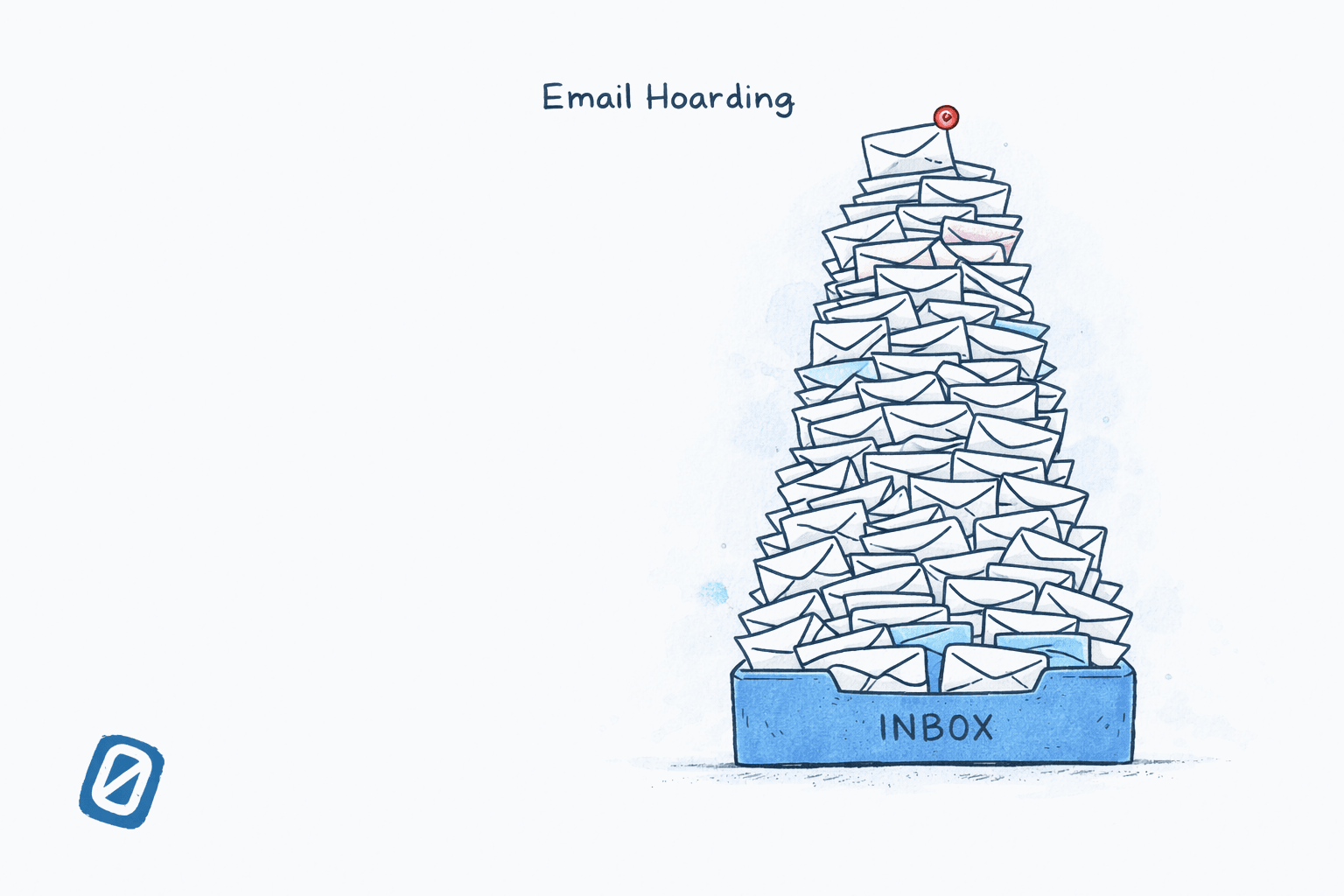
You keep every email because deleting one might cost you something. That instinct has a name, a growing body of research behind it, and a measurable toll on your cognition. Email hoarding, the persistent accumulation of digital messages coupled with an inability or unwillingness to delete them, now affects the majority of working adults. An All About Cookies survey of 1,000 Americans found the average person sits on over 1,000 unread emails, and 77% say that digital clutter is negatively affecting their lives.
The question worth asking isn’t “how do I clean up my inbox?” It’s “why does my brain fight me every time I try?”
This post is the answer. The psychology of email hoarding draws on loss aversion, identity attachment, incomplete-task anxiety, and fear of missing out. Understanding these forces is the first step toward breaking them.
Key Takeaway
Email hoarding is driven by at least four psychological mechanisms: loss aversion (deleting feels like losing something valuable), the Zeigarnik effect (unread messages register as unfinished tasks), FOMO (fear that a deleted email contained something important), and identity attachment (old emails feel like extensions of personal memory). Recognizing which pattern drives your hoarding is the prerequisite to changing it.
What Is Email Hoarding, and Why Does It Matter?#
Email hoarding is a subset of digital hoarding, which researchers define as the excessive accumulation of digital files combined with difficulty discarding them. Nick Neave and colleagues at Northumbria University published the first validated measurement tool for the behavior in 2019. Their Digital Hoarding Questionnaire, published in Computers in Human Behavior, identified two core dimensions borrowed from the clinical literature on physical hoarding: compulsive accumulation and difficulty discarding.
The parallel to physical hoarding is instructive but imperfect. Physical clutter takes up space you can see. Email clutter takes up space you can’t: cognitive space. A 2024 study published in Frontiers in Psychology found that digital hoarding positively predicted cognitive failures, with fatigue serving as the mediating mechanism. In plain language, the more digital clutter people accumulated, the more mental errors they made in daily life.
That finding should concern anyone whose inbox has quietly grown into the thousands. The emails aren’t just sitting there. They’re costing you something.
Why Can’t You Just Delete Them?#
The inability to delete old emails isn’t laziness. It’s loss aversion, one of the most robust findings in behavioral economics.
Daniel Kahneman and Amos Tversky’s prospect theory, published in Econometrica in 1979, demonstrated that losses feel roughly twice as painful as equivalent gains feel pleasurable. The principle was originally studied with money, but subsequent research has extended it to information itself. A 2022 study in Proceedings of the National Academy of Sciences confirmed that loss aversion and the endowment effect apply to noninstrumental information: data that has no practical use but that people still resist giving up.
Every email you’ve ever received feels, on some level, like something you own. Deleting it triggers the same psychological discomfort as throwing away a physical possession. The fact that the email is probably worthless doesn’t matter. Your brain processes the potential loss, not the actual value.
“Keeping data even if its value is unclear provides a level of security and comfort. The prediction of needing something in the future and not having access to it is what motivates people to continue collecting.” — Nick Neave, Professor of Psychology, Northumbria University, in The Conversation
This is why the standard productivity advice (“just delete everything older than 30 days”) fails so many people. It asks you to override a deeply wired instinct without addressing why the instinct exists.
The Four Types of Email Hoarder#
Neave’s research team didn’t stop at measurement. In follow-up qualitative interviews with high-scoring participants, they identified four distinct profiles of digital hoarders. These categories apply directly to email behavior.
| Type | Motivation | Email Behavior | Emotional State |
|---|---|---|---|
| Anxious Hoarder | Fear of future need | Keeps everything “just in case” | Distressed by the idea of deletion |
| Accidental Hoarder | Disorganization | Never deletes because they never think about it | Overwhelmed when confronted with volume |
| Collector | Ownership and control | Systematically archives everything into folders | Satisfied by completeness |
| Compliance Hoarder | External rules | Keeps work emails because policy says they might be needed | Indifferent, but trapped |
Most people aren’t purely one type. You might be an Anxious Hoarder with your personal Gmail and a Compliance Hoarder at work. The useful distinction isn’t which category you fall into; it’s recognizing that the behavior has a cause, and the cause is rarely “I actually need these emails.”
I’ll be honest: I recognized myself as a Collector immediately. The realization that my meticulously labeled folders were serving my sense of control rather than any practical purpose was uncomfortable. But it was also the first step toward letting go.
Does Your Brain Treat Unread Emails as Unfinished Tasks?#
Yes. The mechanism is called the Zeigarnik effect, named after Soviet psychologist Bluma Zeigarnik, who observed in the 1920s that waiters remembered incomplete orders far better than completed ones. Unfinished tasks create a persistent cognitive tension that only resolves when the task is done.
Every unread email is, psychologically, an open loop. Your brain registers it as something unresolved. Research on email-related cognitive load shows that this tension compounds: 50 unread emails aren’t 50 discrete stressors, they’re a single ambient weight that drains attention even when you aren’t looking at your inbox.
Christopher Masicampo and Roy Baumeister demonstrated the downstream effects in a 2011 study published in the Journal of Personality and Social Psychology. Participants with unfulfilled goals performed worse on unrelated cognitive tasks because the unfinished business consumed working memory. The critical finding: making a specific plan to address the goal eliminated the interference, even though the goal remained unfinished.
The implication for email hoarding is significant. You don’t necessarily need to process every old email. You need to make a decision about what those emails mean to you and commit to a plan. The act of deciding, not the act of deleting, is what closes the loop.
How FOMO Fuels the Pile#
Fear of missing out isn’t just a social media phenomenon. It operates in your inbox too.
A 2023 study by Wang, Miao, Jia, and Lai, published in Social Media + Society, surveyed 556 social networking users and found that FOMO was a significant mediator between social comparison and digital hoarding behavior. People who felt they might miss important information were substantially more likely to accumulate digital files without reviewing them.
Email amplifies this dynamic. Every newsletter you subscribed to once “because it looked interesting,” every thread you were CC’d on, every automated notification from a service you forgot about: they all sit in your inbox as potential information you might need someday. The cost of keeping them seems like zero. The perceived cost of deleting them feels enormous, because what if that one email contained something important?
This is the asymmetry that makes email hoarding so sticky. Storage is free (or cheap enough to feel free), deletion is psychologically expensive, and the volume never stops growing. The average office worker receives over 100 emails per day according to the Radicati Group. Even if you process 95% of them, the remaining 5% compounds into thousands within a year.
If the cognitive weight of thousands of unprocessed emails resonates, Swizero takes a different approach: instead of asking you to manage an infinite inbox, it surfaces only the emails that matter as a fixed card limit you can actually finish. The rest don’t disappear; they just stop demanding your attention.
What Does Email Hoarding Actually Cost You?#
The costs are real but invisible, which is why most people never confront them.
Cognitive cost. Gloria Mark, Professor of Informatics at UC Irvine and author of Attention Span, has documented that knowledge workers now average just 47 seconds of sustained attention on any screen before switching tasks. Every unresolved item in your inbox contributes to the fragmentation. As Mark explained in an interview with Dropbox: “This tank just drips, drips, drips away these resources.” An inbox of 10,000 unread messages isn’t a storage problem. It’s an attention problem.
Search cost. The more emails you keep, the harder it becomes to find anything. This is the paradox of digital hoarding: people keep emails because they might need them later, but the sheer volume makes retrieval progressively more difficult. One caveat here: Gmail’s search is good enough that this cost is smaller than it would be for, say, a cluttered hard drive. But “findable” and “found” are different things, and most hoarded emails are never searched for again.
Emotional cost. The All About Cookies survey found that 77% of Americans say digital clutter negatively impacts their lives, and 50% report frustration when trying to find files and apps they need. That frustration compounds into a low-grade anxiety that researchers have linked to email overload more broadly.
Environmental cost. This one surprises people. According to the Carbon Literacy Project, a stored email with attachments generates roughly 50 grams of CO2 equivalent annually through data center energy consumption. Multiply that by the billions of hoarded emails sitting in cloud servers worldwide, and the aggregate footprint is substantial. Global email infrastructure contributes to approximately 150 million tonnes of CO2e per year.
Is Email Hoarding the Same as Physical Hoarding?#
No, but the overlap is more significant than most people realize. The core psychological mechanisms, difficulty discarding and excessive acquisition, are shared. Where the two diverge is in social visibility and physical constraint.
Physical hoarding eventually hits a wall. You run out of space. Neighbors notice. The behavior becomes impossible to hide. Email hoarding has no such natural limit. Gmail offers 15 GB of free storage. Google One starts at $1.99/month for 100 GB. The infrastructure of modern email actively enables hoarding by removing every friction point that might otherwise force a reckoning.
A 2019 paper by Neave et al. in Computers in Human Behavior found that people who scored high on digital hoarding measures also tended to score higher on measures of physical hoarding, suggesting a shared psychological disposition. But digital hoarding was more prevalent, precisely because there’s no physical feedback loop to interrupt it.
“Less mental clutter means more mental resources available for deep thinking.” — Cal Newport, Professor of Computer Science at Georgetown University, in Deep Work: Rules for Focused Success in a Distracted World
The Swizero philosophy is built on this insight. The problem with email isn’t that you don’t have good enough tools to manage it. The problem is that email has no finish line. Without a boundary, accumulation is the default. A fixed card limit creates the constraint that your inbox refuses to provide on its own.
How to Actually Break the Pattern#
Understanding the psychology is the first step. Here’s how to use it.
Name Your Type#
Go back to Neave’s four categories. Which one describes your email behavior? Anxious hoarders need a different strategy than accidental hoarders. If you keep emails because deleting them feels risky, you need to confront the loss aversion directly. If you keep them because you never think about it, you need a system that forces periodic review.
Close the Open Loops#
The Masicampo and Baumeister research offers a practical tool. You don’t need to process every old email. You need to make a single decision: “These emails from before [date] are archived. I will not go back to them unless I actively search for something specific.” That decision, stated explicitly, closes the Zeigarnik loop. The unfinished business becomes finished.
Reduce the Inflow#
Hoarding is an accumulation problem. Strategies for processing email faster help, but they address the symptom, not the cause. Unsubscribe from newsletters you don’t read. Turn off notifications for services that email you by default. Reduce the volume, and the hoarding impulse has less raw material to work with.
Accept Imperfect Information#
FOMO is the hardest force to override because it exploits uncertainty. You genuinely don’t know whether a deleted email might have been useful someday. But the research is clear that the cognitive cost of keeping everything exceeds the informational value of anything you might theoretically retrieve. Cal Newport’s framework is useful here: say yes to the few things that matter, and let the rest go.
I could write an entire separate post about the specific tactics for inbox decluttering, but the key point here is psychological: the barrier to a manageable inbox isn’t technical. It’s emotional. The tools already exist. What’s missing is the framework for understanding why your inbox makes you anxious in the first place.
Frequently Asked Questions#
Is email hoarding a real psychological condition?#
Email hoarding is not a standalone clinical diagnosis in the DSM-5. It is classified as a form of digital hoarding, which researchers study as an extension of hoarding disorder. Nick Neave’s 2019 research at Northumbria University developed the first validated measurement tool (the Digital Hoarding Questionnaire) for assessing the behavior, and a growing body of peer-reviewed literature treats it as a meaningful psychological construct with measurable effects on cognition and well-being.
Why do I feel anxious when I try to delete old emails?#
The anxiety is primarily driven by loss aversion, a cognitive bias identified by Kahneman and Tversky in 1979. Losses feel approximately twice as painful as equivalent gains feel pleasurable. When you hover over the delete button, your brain processes the potential loss of information (even useless information) as a genuine cost. This is compounded by the Zeigarnik effect: unread emails register as unfinished tasks, and deleting them without processing feels like leaving something incomplete.
How many unread emails does the average person have?#
According to an All About Cookies survey of 1,000 Americans conducted in December 2024, the average person has over 1,000 unread emails. Other estimates vary: a study cited by The Ladders found the average worker’s inbox contains 199 unread emails at any given time. The discrepancy reflects different populations and measurement methods, but even conservative estimates suggest most people carry a significant backlog.
Does keeping old emails actually affect my productivity?#
Yes. A 2024 study in Frontiers in Psychology found that digital hoarding positively predicted cognitive failures, with fatigue as a mediating factor. Separately, Masicampo and Baumeister’s 2011 research demonstrated that unfulfilled goals (which unprocessed emails effectively represent) consume working memory and degrade performance on unrelated tasks. The effect is not dramatic on any single day, but it compounds over months and years.
What is the best way to deal with a backlog of thousands of emails?#
The most effective approach, according to the research, is to make a single categorical decision rather than processing emails individually. Declare everything older than a specific date as “archived and resolved.” This closes the cognitive loop identified by Zeigarnik-effect research without requiring you to read thousands of messages. Going forward, adopt a system with natural boundaries, such as checking email at scheduled intervals or using an app that caps the number of emails you see per session.
Sources#
- Digital Clutter: The Average American Has This Many Unread Emails - All About Cookies, December 2024. Survey of 1,000 Americans finding an average of 1,000+ unread emails per person.
- Digital Hoarding Behaviours: Measurement and Evaluation - Neave, Briggs, McKellar & Sillence, Computers in Human Behavior, Vol. 96, 2019. First validated Digital Hoarding Questionnaire.
- Digital Hoarders: We’ve Identified Four Types, Which Are You? - Nick Neave, The Conversation, 2021. Four-type taxonomy of digital hoarding behavior.
- Hoarding Knowledge or Hoarding Stress? - Frontiers in Psychology, 2024. Digital hoarding predicts cognitive failures; fatigue mediates the relationship.
- Prospect Theory: An Analysis of Decision Under Risk - Kahneman & Tversky, Econometrica, 1979. Foundational paper on loss aversion.
- Loss Aversion, the Endowment Effect, and Gain-Loss Framing Shape Preferences for Noninstrumental Information - Proceedings of the National Academy of Sciences, 2022. Loss aversion applies to information with no practical value.
- Consider It Done! Plan Making Can Eliminate the Cognitive Effects of Unfulfilled Goals - Masicampo & Baumeister, Journal of Personality and Social Psychology, 2011. Making a plan eliminates Zeigarnik-effect interference.
- The Dark Side of Upward Social Comparison: FOMO and Digital Hoarding - Wang, Miao, Jia & Lai, Social Media + Society, 2023. FOMO mediates the relationship between social comparison and digital hoarding.
- Attention Span: A Groundbreaking Way to Restore Balance - Gloria Mark, UC Irvine, 2023. Knowledge workers average 47 seconds of sustained attention per screen.
- The Carbon Cost of an Email - Carbon Literacy Project. Email with attachments generates approximately 50g CO2e; global email infrastructure contributes ~150M tonnes CO2e annually.
- Deep Work: Rules for Focused Success in a Distracted World - Cal Newport, 2016. Less mental clutter means more resources for deep thinking.
- Email Statistics Report, 2023-2027 - Radicati Group. Average office worker receives 121+ emails per day.
Your inbox doesn't have to feel like this.
Email with a beginning, middle, and end.
Make email a bounded session