How to Apologize in an Email: Templates That Sound Human
By Chris Stefaner, Co-founder of Swizero
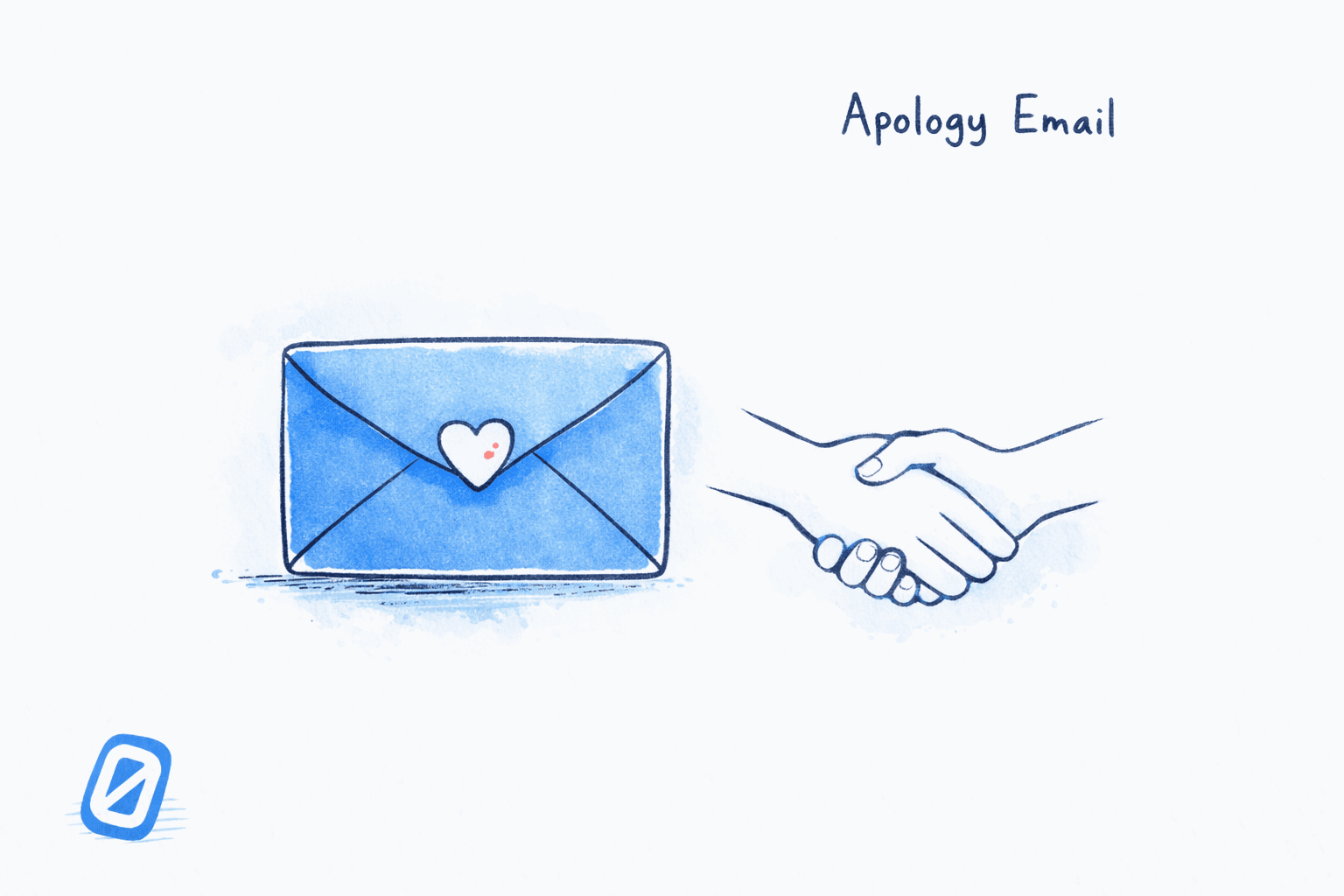
Knowing how to apologize in an email comes down to three moves: stating what went wrong, taking responsibility without excuses, and offering a specific fix. That three-part structure (acknowledge, own, repair) works for nearly every scenario, from a late reply to sending confidential data to the wrong person.
The hard part is making it sound human, not robotic. A 2016 study by Lewicki, Lount, and Polin in Negotiation and Conflict Management Research found that the single most important component of an effective apology is acknowledging responsibility. The second is an offer of repair. Everything else ranks lower.
Below: the structure behind a good apology email, seven templates for common workplace mistakes, and guidance on when email is the wrong medium.
The 3-Part Structure of a Good Apology Email#
A professional apology email differs from a personal one in tone, but the underlying structure is the same. Every apology email that works follows the same skeleton. You do not need to reinvent it each time.
1. Acknowledge the specific mistake. Name exactly what happened. “I sent the Q3 projections to the wrong distribution list” is better than “I made an error with the report.” Vague apologies read as evasive.
2. Take responsibility without qualifiers. Drop “but,” “however,” and “if.” Lois Frankel, author of Nice Girls Don’t Get the Corner Office, puts it directly: “Apologize once, then move on. Turn it into an objective assessment and think of ways to fix the problem.” One clean sentence of ownership is more credible than three sentences of hedging.
3. State the remedy. What will you do to fix the situation, and what will you do differently next time? A remedy turns your apology from words into action. According to the Lewicki et al. study, an offer of repair is the second strongest predictor of whether people accept an apology, right behind taking responsibility.
That is the entire framework. Keep it short. Most apology emails should be five to eight sentences total. Mastering how to apologize in an email is less about the words and more about this structure.
Why Do Email Apologies Feel Harder Than In-Person Ones?#
Understanding how to apologize in an email requires understanding why the medium works against you. Email strips away every signal that makes an apology feel genuine: eye contact, tone of voice, remorseful posture. All gone.
Kruger and Epley showed this in a 2005 study in the Journal of Personality and Social Psychology. Email recipients correctly identified the sender’s intended tone only 56% of the time, barely better than chance. Yet both sides believed they had communicated clearly about 90% of the time. You think your remorse came through. The reader may have perceived indifference.
A 2022 study in Frontiers in Psychology by Gao and Yan added nuance: written apologies outperform verbal ones for integrity violations (broken promises, dishonesty), but verbal apologies work better for competence violations (missed deadlines, errors). If your mistake was about character, email works. If it was about competence, pick up the phone when you can.
How to Apologize in an Email: 7 Templates for Common Mistakes#
Each apology email template below follows the three-part structure from above. Adapt these to your situation. The bracketed sections are the parts you customize.
1. Late Reply#
Subject: Following up (apologies for the delay)
Hi [Name],
I’m sorry for the slow response. [Your email / your question about X] deserved a faster reply, and I dropped the ball.
[Your actual response to their original message.]
I’ll be more responsive going forward. Thanks for your patience.
[Your name]
Honestly, “sorry for the late reply” is probably the most common apology in professional email, and most of the time it is unnecessary. If only a day or two has passed, skip the apology and just reply. Research from timetoreply shows the average professional email response time is 3 hours and 50 minutes during work hours. If you are replying within 24 hours, you are doing fine.
2. Missed Deadline#
Subject: Update on [Project/Deliverable]: missed the [date] deadline
Hi [Name],
I missed the [date] deadline for [deliverable], and I take full responsibility. [One sentence explaining what happened, no excuses.]
Here is where things stand: [current status]. I will have the completed [deliverable] to you by [new date].
I’ve [specific change: added calendar blocks / adjusted my workflow / delegated X] to make sure this doesn’t happen again.
[Your name]
The key here is the new deadline. If you need to write a sorry email to boss or senior leadership about a missed deadline, this template works especially well because it leads with accountability and a concrete plan. An apology without a revised timeline is just a confession.
3. Sent to the Wrong Recipient#
Subject: Please disregard my previous email
Hi [Name],
I accidentally sent you an email meant for someone else. Please disregard and delete it if you can.
I apologize for the confusion, and I’m taking steps to prevent this (double-checking recipients before sending).
Thanks, [Your name]
If the misfired email contained sensitive information, escalate immediately. Notify your manager or IT. An email apology alone is not enough for a data exposure.
4. Sent Wrong Information#
Subject: Correction: [topic of original email]
Hi [Name],
In my [date] email about [topic], I included incorrect [data / figures / details]. The correct information is:
[Corrected information, clearly formatted.]
I should have verified this before sending. I apologize for any confusion this caused, and I’ve updated [the document / spreadsheet / report] with the correct figures.
[Your name]
Lead with the correction, not the apology. Knowing how to apologize in an email for wrong information means prioritizing what the reader actually needs: the right data, fast.
5. Workplace Conflict or Offending a Colleague#
Subject: I owe you an apology
Hi [Name],
I want to apologize for [specific behavior: what I said in the meeting / how I reacted to your feedback / interrupting you during the presentation]. It was disrespectful, and I understand how it could have made you feel [dismissed / undermined / uncomfortable].
I value working with you, and I’ll be more mindful of [specific change] going forward. If you’d like to talk about this in person, I’m happy to do that too.
[Your name]
This is one scenario where you should strongly consider whether email is even the right channel. For interpersonal conflict, a face-to-face conversation (or at minimum a phone call) usually rebuilds trust faster, as the Gao and Yan research on competence-based violations suggests. Use the email to open the door, then have the real conversation in person.
6. Customer Complaint#
Subject: We made a mistake, and here’s how we’re fixing it
Hi [Name],
Thank you for letting us know about [specific issue]. You’re right that [acknowledgment of the problem], and I’m sorry for the [inconvenience / frustration / disruption] it caused.
Here is what we have done: [specific action taken]. Here is what we are doing next: [preventive measure].
[Optional: offer of compensation, discount, or goodwill gesture.]
Please don’t hesitate to reach out directly if anything else comes up.
[Your name]
For customer-facing apologies, speed matters enormously. How to apologize in an email to a customer is as much about timing as wording. Research compiled by Mailmodo shows that 88% of customers expect a reply within 60 minutes, yet the average customer service response time is 12 hours. Closing that gap is sometimes more powerful than the apology itself.
7. CC Mistake (Reply-All or Wrong CC List)#
Subject: Apologies for the unnecessary CC
Hi all,
I accidentally included [people / this group] on my previous reply. Apologies for cluttering your inboxes. Please disregard.
[Your name]
Keep it brief. The CC mistake is minor, and a long apology draws more attention to the error than the error itself deserves. If you are curious about how email anxiety compounds from small mistakes like these, the psychology is worth understanding.
If catching mistakes before they snowball matters to you, Swizero reduces your inbox to a handful of cards per session, so errors surface faster and apologies happen sooner, not days later when the damage has compounded.
When Is Email the Wrong Medium for an Apology?#
Learning how to apologize in an email also means knowing when email is not the right channel. Not every apology belongs in an inbox.
| Situation | Best Medium | Why |
|---|---|---|
| Minor delay or small error | Low stakes; a quick note is sufficient | |
| Wrong info sent to a group | Email + correction | The group needs the fix in writing |
| Interpersonal conflict | In person or phone, then email | Tone and body language carry sincerity |
| Serious professional mistake | Phone first, then email to document | Email alone feels avoidant |
| Data breach or privacy violation | Escalate to leadership/legal | Beyond a personal apology |
The rule: the more personal the harm, the more personal the medium. Email works for factual corrections and logistical mistakes. It falls short when someone’s feelings are the primary casualty. Understanding how email affects mental health can help you judge when a message needs a different channel.
How Does Over-Apologizing Hurt Your Credibility?#
Part of understanding how to apologize in an email is knowing when not to. When “sorry” becomes filler, people stop taking it seriously. A 2023 study by Schumann, Ritchie, and Forest in Personality and Social Psychology Bulletin found that frequent apologizers were seen as warmer but less assertive and less powerful. The critical nuance: this only applied to low-quality apologies. Frequent high-quality apologies did not diminish assertiveness. The problem is not saying sorry often; it is saying sorry carelessly.
Signs you are over-apologizing:
- Starting messages with “Sorry to bother you” when you have a legitimate reason to write
- Apologizing for things outside your control (“Sorry for the rain delay on shipping”)
- Using “sorry” as a transition word (“Sorry, just to clarify…”)
Replace unnecessary apologies with gratitude or direct language. “Thanks for your patience” carries the same goodwill as “Sorry for the delay” without the self-diminishing undertone. For more on how email tone shapes professional relationships, the nuance runs deeper than most people realize.
Tips for Better Apology Emails#
These tips distill how to apologize in an email into habits you can apply every time.
-
Send it quickly. The longer you wait, the more the other person fills the silence with their own narrative. A prompt apology signals that you noticed and you care. If your inbox is structured so that mistakes surface in minutes rather than days, the apology window stays open.
-
Match the formality to the relationship. “I’m sorry” works for a colleague you email daily. “I sincerely apologize” fits a client or executive you rarely contact. Reading the relationship wrong makes the apology feel performative.
-
Never apologize in the subject line alone. A subject line reading “Sorry!” with no body text is worse than no apology at all. It signals you could not be bothered to explain.
-
Skip the passive voice. “Mistakes were made” is a meme for a reason. Say “I made a mistake.” Active ownership is the foundation of credibility.
-
Read it once from the recipient’s perspective. Before you hit send, reread the email as if you are the person receiving it. Does it sound sincere, or does it sound like damage control? If you are unsure, simplify. Shorter apologies almost always read as more genuine than longer ones.
Frequently Asked Questions#
How do you apologize professionally in an email?#
The core of how to apologize in an email professionally is to state the specific mistake, take responsibility without excuses or qualifiers, and offer a concrete remedy or preventive step. Keep the email between five and eight sentences. According to research by Lewicki, Lount, and Polin (2016), the two most effective components of any apology are acknowledging responsibility and offering repair.
Should I apologize for a late email reply?#
Only if the delay was genuinely disruptive. If you are responding within 24 hours, skip the apology and just answer the question. The average professional email response time is about 3 hours and 50 minutes during business hours, so most “late” replies are not actually late.
Is it better to apologize in person or by email?#
It depends on the type of mistake. Research by Gao and Yan (2022) found that written apologies are more effective for integrity-based violations (broken promises, dishonesty), while verbal apologies work better for competence-based violations (errors, missed deadlines). Knowing how to apologize in an email matters most for integrity issues. For serious interpersonal conflicts, start with a call or in-person conversation and follow up with an email to document the resolution.
How do you say sorry in an email without sounding weak?#
Use direct language and active voice. Say “I made an error” instead of “Mistakes were made.” Pair the apology with a specific corrective action so the focus shifts from guilt to resolution. Avoid hedging phrases like “I’m sorry if you felt…” which undermine sincerity.
What should you not say in an apology email?#
Avoid conditional apologies (“I’m sorry if this caused any inconvenience”), blame-shifting (“I’m sorry, but the system was down”), and over-explaining. Long justifications read as excuses. Also avoid apologizing for things outside your control, which dilutes the meaning of future genuine apologies.
How many times should you apologize in a single email?#
Once. When figuring out how to apologize in an email, state the apology clearly in the first or second sentence, then move to the remedy. Repeating “I’m sorry” multiple times within the same message can undermine credibility. Research on apology frequency shows that message persuasiveness increases with up to three repetitions but decreases beyond that threshold.
Can you send an apology email to someone you accidentally emailed?#
Yes. Send a brief follow-up asking them to disregard and delete the message. If the misfired email contained sensitive or confidential information, escalate to your manager or IT department immediately rather than relying on the recipient to delete it.
How do you follow up after an apology email with no response?#
Wait at least 48 hours before following up. When you do, keep it short: reference your original apology, restate the remedy, and ask if there is anything else they need. Do not re-apologize at length. For guidance on effective follow-ups, see this guide on how to write a follow-up email that gets replies.
Sources#
- An Exploration of the Structure of Effective Apologies. Lewicki, Polin, and Lount, Negotiation and Conflict Management Research, 2016. Identified six components of effective apologies; acknowledgment of responsibility ranked most important.
- Egocentrism Over E-Mail: Can We Communicate as Well as We Think?. Kruger and Epley, Journal of Personality and Social Psychology, 2005. Email recipients correctly identified intended tone only 56% of the time.
- Verbal or Written? The Impact of Apology on the Repair of Trust. Gao and Yan, Frontiers in Psychology, 2022. Written apologies outperformed verbal for integrity violations; verbal outperformed for competence violations.
- The Social Consequences of Frequent Versus Infrequent Apologizing. Schumann, Ritchie, and Forest, Personality and Social Psychology Bulletin, 2023. Frequent low-quality apologies reduced perceptions of assertiveness and power.
- Average Email Response Time. timetoreply, 2024. Average professional email response time is 3 hours 50 minutes during work hours.
- Email Response Time Statistics. Mailmodo, 2024. 88% of customers expect a reply within 60 minutes.
Your inbox doesn't have to feel like this.
Apply what you just learned, faster.
Put this into practice with Swizero