How to Write a Follow Up Email That Gets Replies (Templates + AI Automation)
By Chris Stefaner, Co-founder of Swizero
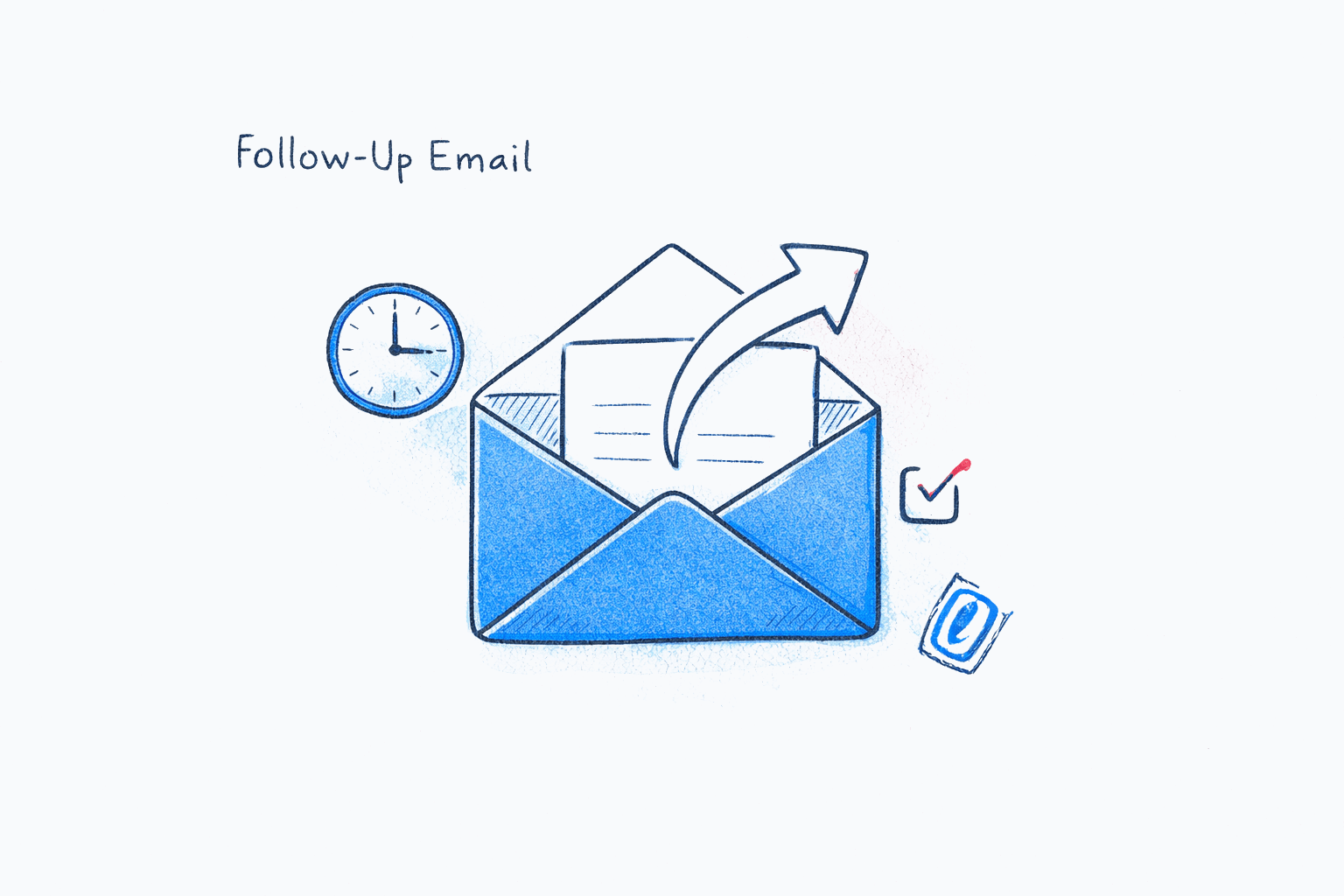
A good follow-up email does three things: reminds the recipient you exist, adds something they didn’t have before, and makes replying easy. That’s the entire formula for how to write a follow-up email that gets replies. The first message opens the door; the follow-up walks through it.
Most people either never follow up (leaving opportunities on the table) or follow up badly (vague “just checking in” messages that get deleted on sight). The data is stark: a first follow-up boosts reply rate by 49%, according to Instantly’s 2026 Cold Email Benchmark. Yet 48% of sales reps never send a second message, per Belkins’ 2025 report. The gap between knowing you should follow up and doing it well is where most communication breaks down.
This guide covers the structure, templates, timing, and tone that turn a follow-up from an annoyance into an asset.
Why Follow-Up Emails Matter More Than Your First Message#
Your first email competes with every other unread message in someone’s inbox. It arrives cold, without context or relationship weight. A follow-up has an advantage: it signals persistence, which humans interpret as a proxy for importance.
There’s a psychological mechanism at play. The mere-exposure effect means people develop preference for things they’ve encountered before. Your second email isn’t starting from zero; it’s building on a thread of familiarity.
Follow-ups also catch people at better moments. The recipient may have seen your first message on a busy Monday morning, intended to reply, and then gotten buried. Your follow-up arriving Wednesday afternoon lands in a different cognitive state entirely. That’s why email timing and frequency matters so much for response rates.
The uncomfortable truth: silence usually means “not now,” not “never.” Follow-up emails convert that ambiguity into an answer.
How to Write a Follow Up Email That Actually Gets Replies#
Every effective follow-up has four components. Get all four right and your response rate improves dramatically.
Subject Line#
Keep it short, specific, and connected to the original thread. The best approach: reply to your own sent email so the subject line reads “Re: [Original Subject].” This places your follow-up inside the existing thread and leverages recognition over novelty.
If you’re starting a new thread (sometimes necessary after 7+ days of silence), use a subject line that references something specific: “The Q3 proposal from last Tuesday” rather than “Following up.” For deeper guidance on what makes subject lines work, the post on how to write emails people actually read covers the research on length and specificity.
Opening Line#
Never open with “Just checking in” or “I wanted to follow up on my previous email.” These phrases signal that you have nothing new to say. Instead, acknowledge the gap and move forward:
- “Realized I didn’t mention [specific thing] in my last note.”
- “Quick update since my Tuesday email:”
- “Saw [relevant news/development] and thought of our conversation.”
The opening should give the recipient a reason to keep reading beyond obligation.
Value Add#
This is what separates effective follow-ups from spam. Every follow-up should contain something the recipient didn’t have before: a relevant article, a new data point, a simplified version of your ask, or a brief case study. If you have nothing new to add, wait until you do.
The value add doesn’t need to be elaborate. Even reframing your original request more clearly counts, because clarity is a form of value when email productivity is at stake for busy professionals.
Call to Action#
Make the next step absurdly easy. One question. One binary choice. One link to click. The harder you make it to respond, the less likely anyone will.
Good CTAs for follow-ups:
- “Does Thursday at 2pm work, or should I suggest another time?”
- “Would a 2-minute demo video be helpful? I can send one over.”
- “Happy to take this off your plate if the timing isn’t right. Just let me know either way.”
Reply to your own sent email
Open your Sent folder, find the original email, click Reply, and compose your follow-up. This keeps the conversation in one thread and auto-populates the 'Re:' subject line.
Replying to your own sent message (rather than composing new) preserves the full thread context for the recipient.
Add your value-add before the ask
Write 1-2 sentences that offer something new: a resource, an insight, or a reframed version of your original point. Place this before your call to action so the recipient gets value before being asked for something.
If you can't think of anything new to add, it's too soon to follow up. Wait until you have a reason.
End with a single low-friction question
Close the email with one question that can be answered in under 10 words. Avoid multi-part asks or open-ended requests that require the recipient to think hard about how to respond.
Binary questions ('Would Tuesday or Thursday work better?') consistently outperform open-ended ones ('When are you free?') in response rate.
How Do I Follow Up on an Email That Got No Response?#
The key principle: each follow-up should feel like a new, useful touchpoint rather than a repeated ask. Here are three templates for different follow-up stages.
Template 1: The Polite Nudge (3-4 days after original)#
Subject: Re: [Original Subject]
Hi [Name],
Know things get buried. Wanted to resurface this in case the timing is better now.
[One sentence restating the core ask or opportunity.]
Would it help if I [simplified offer: sent a shorter version / scheduled a 10-min call / shared a quick summary]?
[Your name]
Template 2: The Value-Add (7-10 days after original)#
Subject: Re: [Original Subject]
Hi [Name],
Since my last note, [new development: found relevant data / saw your company announcement / came across a case study that maps to your situation].
Thought it might be useful: [link or one-line summary].
Still interested in [original proposal] if the timing works on your end. No pressure either way.
[Your name]
Template 3: Closing the Loop (14+ days, final follow-up)#
Subject: Re: [Original Subject]
Hi [Name],
Want to respect your time, so this will be my last note on this.
If [original opportunity] isn’t a fit right now, completely understand. If it is, I’m here whenever makes sense.
Either way, appreciated you [specific thing: taking the initial call / reviewing the proposal / connecting at the event].
[Your name]
The “closing the loop” template works remarkably well because it removes pressure. People who felt guilty about not responding suddenly have an easy exit, and paradoxically, that freedom often prompts them to re-engage.
If tracking which conversations have gone cold feels like a job in itself, Swizero detects stalled threads in your Gmail and surfaces them as cards, so you never lose a follow-up to forgetfulness.
What Should I Write Without Being Annoying?#
The line between persistent and annoying comes down to three things: spacing, value, and tone.
The 3-Strike Rule. Three follow-ups is the maximum for most professional contexts. After that, silence is your answer. The cadence: first follow-up at 3-4 days, second at 7-10 days, third (closing the loop) at 14+ days. This follow-up sequence gives someone three weeks to respond before you move on.
Spam avoidance. Every follow-up must pass this test: “Does this email contain something the recipient didn’t already have?” If the answer is no, you’re not following up; you’re nagging. A nudge email works when it adds context, adjusts the ask, or offers an easy out.
Tone by context:
- Job applications: Formal, grateful, brief. One follow-up is standard; two is acceptable only if you had a real conversation.
- Sales outreach: Direct, value-forward. The email cadence can be slightly more aggressive because the recipient expects it.
- Networking: Warm, low-pressure, reference something specific from your interaction.
- Internal colleagues: Casual, assume good intent. “Hey, bumping this up in your inbox” is fine with people you work with daily.
The single biggest predictor of whether a follow-up annoys someone: did you make them feel obligated, or did you make it easy to say no? People resent obligation. They appreciate options.
Can AI Write Follow-Up Emails for Me?#
Yes, and it’s one of the use cases where AI performs genuinely well.
What AI gets right: Follow-up emails are formulaic enough that a language model can draft solid versions quickly. The structure is predictable (acknowledge gap, add value, ask one thing), the personalization requirements are moderate, and the stakes per individual email are low enough that imperfect phrasing rarely causes damage.
How to use AI as a co-pilot: The best workflow isn’t “let AI send follow-ups automatically.” It’s letting AI handle detection and drafting while you handle judgment and send. Tools like Swizero, which sits on top of Gmail, detect stalled conversations and surface them as cards for follow-up. You review the context, approve or edit the suggested draft, and send.
For a deeper look at the technology, the guide on how AI email assistants actually work covers the retrieval and generation pipeline. And if you’re interested in broader automation, the post on using AI to sort and manage email walks through the full spectrum from Gmail’s native tools to custom AI agents.
The honest assessment: AI removes the friction of writing follow-ups, but it can’t replace your judgment about whether a follow-up is appropriate, what value to add, or when to stop. Use it as a drafting partner, not an autopilot.
Follow-Up Email Templates for Every Situation#
After a Job Interview#
Hi [Name],
Thank you again for taking the time to speak with me on [day]. The conversation about [specific topic discussed] reinforced my interest in the role.
I wanted to mention one thing I didn’t get to in our chat: [brief relevant qualification or insight].
Looking forward to hearing about next steps. Happy to provide any additional information that would be helpful.
Best regards, [Your name]
After a Sales Call#
Hi [Name],
Good speaking with you on [day]. Wanted to share the [case study / ROI calculator / comparison doc] I mentioned during our call: [link].
Based on what you shared about [their specific challenge], I think [one sentence connecting your solution to their pain point].
Would a 15-minute follow-up next week make sense, or would you prefer I send a written proposal first?
[Your name]
After Sending a Proposal#
Hi [Name],
Wanted to check whether you’ve had a chance to review the proposal I sent on [date]. Happy to walk through any section in detail or adjust scope if needed.
One thing I’d flag: [time-sensitive element, e.g., “the pricing holds through end of month” or “our team’s availability for Q3 is filling up”].
Let me know if questions come up. A quick 10-minute call can usually resolve anything faster than email.
[Your name]
After a Networking Event#
Hi [Name],
Great meeting you at [event] on [day]. Enjoyed our conversation about [specific topic].
[One sentence of value: a link to something you discussed, an intro you can make, or a resource they’d find useful.]
Would love to continue the conversation. Coffee or a 20-minute call sometime in the next few weeks?
[Your name]
If timing follow-ups manually feels tedious, AI-powered tools can handle detection and drafting inside your existing Gmail.
Reply Rate by Follow-Up Number
Source: Instantly Cold Email Benchmark, 2026
Frequently Asked Questions#
How many follow-up emails should you send before giving up?#
Three follow-ups is the standard maximum for professional cold outreach. For warm contacts (people you’ve already spoken with), two follow-ups is usually sufficient. After three attempts with no response over 2-3 weeks, interpret the silence as a “not now” and move on. You can always circle back months later with a fresh reason.
How long should you wait before sending a follow-up email?#
Wait 3-4 business days for the first follow-up, 7-10 days for the second, and 14+ days for the third. For time-sensitive matters (job applications after an interview, proposals with deadlines), shorter intervals of 2-3 days are appropriate. Avoid following up on the same day or next day unless there’s a genuine urgency.
Is it rude to send a follow-up email?#
No. Following up is a normal part of professional communication. People miss emails, forget to reply, or intend to respond later and lose track. What makes a follow-up rude is tone (demanding, guilt-tripping) or frequency (daily messages). A respectful follow-up that adds value and offers an easy exit is universally acceptable.
What is the best subject line for a follow-up email?#
Reply to the original thread so the subject reads “Re: [Original Subject].” This leverages recognition and keeps the conversation organized. If you need a fresh thread (after a long gap), reference something specific: “Quick question about the Q3 timeline” rather than generic “Following up” or “Checking in.”
Should I reply to the same thread or start a new email?#
Reply to the same thread for follow-ups within 7 days. Start a new email if more than 2 weeks have passed, if the original subject line no longer fits, or if you’re following up with someone who receives very high email volume (a fresh subject line may get better visibility in a crowded inbox).
Can AI tools write follow-up emails for you?#
Yes. AI excels at drafting follow-up emails because the structure is predictable and the personalization requirements are moderate. The best approach is using AI for detection (identifying which conversations need follow-up) and drafting (generating a first version), while you handle judgment calls about timing, tone, and whether to follow up at all.
What is the ideal length for a follow-up email?#
50-75 words for the body text, excluding greetings and sign-off. Shorter than your original email. Follow-ups should feel quick to read and easy to respond to. If your follow-up is longer than your first email, you’re overcomplicating it. The goal is to make responding the path of least resistance.
Sources#
- Cold Email Statistics & Benchmarks 2026 — Instantly, 2026. First follow-up boosts reply rate by 49%.
- Cold Email Statistics You Need to Know — Belkins, 2025. 48% of sales reps never send a second message.
- Mere-exposure effect — Wikipedia. Psychological basis for why repeated contact increases receptivity.
Your inbox doesn't have to feel like this.
Apply what you just learned, faster.
Put this into practice with Swizero