Email and Dopamine: The Neurochemistry of Your Inbox
By Chris Stefaner, Co-founder of Swizero
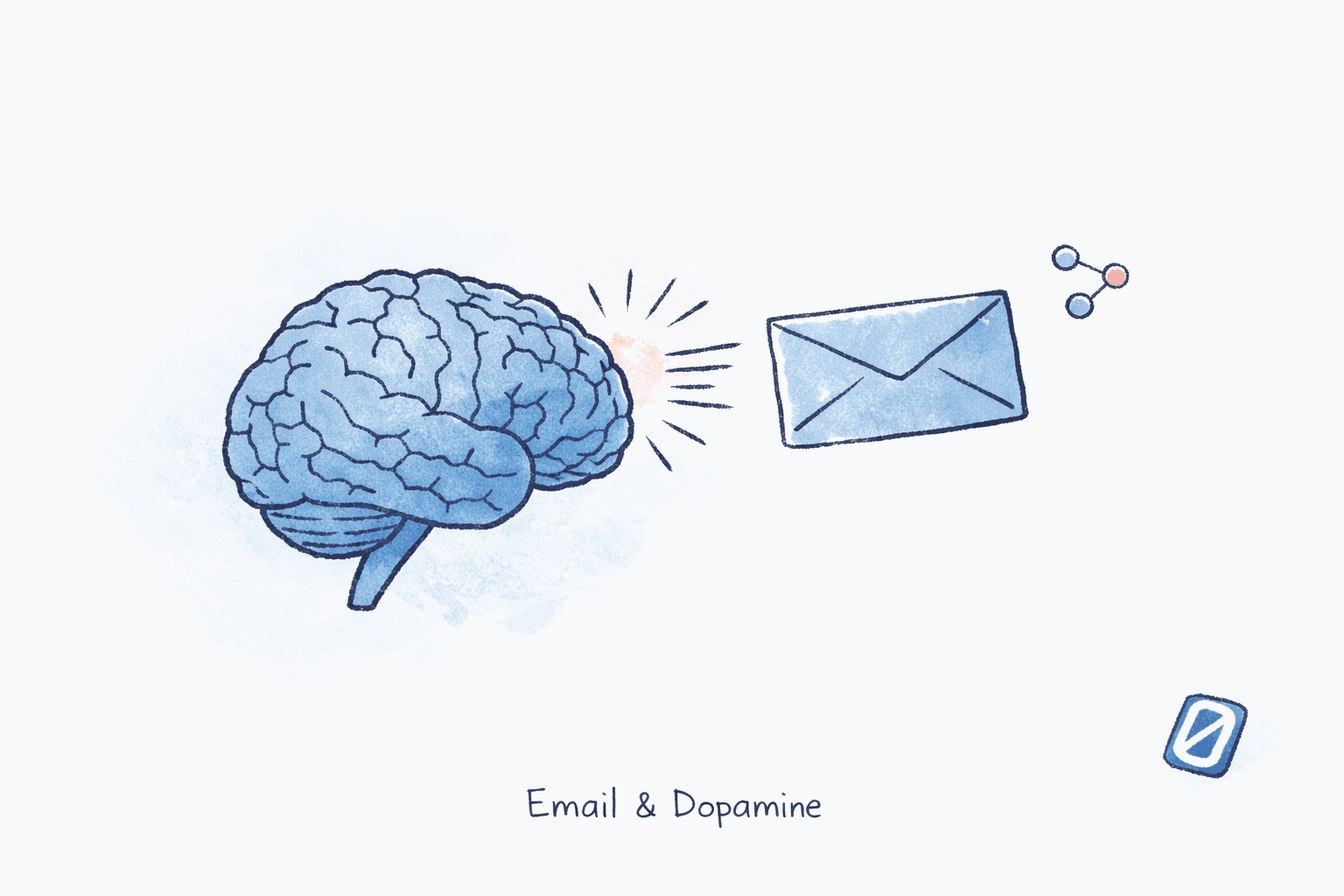
Your inbox is a slot machine that pays out in social validation. That is not a productivity metaphor. It is a description of the neurochemical mechanism that keeps you checking: dopamine prediction error signaling, the same reward-learning system that makes gambling, social media, and certain drugs compulsive. The difference is that email disguises the compulsion as responsibility.
This post is not about notification addiction (we covered that behavioral angle separately) or email anxiety in the cortisol sense. It is about one specific circuit: the mesolimbic dopamine pathway, the prediction errors it computes, and the variable-ratio reinforcement schedule that email accidentally became. Understanding the neurochemistry changes how you design your relationship with your inbox, because you stop blaming willpower and start changing the reward structure itself.
Key Takeaway
Email checking activates the same dopamine prediction-error system that drives slot machine gambling. Your brain releases dopamine not when you receive a good email, but when you anticipate one might be there. Variable-ratio delivery (you never know when the next important message arrives) makes the behavior maximally resistant to extinction. Breaking the loop requires removing unpredictability, not improving self-control.
What Does Dopamine Actually Do in Your Brain?#
Dopamine is not a pleasure chemical. This is the most persistent misconception in popular neuroscience, and correcting it changes everything about how we understand compulsive email checking.
In 1997, Wolfram Schultz, Peter Dayan, and P. Read Montague published a landmark paper in Science titled “A Neural Substrate of Prediction and Reward” that redefined dopamine’s function. They demonstrated that midbrain dopamine neurons do not fire when a monkey receives a reward. They fire when the monkey detects a discrepancy between expected and received outcomes, what neuroscientists now call the reward prediction error. When a reward is larger or earlier than expected, dopamine neurons burst. When the reward arrives exactly as predicted, they stay silent. When an expected reward fails to arrive, they dip below baseline.
“Dopamine neurons do not simply report reward. They report a teaching signal: the difference between what was predicted and what actually occurred.”
Wolfram Schultz, Professor of Neuroscience, University of Cambridge, in Dopamine reward prediction error coding, Dialogues in Clinical Neuroscience (2016)
This prediction-error signal is what makes your inbox neurochemically interesting. When you open your email, your brain is not seeking the pleasure of reading messages. It is computing a prediction: “Is there something here better or worse than what I expected?” Every refresh is a prediction-error experiment. Your dopamine system does not care about the content of emails. It cares about the surprise.
Kent Berridge, Professor of Psychology and Neuroscience at the University of Michigan, took this further with his distinction between “wanting” and “liking.” In a 2016 paper in American Psychologist co-authored with Terry Robinson, he demonstrated that mesolimbic dopamine mediates incentive salience (the “wanting” of a reward) but does not mediate the hedonic experience of enjoying that reward. You can want to check your email compulsively while simultaneously finding the experience unrewarding. The dopamine system does not require that you like what you find. It only requires that you keep looking.
How Email Became a Variable-Ratio Reinforcement Schedule#
B.F. Skinner identified four reinforcement schedules in the 1950s, and one of them produces behavior so persistent that it is essentially extinction-proof: the variable-ratio schedule. You receive a reward after an unpredictable number of responses. Slot machines use it. Social media uses it. And email, without anyone designing it this way, became one.
Robert Sapolsky, Professor of Biology and Neurology at Stanford University, explains the mechanism in his human behavioral biology lectures: when a monkey presses a lever and receives a food reward 100% of the time, dopamine fires at a predictable rate. But when the reward probability drops to 50%, when “maybe” enters the equation, dopamine output does not halve. It increases. The uncertainty itself becomes the reward signal. As Sapolsky describes it, dopamine “is not about pleasure. It’s about the anticipation of pleasure.”
Your inbox operates on almost exactly 50% reward probability. Research suggests roughly half of all emails a knowledge worker receives in a given day require no action and provide no value. But scattered among them, unpredictably, are messages that matter: a client signing a deal, a promotion offer, an introduction that leads somewhere. You cannot predict when these will arrive, how many lever-pulls (refreshes) will separate them, or which sender name on the preview will contain something important. This is variable-ratio reinforcement in its purest form.
The EVADD study published in JMIR Mental Health (2025) surveyed 21,244 adults in France and found that 66.7% exhibited compulsive smartphone use patterns, with email and messaging being primary drivers. The compulsion is not a character flaw. It is the predictable output of a brain running prediction-error computations against a variable-ratio input stream.
Why “Maybe” Is More Addictive Than “Yes”#
The neuroscience of uncertainty deserves its own section because it explains something counterintuitive: if every email you received were important, you would check less often. If every email were junk, you would check less often. It is the mixture, the maybe, that keeps you locked in.
Christopher Fiorillo, along with Philippe Tobler and Wolfram Schultz, published a 2003 study in Science demonstrating that dopamine neurons show sustained activation during periods of reward uncertainty. When a monkey learns that a cue predicts a 50% chance of reward, dopamine neurons fire not just at the cue but maintain elevated activity throughout the delay period, the entire time the animal is waiting to find out. Maximum uncertainty produces maximum sustained dopamine.
This maps directly onto inbox behavior. The moment you see the notification badge (or simply remember that time has passed since your last check), your dopamine system activates in anticipation. The sustained firing continues until you actually open the inbox and resolve the uncertainty. Crucially, even if the resolution is disappointing (nothing but newsletters and automated receipts), the dopamine has already been released during the anticipation phase. The checking behavior has already been reinforced.
Anna Lembke, Professor of Psychiatry and Behavioral Sciences at Stanford and author of Dopamine Nation (Dutton, 2021), describes the downstream consequence: “The smartphone is the modern-day hypodermic needle, delivering digital dopamine 24/7 for a wired generation.” Her research shows that repeated exposure to variable-reward stimuli creates a chronic dopamine-deficit state. The brain downregulates dopamine transmission in response to overstimulation, leaving people less able to experience pleasure from ordinary activities, and more dependent on the variable-reward source to feel normal.
This is why email before bed is particularly destructive. The dopamine activation from anticipation and uncertainty checking disrupts the neurochemical wind-down that precedes sleep. Your brain is computing reward predictions when it should be settling into parasympathetic rest.
The 47-Second Refresh: How Fragmented Attention Reinforces the Loop#
Gloria Mark, Professor of Informatics at UC Irvine and author of Attention Span (Hanover Square Press, 2023), measured that knowledge workers now maintain focus on a single screen for an average of 47 seconds before switching. In 2004, that number was 150 seconds. The decline tracks almost perfectly with the rise of smartphone notifications and always-on email access.
This is not coincidental. The dopamine prediction-error system and attention switching are neurologically linked. Every time you switch to your inbox, resolve the uncertainty (positive or negative prediction error), and switch back, you complete one reinforcement cycle. The shorter the interval between checks, the more cycles per hour, and the more entrenched the neural pathway becomes through long-term potentiation, the process by which repeatedly activated synaptic connections grow physically stronger.
Attention Span on Screens (2004-2023)
Source: Gloria Mark, UC Irvine, Attention Span (2023)
Adam Gazzaley, Professor of Neurology, Physiology, and Psychiatry at UCSF and co-author of The Distracted Mind: Ancient Brains in a High-Tech World (MIT Press, 2016), identifies the core conflict: “Our brains evolved to seek information as a survival mechanism. The problem is that our modern information environment has no end. The ancient drive to forage for information now operates in an infinite field.” Email is that infinite field. Your foraging instinct, mediated by dopamine, was designed for an environment where information was scarce and every new data point had survival value. In an inbox with 121 messages per day (the current average per Radicati Group), the foraging circuit fires constantly because it cannot distinguish between a predator-sighting-level signal and a promotional email from a shoe brand.
If the infinite foraging field resonates, Swizero replaces it with a fixed card limit: a finite set your brain can process to completion, eliminating the open-ended uncertainty that drives dopamine-seeking behavior.
Why Willpower Fails Against Neurochemistry#
The dopamine prediction-error system operates below conscious control. It activates in the ventral tegmental area and projects to the nucleus accumbens before the prefrontal cortex (your “willpower” center) can intervene. By the time you consciously decide whether to check your inbox, the wanting signal has already fired. This is why “just don’t check” is neurologically naive advice. It asks the prefrontal cortex to override a faster, deeper circuit on every single occasion.
Sharpe and Spooner’s 2025 paper in Perspectives in Public Health formalized this as “dopamine-scrolling,” a distinct behavioral pattern characterized by variable-reinforcement-driven compulsive checking that bypasses deliberate decision-making. They identified it as a public health concern because it operates through subcortical mechanisms that executive function alone cannot reliably override.
The decision fatigue research compounds this problem. Each time you resist the checking impulse, you deplete the same prefrontal resources you need for actual work decisions. This is why people report checking email more frequently as the day progresses. It is not because more important emails arrive later. It is because their prefrontal override capacity diminishes while the dopamine drive remains constant.
How Do You Break the Email and Dopamine Loop?#
If willpower cannot reliably override the loop, what can? The neuroscience points to three structural interventions:
1. Remove the variable-ratio schedule#
The compulsion depends on unpredictability. If you process email only at scheduled times (batching), you convert a variable-ratio schedule into a fixed-interval schedule, the least addictive reinforcement pattern. Your brain learns that checking between scheduled times produces no reward, and the prediction-error signal extinguishes for those intervals. Kushlev and Dunn’s 2015 study at UBC in Computers in Human Behavior demonstrated that participants who batched email into three daily sessions reported significantly lower daily stress than those who checked continuously.
2. Make the outcome predictable#
Variable reward drives the loop. A fixed card limit makes the outcome predictable: you will process a set number of messages, then you are done. The prediction-error system calms when outcomes match expectations. When you know exactly what your email session contains and when it will end, the “maybe” that sustains dopamine firing disappears.
3. Provide a completion signal#
The dopamine system continues firing as long as uncertainty persists. A concrete endpoint, a finish line, provides the neural “expected reward received” signal that returns dopamine to baseline. Without a completion signal, your brain keeps computing “maybe there’s something else” indefinitely. This is why an email finish line is not a productivity hack. It is a neurochemical intervention. It provides the prediction-error system with the “fully predicted” outcome that produces silence in the dopamine circuit.
Frequently Asked Questions#
Is email actually addictive in a clinical sense?#
Email checking behavior meets several criteria for behavioral addiction as defined by the DSM-5: continued use despite negative consequences, tolerance (needing to check more frequently for the same relief), withdrawal symptoms (anxiety when unable to check), and loss of control. The EVADD study (2025) found 36.7% of 21,244 participants scored as addicted on validated smartphone use scales, with email and messaging as primary drivers. However, most clinicians reserve the term “addiction” for cases involving significant functional impairment.
Does turning off notifications fix the dopamine problem?#
Turning off notifications removes external triggers but does not eliminate internal ones. Once the habit loop is established, the prediction-error system fires based on time elapsed and contextual cues (sitting at your desk, picking up your phone) rather than requiring an external ping. Notifications are the entry point, but the variable-ratio schedule sustains the behavior independently. Structural changes to when and how you process email matter more than notification settings alone.
Can a dopamine fast reset email checking habits?#
Anna Lembke’s research suggests 30 days of complete abstinence from a variable-reward stimulus can reset dopamine receptor sensitivity. For email, complete abstinence is rarely practical. The functional equivalent is switching from continuous checking (variable-ratio) to strict batching (fixed-interval) for at least four weeks, which gives the prediction-error system time to extinguish the between-batch checking impulse.
Why does email feel more compulsive than other work tasks?#
Email combines three features that maximize dopamine-driven compulsion: variable-ratio reward delivery (unpredictable timing of important messages), zero effort to check (one tap or glance), and social reward potential (each message might contain validation, opportunity, or connection). Most work tasks have predictable outcomes, require sustained effort, and do not deliver social rewards on every interaction. Email hits all three dopamine triggers simultaneously.
How is this different from email anxiety?#
Email anxiety operates primarily through the cortisol and HPA axis stress response. It is about threat detection and anticipatory dread. The dopamine mechanism described here operates through the reward system. It is about anticipation of possible positive outcomes. Both can coexist. You can simultaneously dread your inbox (cortisol) and feel compelled to check it (dopamine). They are different neurochemical systems producing different aspects of the same dysfunctional relationship.
Sources#
- A Neural Substrate of Prediction and Reward | Schultz, Dayan & Montague, Science, 1997. Established dopamine reward prediction error as the fundamental learning signal in the mammalian brain.
- Dopamine reward prediction error coding | Wolfram Schultz, Dialogues in Clinical Neuroscience, 2016. Comprehensive review of prediction error signaling across human, monkey, and rodent studies.
- Liking, Wanting, and the Incentive-Sensitization Theory of Addiction | Berridge & Robinson, American Psychologist, 2016. Demonstrates that dopamine mediates wanting (incentive salience) without requiring liking (hedonic pleasure).
- Discrete Coding of Reward Probability and Uncertainty by Dopamine Neurons | Fiorillo, Tobler & Schultz, Science, 2003. Showed sustained dopamine neuron activity during periods of maximum reward uncertainty.
- Dopamine-scrolling: a modern public health challenge requiring urgent attention | Sharpe & Spooner, Perspectives in Public Health, 2025. Identifies compulsive scrolling/checking as a variable-reinforcement-driven public health phenomenon.
- Understanding Problematic Smartphone and Social Media Use Among Adults in France | EVADD study, JMIR Mental Health, 2025. Found 66.7% of 21,244 adults exhibited compulsive smartphone use; 36.7% scored as addicted.
- Checking Email Less Frequently Reduces Stress | Kushlev & Dunn, Computers in Human Behavior, 2015. Demonstrated batched email checking significantly reduces daily stress.
- Attention Span: A Groundbreaking Way to Restore Balance, Happiness and Productivity | Gloria Mark, Hanover Square Press, 2023. Documents 47-second average screen attention spans among knowledge workers.
- The Distracted Mind: Ancient Brains in a High-Tech World | Adam Gazzaley & Larry Rosen, MIT Press, 2016. Explores the mismatch between evolutionary information-foraging drives and infinite digital environments.
- Dopamine Nation: Finding Balance in the Age of Indulgence | Anna Lembke, Dutton, 2021. Describes how repeated variable-reward exposure creates chronic dopamine-deficit states and recommends abstinence-based reset protocols.
Your inbox doesn't have to feel like this.
Email with a beginning, middle, and end.
Make email a bounded session