Email Before Bed: One Check Costs 37 Minutes of Sleep (Studies)
By Chris Stefaner, Co-founder of Swizero
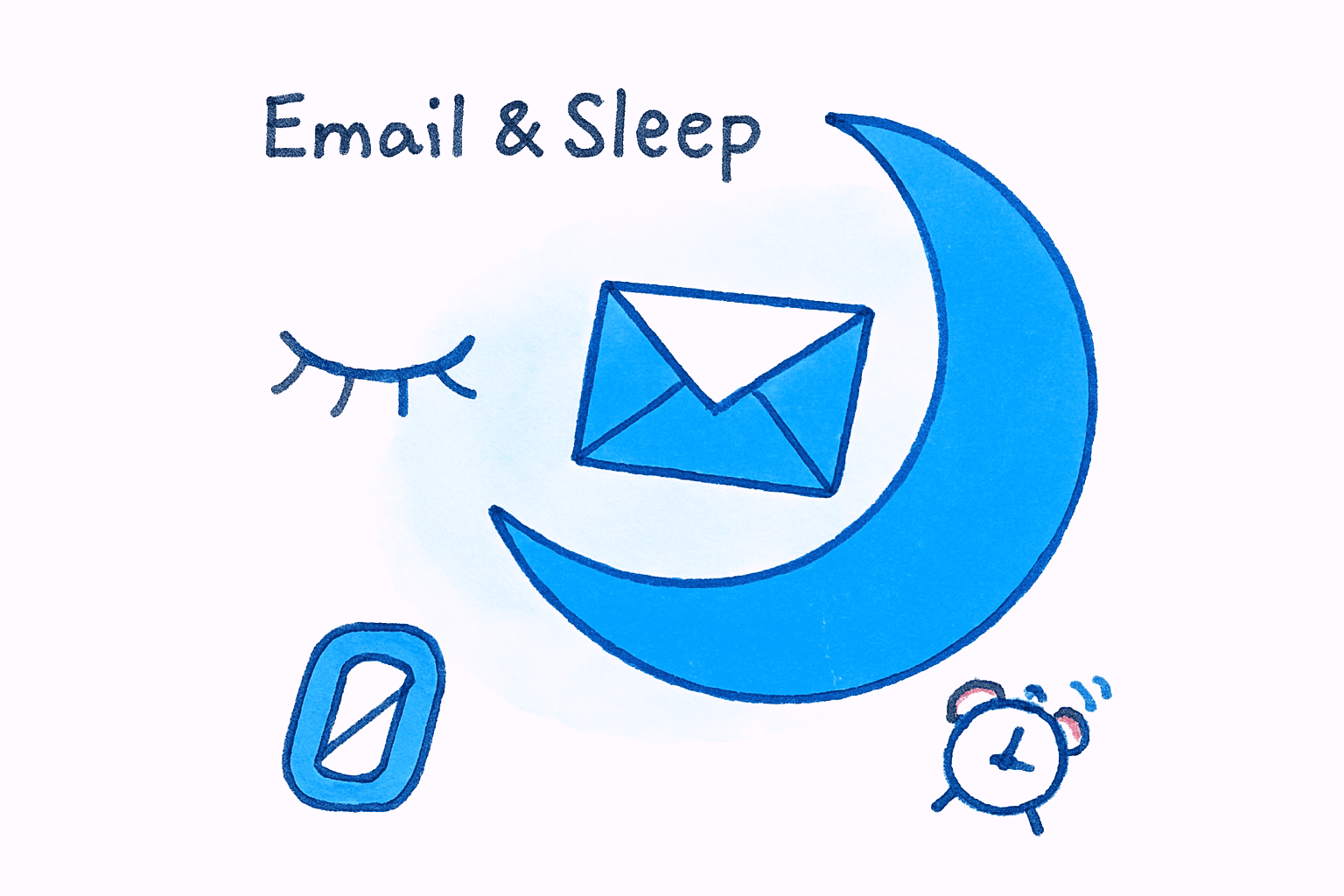
The cleanest way to understand what checking email before bed does to your sleep is to read one bad message at 11:43 PM and then try to fall asleep. Your body will do the experiment for you. Heart rate up. Sleep latency up. Cortisol curve flattened. Next morning, more reactive. The mechanism is well-described in the literature; the only thing surprising about it is how quietly we have accepted it as the default.
Email has no closing time. That is not a flaw in the protocol; it is the protocol. SMTP was designed in 1982 to be permanently open, and the inbox inherited that openness. Your nervous system did not. The result is a daily collision between an unbounded medium and a body that runs on circadian rhythms. The collision happens, by the data, in two places: the last hour before you sleep and the first hour after you wake.
Here is the editorial stance most “email tips” articles refuse to take: the problem is not your willpower at 11 PM. The problem is that email has no finish line, so your brain treats every check as potentially unfinished work. A 2018 Belkin and Becker study published in the Journal of Occupational Health Psychology found that the expectation of after-hours email, not the time spent on it, was what drove exhaustion. Anticipation alone did the damage.
Key Takeaway
Checking email in the hour before bed and the first hour after waking measurably disrupts sleep onset, sleep efficiency, and cortisol regulation. A Norwegian cohort study found one hour of pre-bed screen use raised insomnia risk by 59%. The fix is structural: an inbox with a finish line, not better willpower at midnight.
Contents#
- Why Email at Night Is Different from Other Screen Time
- What Happens to Your Sleep When You Check Email Before Bed?
- Is Morning Email Just as Bad for Your Body?
- What the Cortisol Curve Actually Looks Like
- How to Set a Real Email Bedtime
- Frequently Asked Questions
- Sources
Why Email at Night Is Different from Other Screen Time#
Most pre-bed screen advice treats all screens the same. They are not. A late-night TV episode and a late-night inbox check produce very different sleep outcomes because they activate different systems. The TV episode is mostly visual and passive. The inbox is conditional, social, and unfinished. And unfinished is the operative word.
Sophie Leroy’s research on attention residue at the University of Washington showed that switching tasks while one is unresolved leaves a cognitive trace that interferes with the next task. Reading an email at bedtime is the worst possible trigger for this effect. You see a request, you do not act on it, and the unresolved fragment occupies working memory exactly when working memory is supposed to be quieting down.
A 2011 paper in Behaviour Research and Therapy on pre-sleep cognitive arousal found that high cognitive arousal added an average of 37 minutes to sleep onset latency. That is not a marginal effect. That is a meaningful chunk of your night, lost to a single message you could have read in the morning.
The Norwegian Institute of Public Health’s 2025 cohort study of 45,202 students, published in Frontiers in Psychiatry, found that one hour of screen use at bedtime corresponded to a 59% increase in insomnia risk and 24 fewer minutes of sleep on average. The researchers noted that the type of screen activity mattered less than they expected. What mattered was that screens displaced sleep. And email, with its mix of stimulation and obligation, displaces it more efficiently than most.
Honestly, this is the part of the research I had to sit with. I assumed scrolling social media at night was worse than checking email. The data does not support that intuition. Email’s combination of low-stakes addiction and high-stakes content (a newsletter, then a passive-aggressive client message, then nothing, then a reply that needs thought) produces exactly the variable arousal pattern that wrecks sleep onset.
What Happens to Your Sleep When You Check Email Before Bed?#
Pre-bed email shortens your sleep, lengthens the time it takes to fall asleep, and reduces sleep efficiency. The effect sizes are not subtle. A 2022 randomized pilot trial in PLOS ONE restricted bedtime mobile phone use for four weeks and found sleep latency dropped by about 12 minutes and sleep duration increased by about 18 minutes. That is a free 30-minute swing in sleep quality from a single behavioral change.
A 2021 observational study of IT employees published in Stress and Health tracked actigraphy and salivary cortisol over a month. Workers with high-frequency after-hours emailing showed roughly a 1% drop in sleep efficiency and a 5-minute increase in wake-after-sleep-onset compared to low-frequency emailers. Sleep efficiency is a brutal metric. Even a small reduction means more fragmented sleep with the same time in bed.
Larissa Barber and Alecia Santuzzi’s research on workplace telepressure, published in the Journal of Occupational Health Psychology, identified the psychological mechanism behind these numbers. Telepressure is the felt urge to respond to work messages immediately, regardless of objective deadline. Their three-wave survey of 234 employed adults found that high telepressure predicted poorer sleep quality, more burnout, and lower psychological detachment from work. Email is the primary delivery system for telepressure; it is what makes Sunday at 9 PM feel like a workday. (We explored this compulsion loop further in our piece on email notification addiction.)
“The expectation that employees need to respond to email outside the workday creates a state of constant readiness. The body cannot distinguish ‘I might have to work’ from ‘I am working.’” — paraphrasing the construct from Barber and Santuzzi’s telepressure framework
This is the part Cal Newport, Georgetown computer science professor and author of A World Without Email, keeps making in his work: knowledge workers have offloaded their cognitive boundary-keeping onto an inbox that has none of its own. The medium has no built-in “you are done” signal. Without a signal, the brain manufactures vigilance, and vigilance is the enemy of sleep.
If you have already read our piece on the hidden cost of an inbox that never ends, you have seen the chronic-stress version of this argument. The bedtime version is sharper because it is acute and measurable in a single night.
If the urge to do “one quick email check” before bed is the thing keeping you up, Swizero caps your inbox at a fixed handful of cards per session. When the cards are done, the session is done. There is nothing to pull you back at 11 PM.
Is Morning Email Just as Bad for Your Body?#
The pre-bed problem has a mirror image at wake. They share a mechanism: cortisol regulation.
In a healthy circadian rhythm, cortisol begins rising about three hours before wake and peaks in the Cortisol Awakening Response (CAR) within 30 to 45 minutes of opening your eyes. The CAR is preparatory, not stressful. Your body is mobilizing energy for the day. Adding stressors during the CAR window blunts or distorts this curve, with downstream effects on mood, focus, and immune function.
A 2024 American Academy of Sleep Medicine survey found that 80% of smartphone users check their phones within 15 minutes of waking, and 62% check before getting out of bed. For people who get a meaningful share of email on their phones (most knowledge workers), that is the morning’s first cognitive load arriving before the body has finished assembling the cortisol response that is supposed to handle the day.
The WIRED study published in Computers in Human Behavior tracked technology use, cortisol, and inflammatory markers (interleukin-6) across 62 families over four days using cortisol and IL-6 sampling. Fathers’ phone and email use was associated with elevated CAR and IL-6, a genuinely worrying combination because elevated IL-6 is a marker of systemic inflammation associated with cardiovascular risk over time.
You may have seen the figure floating around online that morning phone-checking raises cortisol by 25%. I have not been able to trace that to an unambiguous primary source despite multiple searches; it appears in popularizations but the underlying study is not always cited. I am leaving it out for that reason. The directionally consistent finding, that morning digital intrusion blunts or distorts the CAR, is well-supported by the WIRED data and by the broader literature on pre-sleep and morning cognitive arousal at PMC. The exact percentage is downstream of methodology I cannot verify.
What does seem solid: the morning inbox check is not a neutral act. It conscripts your cortisol response to handle work content before your body has finished its preparatory work. Repeated daily, the curve flattens. Flat cortisol curves are associated with worse sleep, fatigue, and depressive symptoms. This is not a productivity problem. It is an endocrine one.
What the Cortisol Curve Actually Looks Like#
Cortisol is the most-misunderstood word in popular wellness writing. It is not “the stress hormone” in any useful sense. It is a circadian regulator with a daily curve: low at midnight, climbing through the early morning, peaking shortly after wake, falling through the afternoon, near-zero by evening. Disruptions to that curve, not the absolute level, are what predict bad outcomes.
Email disrupts the curve at both ends. At night, you generate evening cortisol spikes that should not exist (Belkin & Becker; the IT employee actigraphy study). In the morning, you front-load stress onto the CAR window, blunting the natural rise.
| Time | Healthy Pattern | Email-Disrupted Pattern | Why It Matters |
|---|---|---|---|
| 9–10 PM | Cortisol low, melatonin rising | Cortisol bumps from inbox stressor | Delays sleep onset by ~37 min in high-arousal cases |
| 11 PM – 12 AM | Deep cortisol nadir | Sustained low-grade arousal | Reduces sleep efficiency, increases WASO |
| 6–7 AM (CAR) | Sharp CAR peak, ~30–45 min post-wake | Blunted or distorted CAR | Predicts worse mood, focus, fatigue |
| 9 AM | CAR resolved, normal daytime curve | Compensatory anxiety, “wired but tired” | Drives more checking, reinforces the loop |
The PMC paper on sleep and circadian regulation of cortisol is the clearest review I have found on what disruption looks like and why a flattened diurnal slope predicts so many bad health outcomes. It is the kind of paper that should be required reading for anyone designing a notification system.
This is the part where the “finish line” framing earns its keep. A medium that runs 24 hours a day is fundamentally incompatible with an endocrine system that runs on a 24-hour clock unless someone (you, your manager, your software) draws the boundary. The default is no boundary. Defaults win.
How to Set a Real Email Bedtime#
The advice on email-and-sleep usually amounts to “have more discipline.” That advice fails because the system is designed against you. Here is what works, ranked by leverage:
1. Move email off the bedside device. Do not put your work email on the same phone you use as an alarm clock. The IT employee study above found that high-frequency after-hours emailers had measurably worse actigraphic sleep; “high frequency” required only that the inbox be a thumb-tap away.
2. Set a hard “last check” time and treat it like a flight cutoff. Pick a time (8 PM, 9 PM, whatever) and treat the inbox as closed after it. Closed means closed; not “I’ll just glance.” Glancing is what generates the 37-minute latency penalty in the cognitive arousal data.
3. Move morning email past the CAR window. Aim for 30 to 60 minutes between waking and your first inbox check. The exact threshold is less important than the principle: let your cortisol curve do its job before adding cognitive load. When you do sit down for that first session, a structured triage approach helps you sort by urgency before engaging with content, so the decisions stay cheap and the session stays short. Our guide on how often you should check email covers the optimal cadence in more detail.
4. Replace willpower with a session-based inbox. Most “email boundaries” advice asks you to resist a system that is engineered to be hard to resist. A session-based inbox (a fixed number of cards, a defined endpoint) replaces the resistance with a structural cue. When the session ends, there is nothing to check. This is the principle behind why our inbox finite vs inbox zero post argues for a card limit over an empty-tray goal.
5. Negotiate the expectation, not just the behavior. Belkin and Becker’s finding was that expectation drove exhaustion. If your team or manager genuinely expects after-hours response, fixing your behavior alone leaves the anxiety in place. The fix has to include explicit norms. Our after-hours email guide covers the policy side in detail.
I should be honest: tip 4 is the one I personally found hardest. Tip 3 was almost easy once I moved my charger to the kitchen. Tip 4 required a different kind of inbox entirely. That is the structural part, and it is also the part Swizero exists to solve.
Frequently Asked Questions#
Is checking email right before bed actually that bad, or is this overhyped?#
The effect is real and measurable. The Norwegian cohort study of over 45,000 participants found one hour of bedtime screen use raised insomnia risk by 59% and reduced sleep by 24 minutes. A randomized pilot trial showed restricting pre-bed phone use cut sleep latency by 12 minutes and added 18 minutes of sleep over four weeks. The mechanism (pre-sleep cognitive arousal delaying sleep onset) is well-supported across multiple studies.
What about checking email first thing in the morning? Is that as bad as before bed?#
Different mechanism, also problematic. Morning email checking arrives during the Cortisol Awakening Response window (the first 30–45 minutes after wake), when your body is mobilizing for the day. Adding work stressors during that window distorts the curve. The WIRED study published in Computers in Human Behavior found that fathers’ phone and email use correlated with elevated CAR and IL-6 (a systemic inflammation marker). Morning is more about endocrine disruption; night is more about sleep disruption.
How long before bed should I stop checking email?#
The research suggests at least one hour, and ideally more. The Norwegian study found insomnia risk rose with just one hour of bedtime screen use. The pilot trial that produced measurable sleep improvement restricted phone use throughout the bedtime period. A practical floor is one hour before sleep; a stronger version is “after 8 or 9 PM the inbox is closed.”
My job genuinely requires being responsive at night. What do I do?#
First, audit the requirement. Belkin and Becker’s research found that perceived expectation often exceeds actual expectation. Your manager may not require what you think they require. Second, if the requirement is real, separate the channel. Move urgent contact to text or phone (which is reserved for actual emergencies), and let email rest at night. The constant low-grade vigilance of “an email might come” is what drives the cortisol disruption, not the rare actual emergency.
Will switching to “do not disturb” before bed fix this?#
Partially. DND blocks notifications but does not block your habit of opening the inbox. The 2024 AASM survey found 80% of smartphone users check phones within 15 minutes of waking, and almost all of them have DND active during sleep. The trigger is internal as much as external. Removing the app from the device, or using a session-based inbox that ends at a defined point, addresses the habit. DND alone does not.
Sources#
- Exhausted but Unable to Disconnect: After-Hours Email, Work-Family Balance and Identification. Belkin, Becker & Conroy, Journal of Occupational Health Psychology, 2018. Anticipatory stress, not time spent, drives email-related exhaustion.
- Screen Use at Bedtime and Sleep Duration and Quality. Norwegian Institute of Public Health cohort, Frontiers in Psychiatry, 2025. One hour of bedtime screen use raises insomnia risk by 59%.
- The influence of pre-sleep cognitive arousal on sleep onset processes. Wuyts et al., Behaviour Research and Therapy, 2011. High cognitive arousal adds 37 minutes to sleep latency.
- Effect of restricting bedtime mobile phone use on sleep, arousal, mood, and working memory: A randomized pilot trial. PLOS ONE, 2022. Restriction reduced sleep latency by 12 min, increased sleep duration by 18 min.
- Work e-mail after hours and off-job duration and their association with psychological detachment, actigraphic sleep, and saliva cortisol. Stress and Health, 2021. High-frequency after-hours email reduced sleep efficiency and increased WASO.
- Please Respond ASAP: Workplace Telepressure and Employee Recovery. Barber & Santuzzi, Journal of Occupational Health Psychology, 2014. Telepressure predicts sleep problems and burnout.
- WIRED: The impact of media and technology use on stress (cortisol) and inflammation (IL-6) in fast-paced families. Computers in Human Behavior, 2018. Fathers’ phone/email use linked to elevated CAR and IL-6.
- Sleep and Circadian Regulation of Cortisol: A Short Review. PMC, 2022. Disrupted diurnal cortisol slope predicts worse health outcomes.
- Cortisol Awakening Response. Reference overview of the CAR mechanism and its 30–45 minute peak window.
- Why Your Brain Won’t Stop Working While You Try to Sleep. Leroy, Organizational Behavior and Human Decision Processes, 2009. Attention residue from unfinished tasks impairs subsequent cognitive performance.
Your inbox doesn't have to feel like this.
Email with a beginning, middle, and end.
Make email a bounded session