The AI Email Arms Race: How Every Inbox Got a Language Model
By Chris Stefaner, Co-founder of Swizero
In January 2026, Google flipped a switch that affected 1.8 billion Gmail accounts. AI-generated email summaries, drafting tools, and a new “AI Inbox” view powered by Gemini 3 began rolling out to every user, with free summaries enabled by default. Three months later, Microsoft launched Copilot Agent Mode in Outlook, giving AI the ability to triage emails, draft replies, and create inbox rules autonomously. Apple had already shipped AI summaries and priority sorting in Mail with iOS 18.2 the previous December.
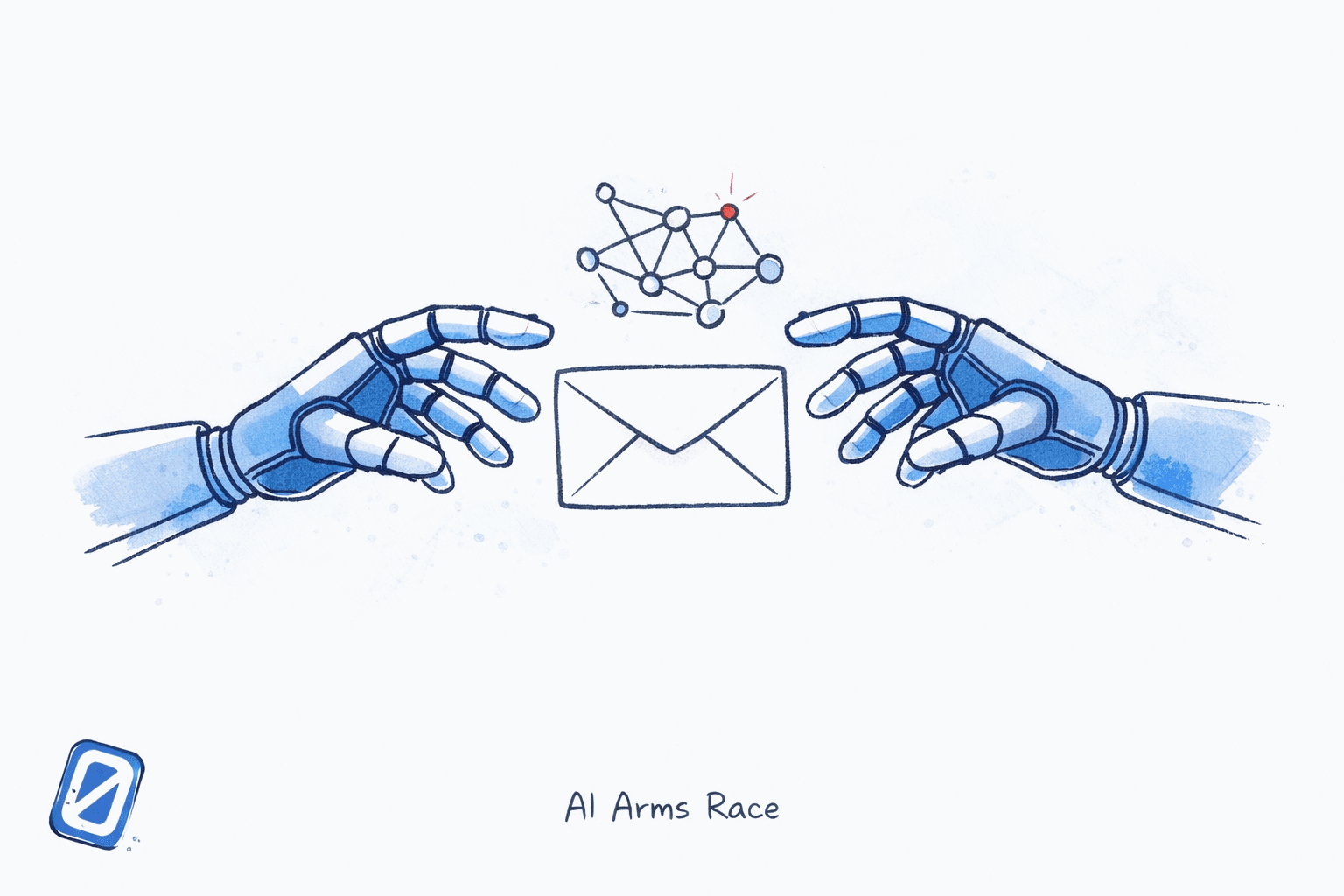
Within 18 months, every major email platform added a language model. The AI email arms race is not coming. It already happened.
Here is the problem nobody in that race is asking: if AI can now read, summarize, draft, and organize every message, why is the average professional still spending 4.1 hours a day managing email? The answer points to a blind spot the entire industry shares. The AI email race is solving the wrong problem, making infinite inboxes slightly more manageable instead of making email finite.
Key Takeaway
Every major email platform now embeds a language model to help users manage more email faster. But none of them question whether users should see all that email in the first place. The real opportunity is not AI that manages an infinite inbox; it is AI that reduces the inbox to only what matters.
Who Shipped What: The AI Email Landscape in 2026#
The speed of deployment is worth documenting because it reveals how quickly an optional experiment became table stakes.
Google Gmail + Gemini 3. Gmail’s January 2026 update introduced AI Overviews (thread summarization and natural-language inbox queries), Help Me Write (draft generation and polishing), Suggested Replies that match the user’s writing style, and Proofread for tone and clarity adjustments. The most consequential addition is AI Inbox, a new view that reshapes email around summaries, topics, and to-dos rather than individual messages. Gmail VP Blake Barnes described it as Gmail “entering the Gemini era.” Free summaries are opt-out, not opt-in.
Apple Mail + Apple Intelligence. Apple’s approach, introduced with iOS 18.2 in December 2024, splits the inbox into four categorical views (Primary, Transactions, Updates, Promotions) and surfaces a Priority Messages section at the top. Summaries replace traditional preview text beneath each message. The differentiator: Apple processes most of this on-device, using the Neural Engine rather than cloud servers.
Microsoft Outlook + Copilot Agent Mode. Microsoft’s April 2026 rollout moved Copilot from a drafting assistant to an autonomous agent. Agent Mode can triage your inbox, prioritize messages, surface replies that still need attention, draft follow-ups, and create inbox rules, all without being asked. Microsoft described the goal as handling “the repetitive office work that surrounds communication.” The feature launched through the Frontier early-access program and is not yet available to EU users.
AI-native startups. Companies like Shortwave, Superhuman, and Spark have rebuilt their products around language models, offering AI search, drafting, and triage as core features. Where the big platforms retrofitted AI onto existing email, these startups built AI into the foundation.
| Platform | AI Launch | Key AI Feature | Processing | Default Status |
|---|---|---|---|---|
| Gmail | Jan 2026 | AI Inbox + Gemini Overviews | Cloud (Gemini 3) | Opt-out |
| Apple Mail | Dec 2024 | Priority Messages + Summaries | On-device (Neural Engine) | Opt-in |
| Outlook | Apr 2026 | Copilot Agent Mode | Cloud (Microsoft AI) | Preview (Frontier) |
| AI-native startups | 2023-2025 | Full AI-first architecture | Cloud (various LLMs) | Default |
Why Did Every Platform Add AI at the Same Time?#
Every major email provider added a language model within roughly the same 18-month window because the underlying technology matured simultaneously. Large language models crossed the threshold from experimental to production-ready, and the competitive dynamics made waiting impossible.
Gartner predicts that 40% of enterprise applications will feature task-specific AI agents by the end of 2026, up from less than 5% in 2025. Email, as the most universal enterprise application, became the obvious first target. Global AI software spending is projected at $184 billion in 2026, and much of that investment flows toward productivity tools where ROI is easiest to measure.
The result is a technology arms race where each platform’s AI features serve as marketing differentiators and retention tools. Google cannot afford to let users switch to Outlook for better AI. Microsoft cannot let Gmail’s AI Inbox go unanswered. Apple cannot be the privacy platform without offering comparable intelligence. The competitive pressure ensures convergence on the same capabilities: summarize, draft, prioritize, organize.
I could write a whole post about why this convergence matters for startup strategy specifically, but the critical point here is this: when every player offers the same AI toolkit, the differentiator stops being “we have AI” and starts being what the AI is designed to do.
Projected AI Agents in Enterprise Apps
Source: Gartner, August 2025
What Are All These Language Models Actually Doing?#
The short answer: they are making it faster to read and respond to the same volume of email you already receive. Summarization, smart replies, draft generation, tone adjustment, and natural-language search are the features every platform has converged on.
Summarization condenses long threads into key points. Smart replies generate contextually relevant response options. Draft generation lets you type a prompt (“politely decline this meeting”) and receive a full email. Tone adjustment rewrites cold messages to sound warm, or vice versa. Natural-language search replaces keyword hunting with conversational queries.
These are genuinely useful capabilities. But notice what they share: every one of them operates on email after it arrives. The language model sits between you and your inbox, translating the raw stream into something more digestible. The stream itself remains unchanged.
Professor Gloria Mark, author of Attention Span and researcher at the University of California, Irvine, has spent nearly two decades studying how technology shapes focus. Her research shows that the average attention span on screens has dropped from 2.5 minutes in 2004 to just 47 seconds in recent measurements. “When we’re focused, we’re reflective, we can deliberate, we can think more deeply,” Mark explains. “And when we do that, we can retain information better.” AI that helps you skim faster does not solve the attention problem. It accelerates the skimming.
Cal Newport, Georgetown Computer Science professor and author of Deep Work, frames the issue around context switching. “A big theme of my work is that context shifting kills the human capacity to think,” Newport has said. “If I change what I’m paying attention to, even if it’s brief, and then try to bring it back to the main thing I’m doing, that causes a huge cognitive pileup.” A smarter inbox that still interrupts you 30 times a day does not reduce the pileup. It just makes each interruption more legible.
Is More AI in Email Actually Reducing Email Overload?#
No. The data suggests AI features are making email more efficient to process but not less demanding of attention. Professionals still spend an estimated 4.1 hours per day on email management, according to a 2026 Gmelius analysis of enterprise email workflows. Research cited by Forrester indicates that AI tools help workers save roughly 41% of time on email communication tasks, but the total time in the inbox has not dropped proportionally because the volume of email continues to grow.
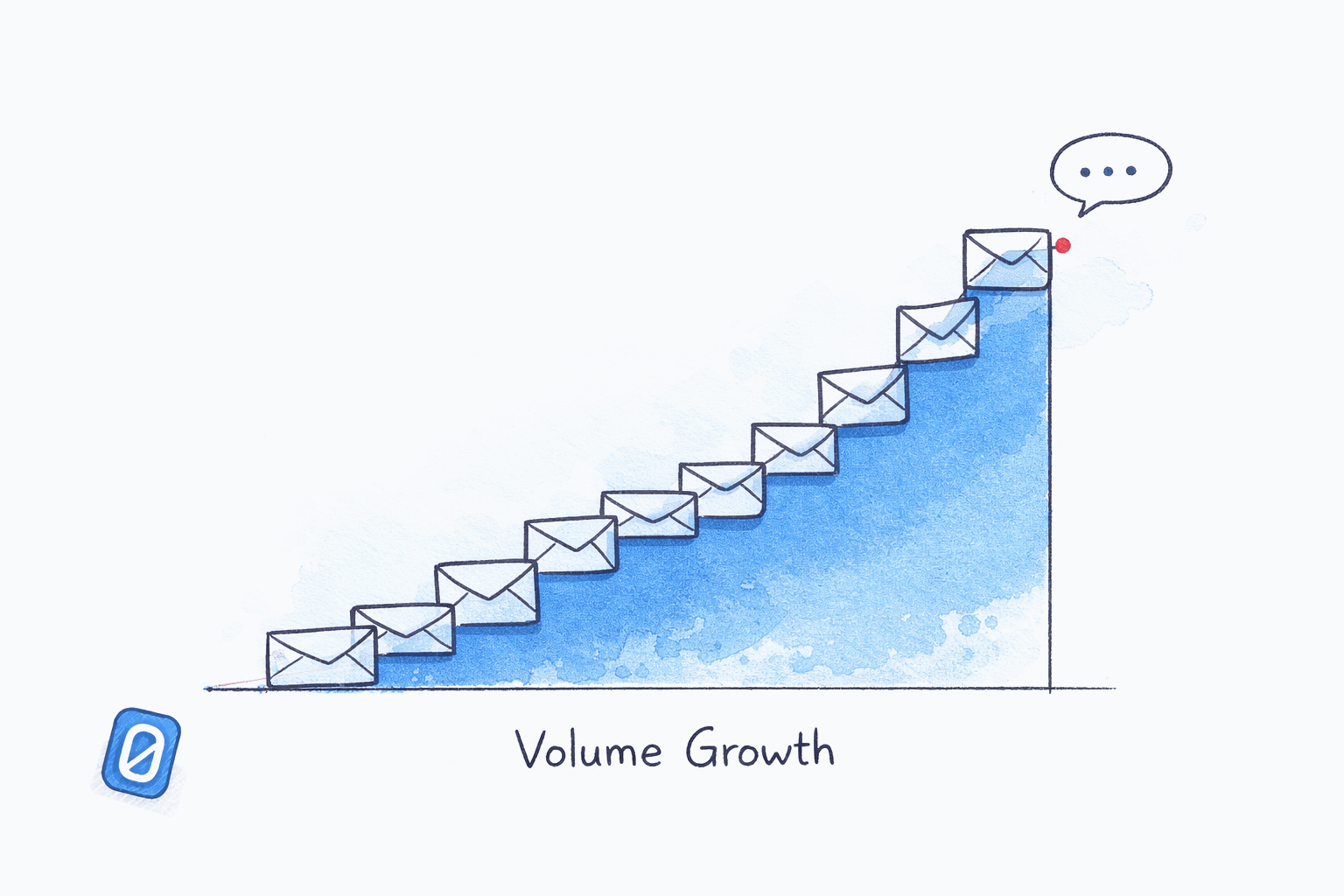
This is the paradox at the center of the AI email arms race. AI makes each email faster to handle, which lowers the friction of sending and receiving, which increases volume, which brings you back to where you started. Economists call this Jevons’ paradox: when technology makes a resource more efficient to use, consumption of that resource tends to increase rather than decrease. Coal-fired steam engines did not reduce coal consumption. They made coal so useful that demand exploded.
One honest caveat: measuring the counterfactual is hard. Maybe without AI features, email overload would be even worse than it is now. We cannot run the experiment. But the directional evidence is clear: email volume has grown every year for two decades, and the arrival of AI email tools has not reversed that trend.
If the idea of AI that accelerates the treadmill rather than building an off-ramp resonates, Swizero takes a different approach: AI that ranks your email by importance and then caps what you see at a fixed card limit. The inbox has a finish line. You reach it.
What Is the Blind Spot in the AI Email Race?#
Every platform in the AI email arms race has converged on the same assumption: users want to process all their email, just faster. The entire feature set (summarize, draft, prioritize, organize) is designed to help you get through an infinite stream more efficiently.
Nobody is asking whether the stream should be infinite in the first place.
Consider the analogy to content feeds. Social media platforms spent years adding algorithmic feeds and “caught up” markers to help users manage infinite scrolling. The most meaningful interventions turned out to be screen-time limits and usage dashboards, tools that constrained the feed rather than optimized it.
Email is following the same trajectory, a few years behind. Gmail’s AI Inbox reshapes email around summaries and to-dos, but it still shows you everything. Copilot Agent Mode triages your inbox, but the inbox itself has no boundary. Apple Mail surfaces priority messages, but the non-priority messages are still there, still generating decision fatigue with every glance.
The blind spot is structural. These platforms make money when you spend time in their ecosystem. Google serves ads around Gmail. Microsoft sells Copilot licenses per seat. Apple sells devices that stay useful when you keep using them. None of these business models incentivize reducing the time you spend in email.
Swizero starts from a different premise: the AI’s job is not to help you manage an infinite inbox but to rank every email by importance and then surface only a handful of cards. The constraint is the feature. This is closer to how a chief of staff screens your calls than how a search engine indexes your archive.
That constraint also defines a safer division of labor: our guide to what an AI email agent can safely do separates low-risk ranking and summarization from actions that should still require human approval.
What Happens When AI Writes the Emails Too?#
There is a second-order effect worth noting. When every inbox has a language model for reading, the senders start using language models for writing. Gmail’s Help Me Write, Copilot’s draft generation, and dozens of third-party tools now generate the emails that other AI systems will summarize.
We are approaching a world where AI writes the email, AI summarizes it on the other end, and the humans on both sides interact only with the summaries. Research from McKinsey’s 2023 report The Economic Potential of Generative AI estimated that 60 to 70% of worker activities could theoretically be automated. Email drafting is among the most straightforward applications. But automating both sides of a communication channel does not eliminate the channel; it inflates it. If sending email costs less effort, more email gets sent.
A constraint-first approach, the kind explored in the finish-line philosophy, breaks this flywheel by design. When your inbox has a hard cap, the AI must choose what matters rather than translating everything that arrives.
What Should Users Do Right Now?#
Knowing that every inbox now has AI does not mean every user benefits equally. Here are three principles worth adopting regardless of which platform you use.
Audit the defaults. Gmail’s AI summaries are opt-out, meaning they are already running unless you disabled them. Apple’s Priority Messages are opt-in. Microsoft’s Agent Mode requires Frontier access. The default settings shape your experience more than any feature you consciously activate.
Distinguish between speed and reduction. AI that helps you reply faster is not the same as AI that reduces how many messages require your attention. If your goal is fewer email decisions per day, you need a tool that filters, not one that accelerates.
Evaluate privacy trade-offs. Google’s Gemini processes email in the cloud. Apple’s intelligence runs mostly on-device. Microsoft’s Copilot uses cloud processing with enterprise data protections. If email privacy matters to you, understanding where your data goes is more important than which feature set looks best in a demo.
Frequently Asked Questions#
Does every email app use AI now?#
Every major email platform now integrates AI features. Gmail uses Gemini for summaries and drafting, Apple Mail uses Apple Intelligence for prioritization and summaries, and Microsoft Outlook uses Copilot for triage and drafting. Third-party email apps have also added AI since 2023. Clients without AI integration still exist but represent a shrinking market share.
Is AI in email safe for privacy?#
Privacy depends on the implementation. Apple processes most AI features on-device using the Neural Engine. Google and Microsoft process email in the cloud, though both state they do not use email content to train their AI models. Third-party tools vary widely, so reviewing privacy policies before granting inbox access is essential.
Will AI replace the need to read email?#
AI summarization reduces the need to read every word of every message, but critical decisions still require human judgment. Summaries can miss nuance, misinterpret tone, or omit context that matters for your specific situation. AI handles the volume; humans handle the judgment calls.
Can AI actually reduce email overload?#
Current AI email features make individual messages faster to process but do not reduce the total number arriving. Research suggests that reducing how often you check email and setting boundaries on inbox time remain more effective strategies for managing overload than AI summarization alone.
Sources#
- Gmail Is Entering the Gemini Era. Google, January 2026. Announcement of Gemini 3-powered AI features for Gmail including AI Inbox, summaries, and writing tools.
- Agent Mode Is Here in Outlook. WinBuzzer, April 2026. Coverage of Microsoft Copilot Agent Mode launch for Outlook.
- Copilot in Outlook: New Agentic Experiences. Microsoft Tech Community, April 2026. Official announcement of Copilot Agent Mode capabilities.
- Use Apple Intelligence in Mail on iPhone. Apple Support, 2025. Documentation of Apple Intelligence email features.
- Gartner Predicts 40% of Enterprise Apps Will Feature AI Agents by 2026. Gartner, August 2025.
- AI Statistics 2026: Market Size and Growth Trends. Resourcera, 2026. Global AI spending projections and productivity impact data.
- 15 Best AI Email Assistants for Productivity in 2026. Gmelius, 2026. Analysis of enterprise email time expenditure.
- 5 Ways to Maintain Deep Focus. CNBC, March 2026. Gloria Mark on declining attention spans and screen focus.
- Cal Newport on Deep Work, Focus, Productivity, Email. Lex Fridman Podcast. Cal Newport on context switching and cognitive pileup.
- The Economic Potential of Generative AI. McKinsey, June 2023. Estimate that 60-70% of worker activities could be automated with generative AI.
- Gmail AI Inbox Announcement. 9to5Google, January 2026. Coverage of Gmail’s AI Inbox view launch.
Your inbox doesn't have to feel like this.
Be among the first to experience a finished inbox.
Join the finite inbox beta