Email Etiquette for Async and Remote Teams in 2026
By Chris Stefaner, Co-founder of Swizero
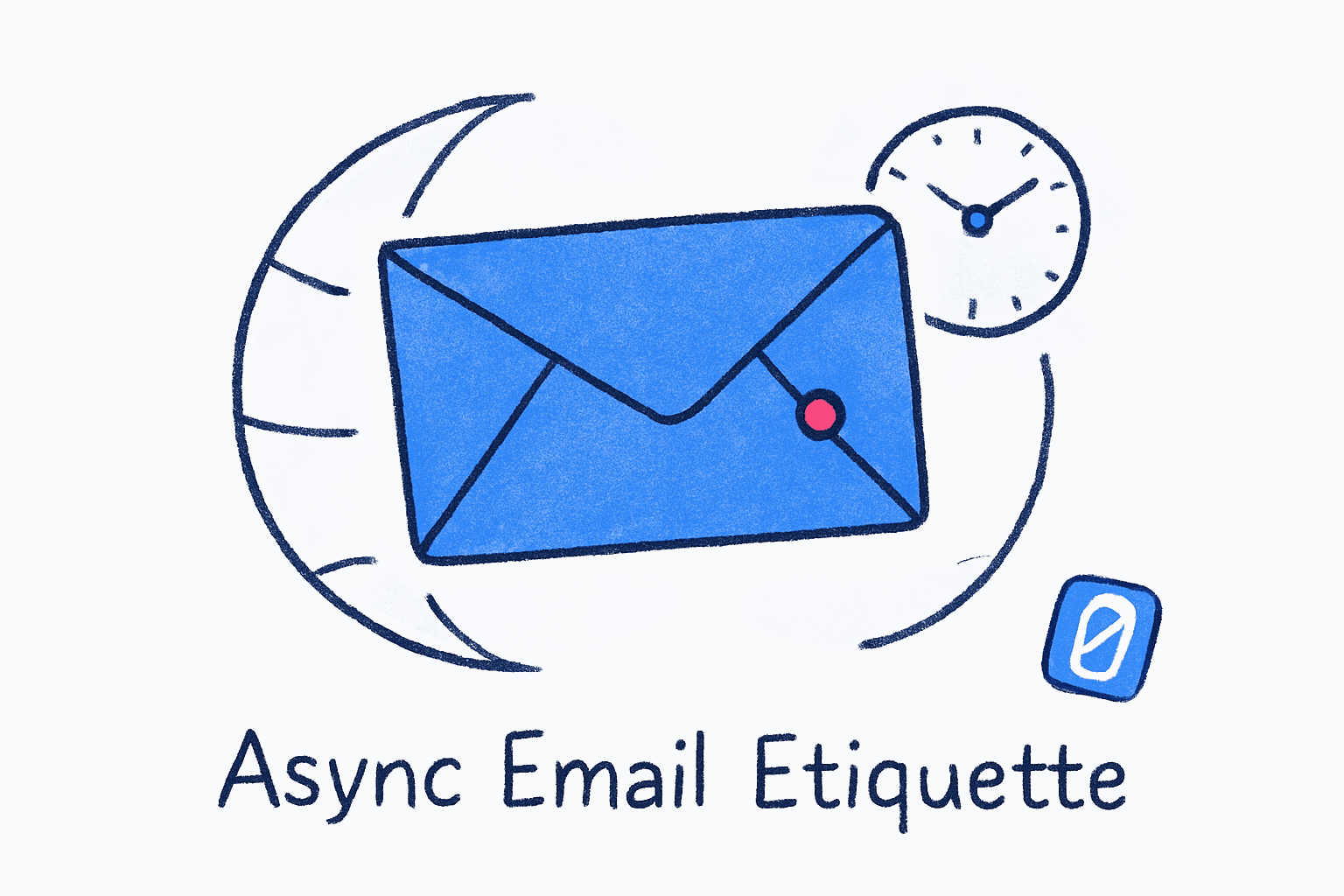
Good async email etiquette starts with one move: writing the response time on the email itself. Not in a handbook. Not in onboarding. On the message. “Reply by Thursday EOD” or “FYI, no reply needed”; pick one, every time. The rest of this guide is downstream of that one move.
That’s not a stylistic preference. It’s a fix for a structural problem in distributed work: when nobody knows when a reply is expected, everyone defaults to “as soon as possible,” and “as soon as possible” is how you end up with people answering email at 10pm. Microsoft’s 2025 Breaking Down the Infinite Workday report found that 29% of active workers are back in their inbox by 10pm and the average employee now sends or receives more than 50 messages outside core business hours.
The deeper issue is that most “email etiquette” advice was written for a co-located office where you could lean over and clarify a message in person. Remote teams don’t have that fallback. Every ambiguity in an email turns into a Slack DM, a meeting, or; worst case; silent assumptions that diverge for days. The unwritten rules in this guide come from companies that have actually had to write them down: GitLab, Basecamp, Doist, Buffer. Their handbooks are the closest thing the industry has to an empirical literature on how to do email when you can’t tap someone on the shoulder.
Key Takeaway
Async email etiquette for remote teams in 2026 boils down to three rules: state the expected response time on every message (default 24 hours, never “ASAP” without a reason), put the conclusion in the subject line and the first sentence, and stop CCing the boss; research from the University of Cambridge shows it actively erodes trust. Everything else is a detail.
Contents#
- Why Remote Teams Need Different Email Rules
- What Counts as a Reasonable Response Time?
- The Subject Line Is the Email
- When Not to CC (And Why CCing the Boss Backfires)
- Time Zones Are a Permission, Not a Problem
- How Async-First Companies Actually Do Email
- Frequently Asked Questions
Why Does Async Email Etiquette Matter for Remote Teams?#
Remote work didn’t invent bad email habits. It exposed them. In an office, an unclear email gets repaired through proximity; someone walks over, you have a one-minute hallway clarification, work continues. Remove proximity and the same unclear email becomes a 6-hour blocker, then a Slack DM, then a “quick sync” that eats half an afternoon.
The data says this is happening at scale. Microsoft’s 2025 study found that knowledge workers are interrupted by a meeting, message, or notification every two minutes during the workday, and 60% of work time is spent in email, chat, and meetings; leaving 40% for the work people were actually hired to do. The 30% of meetings that now span multiple time zones are a remote-era addition. Every one of those meetings is a candidate for being an async email instead.
Here’s the editorial position this post takes: most email-etiquette advice is wrong for remote teams because it was written for synchronous environments where ambiguity gets resolved by being in the same room. Async teams need rules that encode the missing context into the message itself. That’s a different bar.
What Counts as a Reasonable Response Time?#
For non-urgent email on a remote team, 24 hours is the right default. For genuinely urgent items, use a different channel entirely; phone, on-call paging, or whatever your team’s escalation path is. Not “URGENT” in the subject line. The escalation path.
This isn’t aspirational. It’s the explicit norm at the most successful async-first companies. Doist, the maker of Twist and Todoist, runs a fully distributed team across 60+ countries on a 24-hour response default. Founder Amir Salihefendić has been clear that “everyone at Doist knows that asynchronous communication is the default, and no one should expect an immediate response from their teammates.” Basecamp’s internal communication guide is even more pointed: in The 37signals Guide to Internal Communication, the company writes that “the expectation of immediate response is toxic.” That’s not a typo. They use the word toxic.
Why this matters for etiquette: when senders don’t state the expected response time, recipients default to “as soon as I can get to it without seeming rude,” which in practice means right now. That’s how you build a team that’s always context-switching and never doing deep work. Sophie Leroy’s research at the University of Washington on “attention residue”; the cognitive overhead that lingers when you switch tasks before finishing; shows the cost compounds across each interruption. A 24-hour default is a kindness to your colleagues’ attention.
The practical etiquette move: write the deadline on the message. Microsoft Research’s analysis of 938,035 enterprise emails found that messages containing an explicit request are answered roughly twice as often as those without, 14.81% versus 7.45%. State it in the subject line if possible.
| Message type | Suggested response window | Channel |
|---|---|---|
| Informational FYI | No reply needed (say so) | |
| Standard request | 24 hours | |
| Cross-time-zone work blocker | 48 hours | Email + status doc |
| Same-day decision | Same day, by stated time | Email with clear deadline |
| Genuinely urgent | Minutes | Phone / on-call / paging |
One caveat: 24 hours assumes a five-day work week and no weekend obligation. Several remote-first companies; GitLab, Doist, Basecamp; explicitly carve out weekends and after-hours from response expectations. If your team hasn’t done this, the right-to-disconnect frame in our after-hours email guide is the place to start before fixing anything else.
The Subject Line Is the Email#
In async work, half your colleagues will read only the subject line. Treat it like a headline, not a folder label.
The same corpus shows reply rates falling steadily as subject lines lengthen, from 11.47% at one word down to 1.10% at 29 words; but the underlying principle is clarity, not brevity for its own sake. The Mailchimp benchmark research recommends keeping subject lines at or below 60 characters because mobile email clients truncate everything past that. If your conclusion is in word 12, half your team never sees it.
The async-friendly subject line pattern looks like this: [Tag] Topic; action needed by date. Examples:
[FYI] Q2 launch dates locked; no reply needed[Decision] Vendor pick by Thursday EOD; pls weigh in[Blocker] API key expired; need rotation today[Status] Week 17 update; read when you have 5 min
The tags are doing real work. They tell a recipient in 0.3 seconds whether to open this now, batch it for later, or skip it entirely. GitLab’s communication handbook is built on a related principle: every message should declare its expected handling. The handbook defaults to public, written, and self-contained; meaning a stranger should be able to open the thread and understand what’s going on. That’s a useful test for your subject lines too. Would someone three time zones away, opening this on their phone with seven other things to read, immediately know what to do?
Honestly, I struggled with this one for years. I used to write subject lines like “quick question” because I thought it sounded casual and friendly. It’s not friendly. It’s the opposite. It forces the recipient to open the email to find out what they’re actually being asked, and “quick question” almost always means a slow question. Specificity is the actual courtesy.
If your inbox is full of vague subject lines from teammates who haven’t read this guide yet, Swizero distills every email down to its essence on a fixed card; so even a subject line saying “quick question” gets a one-sentence summary of the actual ask. The sender might still be vague. Your inbox doesn’t have to be.
When Not to CC (And Why CCing the Boss Backfires)#
The CC line is the most quietly destructive feature in email, and remote teams over-use it more than co-located ones do. If you only take one rule from this section: never CC someone’s manager unless that manager has a specific decision to make on the thread.
The research on this is striking. David De Cremer, KPMG Professor of Management Studies at the University of Cambridge Judge Business School, published a series of six studies in 2019 with 594 working adults in experimental conditions and 345 in survey conditions. The finding: when a supervisor was always CC’d on emails, recipients reported significantly lower trust in the sender than when the supervisor was sometimes or almost never CC’d. As De Cremer put it, the recipient interprets habitual CCing as surveillance, and the sender’s apparent transparency becomes evidence of the opposite; that they’re documenting against you, not communicating with you.
This is the dynamic Alison Green at Ask a Manager called the “passive-aggressive CC field.” It’s worse on remote teams because the CC is now the only signal you get about social dynamics. In an office, you can read the room; see who’s smiling, who’s tense, what the body language is. Online, the CC list is the body language. When someone CC’s three levels of management on a routine question, the recipient doesn’t think “what a thorough communicator.” They think “this person is escalating.”
When CC is appropriate:
- The CC’d person needs the information for a decision they’re about to make
- The CC’d person owns the outcome and is doing approval-by-silence
- The thread is closing a loop someone explicitly asked to be kept on
When CC is not appropriate:
- “Just to keep the boss in the loop”; your boss has 117 emails today; this is not a kindness
- Documenting that you replied (use a tracking tool, not human attention)
- Implying the recipient can’t be trusted to handle this alone
- Adding eight people to a two-person decision in case someone might want to know
The deeper issue is that in async work, every CC’d person now owes the thread a decision: “Do I need to read this? Do I need to act? Do I just delete?” Multiply that across 117 emails per weekday and you’re stealing minutes from people you didn’t need to involve. The volume problem in group email threads compounds this, and when you CC widely, everyone you added now has the option to reply-all, and the option to do so is itself a tax.
Time Zones Are a Permission, Not a Problem#
The standard remote-work advice on time zones is wrong. It treats time-zone gaps as friction to minimize. They’re not. They’re permission to do focused work without being interrupted, and good email etiquette protects that permission instead of eroding it.
Here’s the etiquette move: assume your recipient is asleep. Write the email so they can act on it whenever they wake up, with everything they need to do their part already in the message. No “let me know if you need more info”; pre-empt the questions they’d ask. No “can we hop on a call to discuss?”; propose three options and let them pick. No “thoughts?”; write your thoughts, ask them to confirm or revise.
Buffer, distributed across more than ten time zones, has built their internal communication around this principle. Their team relies on long-form async tools (Threads inside Slack) for substantive discussions specifically because they want timezone-inclusive conversations where someone in Cape Town can engage as deeply as someone in Toronto. The async-first move is to make the message complete enough that the next person doesn’t have to wait for you to wake up.
Practical conventions that help:
- Always state your time zone in scheduling emails. “Thursday 3pm” is meaningless. “Thursday 3pm CET (9am ET, 6am PT)” takes 4 seconds to write and saves a round trip.
- Use absolute dates, not relative ones. “Tomorrow” depends on when you read this. “Friday May 2” doesn’t.
- Pre-stage decisions. Instead of “let’s discuss,” write “I propose X. If you disagree, reply by Wednesday with a counter; otherwise I’ll move forward Thursday.”
- Send during your working hours, not theirs. Let the email arrive when it arrives. Scheduling a 3am send to “respect their morning” is a fiction; they’ll see the timestamp and know you wrote it at 3am.
The scheduled-send debate is interesting. GitLab’s handbook explicitly recommends not using scheduled send, on the grounds that it hides the reality of when you’re working and creates a false impression of universally synchronous availability. Basecamp takes the opposite position. Reasonable people disagree. The actual etiquette principle underneath both views: don’t pretend you’re working when you aren’t, and don’t expect anyone else to.
How Async-First Companies Actually Do Email#
The companies that have run distributed teams the longest converge on a pattern, even though they use different tools. The pattern is worth naming because it’s the closest thing to a working theory of remote email etiquette.
Default to public. GitLab’s handbook is famous for this: discussions happen in issues, merge requests, and channels visible to the whole company by default. Email and DMs are the exception, not the rule. The reasoning is async-friendly: a public thread can be searched, referenced, and joined by people who weren’t on the original list. A private email is a black hole.
Write for the second reader. Every email on an async team has at least two audiences: the person you’re sending it to, and the person who will find this thread three months from now trying to understand a decision. Write for both. State context. Link to source documents. Spell out the decision you’re proposing.
Treat the inbox as a queue, not a chat room. Basecamp’s internal-comms guide draws a sharp line between “real-time sometimes” and “asynchronous most of the time.” Email belongs in the second category. Treating it like chat (expecting fast replies, sending one-line questions, asking “you there?”) corrupts both. There’s a longer version of this argument in our piece on why email was never meant to be a task list.
Make conclusions retrievable. GitLab’s “single source of truth” principle says the handbook beats Slack, email, or memory when they conflict. Practically: if a decision happened in email, the decision belongs in a document somewhere a future teammate can find. The email is just the conversation that produced the artifact.
Use templates without sounding like a template. Most async-first teams have shared norms for status updates, decision memos, and announcements. The template carries the rigor; the prose carries the personality. “How to Write Emails People Actually Read” covers the prose half of this.
There’s a thread running through all five points, and it’s the same thread that runs through Swizero’s entire view of email: email isn’t broken, it’s unbounded. It has no finish line. Async-first companies fix this culturally by writing rules that make every message do more work, so that fewer messages are needed. The product equivalent; capping the inbox to a fixed number of cards instead of an infinite scroll; is just the same logic applied at the tool layer. Constraints, not features.
One caveat worth naming: most of the companies cited above are software companies with high-trust, well-paid teams. The norms scale, but the enforcement of those norms relies on a culture where managers actually model the behavior. If your CEO sends 11pm “thoughts?” emails, the rest of the team will too, no matter what the handbook says. Email etiquette is downstream of leadership behavior.
Frequently Asked Questions#
Is it rude to not reply to a remote team email within 24 hours?#
No, unless the email itself stated a faster expectation. The 24-hour default is exactly that; a default. If you’re heads-down on deep work, replying within 48 hours is reasonable as long as the original message didn’t flag urgency. The actual rudeness is on the sender’s side: not stating an expected response time. If you’re consistently behind on replies, send a one-line acknowledgement (“Got this, will respond Thursday”) rather than going silent.
What’s the right response time for a remote-first company?#
The published norms at the largest async-first companies; GitLab, Doist, Basecamp; all converge on 24 hours for non-urgent matters and a separate channel (phone, on-call paging) for genuinely urgent ones. Doist’s published policy is explicit: 24 hours is the maximum acceptable delay. If your team hasn’t agreed on a number, agreeing on one is more important than which number you pick.
Should I CC my manager on emails to stay transparent?#
No. The University of Cambridge research from David De Cremer’s team, based on six studies and nearly 1,000 participants, found that recipients trust senders less when a manager is habitually CC’d. Transparency is built through shared documents, public channels, and explicit weekly updates; not through ambient surveillance. CC the manager only when they have a specific decision to make on the thread.
How do you handle email across multiple time zones without burning people out?#
Three rules: state your time zone explicitly in any scheduling email, write messages complete enough to act on without a follow-up, and send during your working hours rather than scheduling messages to land during the recipient’s day. The deeper principle is that time-zone gaps are an opportunity to do focused work without interruption; async etiquette protects that gap rather than collapsing it.
What does “async-first” actually mean for email?#
Async-first means real-time communication is the exception, not the default. For email specifically, it means: longer messages with full context, explicit response times stated on every message, conclusions in the subject line and first sentence, and shared documents replacing endless threads. It doesn’t mean slower; done well, async-first is faster than synchronous because decisions stop waiting on calendars.
Sources#
- Breaking Down the Infinite Workday. Microsoft Work Trend Index Special Report, 2025. 117 emails/day, 50+ outside-hours messages, 29% return to inbox by 10pm, interrupted every 2 minutes.
- The 37signals Guide to Internal Communication. Basecamp, ongoing. “The expectation of immediate response is toxic.”
- How to embrace asynchronous communication for remote work. The GitLab Handbook, 2024-2026.
- What is asynchronous communication? Plus, how to implement it. Doist / Twist, 2024. Doist’s 24-hour response default.
- CCing Boss Can Create ‘Erosion of Trust’: U.K. Study. De Cremer et al., University of Cambridge Judge Business School, 2019. Six studies; 594 + 345 participants.
- The CC Line Is the Most Passive-Aggressive Email Field. Alison Green, Ask a Manager, 2019.
- Characterizing and Predicting Enterprise Email Reply Behavior. Yang, Dumais, Bennett & Awadallah, SIGIR 2017. Microsoft Research, 938,035 enterprise messages: subject-line length and explicit-request effects on reply rate.
- Email Marketing Benchmarks & Industry Statistics. Mailchimp, 2026. 60-character subject line guidance.
- Working Remotely When Everyone is in a Different Timezone. Buffer Open, ongoing. Distributed team across 10+ time zones.
- Why context-switching is killing your productivity. Sophie Leroy, University of Washington, attention residue research.
Your inbox doesn't have to feel like this.
Apply what you just learned, faster.
Put this into practice with Swizero