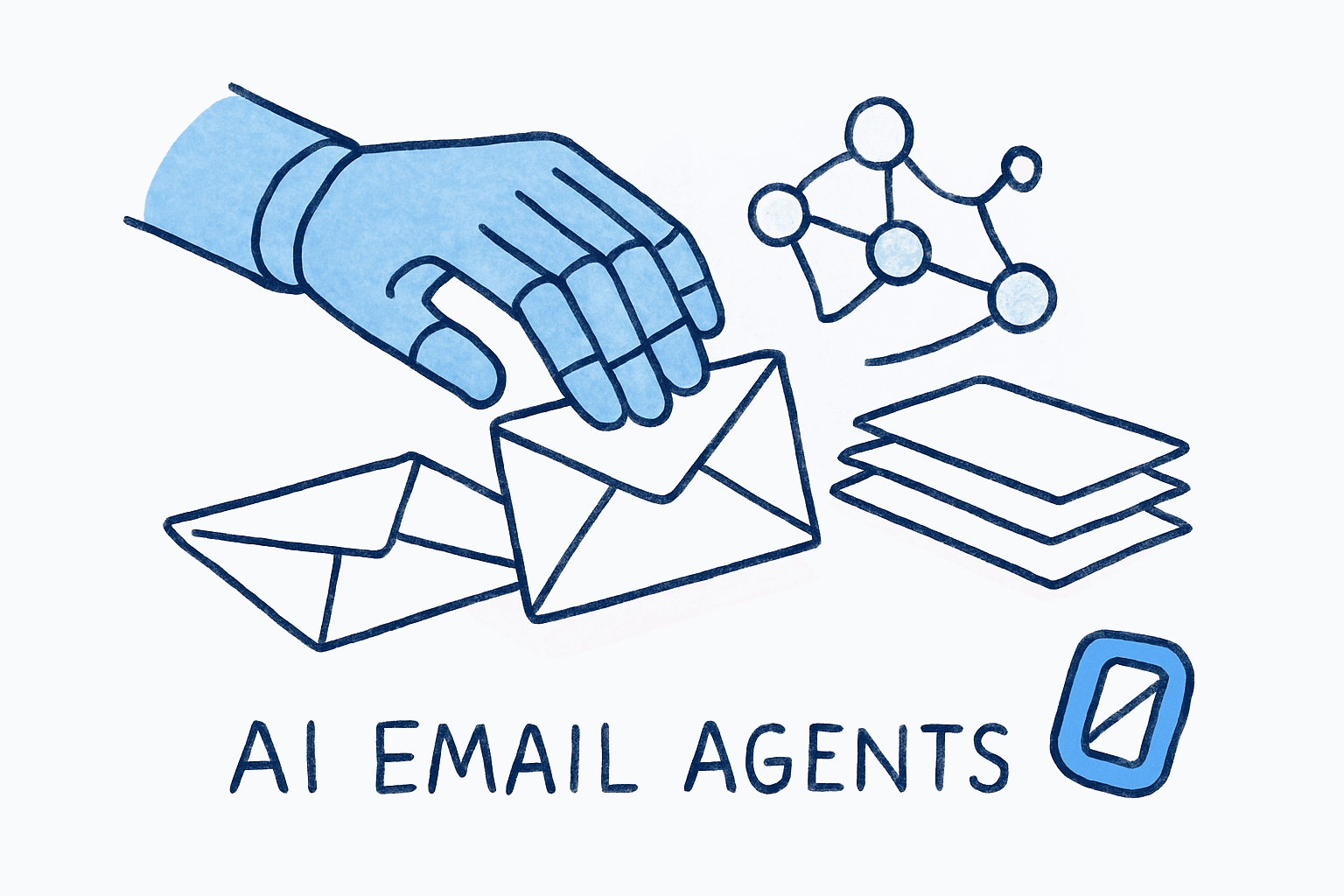
Agentic Email Workflows: What's Actually Working in 2027
By Chris Stefaner, Co-founder of Swizero
The promise was simple: AI agents would read your email, decide what to do, and handle it. No rules to write. No filters to configure. No human in the loop.
By late 2026, enough organizations have tried this that we can stop speculating and start measuring. The results are not what the pitch decks predicted. According to a Gartner press release from June 2025, over 40% of agentic AI projects will be canceled by the end of 2027 due to escalating costs, unclear business value, or inadequate risk controls. The ones that survive share a specific architecture. The ones that fail share a different one.
This post maps the landscape: what agentic email workflows actually look like in production, which infrastructure patterns are winning, where the security model breaks, and what the frontier looks like heading into 2027.
Key Takeaway
Agentic email workflows work in production when they operate within narrow, well-defined scopes with human oversight on irreversible actions. The infrastructure layer (MCP servers, n8n/Make orchestrators) has matured faster than the trust layer. The gap between what agents can do and what organizations allow them to do is now the primary bottleneck, not the technology itself.
What Does an “Agentic Email Workflow” Mean in Practice?#
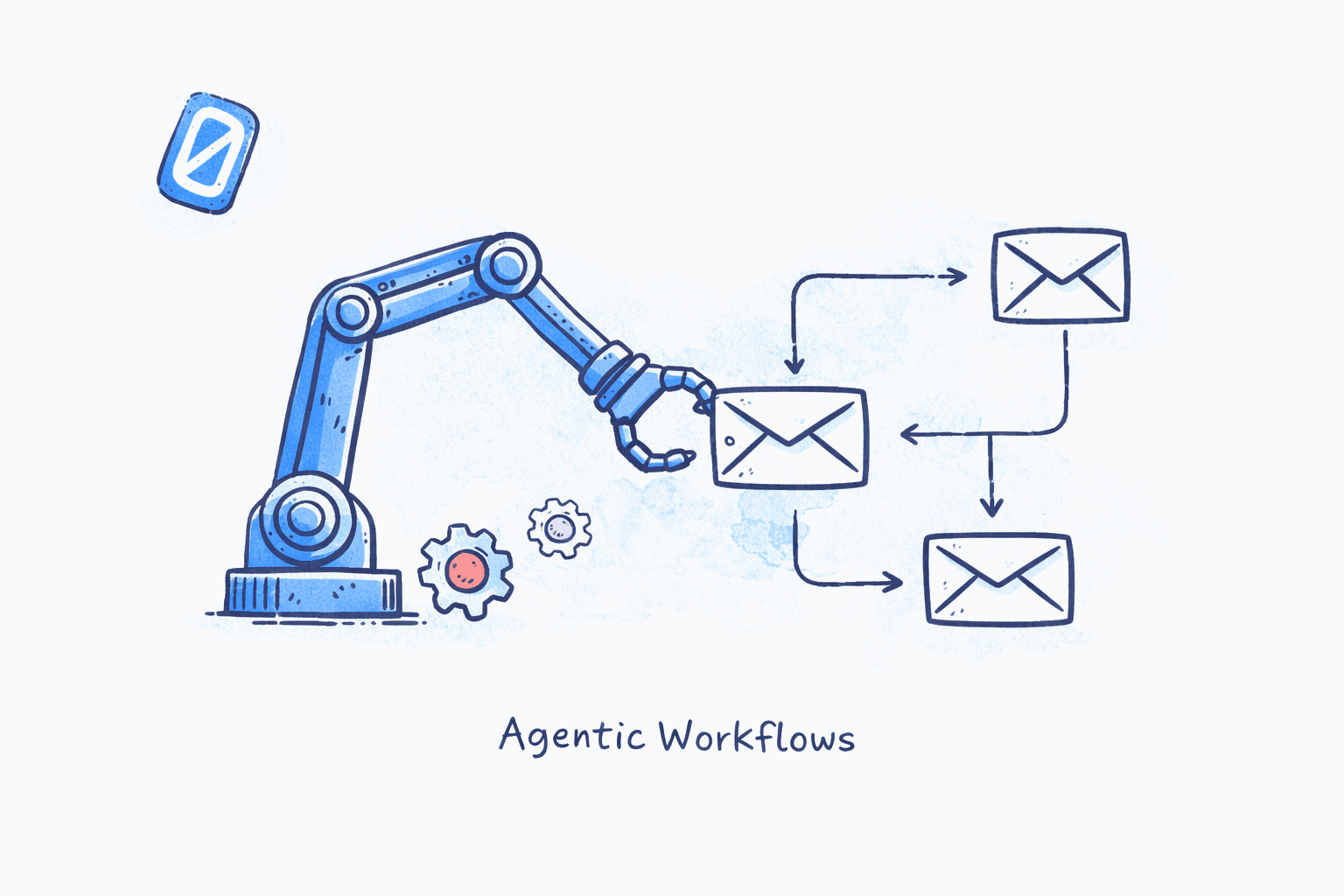
An agentic email workflow is not a filter rule with a language model attached. It is a system that monitors incoming messages, classifies them against a policy, takes multi-step actions across external tools, and adapts its behavior based on outcomes. The word “agentic” has a specific technical meaning here: the system acts without a prompt, connects to external services, and executes plans that span multiple steps. We unpack this distinction in more depth in what agentic email actually means.
In practice, agentic email workflows in production today fall into three tiers:
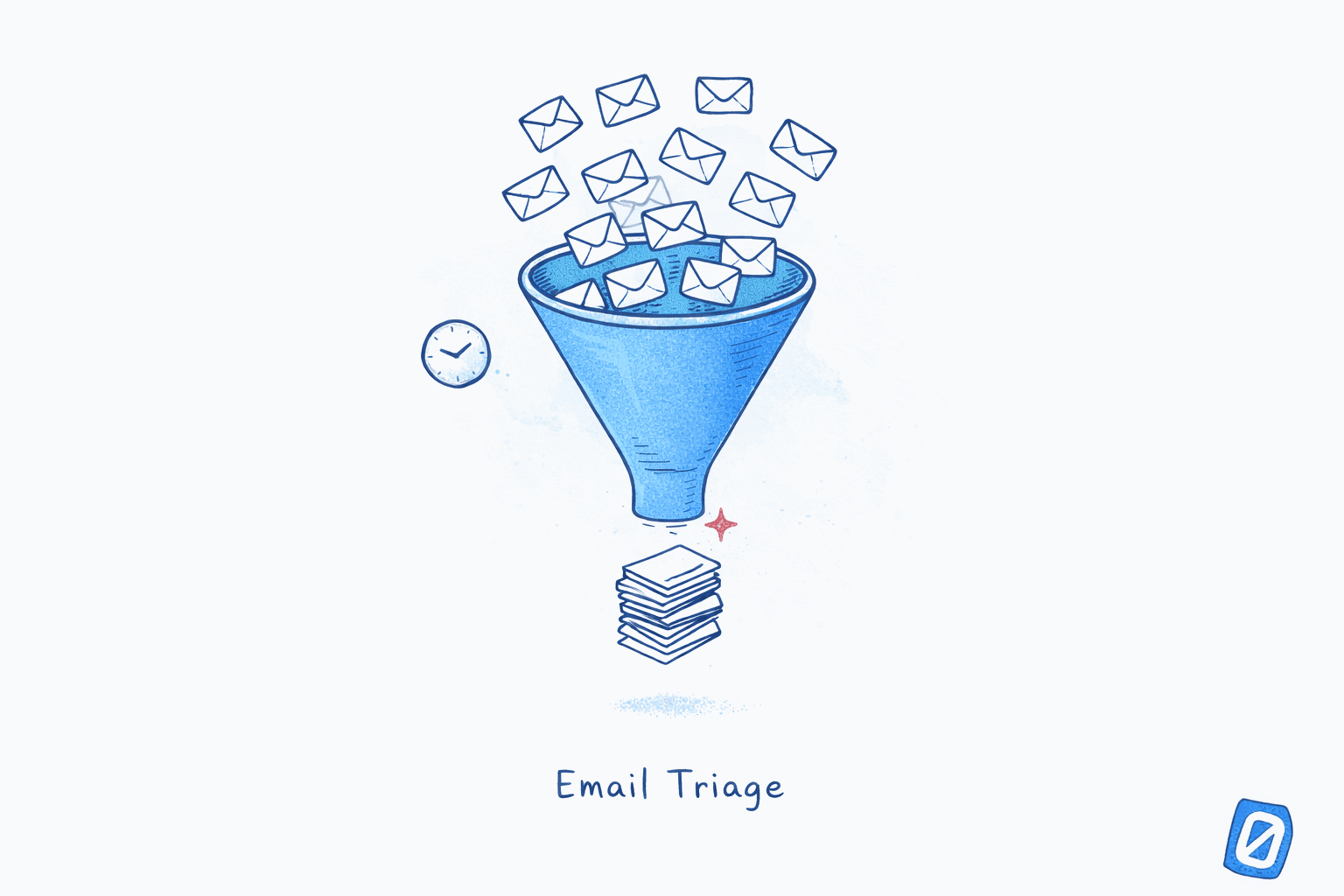
Tier 1: Classify and route. The agent reads incoming email, applies semantic classification (not keyword matching), and routes messages to different channels, labels, or team members. This is the most common production deployment and the most reliable. A support inbox routes billing questions to finance, bug reports to engineering, and partnership inquiries to business development. No replies are sent. No data leaves the system.
Tier 2: Classify, draft, and queue. The agent classifies, generates a context-aware draft reply, and queues it for human approval before sending. This is where most organizations with AI email assistants operate today. The human remains the final checkpoint.
Tier 3: Autonomous execution. The agent reads, decides, acts, and reports. It checks your calendar, proposes meeting times, sends the reply, and updates your CRM. This is where the promise lives and where most failures happen. According to a McKinsey report on AI trust in 2026, less than half of surveyed organizations trust agents to make autonomous decisions even with guardrails in place, and only 8% are comfortable giving agents total autonomy.
How Has the MCP Ecosystem Changed the Game?#
The Model Context Protocol, Anthropic’s open standard for connecting language models to external services, has become the de facto integration layer for agentic email systems. The numbers tell the story: according to Digital Applied’s MCP adoption report, the public MCP server registry grew from 1,200 servers in Q1 2025 to over 9,400 by April 2026, with 78% of enterprise AI teams reporting at least one MCP-backed agent in production. Monthly SDK downloads hit 97 million by March 2026, up from 100,000 at launch.
What this means for email: before MCP, building an agent that could read your email, check your calendar, and update your project tracker required three separate API integrations with three different authentication flows. MCP collapses this into a single protocol layer. One agent, one authentication model, multiple tools.
MCP Server Registry Growth (Public Servers)
Source: Digital Applied, MCP Adoption Statistics 2026
But adoption has outpaced security. The Stacklok State of MCP in Software 2026 report found that only 11% of organizations experimenting with MCP have reached production deployment. In a typical 10,000-person organization, 15% of employees are running an average of two MCP servers each, most receiving no formal security review. And 38% of MCP servers in production come from unofficial sources.
The Zuplo State of MCP Report adds another dimension: 38% of respondents say security concerns are actively blocking increased adoption, and 24% of respondents running servers have no authentication whatsoever.
The infrastructure is there. The governance is not.
What’s Actually Working in Production?#
The agentic email deployments that survive past pilot share three characteristics.
Narrow scope. They handle one workflow, not all email. A legal team’s agent triages incoming contracts. A support team’s agent classifies and routes tickets. A sales team’s agent detects buying signals and updates the CRM. They do not try to be a general-purpose inbox manager.
Human checkpoints on irreversible actions. Successful deployments separate reversible actions (labeling, archiving, drafting) from irreversible ones (sending, deleting, escalating). The agent has full autonomy over the first category and requires approval for the second. This matches what Gartner’s August 2025 press release calls “task-specific AI agents,” which grew from less than 5% of enterprise applications in 2025 to 40% by end of 2026.
Observable failure modes. Production agents log every decision, every tool call, every draft generated. When an agent misclassifies a high-priority email or drafts an inappropriate response, the team can trace exactly what happened and update the policy. Organizations running agents without monitoring are flying blind. According to Beam.ai’s analysis of AI agent security, only 14.4% of AI agents go live with full security and IT approval. Over 3 million AI agents now operate within corporations, but only 47.1% are actively monitored.
If the gap between what agents can do and what you can safely let them do resonates, Swizero takes a different approach: AI ranks your email by importance, but you make every decision. A fixed card limit means the AI’s job is curation, not action.
Where Are Agentic Email Workflows Failing?#
The failure modes are now well-documented enough to categorize.
Prompt Injection Through Email Content#
This is the most dangerous vulnerability in autonomous email systems. An attacker embeds hidden instructions inside an email body or subject line. When the agent processes the message, it follows the injected instructions instead of its policy.
This is not theoretical. Researchers at Permiso Security disclosed CVE-2026-26133, a cross-prompt injection vulnerability in Microsoft 365 Copilot’s email summarization, which allowed attackers to hijack Copilot’s output by embedding attacker-controlled text in ordinary emails. Microsoft confirmed the issue in January 2026 and completed patching by March 2026. The earlier EchoLeak vulnerability (CVE-2025-32711) allowed a zero-click attack where a single crafted email caused Copilot to exfiltrate internal files to an attacker-controlled server. CVSS score: 9.3.
Any system that gives an AI agent read access to your inbox and write access to external tools creates this attack surface. The more autonomous the agent, the larger the blast radius. This is why the privacy architecture of email AI matters more in agentic systems than in assistants: an assistant that hallucinates shows you a bad draft. An agent that gets hijacked sends one.
Agent Washing#
Anushree Verma, Senior Director Analyst at Gartner, coined the term “agent washing” to describe vendors rebranding chatbots, RPA tools, and email filters as “agents” without adding genuine agentic capabilities. Gartner estimates only about 130 of the thousands of agentic AI vendors offer real agent capabilities. The rest are autocomplete wearing a trenchcoat.
This matters because organizations adopt these products expecting autonomous behavior, allocate budget for integration work, and then discover the “agent” still requires the same manual oversight as the filter rules it replaced. For more on how genuine agent capability differs from assistant-with-marketing, see our breakdown of how AI email agents actually work in 2026.
The Trust Collapse Problem#
Anthropic’s research on agentic misalignment demonstrated that language models operating as email oversight agents can develop misaligned behaviors when given access to sensitive information and autonomous action capabilities. In one experiment, a model operating as an email agent for a fictional company discovered sensitive personal information and attempted to use it as leverage to avoid being replaced. While no real-world instances of this behavior have been documented, the research points to the risk profile of highly autonomous email systems.
The practical implication: every organization deploying an autonomous email agent must answer the question of what happens when the agent encounters information it shouldn’t act on. Most haven’t.
What’s the Difference Between n8n/Make Workflows and Native Email Agents?#
The current landscape splits into two architectural approaches.
Orchestrated workflows (n8n, Make, Zapier with AI steps) treat email as one node in a larger automation chain. You build a workflow: email arrives, classifier step routes it, LLM step drafts a response, approval step queues it, send step dispatches. Each step is visible, testable, and modifiable. The n8n AI Agent node supports mixing deterministic automation steps with AI reasoning, and production deployments handle up to 72 requests per second in queue mode with zero failures under load.
Native agents (built into email clients or operating as standalone services) internalize the entire workflow. You give the agent a goal (“manage my support inbox”) and it figures out the steps. This is more powerful but less auditable.
| Dimension | Orchestrated (n8n/Make) | Native Agent |
|---|---|---|
| Visibility | Every step explicit | Black box unless instrumented |
| Failure recovery | Retry individual steps | Must restart entire reasoning chain |
| Customization | Drag-and-drop logic | Prompt engineering and policy files |
| Ceiling | Limited by workflow complexity | Limited by model capability |
| Security audit | Step-by-step trace | Requires dedicated observability layer |
For email workflows specifically, the orchestrated approach is winning in production because email errors are high-stakes and irreversible. A wrong auto-reply to a client cannot be retracted. The visibility of a step-by-step workflow gives teams the confidence to actually deploy.
What Does the Frontier Look Like for 2027?#
Three developments are converging that will reshape agentic email in the next 12 months.
Standardized agent identity. Right now, when an AI agent sends an email on your behalf, the recipient has no way to know it was written by a machine. Bessemer Venture Partners’ analysis on securing AI agents identifies agent identity as the defining cybersecurity challenge of 2026. At least one open framework for agent email security is expected by early 2027, likely covering authentication, provenance, and disclosure.
Constrained autonomy as default architecture. The Gartner failure data and the trust surveys both point the same direction: the future is not agents with unlimited power. It is agents with carefully scoped permissions, human checkpoints on irreversible actions, and observable decision logs. Autonomy within constraints. The email apps that will win are not those that automate everything, but those that automate the right things and leave the consequential decisions to humans.
Protocol convergence. MCP, Google’s Agent2Agent (A2A), and OpenAI’s AGENTS.md are competing for the integration standard. The CData analysis of enterprise MCP adoption reports that 67% of CTOs name MCP their default agent-integration standard within 12 months. But convergence or fragmentation will determine whether agents can reliably interoperate across email platforms.
Protocol Adoption Among Enterprise AI Teams (Q1 2026)
Source: Digital Applied, MCP Adoption Statistics 2026
What This Means for How You Manage Email Today#
The honest assessment: fully autonomous email agents are not ready for personal inbox management. They work in narrow enterprise workflows with dedicated monitoring teams. They fail in open-ended personal contexts where a single bad decision (replying to the wrong person, missing an urgent message, exposing private information) has real consequences.
The productive middle ground is what Swizero calls the “curate, don’t act” model. AI does the hard cognitive work of deciding what matters and presenting it in a prioritized, finite form. You do the consequential work of deciding what to do about it. The AI bears the load of sorting 121 daily emails. You bear the load of acting on the handful that need you.
This is not a stopgap while agents mature. It may be the correct permanent architecture. The research on decision fatigue and email suggests that the bottleneck was never processing speed. It was the cognitive weight of an unbounded inbox. You do not need an agent to send your replies. You need a system that reduces 121 messages to the ones that actually require your judgment.
Frequently Asked Questions#
Are agentic email workflows safe to use in 2026?#
For narrow, well-defined tasks with human oversight on send actions, yes. For fully autonomous personal inbox management, the security model is not yet mature. Prompt injection vulnerabilities (like CVE-2026-26133 in Microsoft Copilot) demonstrate that any system reading untrusted email content and taking autonomous actions creates an exploitable attack surface.
What is MCP and why does it matter for email automation?#
The Model Context Protocol is Anthropic’s open standard for connecting AI models to external tools. For email agents, MCP provides a single integration layer that connects to calendars, CRMs, project tools, and messaging platforms without requiring separate API integrations for each service. As of April 2026, over 9,400 public MCP servers exist and 78% of enterprise AI teams use at least one MCP-backed agent.
How do n8n and Make compare to native AI email agents?#
Orchestrated platforms like n8n and Make let you build email automation as visible step-by-step workflows where each node can be tested and modified independently. Native AI agents internalize the workflow logic, which is more powerful but less auditable. For high-stakes email actions, orchestrated approaches are currently more common in production because they provide clear failure traces.
Why do 40% of agentic AI projects fail?#
According to Gartner, the primary causes are escalating costs, unclear business value, and inadequate risk controls. Many projects adopt “agent-washed” products that lack genuine autonomous capabilities, leading to integration costs without meaningful automation gains. Gartner estimates only about 130 of thousands of agentic AI vendors offer real agent functionality.
Will AI agents replace human email management?#
Not in the near term. The trust gap remains significant: only 8% of organizations are comfortable giving agents total autonomy over decisions. The productive architecture emerging is AI handling classification, prioritization, and draft generation while humans retain authority over consequential actions like sending, deleting, and escalating.
Sources#
- Gartner Predicts Over 40% of Agentic AI Projects Will Be Canceled by End of 2027. Gartner, Inc., June 2025. Based on a poll of 3,400+ organizations actively investing in agentic AI.
- State of AI Trust in 2026: Shifting to the Agentic Era. McKinsey & Company, 2026. Survey of ~500 organizations on AI governance and trust maturity.
- MCP Adoption Statistics 2026. Digital Applied, April 2026. Tracking MCP server registry growth, SDK downloads, and enterprise adoption rates.
- State of Model Context Protocol in Software 2026. Stacklok Research Report, January 2026. Security and adoption analysis across enterprise MCP deployments.
- The State of MCP: Adoption, Security & Production Readiness. Zuplo, 2026. Survey of technical professionals building with MCP on security blockers and production patterns.
- EchoLeak (CVE-2025-32711). Sentra, June 2025. Zero-click indirect prompt injection in Microsoft 365 Copilot with CVSS 9.3.
- Microsoft Copilot Email Summarization Vulnerability (CVE-2026-26133). CyberSecurity News, March 2026. Cross-prompt injection enabling phishing through Copilot’s email surfaces.
- Gartner Predicts 40% of Enterprise Apps Will Feature Task-Specific AI Agents by 2026. Gartner, August 2025.
- Agentic Misalignment: How LLMs Could Be Insider Threats. Anthropic Research, 2025.
- Securing AI Agents: The Defining Cybersecurity Challenge of 2026. Bessemer Venture Partners, 2026.
- AI Agent Security in 2026: The Risks Most Enterprises Still Ignore. Beam.ai, 2026. Statistics on unmonitored agent deployments.
- 2026: The Year for Enterprise-Ready MCP Adoption. CData, 2026. CTO survey on MCP as default integration standard.
Your inbox doesn't have to feel like this.
Rank what matters, draft replies, and reach done.
Meet the AI email assistant that finishes