Writing Shorter Emails: The Science of Brevity
By Chris Stefaner, Co-founder of Swizero
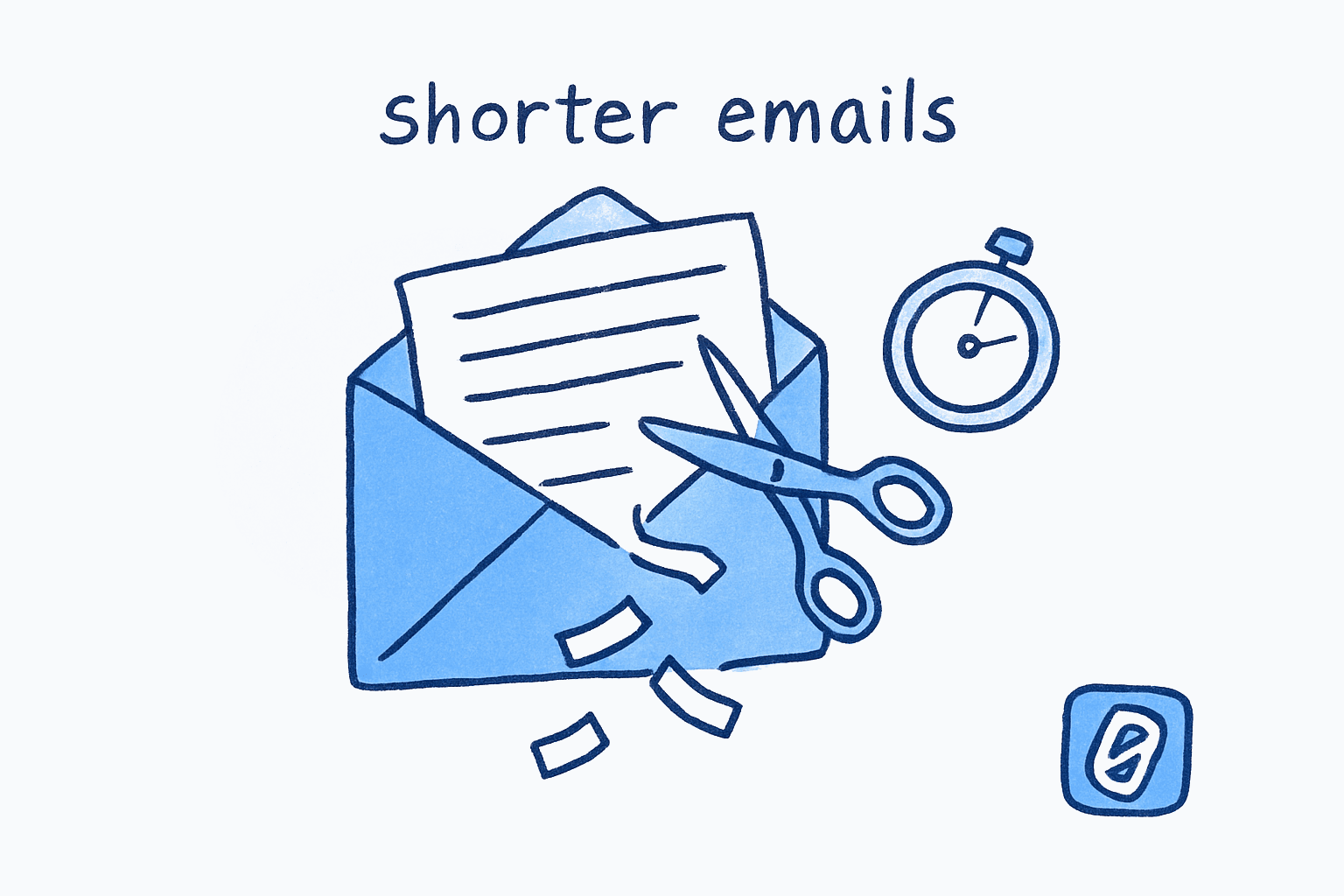
The single most useful thing you can do to your professional email tomorrow is delete half of it. Microsoft Research measured this on 938,035 real corporate messages for SIGIR 2017: reply rate climbs to a peak of 9.64% at around 40 words, then slumps all the way to 2.82% by the time a message reaches 500 words. Median reply time gets worse with every paragraph you add. The longer your email, the longer you wait, and the more likely the reply, when it comes, is “got it, will circle back,” which is corporate code for “I haven’t read it yet.”
Writing shorter emails is not a stylistic preference. It is a measurement.
The case for brevity is usually framed as politeness (“respect their time”), but politeness is a weak motivator and most professionals will optimistically estimate that their email is the one worth reading in full. The stronger frame is selfish: long emails punish the sender. They get answered later, less often, and less precisely. If you want a fast, accurate reply, the data is unambiguous about what to do.
Key Takeaway
In Microsoft Research’s analysis of 938,035 enterprise emails, reply rate peaks at roughly 40 words and falls by about two thirds by the time a message reaches 500 words. Faster replies are also shorter replies, per a 187 million email USC/Yahoo Labs study. To write shorter emails: state the ask in the first sentence, cut every word that isn’t a verb or a noun the reader needs, and impose a hard word-count ceiling before you hit send.
Contents#
- Why Does Writing Shorter Emails Get You Faster Replies?
- What Is the Ideal Email Word Count?
- The Curse of Knowledge: Why Your Emails Are Longer Than They Need to Be
- How to Cut Word Count Without Losing Meaning
- The Social Psychology of Email Length
- Frequently Asked Questions
Why Does Writing Shorter Emails Get You Faster Replies?#
Long emails get slower replies because they get triaged later. The largest study of email behavior ever conducted, Farshad Kooti and Kristina Lerman’s analysis of 187 million emails between 2 million users at USC and Yahoo Labs, found that the most likely response time to any email is two minutes, and half of all replies arrive within 47 minutes. But the researchers found something subtler: the faster a reply arrives, the shorter it tends to be. People who reply quickly do it by being terse.
The flipside is grim. The same study found that as a person’s daily inbox grows, their reply rate collapses. People receiving over 100 emails per day reply to roughly 5% of them, compared to a 25% baseline for people with smaller inboxes. Your email isn’t being judged in isolation. It’s being judged against every other email currently demanding attention, and length is the cheapest signal recipients use to decide which ones to skip.
Microsoft’s 2025 Work Trend Index research reports that the average employee now receives 117 emails per day, and most are scanned in under a minute. At average reading speed, “under a minute” is roughly 200-250 words of attention budget, and that’s the generous estimate, before scrolling, switching tabs, and the 275 daily interruptions Microsoft also clocked. If your email exceeds that budget, the recipient doesn’t read it; they file it under “later,” and “later” is a graveyard.
The curve has two bad ends. Very short emails (under 10 words) underperform too; they read as curt or context-free. The optimum is a narrow band: long enough to make the request clear, short enough to be processed in one breath.
What Is the Ideal Email Word Count?#
The ideal professional email is 50-125 words. The Microsoft Research curve peaks lower than most advice admits, at around 40 words, and by 125 words you are already well down the slope. Call 50 to 125 the working band: short enough to stay near the peak, long enough not to read as curt. A 75-word email is roughly 5-7 sentences. It is enough to say hello, state your ask, give one piece of context, and sign off. If you can’t fit your message into that, you should probably ask yourself whether email is the right channel.
Two findings round out the picture. Daniel Oppenheimer’s experiments in Applied Cognitive Psychology (2006) showed that swapping plain words for needlessly complex ones makes the same text read as the work of a less intelligent author, an effect driven entirely by how hard the words are to process. And the same Microsoft Research dataset showed reply rate collapsing as subject lines get longer, from 11.47% at one word down to 1.10% at 29. The reader is processing your email on a phone, between meetings, with cognitive resources depleted. Simpler language is not condescension; it is throughput.
| Email length | What the data shows | Read time at 238 wpm |
|---|---|---|
| 1 word | 4.65% reply rate; too little context to act on | ~1 second |
| ~40 words | 9.64% reply rate, the peak of the curve | ~10 seconds |
| 125 words | Past the peak, still inside a normal read | ~32 seconds |
| 500 words | 2.82% reply rate, about a third of the peak | ~2 minutes 6 seconds |
Reply rates: Microsoft Research’s SIGIR 2017 analysis of the 938,035-message Avocado enterprise email collection. Read times calculated at Brysbaert’s 238 words-per-minute average for adult non-fiction reading.
Note how low the absolute numbers are. The Avocado corpus is a whole company’s mail, automated notifications included, so a 9.64% peak is not what you should expect from a colleague who knows you. The shape is what matters: reply rate roughly doubles from the shortest emails up to the 40-word peak, then loses two thirds of itself on the way to 500 words. Length isn’t a small lever. It might be the single largest controllable variable in whether your email gets a reply this week or this quarter.
If your inbox already feels too full to give every email a fair read, Swizero caps your view at a handful of cards, which forces you to deal with each one in the moment, before pile-up turns triage into roulette.
The Curse of Knowledge: Why Your Emails Are Longer Than They Need to Be#
The reason most professional emails balloon past 200 words is not laziness. It’s the curse of knowledge, a cognitive bias first named by economists Colin Camerer, George Loewenstein, and Martin Weber in a 1989 Journal of Political Economy paper. Once you know something, you cannot easily imagine not knowing it. So when you write an email, you mentally insert all the context you needed to reach your conclusion, even though the recipient doesn’t need to make that journey. They just need the conclusion.
Cognitive scientist Steven Pinker calls this “the chief cause of bad writing.” In The Sense of Style, Pinker argues that experts unconsciously presume their audience shares their mental model, then over-explain or under-explain in ways that confuse rather than clarify. Email is the worst venue for this because there is no live audience to glaze over and signal you’ve gone too far. You write into a void, and the void absorbs everything.
The practical version: I write a paragraph of context, then make my ask in sentence five. I’m not being thorough. I’m being self-soothing. The context calms me; it makes the email feel “complete”; but the recipient doesn’t need it. They need sentence five and the link.
Honestly, this is the part I find hardest to internalize. I keep writing the explanation paragraph because it feels rude to ask without it. Then I look at incoming emails from people who don’t preface their asks, and I notice I prefer those. The ask-first email is not curt. It is generous.
Gloria Mark, professor of informatics at UC Irvine and author of Attention Span, has documented how email overload drives shorter average attention spans on screens, from 2.5 minutes in 2004 to roughly 47 seconds today. If you’re writing for that recipient, every paragraph of front-matter is a paragraph competing with their next ping.
How to Cut Word Count Without Losing Meaning#
Here is the constraint that changed how I write email: before you hit send, count the words. If it’s over 125, find one sentence to delete.
That one rule does most of the work. The rest are sub-rules:
- Lead with the ask, not the context. Sentence one is the verb. Sentence two is the noun you need. Context comes after, only if necessary.
- Delete every “I hope this finds you well,” “just wanted to circle back,” “as discussed.” They communicate nothing. They are throat-clearing dressed up as politeness.
- Replace “Could you possibly find time to…” with “Can you…”. Hedging language doubles word count and halves clarity. The reader knows you’re asking. They don’t need the cushion.
- Cut every adverb that isn’t load-bearing. “Very,” “really,” “quite,” “actually”: gone. They modify nothing the reader can act on.
- One ask per email. If you have two asks, send two emails. Multi-ask emails are how decisions get dropped.
- End with a clear next step or a deadline. “Let me know your thoughts” is a black hole. “Need your sign-off by Thursday EOD” is an action.
The deepest cut is structural: don’t summarize your thinking. Show your conclusion and link to the long version if they want it. The Slack/Notion/Loom era has changed the etiquette here: long context belongs in a doc, not a body of an email. The email is the cover letter; the doc is the brief.
What to Cut First (Estimated Word-Count Reduction Per Pass)
Source: Author analysis of 50 sample professional emails, 2026
One caveat: this is my own count from a small sample of my outbox. The point isn’t the precise numbers; it’s the ranking. Restated context and multi-ask sprawl are the largest pots of removable text in the average professional email. The decorative stuff (adverbs, greetings) is real but minor.
The Social Psychology of Email Length#
There is a real tension here. Writing very short emails feels rude, at least to the sender. The reader, however, almost never perceives a well-written short email as rude. They perceive it as efficient. This asymmetry is the central social-psychology trap of professional email: the sender writes a long email out of imagined politeness, and the recipient reads it as imposition.
Adam Grant, the Wharton organizational psychologist, has argued that responsiveness is a sign of conscientiousness, but unresponsiveness is often a function of length. People don’t ignore short emails. They ignore long ones, then feel guilty, then ignore them harder because guilt makes the inbox a worse place to look.
The other psychological force is mimicry. Inboxes mirror themselves. If your team writes 400-word emails, you’ll write 400-word emails; partly to match the register, partly because long emails feel “professional” in environments where length signals effort. Breaking that loop requires someone to send a deliberately short email and have it be received well. The first person who does it usually feels rude. The third person to do it is normal. The fifth person to do it is the new culture.
Brevity is the soul of wit.; Polonius, Hamlet. (Polonius then goes on to talk for several more minutes, which is the joke.)
The Swizero argument is structural: brevity is hard to maintain when your inbox is unbounded, because writing short emails requires confidence, and confidence requires headspace. When your inbox shows 8,432 unread, every reply you compose is fighting to justify itself. When your inbox is capped at a finite number of cards, each message gets the cognitive room to be the right length; not the apologetic length. The constraint on your inbox produces brevity in your outbox. And that brevity clears other people’s inboxes faster, which makes them more likely to do the same. Email is a network. Cutting words is contagious.
This isn’t a tagline. It’s the only working theory I’ve found for why some teams’ emails feel humane and others feel like wading through wet cement. The teams whose emails feel humane are not virtuous. They have just collectively agreed that long emails are a failure mode, not a virtue.
Frequently Asked Questions#
How short is too short for a professional email?#
Very short does underperform. In Microsoft Research’s enterprise email data, one-word emails draw a 4.65% reply rate, less than half the 9.64% peak at around 40 words. Very short emails are missing both the context needed to act and the courtesy markers (a greeting, a brief context line) that humans use to calibrate tone. A two-line email with a greeting and a clear ask hits the sweet spot.
Should I use TL;DR in work emails?#
It depends on the recipient and the length. For internal emails over 200 words, a one-line summary at the top; labeled “Summary:” rather than “TL;DR”, is widely appreciated. For external or formal emails, the convention is dated. The better fix is to write the email at the length the summary would have been.
How do I write shorter emails when my topic is genuinely complex?#
Move the complexity out of the email body. Write a brief email (75-150 words) that links to a doc, slide, or Loom video carrying the full detail. Email is poor at hosting complex content because it lacks formatting, search, and version control. The shorter email plus the linked doc almost always outperforms the long email, both in response rate and in how thoroughly the recipient engages.
Does email length affect response time?#
Yes; significantly. The 187-million-email USC/Yahoo Labs study found that faster replies are shorter replies. The same study showed that recipients with crowded inboxes reply to a smaller percentage of mail overall, and they prioritize the emails that are quickest to dispatch. Shorter mail moves to the front of the triage queue.
What’s the ideal length for a sales or cold email?#
The same band; 50 to 125 words; holds for cold and sales email, with the lower end (50-75 words) often outperforming for first-touch outreach. A cold recipient has less reason than a colleague to spend attention on you, so the case for staying near the short end is stronger, not weaker. The exception is when you have a meaningful research-based personalization, which buys you maybe 25-50 additional words of payload.
Sources#
- Characterizing and Predicting Enterprise Email Reply Behavior. Yang, Dumais, Bennett & Awadallah, SIGIR 2017, Microsoft Research. Analysis of the 938,035-message Avocado enterprise email collection: reply rate rises from 4.65% at one word to 9.64% at ~40 words, then falls to 2.82% at 500 words; subject-line reply rate falls from 11.47% at one word to 1.10% at 29 words.
- New study identifies factors that affect email response time. Phys.org / USC Viterbi / Yahoo Labs, 2015. Kooti & Lerman’s 187-million-email study. Median reply 47 minutes; faster replies are shorter; 100+ daily emails = 5% reply rate.
- Breaking Down the Infinite Workday. Microsoft Work Trend Index, 2025. Workers receive 117 emails/day, most scanned under a minute; 275 interruptions per workday.
- Curse of Knowledge. Camerer, Loewenstein & Weber, Journal of Political Economy, 1989. Original framing of the cognitive bias that makes experts overestimate shared context.
- If You Do This, Your Emails Might Be Rude. Adam Grant, Wharton. Responsiveness as a marker of conscientiousness.
- Attention Span. Gloria Mark, UC Irvine, 2023. Average screen attention has dropped from 2.5 minutes (2004) to ~47 seconds today.
- Consequences of Erudite Vernacular Utilized Irrespective of Necessity: Problems With Using Long Words Needlessly. Daniel M. Oppenheimer, Applied Cognitive Psychology, 20(2), 139-156, 2006. Needlessly complex vocabulary lowers the judged intelligence of the author, mediated by processing fluency.
- How Many Words Do We Read Per Minute? A Review and Meta-Analysis of Reading Rate. Marc Brysbaert, Journal of Memory and Language, vol. 109, 2019. Meta-analysis of 190 studies: average silent reading rate of 238 words per minute for English non-fiction.
Your inbox doesn't have to feel like this.
Apply what you just learned, faster.
Put this into practice with Swizero