How to Reply to a Rejection Email (8 Templates)
By Chris Stefaner, Co-founder of Swizero
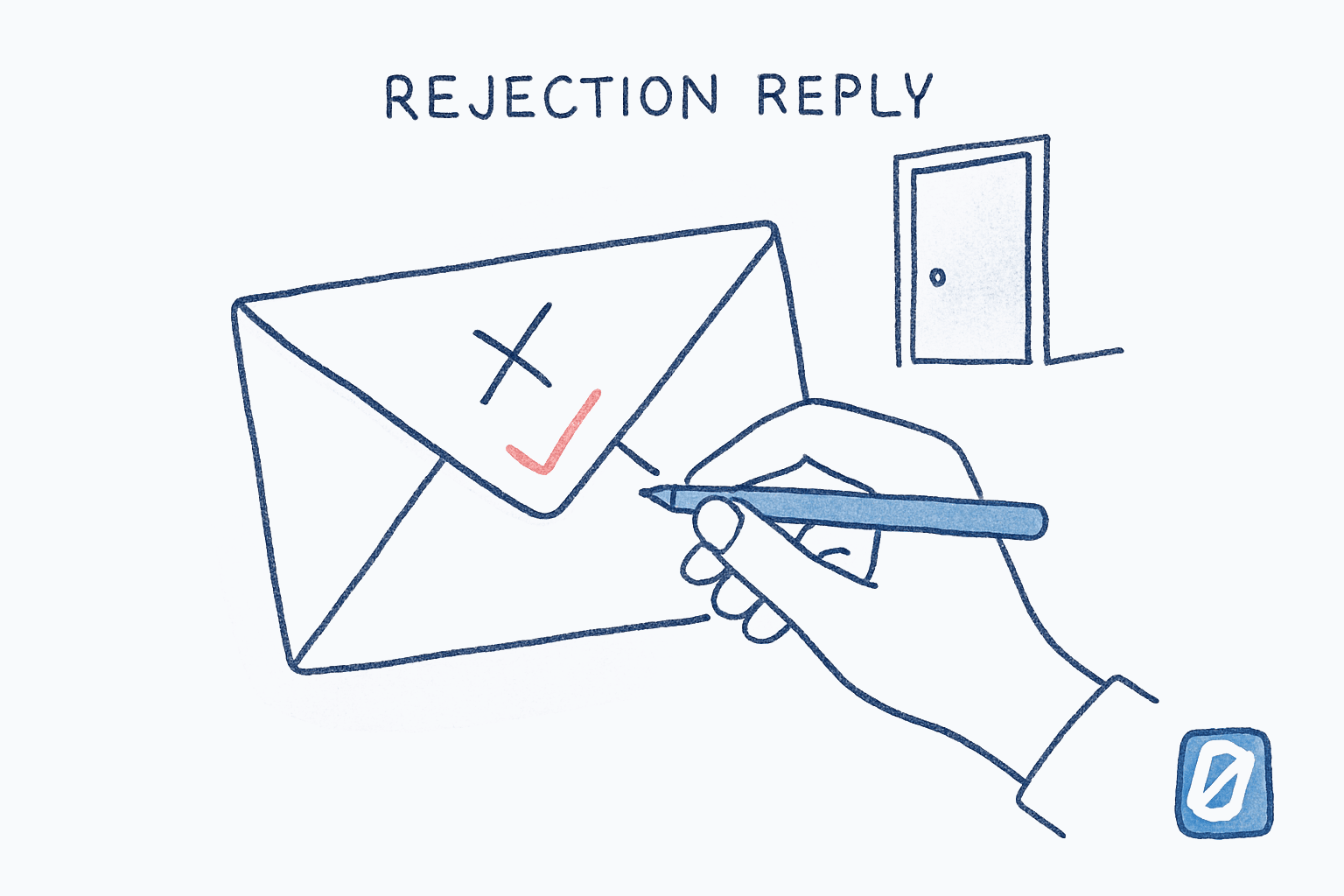
To reply to a rejection email, thank the sender, express brief disappointment, reaffirm your interest, and close warmly. The whole response should be 75 to 150 words, sent within 24 hours. That four-part structure (Thank, Affirm, Ask, Close) works whether you were turned down for a job, a business proposal, a partnership, or a university spot.
Most people never respond to rejection emails at all. That’s the opportunity. According to Talent MSH’s 2026 Candidate Experience report, candidates who respond professionally are four times more likely to be considered for future roles at the same company.
Below you’ll find the framework, eight copy-paste templates, and the mistakes to avoid. (And if the rejection prompts a follow-up conversation later, our guide on how to write a follow-up email covers that next step.)
The Thank-Affirm-Ask-Close Framework#
Every strong rejection response follows four steps. You can adjust the length and tone for different situations, but the order stays the same.
| Step | What It Does | Example Phrase |
|---|---|---|
| Thank | Acknowledges their time and transparency | “Thank you for letting me know, and for the time you invested in our conversation.” |
| Affirm | Shows genuine interest hasn’t evaporated | “I remain impressed by what your team is building.” |
| Ask | Opens one specific door (feedback, future roles, staying connected) | “Would you be open to connecting on LinkedIn?” |
| Close | Ends warmly without overstaying | “Wishing you and the team all the best.” |
The framework works because it mirrors what the sender hopes to hear: no drama, no guilt trip, just professionalism.
How Should You Reply to a Job Rejection Email?#
Job rejections sting the most, but they’re also where a strong response creates the most leverage. Hiring managers fill multiple roles over time. The candidate who replied gracefully in March is the one they remember in September.
Template 1: Standard Job Rejection Response#
Subject: Re: [Original Subject Line]
Hi [Name],
Thank you for letting me know, and for the time your team spent getting to know my background. While I’m disappointed, I completely understand that these decisions are never easy.
I was genuinely impressed by [specific thing: the team’s culture, the product roadmap, the interview process], and I’d welcome the chance to be considered for future openings that align with my experience.
Wishing you and the team continued success.
Best regards, [Your Name]
Save as a Gmail Template
DesktopOpen Gmail, click Compose, paste the template above, then click the three-dot menu in the bottom-right corner of the compose window. Select Templates → Save draft as template → Save as new template. Name it "Rejection Response - Job."
You can create multiple templates for different rejection types and swap the name accordingly.
Template 2: Requesting Feedback After Rejection#
Subject: Re: [Original Subject Line]
Hi [Name],
Thank you for the update. I appreciate the transparency, and I enjoyed learning about [company name] throughout the process.
If you have a moment, I’d value any feedback on where I could strengthen my candidacy for similar roles in the future. No pressure at all; I understand how busy things get.
Either way, I’d love to stay connected. Thanks again for your time.
Best, [Your Name]
Honestly, feedback requests work better early in your career. Senior candidates should skip this unless they built genuine rapport across multiple rounds.
Template 3: After a Final-Round Rejection#
Subject: Re: [Original Subject Line]
Hi [Name],
This one stings a bit, I’ll be honest. I felt a real connection with the team during our conversations, and the role seemed like a strong fit.
That said, I respect the decision and I’m grateful for how thoughtfully you ran the process. If anything changes or a similar role opens up, I’d be glad to reconnect.
Wishing [company name] a great [quarter/launch/year ahead].
Warm regards, [Your Name]
The “this one stings” line is intentional. Robotic positivity after a final-round rejection reads as disconnected.
What Should You Say When a Business Proposal Gets Rejected?#
Proposal rejections differ from job rejections. The relationship is peer-to-peer, and the door for future collaboration is often wider.
Template 4: Proposal or Pitch Rejection#
Subject: Re: [Original Subject Line]
Hi [Name],
Thanks for getting back to me with a clear answer. I appreciate that you took the time to review [proposal/pitch name] rather than letting it sit unanswered.
I understand the timing isn’t right, and priorities shift. If circumstances change down the line, I’d be glad to revisit the conversation. In the meantime, I’ll keep an eye on what your team is doing.
All the best, [Your Name]
Template 5: Vendor or Service Rejection#
Subject: Re: [Original Subject Line]
Hi [Name],
Understood, and thank you for letting me know. I know these evaluations involve a lot of variables, and I respect the decision.
If your needs evolve or you’d like a second opinion on [specific area] in the future, don’t hesitate to reach out. Happy to help in any capacity.
Best regards, [Your Name]
Position yourself as a resource, not just a seller. Offering help without strings attached earns callbacks when budgets change. Our guide on writing emails that get responses covers why generosity in professional communication outperforms persistence.
Schedule Your Response for the Next Morning
DesktopAfter writing your reply, click the dropdown arrow next to the Send button in Gmail. Select Schedule send, then choose a time the following business morning (e.g., 9:00 AM). This gives you a cooling-off period while ensuring a prompt response.
If the rejection arrives Friday afternoon, schedule for Monday morning. Weekend responses can feel rushed or emotionally reactive.
Other Rejection Response Templates#
Template 6: University or Graduate Program Rejection#
Subject: Re: [Original Subject Line]
Dear [Name/Admissions Committee],
Thank you for reviewing my application. While I’m disappointed, I understand how competitive admissions is.
I plan to strengthen my application for the next cycle. If you’re able to share feedback on areas for improvement, I’d be grateful.
Sincerely, [Your Name]
Template 7: Partnership or Collaboration Rejection#
Subject: Re: [Original Subject Line]
Hi [Name],
Thanks for considering the idea and for being straightforward about the fit. I’d rather hear a clear “not now” than chase an unclear maybe.
I think there’s potential for our paths to cross again as things evolve. I’ll stay in touch periodically and would welcome the same from your side.
Best, [Your Name]
Template 8: Internal Promotion Rejection#
Subject: Re: [Original Subject Line]
Hi [Name],
Thank you for the conversation and for being transparent. I appreciate the honesty.
Would you be open to mapping out a development plan together so I’m better positioned for the next opportunity?
Best regards, [Your Name]
Internal rejections require the most care. The “development plan” angle transforms a setback into a structured path forward.
If managing rejection responses alongside regular email feels overwhelming, Swizero surfaces your highest-priority messages in a finite stack, so sensitive emails don’t get buried under noise.
Tips for Responding to a Rejection Email#
-
Wait at least an hour before hitting send. Emotional reactions written in the first ten minutes rarely serve you well. Write the draft, walk away, then revisit. For more on structuring the opening of important emails, timing matters as much as wording.
-
Keep it under 150 words. A rejection response is not the place to re-argue your qualifications or attach additional materials. The shorter the email, the more confident it reads.
-
Never badmouth the company or the person who got it. Anything negative you write will be screenshot-able forever.
-
Personalize one detail. Reference something specific from your interaction: a project they mentioned, a challenge you discussed. The same principle applies when ending any professional email; specific details outperform generic pleasantries.
-
Connect on LinkedIn the same day. A rejection response paired with a connection request creates a two-touch reinforcement. Building email habits that support your professional reputation compounds over time.
Set a Follow-Up Reminder
DesktopAfter sending your response, open Google Calendar. Create a reminder for 3 months out titled "Check in with [Name] at [Company]." When it fires, send a brief message referencing your original conversation.
A 90-day follow-up is the sweet spot. Sooner feels pushy; longer and you've been forgotten.
Frequently Asked Questions#
Should you reply to a rejection email?#
Yes. Most rejected candidates never respond, so a thoughtful reply immediately differentiates you. The response keeps the relationship alive for future opportunities and demonstrates emotional maturity that hiring managers remember.
How long should a rejection email response be?#
Aim for 75 to 150 words, roughly four to six sentences. Anything shorter feels dismissive; anything longer risks over-explanation. The goal is to be gracious and memorable, not to change their mind.
Is it OK to ask for feedback after a job rejection?#
Asking for feedback is appropriate after multiple interview rounds or when you’re early in your career. Frame the request as optional (“If you have a moment…”) rather than demanding. Many companies have policies against providing specific feedback for legal reasons, so don’t take silence personally.
How quickly should you respond to a rejection email?#
Respond within 24 hours for job and business rejections. Same-day responses are ideal if you’ve had time to process the news calmly. Waiting longer than 48 hours reduces the impact, as the sender has already mentally closed the loop on your candidacy.
Can replying to a rejection email get you the job later?#
It can. Chosen candidates decline offers, fail background checks, or leave within the first few months. A professional rejection response keeps you at the top of the callback list. The same hiring manager may fill a different role months later and remember the candidate who handled rejection well.
What should you not say in a rejection email response?#
Avoid expressing anger, questioning the decision-maker’s judgment, asking “what does the other candidate have that I don’t,” or offering to work for less money. Also avoid restating your qualifications. Your reply is about the future relationship, not the past decision.
How do you reply to a rejection email for a business proposal?#
Keep the tone peer-to-peer rather than deferential. Thank them for the clear answer, acknowledge that timing or priorities drove the decision, and express willingness to revisit if circumstances change. Avoid detailed questions about why your proposal lost; that can feel like a post-mortem the other party didn’t sign up for.
Should you reply to a rejection email from a university?#
Yes, especially if you plan to reapply. A brief, respectful response keeps your name in their system as a serious candidate. Requesting feedback on how to strengthen a future application is more common and more welcome in academic settings than in corporate hiring.
Sources#
- Candidate Experience Statistics 2026 — Talent MSH, 2026. Candidates who respond professionally are four times more likely to be considered for future roles.
- How to Respond to a Rejection Email — Harvard Business Review, 2023. Framework for structuring professional rejection responses.
- How to Respond to a Job Rejection Email — Indeed Career Guide. Best practices for timing, tone, and content of rejection replies.
Your inbox doesn't have to feel like this.
Apply what you just learned, faster.
Put this into practice with Swizero