Reply All Emails: Why Group Threads Spiral Fast
By Chris Stefaner, Co-founder of Swizero
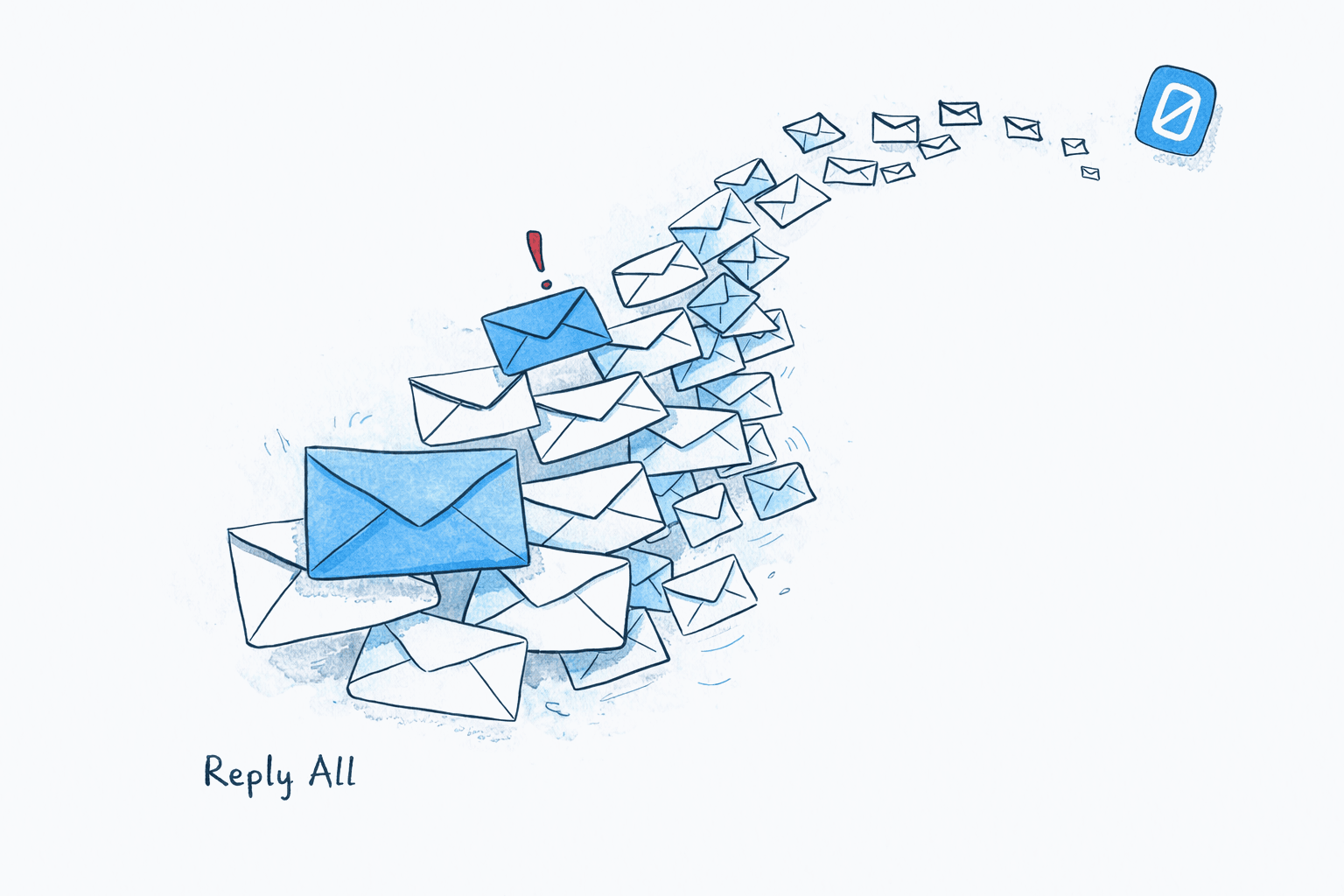
On the morning of November 14, 2016, a test email meant for a handful of London clinics went to every single person with an NHSmail account: 840,000 healthcare workers across the United Kingdom. Within minutes, around 80 people hit reply-all to ask to be removed from the list. Then hundreds more replied to tell those people to stop replying. Then thousands replied to complain about the replies to the replies. In 75 minutes, 500 million emails crossed the NHS network, against a normal daily volume of three to five million. Doctors couldn’t receive patient results. Appointment confirmations stalled. A single misdirected message paralyzed the communication backbone of an entire national health system.
The NHS incident wasn’t a freak accident. It was the predictable result of a psychological chain reaction that plays out at smaller scales in every organization, every day. The reply all email problem isn’t really about technology or etiquette. It’s about what happens to human decision-making when the audience is large, the norms are ambiguous, and everyone can see everyone else responding.
Here’s the stance most productivity advice avoids: reply all storms aren’t caused by careless individuals. They’re caused by email’s fundamental lack of conversational boundaries. Without a mechanism to signal “this thread is done” or “your input isn’t needed here,” every group email becomes an open invitation to participate indefinitely.
Key Takeaway
Reply-all storms are driven by three psychological forces: diffusion of responsibility (nobody owns the thread), social proof (everyone else is replying, so I should too), and information cascades (each reply raises the perceived stakes for staying silent). These forces compound with group size, which is why the only durable fix is structural constraints on how many messages compete for your attention, not etiquette guidelines that ask individuals to override deep social instincts.
What Turns a Group Email Into an Uncontrollable Chain Reaction?#
A group email becomes a storm through a three-stage escalation pattern that maps closely to established social psychology research.
Stage 1: The trigger. Someone sends a message to a large group, either intentionally or by accident. The content barely matters. It could be a misdirected test email (NHS, 2016), a confused request to be removed from a distribution list (Microsoft’s Bedlam DL3 incident, 1997), or a holiday potluck invitation sent to 25,000 state employees (Utah state government, 2018).
Stage 2: The correction attempts. A handful of recipients reply all to request removal, correct the sender, or ask people to stop replying. Every one of these “helpful” messages lands in every inbox on the thread, triggering notifications for hundreds or thousands of people who were quietly ignoring the original message.
Stage 3: The meta-storm. People start replying to complain about the replies. Jokes emerge. Someone sends a GIF. The thread develops its own social momentum, and each new message reinforces the perception that this is an event worth participating in. At Thomson Reuters in August 2015, a single misdirected email to 33,000 employees generated nearly 23 million messages over seven hours and trended on social media under #ReutersReplyAllGate.
The pattern is so consistent that Microsoft spent 23 years developing a technical solution. In 2020, Exchange Online finally shipped Reply All Storm Protection, which automatically blocks reply all email messages when it detects 10 or more replies to a thread with 2,500+ recipients within 60 minutes. The feature exists because Microsoft learned the hard way: during the 1997 Bedlam incident, 13,000 employees on a single distribution list generated an estimated 15 million emails in one hour, pushing 195 GB of data through the network and crashing the mail servers entirely.
That Microsoft built a dedicated feature to suppress reply all behavior tells you something important. The problem isn’t solvable through training, etiquette guides, or polite reminders. It requires structural intervention.
Famous Reply-All Storms: Messages Generated
Source: The Register, 2017; CBS News, 2015; TechCommunity Microsoft, 2020
Why Does Social Proof Make Reply-All Threads Worse?#
Social proof, the tendency to copy what others are doing when we’re uncertain how to behave, is the primary accelerant of reply all storms. Robert Cialdini, Regents’ Professor of Psychology and Marketing at Arizona State University, defined the principle in his 1984 book Influence: Science and Practice: “We view a behavior as more correct in a given situation to the degree that we see others performing it.”
In a group email thread, social proof operates through a visible feedback loop. Each reply all notification signals that participation is normative. When you see six colleagues have already responded, staying silent starts to feel like disengagement. This dynamic intensifies in workplace settings where responsiveness is equated with professionalism.
Cialdini identified two amplifiers of social proof: multiple others acting and similar others acting. A reply all thread delivers both simultaneously. You’re watching many people respond, and those people are your direct colleagues. The psychological pressure to conform is enormous, and it scales directly with group size.
The result is a paradox. Each individual reply all email message may be entirely rational from the sender’s perspective (they genuinely want to help, or they genuinely want the thread to stop). But the aggregate effect is catastrophic. Twenty people each making a reasonable individual choice produce an unreasonable collective outcome. This is the core of the reply all problem, and no amount of etiquette training can override it because the behavior feels correct to each person in the moment.
How Does Diffusion of Responsibility Kill Group Email Threads?#
Diffusion of responsibility, the phenomenon where individuals feel less accountable for taking action when others are present, was first demonstrated by John Darley and Bibb Latane in their landmark 1968 study at Columbia University and NYU. Participants who believed they were the only witness to a simulated seizure helped 85% of the time. When they believed four other people were also listening, helping dropped to 31%.
The mechanism is straightforward: perceived responsibility is inversely proportional to group size. With five bystanders, each person feels roughly one-fifth of the total obligation. Applied to a group email thread with 50 recipients, each person feels approximately 2% responsible for resolving the conversation.
This creates two destructive effects in email.
First, nobody takes ownership. A 2025 analysis published on Penn State’s Applied Social Psychology blog described the pattern: “When a manager sends an email requesting input to multiple employees without specifying who should respond, all may assume that one of the others will handle it.” The email sits unanswered. The manager sends a follow-up, CC’ing even more people. The thread expands while the actual decision stalls.
Second, people who do respond feel compelled to signal their engagement loudly enough to be noticed. A one-word “Noted” or “Thanks” reply all becomes a performance of responsiveness. The more people on the thread, the more each reply functions as a visibility signal rather than a substantive contribution. This is where diffusion of responsibility and social proof overlap: low individual accountability plus high social visibility equals a lot of noise and very little resolution.
One caveat worth acknowledging: most of the bystander effect research was conducted in physical emergency settings, not digital communication. The applicability to email is inferred rather than directly tested at scale. But the behavioral pattern, diluted responsibility leading to either inaction or performative action, maps remarkably well onto what we observe in group threads every day.
If group email threads routinely stall because nobody feels responsible for resolving them, Swizero addresses the root cause: a fixed card limit ensures your inbox surfaces only the messages that need your action, so diffuse group threads don’t crowd out the decisions only you can make.
The Information Cascade Effect: Why Each Reply Raises the Stakes#
In 1992, economists Sushil Bikhchandani, David Hirshleifer, and Ivo Welch published “A Theory of Fads, Fashion, Custom, and Cultural Change as Informational Cascades” in the Journal of Political Economy. Their core finding: when people observe others’ actions sequentially, they rationally abandon their own information and follow the crowd, even when the crowd is wrong.
An information cascade in a reply all email thread works like this. The first two or three replies establish a norm. Maybe they’re corrections (“wrong distribution list”), maybe they’re jokes, maybe they’re earnest contributions. Regardless, they signal that participating is acceptable. Each subsequent person observes those replies and concludes that the thread is important enough to warrant engagement. By the tenth reply, staying silent feels like a statement. By the fiftieth, the thread has become a social event with its own gravitational pull.
Bikhchandani, Hirshleifer, and Welch showed that cascades are inherently fragile: a small amount of new information can reverse them entirely. This explains why reply all storms often shift tone abruptly. A thread that starts with polite “please remove me” requests can pivot to irritable complaints, then to humor, then to meta-commentary about the absurdity of the thread itself. Each shift is a micro-cascade where the social norm resets and the cycle restarts.
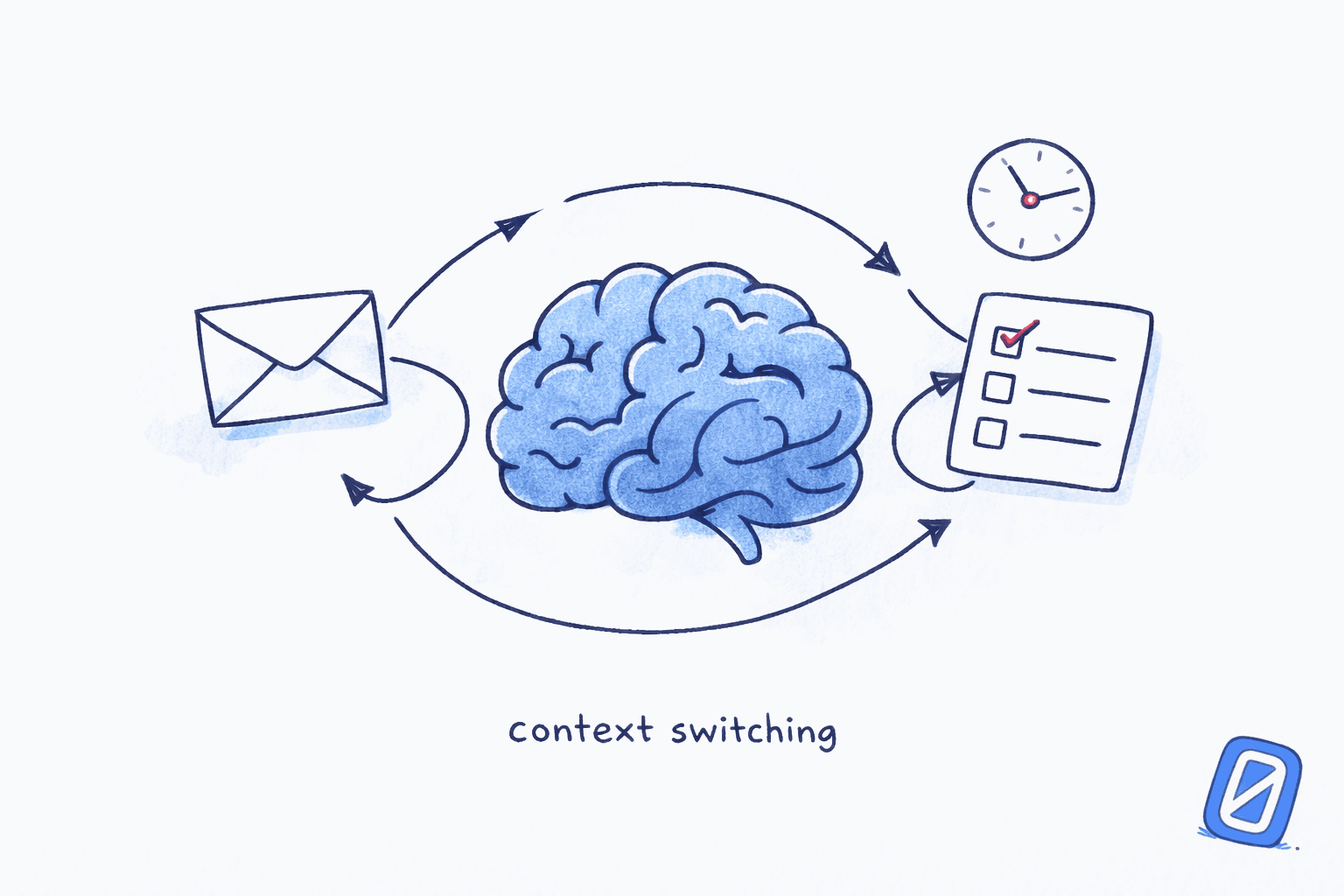
The organizational cost isn’t just the time spent reading messages. It’s the cognitive weight of tracking an evolving social situation. Gloria Mark, Professor of Informatics at UC Irvine and author of Attention Span, has documented that the average person’s sustained attention on a single screen lasts only 47 seconds, down from two and a half minutes in 2004. Each reply all email notification fragments that already-thin attention. Her research found a strong correlation between frequent attention shifts and elevated stress, measured through heart-rate variability during workplace observation studies.
| Reply-All Storm | Recipients | Messages Generated | Time Elapsed | Estimated Cost |
|---|---|---|---|---|
| Microsoft Bedlam DL3 (1997) | 13,000 | 15 million | ~1 hour | 2 days of mail server downtime |
| Cisco Training List (2013) | 23,570 | 4 million | Hours | $600,000 in lost productivity |
| Thomson Reuters (2015) | 33,000 | 23 million | 7 hours | Trending on social media, #ReutersReplyAllGate |
| NHS (2016) | 840,000 | 500 million | 75 minutes | System delays across national health service |
| Utah State Gov (2018) | 25,000 | Hundreds of thousands | Hours | Statewide email disruption |
What Is the Real Productivity Cost of Reply All Email Culture?#
The spectacular blowups grab headlines, but the everyday reply all email problem is more damaging in aggregate. Most organizations don’t experience catastrophic storms. They experience chronic, low-grade reply all pollution: a five-person thread where three people contribute nothing, a ten-person discussion where two people are actually deciding and eight are watching, a department-wide FYI that generates 14 “thanks” replies nobody needs to see.
Cal Newport, Georgetown University computer science professor and author of A World Without Email, calls this the “hyperactive hive mind” workflow: “a workflow centered on ongoing, unstructured conversation through digital communication tools.” Reply-all is the hive mind’s favorite instrument. It enables unstructured conversation at scale, with no mechanism for determining when the conversation has concluded or who actually needs to be part of it.
Microsoft’s 2025 Work Trend Index found that communication (email, chat, and meetings) now consumes 60% of the average knowledge worker’s day, leaving just 40% for focused work. These numbers align with broader email volume trends documented across the industry. The same report documented a 7% year-over-year increase in mass emails sent to large groups. That growth compounds: more recipients per message means more potential reply all triggers, which means more interruptions per thread.
Honestly, the financial calculations you see floating around ($21,000 per employee per year in email costs, $650 billion across the US economy) feel inflated and oversimplified. But even conservative estimates suggest the productivity tax is significant. If only 12% of received emails contain action items, as workflow analytics research consistently finds, then the other 88% represent triage cost: the time spent opening, scanning, and dismissing messages that required no response. Reply-all threads are a disproportionate contributor to that 88%.
What Happens to Received Emails
Source: Email Analytics Productivity Benchmark, 2023
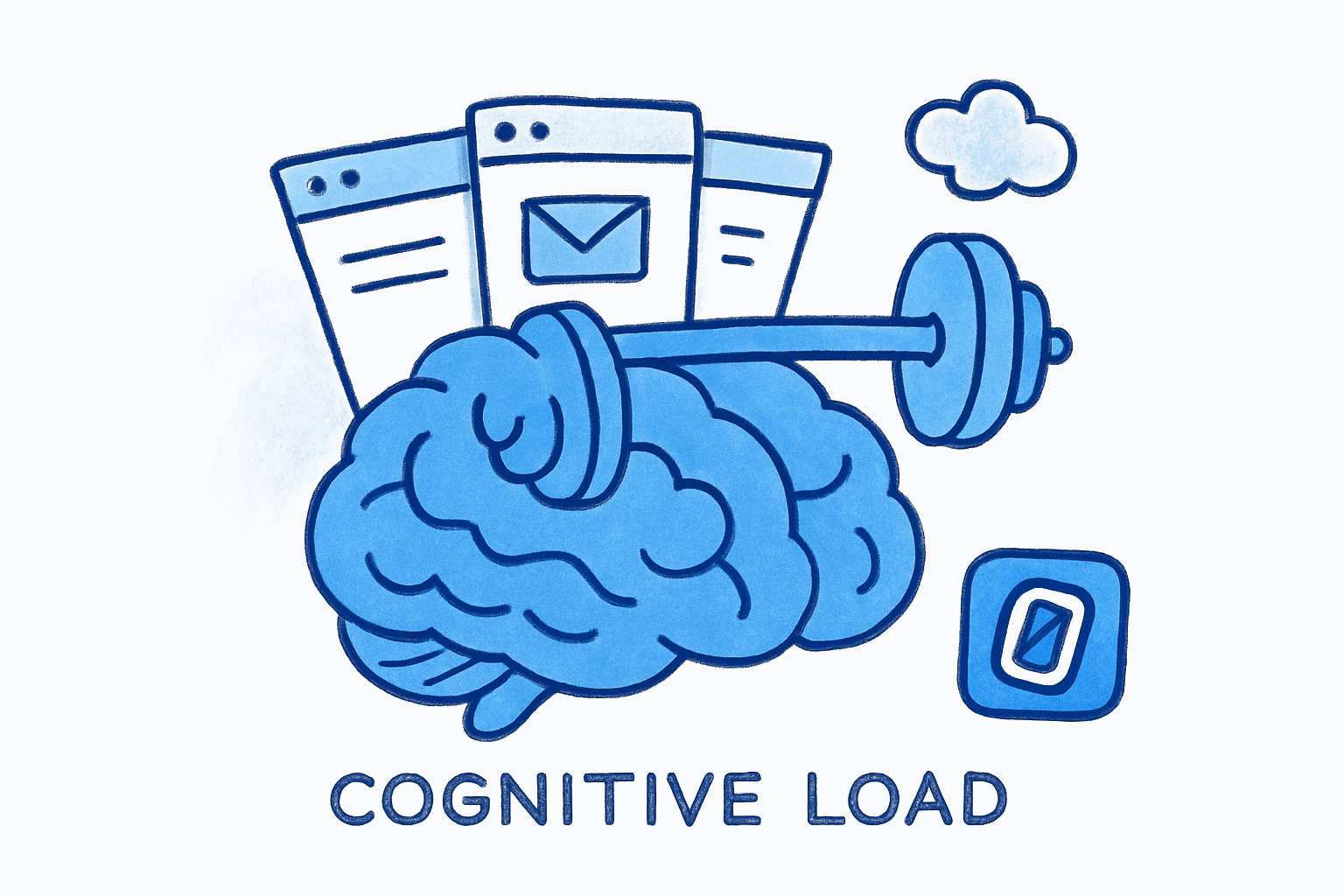
The deeper cost is decision fatigue. Every email in your inbox, including every reply all email you didn’t ask for, demands a micro-decision: read or skip, respond or ignore, archive or leave. Research on the cognitive load of unprocessed messages shows that these decisions accumulate throughout the day, degrading the quality of later choices. A reply all thread with 15 messages doesn’t just steal the time to read 15 messages. It steals 15 decision-making slots from your finite cognitive budget.
Why Reply All Etiquette Guides Don’t Work#
Every organization eventually publishes a reply all etiquette guide. Think before you hit reply-all. Ask yourself if every recipient needs to see your response. Use reply instead of reply-all by default. These guidelines are well-intentioned and functionally useless.
They fail for the same reason that telling bystanders to “be more proactive” doesn’t increase intervention rates. Reply all etiquette assumes that individuals can override social instincts through sheer awareness, but the forces driving reply-all behavior are unconscious, automatic, and context-dependent. You don’t consciously think, “I should follow the social norm and reply to this thread because five other people already have.” You just feel a pull to respond, and the feeling intensifies the more responses you see.
The question of how to stop reply all storms has plagued IT departments for decades, and the organizations that actually reduce email overload don’t rely on individual behavior change. They impose structural constraints. Microsoft’s Reply All Storm Protection is one example: a technical gate that blocks cascade behavior at the infrastructure level. Defined communication protocols that move recurring updates out of email are another, as email productivity research suggests.
The philosophy behind Swizero’s design follows the same logic. Instead of asking people to send fewer reply all email messages (a behavioral ask that 30 years of etiquette guides prove doesn’t stick), it limits how many messages reach your attention in the first place. A fixed card limit means your inbox shows a handful of AI-prioritized cards per session. A reply all thread with 23 “got it, thanks” messages doesn’t occupy 23 separate attention slots. The AI evaluates the thread, surfaces it once if your input is actually needed, and filters the noise if it isn’t.
That’s not a workaround. It’s a recognition that the reply-all problem is architectural. Email was designed without conversational boundaries, so the boundaries need to come from the interface layer.
Frequently Asked Questions#
How do you stop a reply-all email storm once it starts?#
The most effective intervention is technical, not behavioral. Microsoft’s Reply All Storm Protection automatically blocks reply-all messages when it detects cascade patterns (10+ replies to 2,500+ recipients within 60 minutes). For organizations without this feature, an administrator can restrict the distribution list permissions to prevent further replies. Asking people to stop replying is counterproductive because each “please stop replying” message is itself a reply-all that extends the storm.
Why do people keep replying all when they know it makes things worse?#
Social proof and diffusion of responsibility create a powerful psychological incentive to participate. When multiple colleagues are visibly responding, staying silent feels like disengagement. Each individual believes their reply is reasonable in isolation. The collective result is irrational, but no single participant experiences it that way. This is the same dynamic observed in bystander effect research by Darley and Latane: group behavior diverges from what any individual member would choose alone.
What is the biggest reply-all email storm in history?#
The NHS reply-all storm of November 2016 is the largest documented incident by message volume. A misdirected test email reached 840,000 healthcare workers, and the resulting reply-all cascade generated approximately 500 million emails in 75 minutes, against a normal daily traffic volume of three to five million. The incident caused system delays across the entire UK National Health Service.
Is there a psychological term for the reply-all effect?#
The reply-all cascade maps onto several established psychological concepts. Diffusion of responsibility (Darley and Latane, 1968) explains why nobody takes ownership of resolving the thread. Social proof (Cialdini, 1984) explains why participation accelerates as more people respond. Information cascades (Bikhchandani, Hirshleifer, and Welch, 1992) explain why rational individuals sequentially abandon their own judgment to follow the crowd. No single term captures all three dynamics, but collectively they explain why group email threads follow such a predictable escalation pattern.
How many recipients make a reply-all chain dangerous?#
Microsoft’s Reply All Storm Protection uses a default threshold of 2,500 recipients, but the social dynamics begin much earlier. Research on diffusion of responsibility shows that perceived personal obligation drops significantly even in groups as small as five. In practice, any email thread with more than 10 recipients carries meaningful risk of performative reply-all behavior, where people respond to signal engagement rather than add substance. The escalation risk increases with each additional recipient.
Sources#
- NHS reply-all meltdown swamped system with half a billion emails. The Register, 2017. 500 million emails generated in 75 minutes across 840,000 NHS accounts.
- Me Too! (Bedlam DL3 Retrospective). Microsoft TechCommunity. 13,000 recipients, 15 million emails in one hour, 195 GB of network data during the 1997 Microsoft email storm.
- “Reply-all” email catastrophe hits Thomson Reuters. CBS News, 2015. A single misdirected email to 33,000 employees generated approximately 23 million messages in seven hours.
- Reply All Storm Protection in Exchange Online. Microsoft TechCommunity, 2020. Technical feature blocking reply-all cascades for threads exceeding 10 replies to 2,500+ recipients within 60 minutes.
- Group Inhibition of Bystander Intervention in Emergencies. Darley & Latane, Journal of Personality and Social Psychology, 1968. Classic bystander effect study: helping rate dropped from 85% (solo witness) to 31% (four other witnesses present).
- Influence: Science and Practice. Robert Cialdini, 1984. Social proof principle: “We view a behavior as more correct in a given situation to the degree that we see others performing it.”
- A Theory of Fads, Fashion, Custom, and Cultural Change as Informational Cascades. Bikhchandani, Hirshleifer, & Welch, Journal of Political Economy, 1992. Foundational theory of information cascades and rational herding behavior.
- Attention Span: A Groundbreaking Way to Restore Balance, Happiness and Productivity. Gloria Mark, UC Irvine, 2023. Screen attention down to 47 seconds; strong correlation between attention switching and stress.
- A World Without Email: Reimagining Work in an Age of Communication Overload. Cal Newport, 2021. Defines the “hyperactive hive mind” workflow driven by unstructured digital conversation.
- Breaking Down the Infinite Workday. Microsoft Work Trend Index, 2025. Communication consumes 60% of the workday; mass emails growing 7% year-over-year.
- Cisco Reply-All Email Storm. The Register, 2013. Email to 23,570 recipients generated 4 million replies and an estimated $600,000 in lost productivity.
- The Diffusion of Responsibility in Workplace Emails. Penn State Applied Social Psychology, 2025. Analysis of how diffusion of responsibility manifests in group email behavior.
- Email Productivity Benchmark Report. Email Analytics, 2023. Only 12% of received emails contain action items.
Your inbox doesn't have to feel like this.
Swizero finishes your email in minutes, not hours.
Give your inbox a finish line