Email Context Switching Costs 23 Minutes Per Interruption
By Chris Stefaner, Co-founder of Swizero
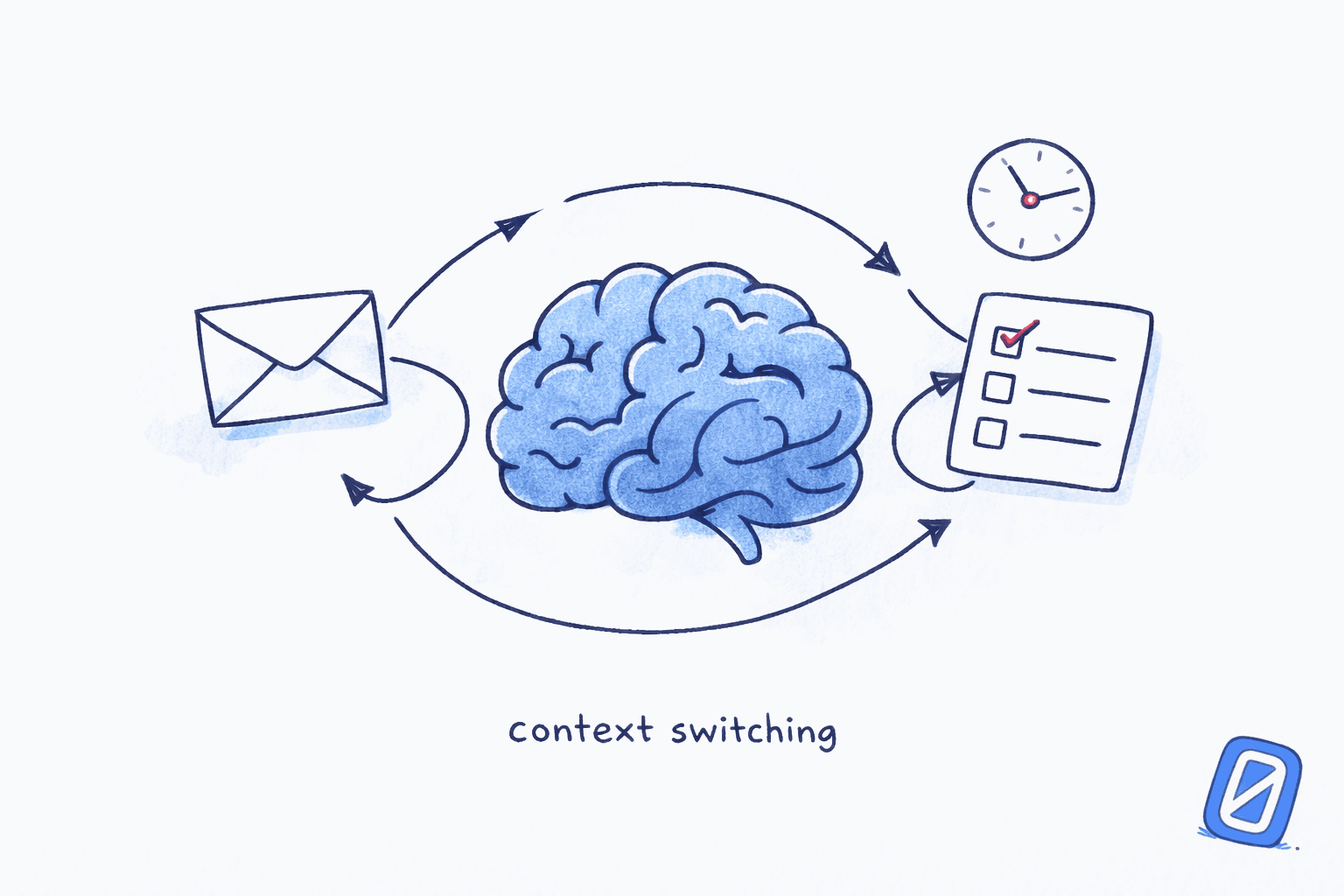
Most productivity advice treats email like a time problem. Block 30 minutes, batch your replies, move on. But the email context switching cost is not about the minutes you spend reading and responding. It is about the 23 minutes your brain needs to recover after you stop.
That recovery figure comes from Gloria Mark, Professor of Informatics at UC Irvine, whose research team observed 36 knowledge workers over multiple days, timing every task transition. The finding, published across her body of work and synthesized in her 2023 book Attention Span: after a single interruption, the average worker takes 23 minutes and 15 seconds to return to the original task at full cognitive engagement. Not because the interruption is long, but because the worker touches an average of two unrelated tasks before circling back.
Here is the uncomfortable editorial claim: the entire concept of “email productivity” is a contradiction when your inbox has no endpoint. You cannot be productive with a tool that, by design, never lets your brain finish and move on. Every email app that shows you an infinite scrolling list is, neurologically speaking, an interruption machine with no off switch.
Key Takeaway
The email context switching cost is driven by two cognitive mechanisms: goal shifting (your prefrontal cortex deactivates one task’s rule set and loads another) and attention residue (part of your focus remains stuck on the interrupted task). Workers who check email every six minutes may never achieve full cognitive depth during an entire workday.
What Causes the Email Context Switching Cost at the Neural Level?#
The neuroscience of task switching is built on a landmark 2001 study by Joshua Rubinstein, David Meyer, and Jeffrey Evans, published in the Journal of Experimental Psychology: Human Perception and Performance. Their four experiments identified two discrete stages of executive control that fire every time you switch tasks.
Stage one is goal shifting. Your prefrontal cortex decides, “I’m doing this now instead of that.” This is a conscious act of reorientation that costs measurable milliseconds even in simple lab tasks.
Stage two is rule activation. The brain deactivates the cognitive rule set governing the previous task and loads the rules for the new one. Rubinstein, Meyer, and Evans showed that switching costs increase with rule complexity: sorting shapes by color costs little, but pivoting from a contract review to a financial model costs a lot.
A 2024 study published in Cortex used combined fMRI and transcranial magnetic stimulation (TMS) to pinpoint where these stages happen. The researchers found a functional dissociation: the right inferior frontal gyrus (IFG) handles goal retrieval during switches, while the right intraparietal sulcus (IPS) implements the switch-specific preparation of new stimulus-response mappings. Disrupting the IPS with TMS selectively impaired switch trial performance, confirming that task switching is not a single mental event but a multi-region, multi-step process.
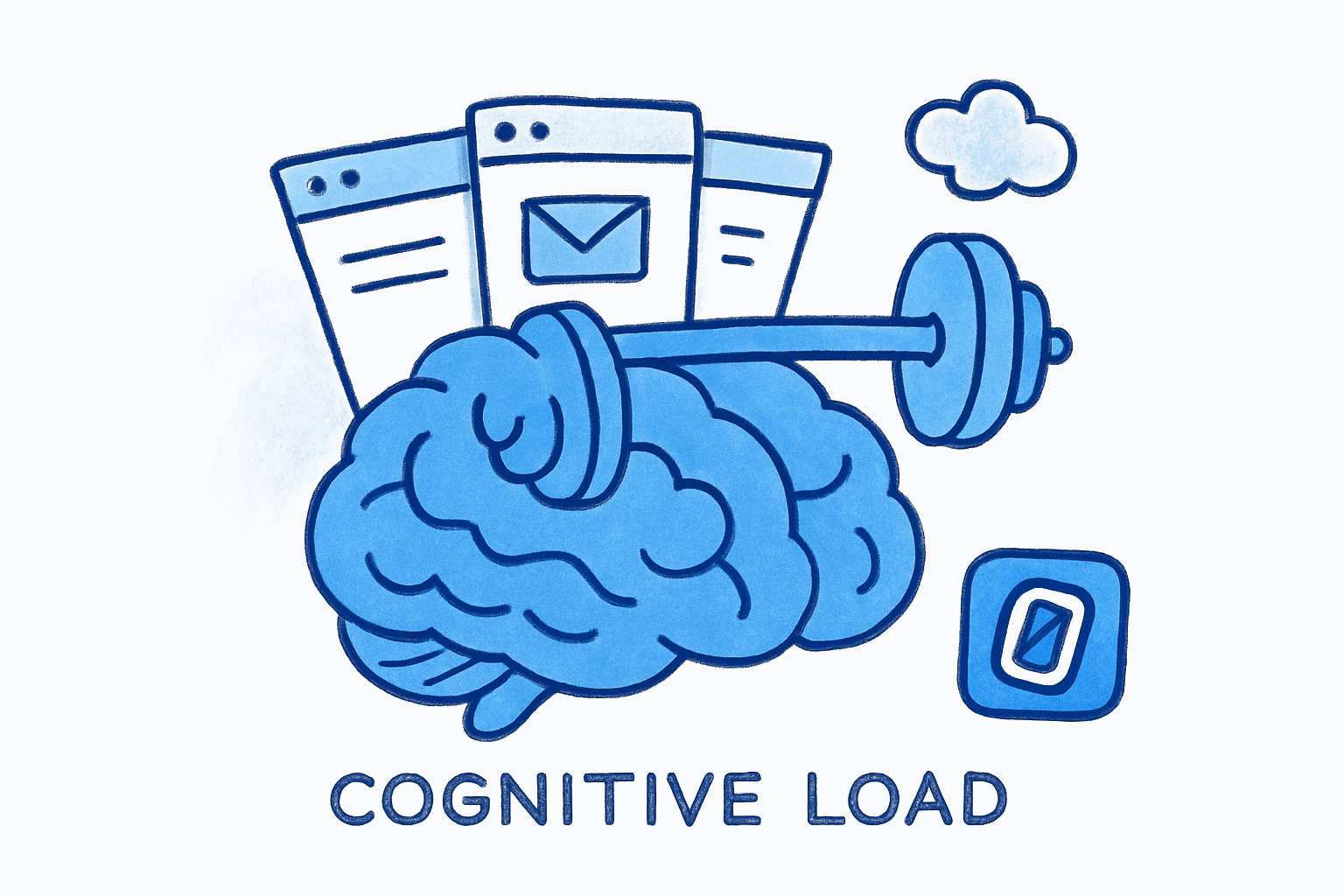
Email sits in the high-cost zone of this process. Each message you open forces your brain to identify the sender, reconstruct the relationship context, parse the request, determine priority, and decide on a response. That is five micro-decisions before you have typed a word. Your prefrontal cortex must configure itself for each message’s unique cognitive demands, then fully reconfigure when you return to your original work.
One caveat worth stating: most fMRI task-switching studies use controlled laboratory tasks, not real email. The 23-minute figure comes from observational workplace research, not neuroimaging. The neuroscience tells us why switching is expensive; the observational data tells us how expensive. Both lines of evidence converge, and together they explain why the email context switching cost is so much steeper than a simple time calculation would suggest.
How Does Attention Residue Amplify the Task Switching Email Penalty?#
If goal shifting and rule activation were the only costs, you would recover from a context switch in seconds. The reason it takes 23 minutes is a phenomenon that Sophie Leroy, Professor at the University of Washington Bothell’s School of Business, identified in her 2009 paper in Organizational Behavior and Human Decision Processes: attention residue.
Leroy’s central finding: when you switch from Task A to Task B, a portion of your cognitive resources remains allocated to Task A. Participants who experienced high attention residue performed measurably worse on subsequent tasks requiring careful judgment. The residue is not metaphorical distraction; it is a quantifiable performance degradation.
“People need to stop thinking about one task in order to fully transition their attention and perform well on another,” Leroy wrote. “Yet results indicate it is difficult for people to transition their attention away from an unfinished task.”
The residue is worst under two conditions: when Task A was left incomplete, and when Task A had no clear deadline. Both conditions describe virtually every email check. You open your inbox, scan eight new messages, reply to two, flag one for later, and leave five unresolved. The email task is unfinished. There was no external pressure forcing closure. Your brain carries the residue of those five unresolved messages into whatever you do next.
Leroy was named the 2024 recipient of UW Bothell’s Distinguished Research, Scholarship, and Creative Activity award for her two decades of work on this topic. Her ongoing research continues to explore whether specific pre-interruption strategies can reduce residue. The early finding: formulating a concrete plan for returning to the interrupted task before you leave it significantly reduces the performance penalty. This aligns with Masicampo and Baumeister’s 2011 research in the Journal of Personality and Social Psychology, which found that making specific completion plans eliminated Zeigarnik-driven intrusive thoughts entirely.
The implication for email is direct: an inbox with no natural endpoint generates maximal attention residue, amplifying the email context switching cost every time you walk away from an unfinished session. An inbox you can actually finish lets your brain discharge the unfinished-business signal and reclaim those resources.
The Six-Minute Trap: Why Most Workers Never Reach Full Focus#
Here is where the switching penalty collides with actual email behavior.
RescueTime’s analysis of over 50,000 users found that the average knowledge worker checks communication tools every six minutes during the workday. A joint study by Qatalog and Cornell University’s Ellis Idea Lab surveying 1,000 workers found it takes 9.5 minutes to re-enter a productive workflow after switching to a different digital tool. Gloria Mark’s research puts full cognitive recovery at 23 minutes.
The arithmetic creates an impossible equation. The email context switching cost requires 23 minutes of recovery, but if you check email every six minutes, you never fully recover. You spend your entire workday in a state of partial attention, touching the surface of every task without reaching cognitive depth on any of them.
The Focus Recovery Gap
Source: RescueTime (2019); Qatalog/Cornell (2021); Gloria Mark, UC Irvine
Mark’s own data shows the problem accelerating. In 2004, her team measured the average time a knowledge worker spent on a single screen before switching: 2.5 minutes. By 2012, that had dropped to 75 seconds. Her most recent measurements, reported in Attention Span, show an average of 47 seconds, with a median of just 40. Other researchers have replicated these findings independently, reporting averages of 44 to 50 seconds.
Microsoft’s 2025 Work Trend Index adds organizational context to these individual numbers: during core work hours, employees face an interruption approximately every two minutes from meetings, emails, or chats, adding up to roughly 275 interruptions per day. Communication tasks consume 60% of the average workday, leaving 40% for focused work, and even that fraction is fragmented by recovery costs from the other 60%.
| Metric | Value | Source |
|---|---|---|
| Average email check interval | Every 6 minutes | RescueTime, 2019 |
| Partial workflow recovery | 9.5 minutes | Qatalog/Cornell, 2021 |
| Full cognitive recovery | 23 min 15 sec | Gloria Mark, UC Irvine |
| Screen focus before switching | 47 seconds (median 40s) | Mark, Attention Span, 2023 |
| Daily workplace interruptions | ~275 | Microsoft Work Trend Index, 2025 |
Honestly, the 47-second figure hit harder than any other data point I found while researching this piece. We have collectively lost more than 75% of our per-screen attention span in two decades, and most of us have not noticed because we have normalized the fragmentation.
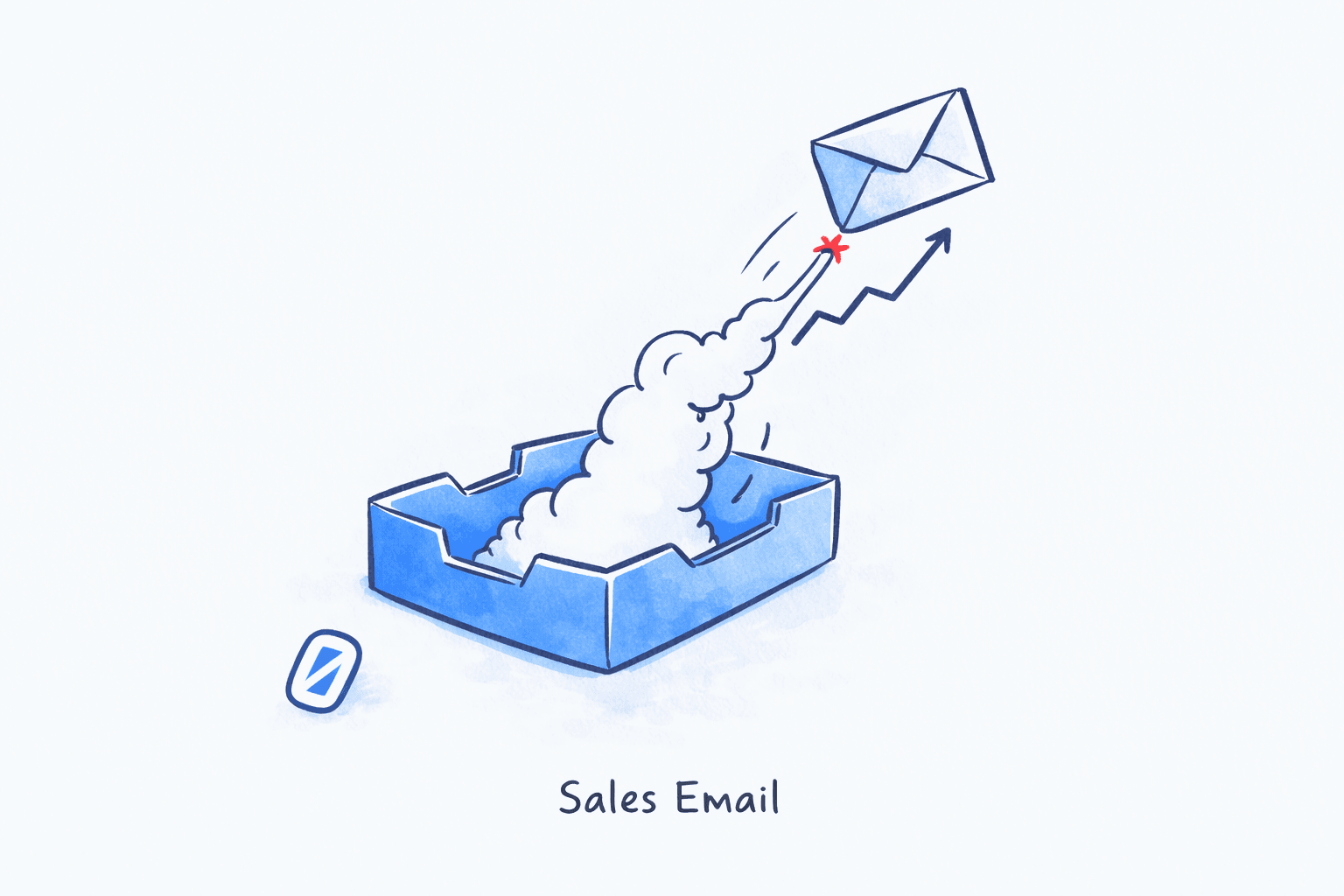
If the six-minute check cycle sounds familiar, Swizero replaces the infinite inbox scroll with a fixed card limit you can clear in one focused session, turning email from an open-ended interruption into a task with a real finish line.
What Is the Real Multitasking Email Cost Across a Team?#
The email context switching cost is not just an individual problem. It scales multiplicatively across organizations.
When one person sends an internal email that interrupts four colleagues, the total switching penalty is not 23 minutes. It is 92 minutes: nearly 1.5 hours of aggregate cognitive recovery time triggered by a single message. Scale that across an organization where hundreds of internal emails fly daily, and the productivity cost becomes structural.
A 2024 study published in Current Psychology by Yuan and Zhong confirmed that multitasking significantly decreased task accuracy, increased reaction time, and increased cognitive load. Task interruptions compounded the reaction time and cognitive load effects even when they did not directly reduce accuracy. The researchers did find one moderating factor: individual resilience buffered some of the cognitive load increase, suggesting that the switching penalty is not purely mechanical but interacts with personal psychological resources.
Asana’s Anatomy of Work Index quantifies what this looks like at the organizational level: knowledge workers spend 60% of their time on “work about work,” including chasing status updates, attending unnecessary meetings, and switching between tools. Only 26% of the workday goes to skilled, focused work. The remaining 14% goes to strategic planning. The multitasking email cost is baked into the structure of how modern teams operate.
Gallup’s 2025 State of the Global Workplace report found that global employee engagement fell to its lowest level since 2020, with the organization estimating $8.8 trillion in lost productivity worldwide. While Gallup attributes disengagement to many factors, the constant interruption cycle is a significant contributor: workers who cannot sustain focus cannot sustain engagement.
Why Is Email Worse for Focus Than Other Interruptions?#
The email context switching cost is disproportionately high compared to other tools. The link between email and focus loss runs deeper than most people realize, driven by three structural reasons that other communication channels do not share.
Email is asynchronous but feels urgent. Unlike a calendar invite or a message in a clearly labeled Slack channel, email arrives with no context about its priority. Your brain must open and evaluate each message to determine whether it requires action. This evaluation process itself triggers the full goal-shifting and rule-activation sequence, even for messages that turn out to be irrelevant.
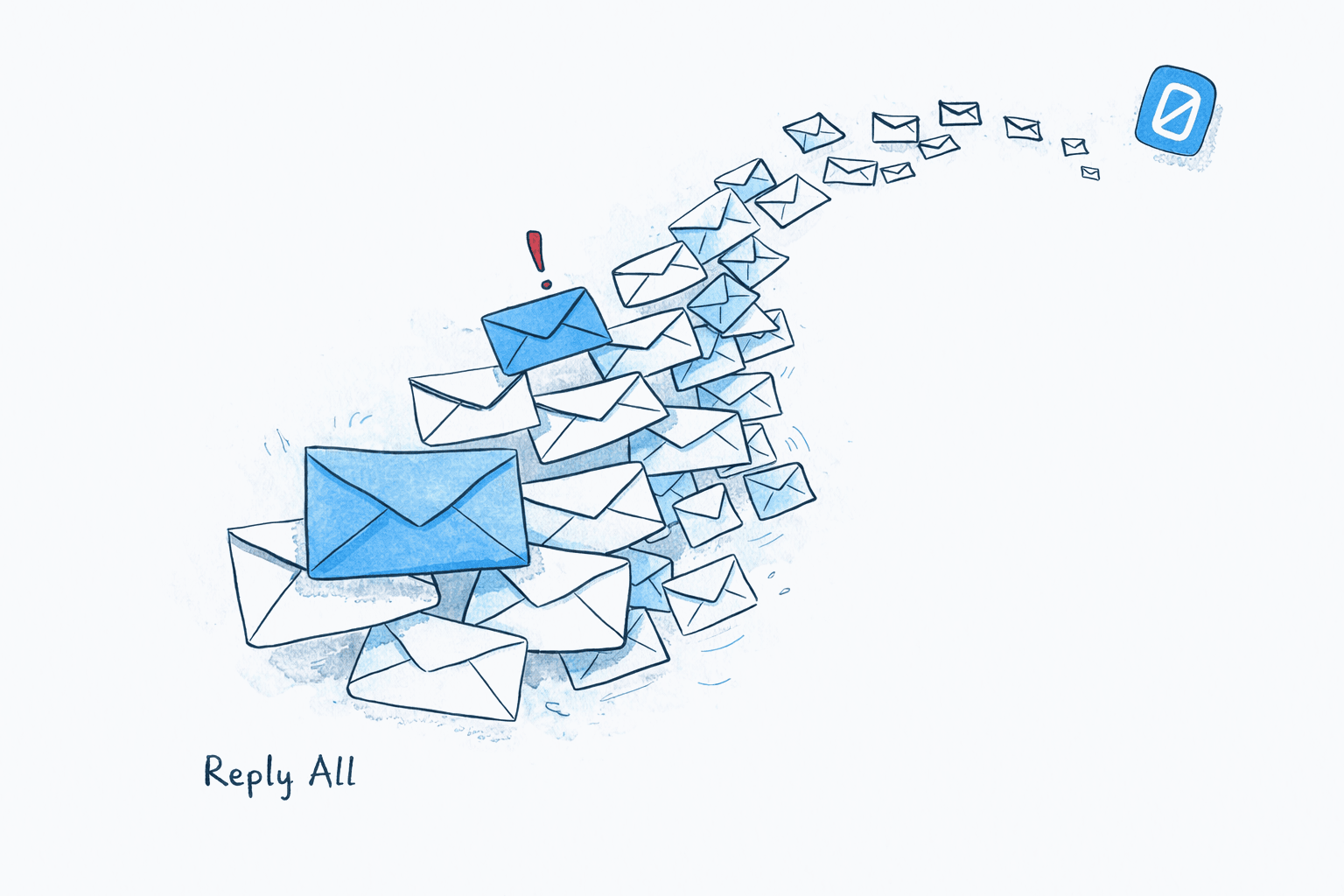
Email has no natural boundary. A meeting has a scheduled end. A phone call concludes when someone hangs up. Email never ends. Without a defined stopping point, every email session risks extending indefinitely. You open your inbox to send one reply and surface 20 minutes later having triaged 14 messages you did not plan to read. The switching penalty compounds with each unplanned interaction. This is the core problem that batching strategies attempt to solve, but batching still does not create an endpoint within each session.
Email threads carry accumulated context. A Slack message is usually self-contained. An email thread can span weeks, involve five participants, and require you to reconstruct an entire decision history before you can respond. This context reconstruction is itself a form of task switching that happens inside the email task, layering switching costs on top of switching costs.
These three properties combine to make email the most expensive interruption in the modern knowledge workplace. Other tools cause switching costs too. But email’s unique combination of ambiguous priority, unbounded sessions, and accumulated thread context creates penalties that other tools simply do not match.
How to Reduce the Email Context Switching Cost#
Understanding the neuroscience is useful only if it changes your behavior. Here are four approaches grounded in the research, ordered from easiest to most structurally effective.
1. Batch your email into defined sessions#
Reducing the email context switching cost starts with the most replicated finding in the email interruption productivity literature: scheduled batching reduces both stress and time loss. Kushlev and Dunn’s 2015 UBC study found that participants who checked email three times per day reported significantly lower daily stress than those who checked continuously. Three sessions is not a magic number, but the principle of limiting checks is consistently supported.
2. Close the loop before you switch#
Leroy’s attention residue research points to a specific remedy: resolve tasks to a terminal state before leaving them. If you must check email mid-task, process every message to completion (replied, archived, or flagged with a specific follow-up time). Half-processed inboxes generate the worst residue because they maximize the number of unfinished cognitive threads your brain must track.
3. Create an artificial finish line#
Since email has no natural endpoint, you need to impose one. Time-box your sessions to 15 minutes. Or use a system that limits how many messages you see. The goal is to transform email from an open-ended activity into a completable task, because completable tasks generate cognitive closure, and closure eliminates the Zeigarnik-driven intrusions that fuel decision fatigue.
Swizero was built around this principle: a fixed card limit you clear in one session, so your brain registers email as done rather than paused. The switching penalty drops because there is nothing unfinished generating residue.
4. Protect your peak cognitive hours#
Gloria Mark’s research shows that interruption tolerance varies throughout the day. Your prefrontal cortex has peak performance windows when complex reasoning is easiest. Scheduling email sessions outside those windows preserves your best hours for work that actually requires depth. Science-backed email habits are not about willpower; they are about respecting your neurobiology.
The Compounding Penalty#
Here is the part of the email context switching cost that gets overlooked: the penalty does not just add up. It compounds.
Every incomplete email check generates attention residue. That residue degrades the quality of your next task. The degraded output may trigger more email (corrections, follow-ups, clarifications). Those additional emails create more interruptions, generating more residue, which degrades the next output further.
This is a negative feedback loop. Poor attention produces poor work. Poor work produces more communication overhead. More communication produces more switching. More switching produces worse attention. The cycle is slow enough to be invisible on any single day, but over weeks and months, it explains why people who process email constantly feel busy but not productive.
Breaking the cycle does not require superhuman discipline. It requires a structural change that eliminates the email context switching cost at its source: something that makes email completable so your brain can fully discharge it and move on. The neuroscience is clear. Closure is the antidote to residue. A finish line is the antidote to perpetual switching.
Frequently Asked Questions#
How long does it take to refocus after checking email?#
The email context switching cost is significant: Gloria Mark’s observational research at UC Irvine found an average recovery time of 23 minutes and 15 seconds after an interruption. This represents the total time before a worker returns to the original task at full cognitive engagement, not the duration of the interruption itself. The delay occurs because workers typically engage with two unrelated tasks before returning to the original one.
Does checking email count as multitasking?#
Yes. Cognitive scientists classify any rapid alternation between tasks as multitasking, even when tasks do not overlap temporally. Rubinstein, Meyer, and Evans demonstrated in 2001 that every task switch incurs measurable time costs through goal shifting and rule activation, regardless of whether you perceive yourself as doing “one thing at a time.”
Can you train your brain to switch tasks faster?#
Practice reduces switching costs for predictable, well-rehearsed task pairs. However, email is inherently unpredictable. Each message presents a novel cognitive demand with a unique sender, context, and required action. The switching cost for email remains high even for experienced professionals because the cognitive rule set changes with every message.
Why does email cause more focus loss than chat apps?#
Email threads carry accumulated context requiring mental reconstruction, messages arrive with no priority signal, and sessions have no natural endpoint. These three structural properties create larger switching penalties than synchronous chat tools, where messages are typically shorter, self-contained, and organized by channel topic.
Sources#
- Executive Control of Cognitive Processes in Task Switching. Rubinstein, Meyer, Evans, Journal of Experimental Psychology: Human Perception and Performance, 2001. Identified goal shifting and rule activation as the two executive control stages in task switching.
- Attention Span: A Groundbreaking Way to Restore Balance, Happiness and Productivity. Gloria Mark, Hanover Square Press, 2023. Average screen focus dropped from 2.5 minutes (2004) to 47 seconds; full recovery time 23 minutes 15 seconds.
- Why Is It So Hard to Do My Work? The Challenge of Attention Residue When Switching Between Work Tasks. Sophie Leroy, Organizational Behavior and Human Decision Processes, 2009. Defined attention residue and demonstrated its performance-degrading effects on subsequent tasks.
- New Functional Dissociations Between Prefrontal and Parietal Cortex During Task Switching. Rodriguez-Toscano et al., Cortex, 2024. Combined fMRI/TMS study showing IFG handles goal retrieval while IPS implements switch-specific preparation.
- Communication Overload: Most Workers Can’t Go 6 Minutes Without Checking Email. RescueTime, 2019. Analysis of 50,000+ users on communication check frequency.
- The Drain of App Switching: Why Employees Lose 5 Hours Per Week. Qatalog and Cornell University, 2021. 9.5 minutes average to re-enter productive flow after app switch.
- Breaking Down the Infinite Workday. Microsoft Work Trend Index, 2025. ~275 daily interruptions, 60% of workday consumed by communication.
- Checking Email Less Frequently Reduces Stress. Kushlev and Dunn, Computers in Human Behavior, 2015. Three-times-daily email checking significantly reduced stress.
- Effects of Multitasking and Task Interruptions on Task Performance and Cognitive Load. Yuan and Zhong, Current Psychology, 2024. Multitasking decreases accuracy, increases reaction time and cognitive load; individual resilience moderates effects.
- How Work About Work Gets in the Way. Asana Anatomy of Work Index. Knowledge workers spend 60% of time on work about work, only 26% on skilled work.
- State of the Global Workplace 2025. Gallup, 2025. Global employee engagement fell to lowest level since 2020, $8.8 trillion in estimated lost productivity.
- An Ongoing Study on the Success of Staying Focused. UW Bothell News, 2024. Sophie Leroy’s 20 years of attention residue research and 2024 Distinguished Research Award.
- Plans and the Realization of Goals. Masicampo and Baumeister, Journal of Personality and Social Psychology, 2011. Specific completion plans eliminated Zeigarnik-driven intrusive thoughts.
Your inbox doesn't have to feel like this.
Swizero finishes your email in minutes, not hours.
Give your inbox a finish line