Email Management for Sales Teams: The Outbox as Revenue Tool
By Chris Stefaner, Co-founder of Swizero
The average sales rep spends 28% of their week actually selling. The rest disappears into CRM updates, internal meetings, prospect research, and the activity that quietly devours more selling time than any other: processing email. Effective email management for sales teams is no longer a nice-to-have; it is a revenue lever. That 28% figure comes from Salesforce’s State of Sales report, surveying more than 4,000 sales professionals globally. It has barely moved in three years.
Most sales productivity advice focuses on what to send: better subject lines, tighter cold email copy, smarter sequences. A disciplined sales inbox strategy separates high performers from everyone else, yet almost none of the standard advice addresses where the real time goes. The inbox is a tar pit. Every new reply, every CRM notification, every Slack-forwarded thread pulls a rep away from the single activity that generates revenue: conversations with buyers.
Here is the opinion that will lose me some readers: the inbox is not a sales tool. It is a liability masquerading as one. The teams that treat email management for sales teams as a revenue discipline, not an administrative afterthought, consistently outperform those running on default settings and good intentions.
Key Takeaway
Sales reps lose roughly 72% of their workweek to non-selling activities, with email management for sales teams consuming the largest single share. Restructuring how sales teams handle inbound and outbound email can recover 5 or more hours per rep per week, translating directly into pipeline and closed deals.
How Much Selling Time Does Email Actually Steal?#
Any serious approach to email management for sales teams starts with measuring the damage. Forrester’s Sales Activity Study, drawing on data from more than 3,000 global sales reps across 39 task categories, found that the average rep loses roughly 14 hours per week to administrative work. Email sits at the center of that administrative sprawl: reading replies, logging interactions, drafting follow-ups, and performing the constant micro-task of deciding what to do with each message.
Salesforce’s 2026 State of Sales update sharpened the picture further. The average seller now spends 40% of their time on selling activities, up slightly from 28% two years prior. But Gen Z reps, the cohort filling most SDR seats, clock just 35%, losing approximately two extra hours per week to manual data entry compared to senior colleagues.
The math behind email management for sales teams is not complicated. A 50-person SDR team where each rep recovers even one hour of selling time per day adds 250 hours of prospect-facing activity per week. At industry-average conversion rates, that is the equivalent of hiring 10 additional reps without paying a single new salary.
How Sales Reps Spend Their Week
Source: Salesforce State of Sales, 2024; Forrester Sales Activity Study
I could write a whole post about CRM data entry alone, but the key point here is simpler: email is the connective tissue between every other time sink. You read an email, switch to the CRM to log it, switch back to draft a reply, get pulled into a Slack thread about the same deal, return to email, and discover six new messages arrived while you were gone. That is not email management for sales teams. That is context-switching theater.
What Does a 5-Minute Response Window Actually Mean for Revenue?#
When it comes to email management for sales teams, speed on inbound signals matters more than almost anything else. The most cited study on lead response timing comes from James Oldroyd, Kristina McElheran, and David Elkington, published in the Harvard Business Review in 2011 as “The Short Life of Online Sales Leads.” Their research analyzed more than 100,000 web-generated leads across 2,241 U.S. companies over three years.
The headline finding: firms that responded to an inbound lead within five minutes were 21 times more likely to qualify that lead than firms that waited 30 minutes. They were also 100 times more likely to make contact at all.
That was 2011. The window has only tightened. In a market where cold email reply rates have dropped to 3.43% on average in 2026 (down from roughly 5% in 2025, per Instantly’s benchmark report across millions of emails), the ability to respond quickly to warm inbound signals is the single highest-leverage email activity a sales team can perform.
Yet most companies still fail at it. The original Oldroyd study found the average first response took 42 hours. More recent data suggests the median has improved to about 29 hours for companies that respond at all, but 63% never respond to web leads in the first place.
| Response Time | Contact Rate Multiplier | Qualification Multiplier |
|---|---|---|
| Under 5 minutes | 100x baseline | 21x baseline |
| 5 to 30 minutes | 10x baseline | 4x baseline |
| 30 minutes to 1 hour | 1x baseline | 1x baseline |
| Over 1 hour | 0.16x baseline | 0.14x baseline |
Source: Oldroyd, McElheran & Elkington, “The Short Life of Online Sales Leads,” Harvard Business Review, 2011.
The takeaway for SDR email management is not “check email more often.” It is the opposite: build a system where the inbox surfaces inbound buying signals immediately, so you can act on them fast, and then get back to the outbound work that fills tomorrow’s pipeline. The best email management for sales teams comes down to one principle: speed on inbound, discipline on everything else.
Why Context Switching Kills SDR Productivity More Than Volume#
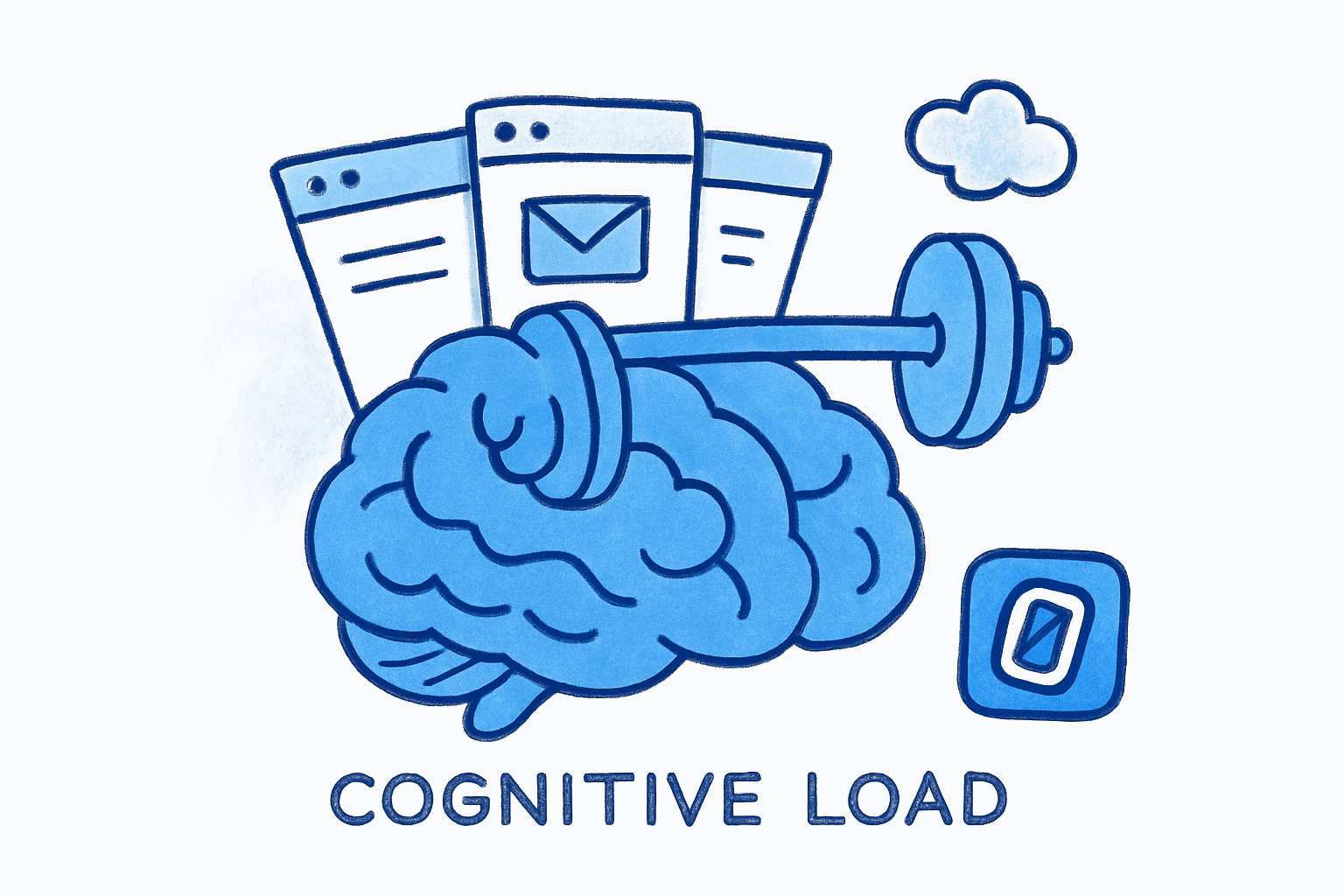
Email management for sales teams is not just about volume; it is about cognitive cost. Sales development representatives toggle between an average of eight or more tools daily: dialer, email sequencer, CRM, data enrichment platform, LinkedIn, Slack, calendar, and whatever internal tool the RevOps team rolled out last quarter. Each switch carries what researchers call a “task-switching cost,” a cognitive penalty that Gloria Mark’s work at UC Irvine has measured at roughly 23 minutes to fully refocus after an interruption.
“People don’t just resume where they left off,” Mark wrote in her 2023 book Attention Span. “They carry residue from the interrupted task, and that residue degrades performance on the new task.”
For SDRs, this plays out dozens of times per day. You are mid-sequence, crafting a personalized first touch for a target account, and an inbound reply from a different deal pops up. You pivot to the CRM, log the interaction, draft a response, and return to your outbound task. But the mental model of that target account has evaporated. You re-read your notes. You re-check their LinkedIn. Fifteen minutes gone, and you have not sent a single new email.
Bain & Company’s 2025 Technology Report found that sellers spend only about 25% of their time actually selling to customers, and identified sales as “one of the most challenging areas to implement AI successfully.” The report noted that basic AI code assistants deliver about 10% productivity gains, while companies that pair AI with end-to-end process redesign see 25% to 30% improvements.
The lesson is not just “use AI.” It is that the process itself, the workflow of moving between inbox and CRM and sequencer and dialer, is broken. Fixing email management for sales teams means reducing the number of transitions a rep makes per hour, not just speeding up each individual task.
If the constant toggle between inbox and CRM sounds familiar, Swizero reduces your personal inbox to a handful of cards so the noise stays out of your selling hours. When your inbox has a finish line, you process it and move on instead of living inside it.
The Outbox as Pipeline: What Top Performers Do Differently#
Most sales email productivity frameworks focus on volume: send more sequences, add more prospects, automate more touchpoints. But the data on email management for sales teams suggests a different approach wins.
Backlinko’s study of 12 million outreach emails, conducted in partnership with Pitchbox, found that a single follow-up message boosts reply rates by 65.8%. Personalized email bodies increased response rates by 32.7%. And reaching multiple contacts at a target company improved outcomes by 93% compared to emailing a single person.
None of those levers require more volume. They require more precision. The sales teams that treat the outbox as a revenue instrument are not sending the most emails; they are sending the right emails at the right time to the right people, and then following up consistently.
Jill Konrath, author of SNAP Selling and More Sales, Less Time, put it this way: “The biggest time waster in sales isn’t cold calling or prospecting. It’s the lack of a system for processing what comes back.”
She is right. The outbound motion generates inbound replies, which generate follow-up obligations, which fill the inbox, which consumes the time meant for more outbound. Without a system for processing email faster, the flywheel stalls. This is why email management for sales teams must address the inbound side, not just the outbound sequences.
The Optimal Cadence#
Cross-referencing data from multiple 2025-2026 outreach studies reveals a pattern:
- Send windows: Tuesday through Thursday, 8 to 11 AM or 2 to 4 PM in the recipient’s local timezone consistently delivers the strongest engagement across platform data
- Follow-up spacing: Monday send with Wednesday follow-up outperforms other combinations
- Message length: Cold emails under 80 words get the best response rates
- Sequence depth: Three or more touches generate materially better outcomes than a single send
Honestly, the timing data was the hardest part of this research to reconcile. Different platforms report slightly different optimal windows depending on industry and geography. The consistent finding is not a specific hour; it is that disciplined timing beats spray-and-pray volume every time.
How Is AI Changing Sales Email in 2026?#
AI is no longer experimental in sales. Salesforce’s 2026 State of Sales report found that 87% of sales organizations now use some form of AI, and sellers using AI tools are 3.7 times more likely to meet quota than those who do not. Once fully implemented, sellers expect AI agents to cut prospect research time by 34% and email drafting time by 36%.
The shift is especially visible in email management for sales teams at the SDR level. AI-powered tools now handle lead scoring, response prioritization, sequence personalization, and even initial reply drafting. Top-performing sellers are 1.7 times more likely to use AI prospecting agents for outreach than underperformers.
But there is a catch that most vendor pitches gloss over. Bain’s research found that the average productivity gain from basic AI tools is just 10% to 15%, and “often the time saved isn’t redirected toward higher-value work.” Teams that see 25% to 30% gains are the ones that redesign the workflow around the AI, not the ones that bolt AI onto a broken process.
One caveat worth noting: the 3.7x quota multiplier from the Salesforce report measures correlation, not causation. High-performing teams adopt AI tools and tend to have better processes, better coaching, and better data hygiene. The AI alone is not a silver bullet. It is a force multiplier for teams that already have the fundamentals in place.
Cal Newport, Georgetown computer science professor and author of Deep Work, has written extensively about how knowledge workers sabotage themselves with always-on communication patterns. “The issue is not whether you use AI to draft emails,” he noted in a 2024 New Yorker essay. “The issue is whether you have a system that prevents email from consuming the cognitive space meant for your most important work.”
For sales teams, that “most important work” is conversations with buyers. AI that improves email management for sales teams by drafting faster emails is helpful. A system that keeps the inbox bounded and finite so reps spend their cognitive budget on deals rather than triage is transformational.
AI Impact on Sales Activities (Expected Time Savings)
Source: Salesforce State of Sales Report, 2026
What Does Better Email Management for Sales Teams Look Like in Practice?#
The practical question is not whether email management for sales teams matters. The data makes that obvious. The question is how to build an email management system for sales teams that works without requiring superhuman discipline.
Separate inbound signals from administrative noise#
Most reps check a single inbox that mixes inbound prospect replies with internal newsletters, CRM notifications, meeting invites, and Slack email digests. The fix is architectural: route everything that is not a prospect or customer reply out of the primary inbox. Filters, labels, and AI-powered sorting all work. The goal is that when a rep opens their email, every message visible is either a buying signal or a deal-related communication.
This is the same principle behind email triage frameworks used in high-volume professional contexts: sort by urgency and relevance before processing, not during.
Time-block outbound and inbound separately#
The fastest way to destroy an outbound prospecting block is to check for replies in the middle of it. Time blocking for email is not a new idea, but sales teams rarely apply it rigorously. Dedicate specific windows to outbound sequences and separate windows to processing inbound. The 5-minute response rule applies to inbound buying signals, not to every message that arrives.
Treat follow-ups as first-class pipeline activities#
Backlinko’s data shows that a single follow-up boosts reply rates by 65.8%, yet 48% of sales reps never send a second message after initial outreach, according to Belkins’ 2025 research. Follow-ups are not nagging; they are pipeline maintenance. Build them into the daily cadence as a dedicated activity, not something that happens if there is time left over. For templates and tactics on this, our guide to writing follow-up emails that get replies breaks down the data in detail.
Cap processing time with artificial constraints#
This is where the “finish line” philosophy of email management for sales teams applies directly. An inbox with no end is an inbox you never leave. The most effective sales email productivity practice is to set a hard boundary on processing time: 20 minutes for morning triage, 15 minutes after lunch for inbound replies, 10 minutes at end of day for loose ends. When the timer stops, you leave the inbox whether it is empty or not. The constraint forces prioritization.
Swizero takes this further by reducing your inbox to a fixed card limit. Instead of scrolling through 50 or 100 messages, you see a handful of cards, ranked by AI. Process them and you are done. For reps who need their personal email cleared quickly so they can get back to selling, the bounded inbox is not a limitation. It is a feature.
Frequently Asked Questions#
How much time do sales reps actually spend on email?#
The most common email management for sales teams question starts here. Sales reps spend approximately 20% to 25% of their workweek on email-related activities including reading, responding, drafting outbound messages, and logging email interactions in CRM systems. Combined with other administrative tasks, non-selling activities consume roughly 60% to 72% of the average sales workweek, according to Salesforce’s State of Sales research and Forrester’s Sales Activity Study.
What is the ideal lead response time for sales teams?#
Research from Oldroyd, McElheran, and Elkington published in the Harvard Business Review shows that responding to an inbound lead within five minutes makes a sales team 21 times more likely to qualify that lead and 100 times more likely to make contact, compared to waiting 30 minutes. Despite this data, the average corporate response time still exceeds 24 hours.
Does AI actually improve sales email productivity?#
AI is reshaping email management for sales teams. Sales teams using AI tools are 3.7 times more likely to meet quota, according to Salesforce’s 2026 State of Sales report. However, the productivity gains vary widely: basic AI tools deliver 10% to 15% improvements, while teams that redesign their workflows around AI see 25% to 30% gains. The tool alone is less important than the process change it enables.
How many follow-up emails should a sales rep send?#
Data from Backlinko’s study of 12 million outreach emails shows that a single follow-up boosts reply rates by 65.8%, and sequences with three or more touches generate materially better outcomes than single sends. Research from Belkins indicates that 48% of sales reps never send a follow-up at all, which represents a significant missed opportunity for pipeline development.
Sources#
- State of Sales Report. Salesforce, 2024. Sales reps spend 28% of their week selling; 84% missed quota.
- The Productivity Gap: State of Sales 2026. Salesforce, 2026. 87% of sales orgs use AI; sellers using AI 3.7x more likely to meet quota; AI expected to cut email drafting time by 36%.
- The Short Life of Online Sales Leads. Oldroyd, McElheran & Elkington, Harvard Business Review, 2011. 5-minute response = 21x more likely to qualify leads.
- Sales Activity Study. Forrester. Average rep loses 14 hours/week to admin across 39 task categories.
- We Analyzed 12 Million Outreach Emails. Backlinko & Pitchbox. Single follow-up boosts replies 65.8%; personalization boosts response rate 32.7%.
- AI Is Transforming Productivity, but Sales Remains a New Frontier. Bain & Company, 2025 Technology Report. Basic AI = 10-15% gains; process redesign + AI = 25-30%.
- Cold Email Benchmark Report 2026. Instantly, 2026. Average cold email reply rate dropped to 3.43%.
- Lead Response Time Statistics. Ainora, 2026 compilation. 63% of companies never respond to web leads.
- Ultimate Guide to Follow-Up Emails. Belkins, 2025. 48% of sales reps never send a second follow-up.
- Attention Span. Gloria Mark, 2023. Average refocus time after interruption: 23 minutes.
Your inbox doesn't have to feel like this.
Swizero finishes your email in minutes, not hours.
Give your inbox a finish line