The Psychology of the Unread Email Badge
By Chris Stefaner, Co-founder of Swizero
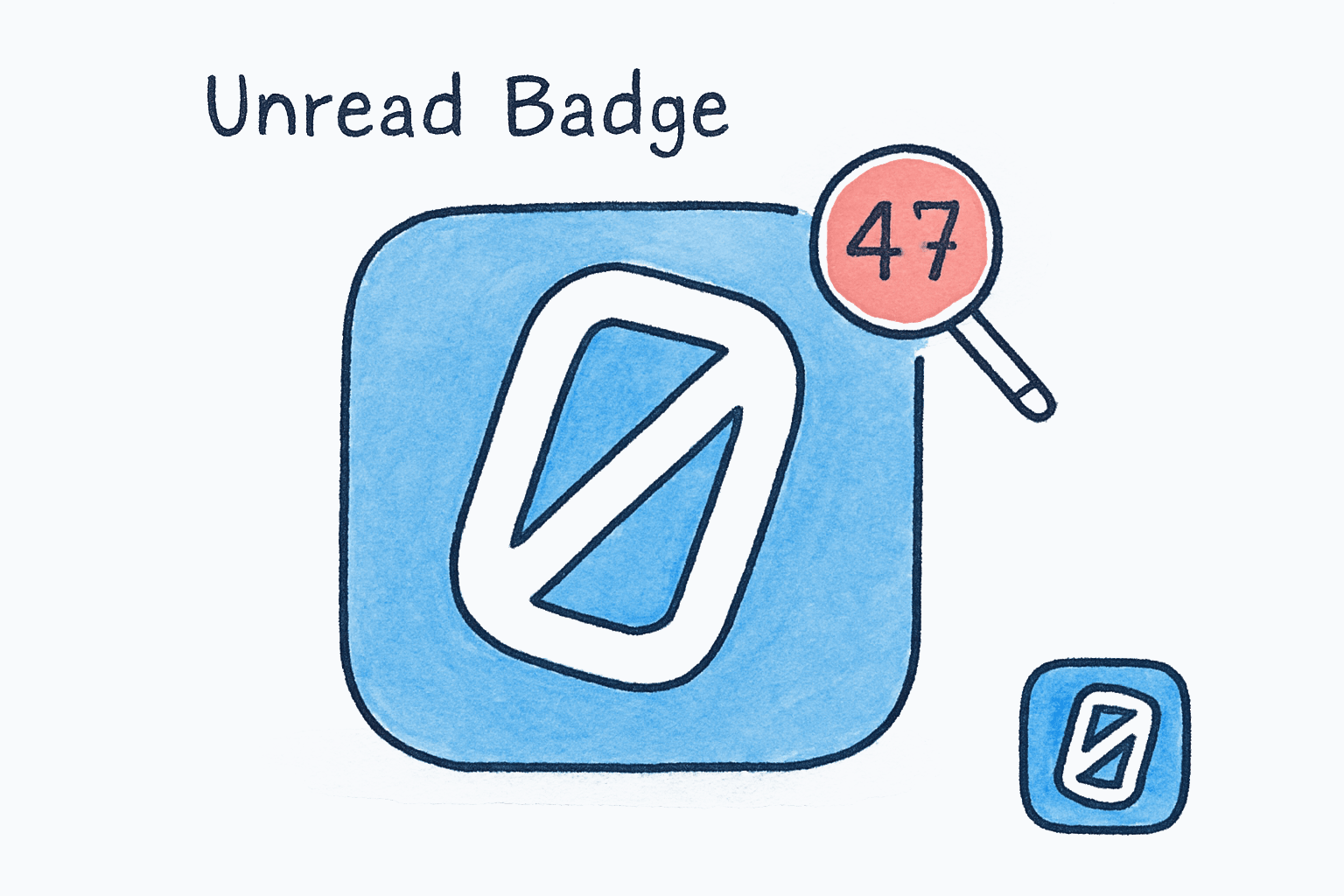
The little red number on your Mail icon is not a feature. It is a design choice; one specific person made it, one specific company shipped it, and you have been living with the consequences for nearly two decades. Once you see it as a designed object rather than a fact of email, the spell breaks a little. The unread email badge psychology is worth understanding because it reveals how a single glyph can reshape your relationship with your inbox.
The badge does three things at once: it uses pre-attentive color processing to bypass your conscious attention, it triggers the Zeigarnik effect by representing an open loop, and it operates a variable-ratio reinforcement schedule identical to a slot machine. None of these are accidents. They are the reasons engagement metrics go up and you feel mildly worse every time you glance at your phone.
If you have read our take on breaking the notification addiction, you already know the broader case against always-on inbox alerts. This post zooms in on the badge itself; the specific glyph, the color choice, the count, and why removing it tends to feel disproportionately liberating.
Key Takeaway
The red unread email badge is engineered to trigger compulsive checking by combining three psychological exploits: pre-attentive red detection, the Zeigarnik effect on open loops, and variable-ratio reinforcement. It is a design decision, not a default. Turning it off is one of the highest-leverage changes you can make for inbox-related stress.
Contents#
- Where the Badge Came From
- Why Is the Badge Red? The Pre-Attentive Hijack
- The Zeigarnik Effect: Why a Number You Cannot Reach Still Bothers You
- Why Does Checking Email Feel Like Gambling?
- Unread Email Badge Psychology: The Measurable Stress of a Number You Are Not Looking At
- What Happens When You Turn It Off?
- Frequently Asked Questions
- Sources
Where the Badge Came From#
The numbered red circle that appears on app icons is so embedded in modern computing that most people treat it as a primitive; like a window or a cursor. It is not. Apple’s iPhone OS introduced the unread email badge in 2007 on the Mail app icon, and the system was generalized into a public API for all apps in iPhone OS 3.0 in 2009. Within a decade, it became the default visual grammar for “you have unfinished business here” across every major mobile operating system.
The shape was inherited from older patterns; the unread count in desktop Mail apps, the dock badge in Mac OS X; but the move to a dense, glanceable home screen changed what the badge did. On a desktop, the badge sat inside an app you had to open. On a home screen, the badge sits on a permanent grid of icons you see dozens of times a day, often when you are reaching for something completely unrelated.
That is the design move worth noticing. The badge was built for desktop attention and ported to ambient attention. Nobody renegotiated the contract.
Honestly, when I first started paying attention to this, I was surprised that I had never thought about it. The badge is not labeled “marketing tool.” But the 2022 PLOS ONE study by Bartoli and Benedetto, conducted with over 1,000 participants in a between-subjects “First Impression Click Test,” showed that the simple presence of a single badge among fifteen icons produced a large, statistically significant increase in clicks on that app. The badge does not just inform. It directs behavior, even on first impression, even with no other context.
Why Is the Badge Red? The Pre-Attentive Hijack#
The badge is red because red wins the race for your attention before you are conscious of looking. Vision researchers call this pre-attentive processing; the few hundred milliseconds in which your visual system scans a scene for salient features (color, motion, orientation) before your prefrontal cortex gets a vote. Red, specifically saturated red against a non-red background, “pops out” reliably. You do not choose to notice the badge. By the time you have, the orienting reflex has already fired.
The evolutionary argument is well-rehearsed: red signals blood, ripe fruit, danger, sexual signaling. The evidence base is more interesting than the just-so story. A 2015 study published in Frontiers in Psychology by Kuniecki et al. used eye-tracking to show that red attracts attention specifically in emotional contexts, with effects strong enough to bias gaze fixation patterns within the first 200 milliseconds of viewing.
This is not a small effect for product designers. Facebook discovered it the expensive way. The notification dot was originally rendered in Facebook blue to feel “subtle and innocuous,” and engineers reported that almost nobody used it. They switched it to red and engagement on notifications jumped substantially; by some internal accounts in the range of 20%. The story has been retold in design circles for years; the lesson stuck. Every consumer app since has used red or red-orange for badges. None of them are doing it for aesthetic reasons.
The point of view declaration: the color of your inbox badge is not a neutral choice, and it never was. It was selected, A/B tested, and standardized because it works on the wiring of your visual cortex. Calling it manipulative is not melodrama. It is just an accurate description of what the design does.
The Zeigarnik Effect: Why a Number You Cannot Reach Still Bothers You#
In the 1920s, the Lithuanian-Soviet psychologist Bluma Zeigarnik noticed that waiters at a Berlin café could remember the orders of customers who had not yet paid in remarkable detail; and forgot them almost completely the moment the bill was settled. Her 1927 doctoral research under Kurt Lewin formalized the finding: interrupted or unfinished tasks occupy mental resources at a higher rate than completed ones. The brain holds open loops in working memory until they are closed.
The unread badge is a Zeigarnik trigger by design. The number is a literal count of open loops. Forty-seven unread messages is forty-seven small “did you handle this yet?” prompts that your brain keeps lukewarm even when you are not looking at the icon. Some loops are real (a client email you owe a reply to) and most are not (a shipping confirmation, three newsletters, a recruiter spam). Your prefrontal cortex cannot tell which is which from the badge alone, so it treats all forty-seven as live.
This is why people with thousands of unread emails report two contradictory states: relief that they have given up on the count, and a low-grade ambient guilt that never quite goes away. The badge does not need to be checked to do its work. The Zeigarnik tension persists in the background, what one Perspectives in Public Health review (2025) framed as “ambient cognitive load from unclosed digital loops.”
A small confession: I am skeptical of any productivity claim that hangs entirely on a single hundred-year-old experiment, and the Zeigarnik effect’s replication record is mixed. But the modern badge does not just rely on Zeigarnik; it stacks Zeigarnik on top of color saturation on top of variable reinforcement. Even if any one of these mechanisms is weaker than originally claimed, the layering is what makes the design effective.
Why Does Checking Email Feel Like Gambling?#
Because the reward schedule is the same. Tristan Harris, the former Google design ethicist who co-founded the Center for Humane Technology, made the comparison explicit in his widely circulated 2016 essay How Technology Hijacks People’s Minds: “When we pull our phone out of our pocket, we’re playing a slot machine to see what notifications we got. When we pull-to-refresh our email, we’re playing a slot machine to see what new email we got.”
Harris’s argument rests on variable-ratio reinforcement, the schedule that B.F. Skinner identified in the 1950s as the most resistant to extinction of any reward pattern in operant conditioning. A predictable reward (every fifth lever press releases a pellet) trains a moderate, well-paced behavior. An unpredictable reward (sometimes the third press, sometimes the eleventh) trains a frantic, persistent one. Slot machines, lottery tickets, and notification systems all run on variable-ratio schedules because nothing else produces such durable engagement.
The badge counter is the slot machine’s display. It tells you something happened; but not what, not from whom, and not whether it matters. To learn that, you have to pull the lever (open the app). Most pulls are nothing. A few are something. The unpredictability is the point.
“Would I allow some random human to follow me around and, whenever they want, to tap me on the shoulder and say, ‘Hey, check this thing out’? If the answer is no, that’s a pretty good reason to turn off your notifications.”
; Adam Alter, Irresistible: The Rise of Addictive Technology
Adam Alter, Professor of Marketing and Psychology at NYU Stern and author of Irresistible, has been arguing for a decade that the persistence of badge-driven checking is closer to behavioral addiction than to ordinary habit. He is not the only one. Nir Eyal, who literally wrote the playbook on engagement design (Hooked) before pivoting to write about how to escape it (Indistractable), distinguishes between the external trigger (the badge) and the internal trigger (the felt urge to check). The external trigger only has to fire often enough to install the internal one. After that, the badge has done its job and you continue checking with the icon hidden.
If a four-digit unread count is doing more work on your mood than you would like, Swizero caps your inbox at a fixed number of cards per session; so the count is bounded by design, not by how disciplined you feel that morning.
Unread Email Badge Psychology: The Measurable Stress of a Number You Are Not Looking At#
The badge produces stress that registers in physiology, not just self-report. The most-cited evidence comes from the Kushlev and Dunn (2015) “Checking email less frequently reduces stress” study at the University of British Columbia, which found that participants assigned to check email three times per day reported significantly lower daily stress than those given unlimited access. Stress, in turn, predicted higher well-being on a range of outcomes; sleep quality, social connection, sense of meaning. The control variable that mattered was access, not volume.
A related finding from psychologist Larry Rosen’s lab at California State University, Dominguez Hills: cortisol response 30 minutes after waking was predicted by morning email use specifically among fathers in the sample, with heavier morning email use mapping to a sharper cortisol spike. One caveat; the effect was not universal across the sample, and Rosen’s broader research program is more nuanced than the single statistic suggests. But it is one of the few studies to tie email behavior to a measurable hormonal stress response within minutes of waking.
What does the badge add to this? It is the persistent cue. A 2022 PLOS ONE field study by Fischer et al. on notification-driven task interruptions found that workers spent an average of 1.5 to 2 hours per day in a degraded cognitive state due to context-switching triggered by communication apps. The badge does not have to chime to count as an interruption. Its visibility on the home screen produces the same orienting response as a sound, just without the acoustic component.
| Mechanism | What the Badge Does | Documented Effect | Source |
|---|---|---|---|
| Pre-attentive processing | Captures gaze in <200ms | Bias toward red stimuli in emotional contexts | Kuniecki et al., Frontiers in Psychology, 2015 |
| Zeigarnik effect | Renders open loops as a count | Unfinished tasks consume working memory | Zeigarnik, 1927 |
| Variable-ratio reinforcement | Unpredictable reward per check | Most extinction-resistant schedule known | Skinner, 1957 |
| Click salience | Single badge directs first click | Large, significant click increase | Bartoli & Benedetto, PLOS ONE, 2022 |
| Stress response | Persistent ambient cue | Lower stress when access is bounded | Kushlev & Dunn, UBC, 2015 |
The table is not meant to be exhaustive. It is meant to make a specific point: the badge is not one psychological trick, it is a stack of them. Each layer is individually small. Together they produce the disproportionate emotional weight of a tiny red number on a glass screen.
There is a particular research finding worth pausing on. A 2024 study published in ScienceDirect on phantom vibration syndrome found that 49.3% of university students reported feeling their phone buzz when it had not. Phantom vibration is an extreme case of the same wiring that responds to a badge; your brain has tuned itself to anticipate the cue so reliably that it generates the sensation without the input. If half the population is hallucinating notifications, “the badge is just information” becomes a hard claim to defend.
What Happens When You Turn It Off?#
You feel worse for two or three days. Then you feel substantially better. This is anecdotal but it shows up in the research too. A 2024 study published in Media Psychology (Beyond the Buzz) tracked participants through a notification-disabling intervention and found that despite an initial uptick in self-reported “fear of missing out,” within a week most participants reported lower stress, better focus, and (notably) no real change in how often they actually missed important messages. The badge had been doing emotional work without doing informational work.
This is the editorial stance of this whole post: most badge-driven email checking is not for you, it is for the metric. It exists to keep an engagement number on a chart in some product manager’s deck pointing in the right direction. If the metric and your well-being were aligned, the design would already look different.
The fix is not motivation, willpower, or a new app with a slightly cleverer way of presenting unread counts. The fix is to remove the trigger. iOS lets you turn the Mail badge off in two taps (Settings → Notifications → Mail → Badges, off). Android has equivalent controls. You can go further and remove email from the home screen entirely so that opening it requires a deliberate search, which restores the gap between intent and action that the badge was specifically engineered to close.
The deeper move, which we have argued for in our piece on why every email app is solving the wrong problem, is to challenge the underlying assumption: that email’s job is to display all of itself, all the time, with a counter. Email could be designed as a session; a fixed batch you process and complete; instead of an open feed. A session has a finish line. A feed does not.
Yes, this is partly a pitch for what Swizero builds. It is also just the truthful answer to “why does my email badge make me feel that way?” The badge is what an unbounded inbox looks like in pixels. Bound the inbox and the badge becomes either unnecessary or, at most, a small honest piece of information rather than a small dishonest source of stress.
The challenge to leave you with is small and concrete: turn off the Mail badge for 72 hours. Just three days. Notice what your hand does when you reach for the phone and the icon is silent. That reflex; the one searching for a number that no longer exists; is the residue of a design choice that was always supposed to be reversible. It still is.
Frequently Asked Questions#
Why does the unread email number give me anxiety?#
Because it is engineered to. The unread email badge stacks three psychological mechanisms; pre-attentive red detection, the Zeigarnik effect on unfinished tasks, and variable-ratio reinforcement; into a single visual element. Even glancing at it triggers an orienting response your conscious mind cannot fully suppress. Research from the University of British Columbia (Kushlev & Dunn, 2015) shows that bounded email access measurably reduces daily stress, suggesting the persistent count itself is a stressor, not just the messages it represents.
Is it OK to ignore unread emails?#
Yes, and it is more OK than the badge implies. The count includes shipping notifications, newsletters, marketing, and other low-priority email indistinguishably from genuine work. Treating all forty-seven unread messages as equally pressing is a category error the badge encourages. A 2024 Media Psychology study on disabling notifications found that participants did not actually miss more important messages once badges were off; they just stopped reacting to unimportant ones.
How do I turn off the unread email badge on iPhone?#
Go to Settings → Notifications → Mail → Badges and toggle off. You can do the same per-account by opening the Mail app, then Settings → Mail → Notifications. On Android, the path is typically Settings → Notifications → App notifications → Mail → Notification dot. Most people who try it report initial discomfort followed by relief within a few days.
Does the color of notifications really matter that much?#
Yes, more than is comfortable to admit. Red wins pre-attentive processing across virtually every documented test. Facebook famously found that switching the notification dot from blue to red produced a substantial engagement increase. A 2015 Frontiers in Psychology paper by Kuniecki et al. showed that red biases gaze fixation in emotional contexts within 200 milliseconds. The choice is not aesthetic. It is functional and measurable.
What is the Zeigarnik effect, and how does it relate to email?#
The Zeigarnik effect is a psychological finding from Bluma Zeigarnik’s 1927 research showing that interrupted or unfinished tasks are remembered better and occupy more mental resources than completed ones. The unread email badge represents your inbox as a literal count of open loops. Each unread message is a small ongoing tension your brain holds in working memory. Closing the loops; by reading, replying, or deleting; releases the tension. A persistent four-digit unread count is, in Zeigarnik terms, four thousand small unresolved threads.
Sources#
- Driven by notifications – exploring the effects of badge notifications on user experience. Bartoli & Benedetto, PLOS ONE, 2022. Badge presence produced a large, significant increase in first-impression clicks among 1,000+ participants.
- The color red attracts attention in an emotional context. Kuniecki et al., Frontiers in Psychology, 2015. Eye-tracking evidence for pre-attentive red bias within 200ms.
- How Technology Hijacks People’s Minds; from a Magician and Google’s Design Ethicist. Tristan Harris, Thrive Global / Medium, 2016. Slot machine framing of notification design.
- Checking email less frequently reduces stress. Kushlev & Dunn, Computers in Human Behavior, 2015. Bounded email access reduces daily stress.
- Effects of task interruptions caused by notifications from communication applications on strain and performance. Fischer et al., PLOS ONE, 2023. Notification-driven context switching costs 1.5–2 hours of degraded cognition daily.
- Beyond the Buzz: Investigating the Effects of a Notification-Disabling Intervention on Smartphone Behavior and Digital Well-Being. Media Psychology, 2024. Disabling notifications reduced stress without increasing missed messages.
- Phantom vibration prevalence in university students. ScienceDirect, 2024. 49.3% prevalence of phantom vibration syndrome.
- Dopamine-scrolling and variable reinforcement in digital behavior. Sharpe & Spooner, Perspectives in Public Health, 2025. Ambient cognitive load from unclosed digital loops.
- Zeigarnik effect. Bluma Zeigarnik, 1927 doctoral research. Interrupted tasks consume working memory.
- Center for Humane Technology; Impact and Story. Tristan Harris’s organizational work on ethical attention design.
Your inbox doesn't have to feel like this.
Email with a beginning, middle, and end.
Make email a bounded session