Email Management for ADHD: Why Your Inbox Feels Impossible (And What Actually Helps)
By Chris Stefaner, Co-founder of Swizero
Your inbox is not a character flaw. If you have ADHD and email feels like an impossible task, there is a neurological reason: the standard inbox is a working memory stress test, and ADHD brains process working memory differently. A 2024 field study from the University of Haifa found that employees with ADHD scored 34% higher on job burnout measures than their neurotypical peers, with executive function deficits, specifically self-organization and time management, driving the gap. Email sits at the center of those deficits. It demands sustained attention, sequential decision-making, and delayed gratification, three things the ADHD brain is wired to resist.
Here is the uncomfortable truth most productivity advice ignores: telling someone with ADHD to “batch their email” or “touch it once” is like telling someone with a broken leg to walk it off. The advice is structurally correct but neurologically naive. What actually helps is not better habits. It is better constraints.
Key Takeaway
ADHD affects email management through four specific mechanisms: working memory overload, decision paralysis from unlimited choices, rejection sensitivity around unanswered messages, and the “out of sight, out of mind” effect. The most effective intervention is not willpower or habits but structural constraints that reduce the number of decisions your inbox demands.
Why Does ADHD Make Email So Much Harder?#
Standard inboxes treat every user identically: here are your 121 daily messages, figure it out. For someone with ADHD, that design choice is actively hostile. Dr. Russell Barkley, Clinical Professor of Psychiatry at Virginia Commonwealth University and author of Taking Charge of Adult ADHD, describes ADHD as “a disorder of performance, of doing what you know rather than knowing what to do.” You know you should answer that email. You know it will take two minutes. And yet.
The CDC’s December 2025 National Center for Health Statistics data brief reports that 6% of U.S. adults (15.5 million people) have a current ADHD diagnosis, with over half first diagnosed in adulthood. That means millions of professionals are navigating inboxes designed for a neurotype that is not theirs, often without knowing why it feels so punishing.
Four specific ADHD traits turn a routine inbox into an adversary. Each one is backed by research, and each one points toward a different kind of solution than the standard “just be more organized” advice.
How Does Working Memory Affect Email Processing?#
Working memory is the mental workspace where you hold and manipulate information in real time. Opening an email requires loading its context, recalling the thread history, weighing a response, and deciding what to do with it. For neurotypical brains, that sequence is effortful but manageable. For ADHD brains, it can be paralyzing.
A 2020 study published in Neuropsychology Review examining information processing capacity in adults with ADHD found consistent impairments in working memory, particularly when tasks required holding multiple pieces of information simultaneously. The researchers noted that these deficits were not about intelligence or motivation but about the raw bandwidth available for cognitive processing.
In practical terms, this means every email in your inbox is competing for the same limited cognitive shelf space. A neurotypical colleague might scan 30 subject lines and quickly triage them. Someone with ADHD hits cognitive overload far sooner because each subject line consumes more working memory than it does for a brain with typical dopamine regulation.
Dr. Edward Hallowell, psychiatrist and co-author of Driven to Distraction, puts it vividly: “A person with ADHD has the power of a Ferrari engine but with bicycle-strength brakes.” The engine is not the problem. The problem is asking that engine to idle through 121 low-stakes decisions without stalling.
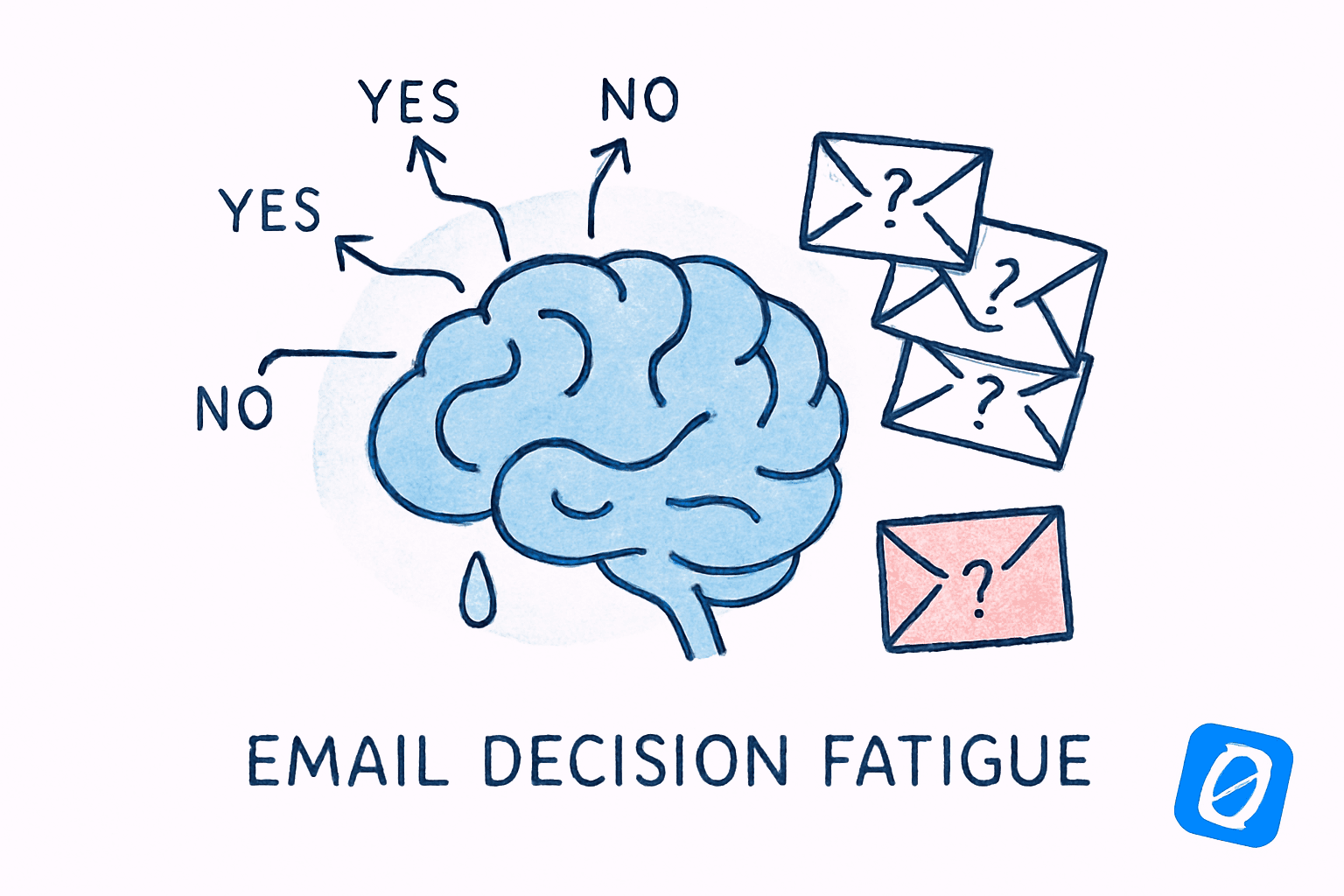
This is why email decision fatigue hits ADHD brains disproportionately hard. Every message in an unbounded inbox is another micro-decision, and the ADHD brain runs out of decision-making fuel faster than most productivity systems anticipate.
The “Out of Sight, Out of Mind” Inbox#
People with ADHD frequently describe a phenomenon that clinicians call object constancy difficulties, colloquially known as “out of sight, out of mind.” It is not that you forget emails exist. Your brain simply stops maintaining an active representation of things that are not directly in front of you.
I could write a whole post about how this single trait reshapes someone’s relationship with email. But here is the key point: in a conventional inbox, emails scroll off the first page and functionally cease to exist for the ADHD brain. A critical project update received on Tuesday might as well have never arrived by Thursday if newer messages have pushed it below the fold.
Medical News Today reports that this challenge stems from impairments in working memory and executive function rather than from literal object permanence deficits. People with ADHD have the knowledge that the email is there. They struggle to maintain an active representation of it in conscious awareness. The effect on email management is identical either way: unanswered messages pile up not from negligence but from a neurological blind spot.
This is also why the typical advice to check email at set intervals can backfire for ADHD brains. Batching works by relying on your ability to remember that important messages are waiting. If your brain quietly drops that awareness the moment you switch to another task, batching becomes a mechanism for missing things rather than a productivity win.
What Does Rejection Sensitivity Do to Your Inbox?#
Rejection sensitive dysphoria (RSD) is one of the most underrecognized aspects of ADHD. It describes an intense emotional response to perceived or anticipated rejection that goes far beyond ordinary disappointment. And email is one of its most reliable triggers.
A 2025 qualitative study published in PLOS ONE by Rowney-Smith and colleagues at Brighton and Sussex Medical School explored the lived experience of rejection sensitivity in ADHD. Participants described how the expectation of rejection elicited more dysphoria than actual rejection itself. They reported anxiety, withdrawal, and what the researchers termed “masking” behaviors to hide their emotional responses, which ultimately led to isolation and impaired social functioning.
Translate this to email, and the pattern becomes painfully clear. An unanswered email from a colleague is not just an unanswered email. It is a potential rejection. A short reply from a manager is not efficiency. It is evidence that you have done something wrong. An overflowing inbox is not a time management issue. It is a visible record of every relationship you are currently failing.
The result is a vicious cycle. RSD makes the inbox emotionally dangerous. Emotional danger triggers avoidance. Avoidance causes messages to pile up. Piled-up messages confirm the fear that you are failing. This pattern overlaps with what researchers call “anticipatory email anxiety”, but for ADHD brains, the emotional voltage is significantly higher.
If the cycle of inbox avoidance and emotional overload resonates, Swizero reduces your inbox to a fixed card limit so the pile never grows large enough to trigger avoidance in the first place.
Hyperfocus: When Email Becomes the Avoidance Tool#
Hyperfocus is often described as ADHD’s “superpower,” but in the context of email, it is more often a trap. A 2025 study published in the Journal of Attention Disorders by Ari Nowacki found that when ADHD symptoms and hyperfocus were included in a model together, procrastination no longer showed a direct association with anxiety and stress. The implication is striking: hyperfocus and procrastination are intertwined coping mechanisms, not opposites.
For email, this plays out in two ways.
The email rabbit hole. You open your inbox to send one message and emerge 90 minutes later having reorganized your labels, researched a product mentioned in a newsletter, and drafted three replies you will never send. The initial email remains unanswered.
Email as productive procrastination. The inbox becomes a refuge from harder tasks. Answering emails feels productive, which gives the dopamine-seeking ADHD brain exactly what it craves: a sense of accomplishment without the executive function demands of the project you are actually avoiding. One caveat: this pattern is not unique to ADHD, but the neurological pull toward stimulation-seeking makes it significantly more pronounced.
This is why productivity advice that says “do email first thing in the morning” can be actively counterproductive for someone with ADHD. It hands the ADHD brain a dopamine-rich avoidance tool at exactly the moment when executive function resources are at their peak. Those resources get spent on low-priority replies instead of the deep work that actually needs the best hours of the day. Cal Newport, Georgetown Computer Science Professor and author of Deep Work, makes a related point: the value of focused work is not just about what you accomplish but about what you protect your attention from. For ADHD brains, the inbox is the single most seductive attentional competitor.
What Does Email Management for ADHD Actually Look Like?#
Most email advice assumes neurotypical executive function. Here is what the research suggests for brains that work differently.
Reduce the decision surface#
The PMC study on ADHD and decision paralysis identifies choice overload as a core mechanism: “Individuals with ADHD may struggle to retain and process multiple pieces of information at once, making it difficult to weigh the pros and cons of different choices effectively.” The intervention is not to become better at choices. It is to face fewer of them.
This is where the concept of a finite inbox becomes specifically relevant for ADHD. Instead of an inbox that presents every message simultaneously, a fixed card limit surfaces only the most important items. You are not ignoring the rest. Automated email management has already triaged them. You are just making decisions about a handful of cards instead of a hundred.
| Strategy | Why it works for ADHD | Neurotypical equivalent |
|---|---|---|
| Fixed card limit (e.g., Swizero) | Reduces decision surface to manageable size | Inbox Zero maintenance |
| Visual timers for email sessions | Externalizes time awareness (compensates for time blindness) | Calendar blocking |
| “Body doubling” while processing email | Social accountability compensates for self-regulation gaps | Simple batching |
| One-action-per-email rule (reply, forward, or clear) | Eliminates multi-step decision trees | “Touch it once” |
| Remove email from phone home screen | Reduces impulsive checking driven by dopamine seeking | Notification management |
Externalize everything#
Barkley’s research consistently emphasizes that ADHD management is about externalizing internal processes. You cannot rely on working memory to remind you about that email from Tuesday, so you need a system that does it for you. Smart follow-up reminders and AI-generated summaries serve this purpose: they keep the critical information visible without requiring you to hold it in memory.
Work with the hyperfocus, not against it#
Honestly, this was the hardest principle for me to accept. If hyperfocus is going to happen, channel it. Set a specific email processing window and use the hyperfocus tendency to power through all your messages in that window. The key is a hard stopping point, which is where a defined “finish line” for email becomes essential. Without one, the hyperfocus session expands to fill whatever time is available.
Make the emotional cost visible#
RSD thrives on ambiguity. An inbox with 847 unread messages is an undifferentiated cloud of potential rejection. An inbox that shows you a handful of cards with AI summaries of each one transforms the ambiguity into specifics. “Your manager wants the Q3 report by Friday” is manageable. “You have 47 unread messages from work” is not.
The Constraint Advantage#
There is a broader principle here that extends beyond ADHD. The research on choice overload shows that reducing options improves decision quality for everyone, but for neurodivergent brains, the effect is amplified.
The 2024 University of Haifa study by Turjeman-Levi, Itzchakov, and Engel-Yeger found that among 171 employees, those with ADHD reported burnout scores of 5.05 out of 7, compared to 3.76 for neurotypical peers. The mediating factor was executive function, specifically self-organization and problem-solving. Tools that reduce the executive function demands of a task do not just improve productivity. They protect against burnout.
Swizero was not designed specifically for ADHD. But the core design principle, that email needs a finish line rather than an infinite scroll, happens to align precisely with what ADHD research recommends: fewer choices, externalized memory, and a clear stopping point. You swipe through a handful of cards. When they are done, you are done. That simplicity is not a feature limitation. For a neurodivergent brain, it is the entire point of an email overload solution.
Frequently Asked Questions#
Is ADHD the reason I can’t keep up with email?#
ADHD significantly impacts email management through working memory deficits, decision paralysis, and emotional dysregulation. The CDC reports that 6% of U.S. adults have a current ADHD diagnosis, and research consistently shows that executive function impairments make sequential decision-making tasks like email triage substantially harder. If you struggle specifically with email despite being competent in other areas, an ADHD evaluation may be worth pursuing.
What is the best email strategy for someone with ADHD?#
Reduce the number of decisions your inbox demands. Research on ADHD and decision paralysis shows that choice overload disproportionately affects neurodivergent brains. Use tools that limit how many messages you see at once, set visual timers for email sessions to compensate for time blindness, and adopt a one-action-per-email rule: reply, forward, or clear. Never leave a message in an ambiguous “I’ll deal with it later” state.
Why do I avoid my inbox even though I know it makes things worse?#
Avoidance procrastination in ADHD is a learned coping mechanism reinforced by immediate emotional relief. A 2025 study in the Journal of Attention Disorders found that ADHD-related procrastination is driven by emotional dysregulation rather than poor time management. The inbox triggers negative emotions (overwhelm, fear of rejection, shame about delayed responses), and avoiding it provides temporary relief that reinforces the behavior.
Can email apps actually help with ADHD email management?#
Apps that reduce cognitive load can meaningfully help. The key features to look for are: a limited view that does not show your entire inbox at once, AI-powered triage that pre-sorts messages by importance, visual summaries that reduce the working memory required to process each message, and a clear completion state so you know when you are done. Generic inbox apps that simply display all messages are unlikely to address the core executive function challenges.
Does rejection sensitive dysphoria affect how people with ADHD use email?#
Yes. A 2025 PLOS ONE study found that people with ADHD experience intense emotional responses to perceived rejection, and that the anticipation of rejection often causes more distress than rejection itself. In email, this manifests as interpreting short replies as hostility, catastrophizing about unanswered messages, and avoiding the inbox entirely to escape the emotional risk of finding bad news.
Sources#
- Products - Data Briefs - Number 543. CDC National Center for Health Statistics, December 2025. 6.0% of U.S. adults (15.5 million) have current ADHD diagnosis.
- Executive function deficits mediate the relationship between employees’ ADHD and job burnout. Turjeman-Levi, Itzchakov, & Engel-Yeger, AIMS Public Health, 2024. Employees with ADHD scored 5.05 vs. 3.76 on burnout measures.
- Constraints on Information Processing Capacity in Adults with ADHD. Neuropsychology Review, 2020. Working memory impairments in adults with ADHD across multiple task domains.
- The lived experience of rejection sensitivity in ADHD. Rowney-Smith et al., PLOS ONE, 2025. Expectation of rejection elicited more dysphoria than rejection itself.
- ADHD and Decision Paralysis: Overwhelm in a World of Choices. PMC, 2025. Choice overload mechanisms in ADHD decision-making.
- ADHD, Hyperfocus, and Procrastination: The Mediating Role of Maladaptive Daydreaming. Nowacki, Journal of Attention Disorders, 2025. Hyperfocus and procrastination as intertwined coping mechanisms.
- The Important Role of Executive Functioning and Self-Regulation in ADHD. Russell A. Barkley, PhD. ADHD as a disorder of performance, not knowledge.
- Object permanence and ADHD: Definition and tips for coping. Medical News Today. Working memory impairments underlying “out of sight, out of mind” in ADHD.
Your inbox doesn't have to feel like this.
Email with a beginning, middle, and end.
Make email a bounded session