Mobile Email Habits vs Desktop: Why Your Phone Inbox Feels Different
By Chris Stefaner, Co-founder of Swizero
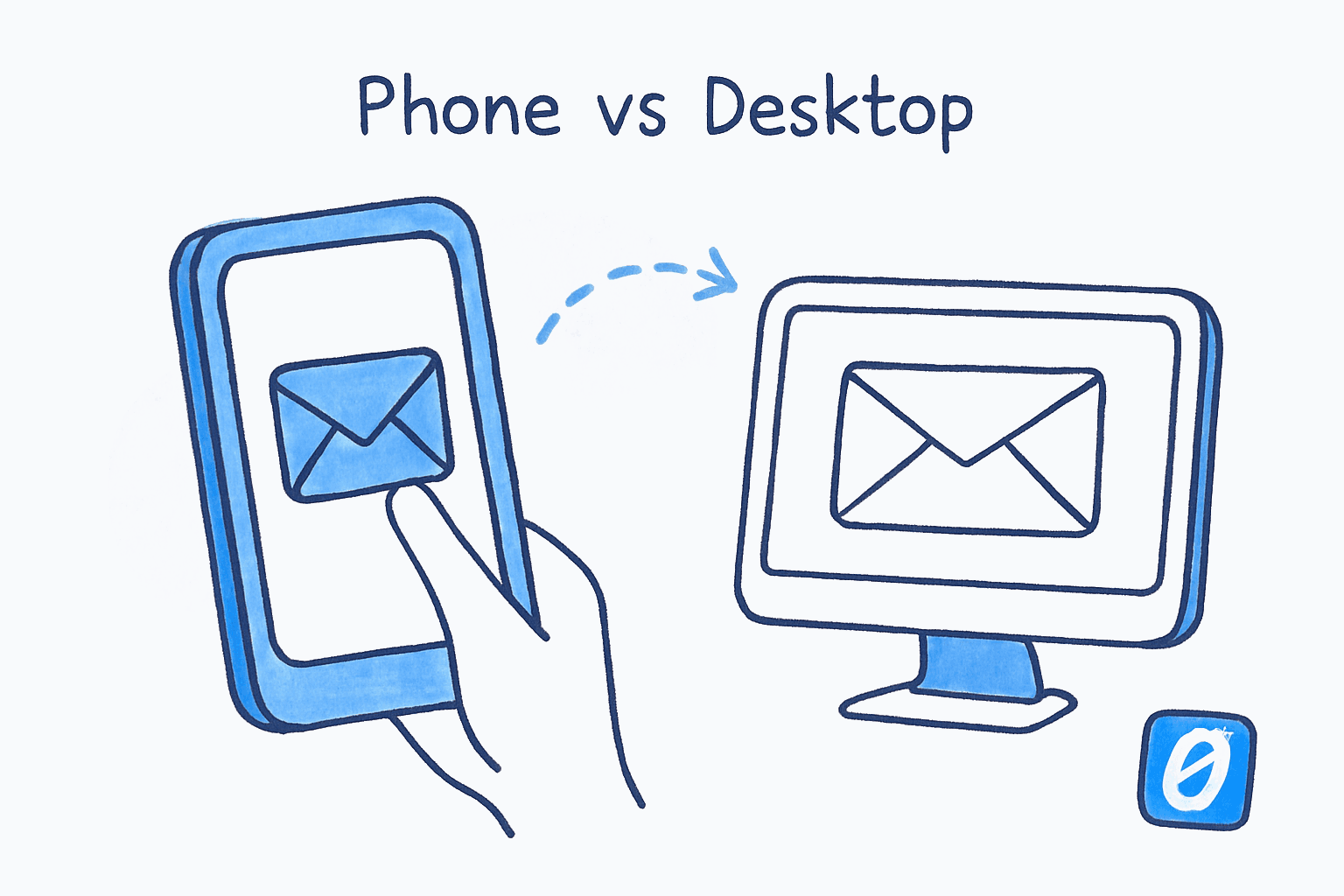
You read an email on your phone, decide it deserves a real answer, and put the phone down. An hour later you open the same email again on your laptop. You read it a second time. You probably read it a third time before you actually reply. This is not laziness; it is a behavior pattern documented across billions of email opens. These mobile email habits explain why the phone inbox is the hardest piece of digital life to give a finish line.
The shorthand version: about 23% of people who open an email on a mobile device open it again later, and 60% of those repeat-opens happen on a different device, according to multi-year analysis from Campaign Monitor’s email engagement research. The phone is where you triage. The desktop is where you actually decide. The space between them is where most of your email stress lives.
Here is the editorial stance: your phone is not a place to finish email. It is a place to feel the weight of email. Every productivity guide that tells you to “use mobile dead time to get through your inbox” is selling you a fiction the data does not support. Phones are where decisions get postponed, drafts get abandoned, and the same message gets re-read four times before it gets a real response. The fix is not to triage harder on mobile; it is to design the mobile inbox so it has a finish line that fits the device.
Key Takeaway
Mobile email behavior is measurably different from desktop: replies are 60% shorter, the same message is often re-read on a second device, and constant in-pocket access raises baseline stress. The phone is the hardest inbox to give a finish line, which is exactly why the finish line has to be designed in; not left to willpower.
Contents#
- How Do Mobile Email Habits Actually Differ From Desktop?
- Why Phone Email Leads to More Re-Reads and Half-Decisions
- What Happens to Your Brain With a Phone in Your Pocket?
- The Always-In-Pocket Inbox and the Boundary Problem
- Designing a Phone Inbox With a Finish Line
- Frequently Asked Questions
How Do Mobile Email Habits Actually Differ From Desktop?#
Mobile email is not just desktop email on a smaller screen. It produces different behavior at every step of processing; opening, reading, replying, deciding.
The most-cited cross-device study is from Yesware’s analysis of mobile vs. desktop email behavior at work, which compared engagement across billions of opens. Two findings stand out. First, 64% of emails opened on mobile were fully read, compared to 45% on desktop, while desktop abandonment (open under two seconds) was twice as high. Second, mobile replies are roughly 60% shorter than desktop replies; sometimes a single line, often a deferral.
Both numbers point to the same behavior: on the phone you read more carefully but commit less. You scan the whole message because you cannot skim a long thread the way you can on a wide monitor. Then you defer the actual decision because typing a real reply on glass is slower and cognitively more expensive than the same reply on a keyboard.
Mobile is now where the majority of email is opened; about 41-47% of opens depending on the methodology; but desktop is still where most email is processed. The cross-device pattern is the giveaway: a Litmus analysis found that consumers are 65% more likely to click through if they first read an email on mobile and then again on desktop. The phone is the preview window. The decision happens elsewhere.
Honestly, this is the part that took me a while to internalize. I used to think mobile email was a productivity tool; a way to get through the inbox while waiting for coffee. The data suggests it is closer to a stress signaling system. You scan, you feel the weight, you put the phone down, and the message stays open in your head until you sit back at a real screen.
Why Phone Email Leads to More Re-Reads and Half-Decisions#
The phone inbox is built for opening, not for finishing. Three constraints stack up.
The screen is small. A 6-inch phone shows roughly one-eighth of the text a 27-inch monitor shows at comparable line height. For any email longer than a paragraph, you are scrolling, which means you are losing the spatial map of the message. Anne Mangen, professor at the Reading Centre at the University of Stavanger, has spent two decades studying how reading interfaces affect comprehension. Her research with colleagues found that readers of digital text scored worse on comprehension tests than print readers, particularly for texts longer than one screen; and that the effect was larger when the digital format required scrolling rather than turning a page.
A 2022 study in Scientific Reports extended this specifically to smartphones. Reading on a smartphone reduced comprehension and altered breathing patterns and brain activity in ways consistent with elevated cognitive load. The takeaway is not “phones are bad”; it is that the phone is a worse substrate for the kind of careful reading that complex emails require.
The keyboard is slow. Typing on glass with two thumbs is roughly half the speed of typing on a physical keyboard for most adults. That speed gap turns every reply into a small cost-benefit calculation: is this email worth the friction right now? Most aren’t. So you swipe, defer, mark as unread, or use a half-baked one-liner you would never send from a desktop.
The context is fragmented. You read email on your phone in the spaces between other things; in line, in bed, in the elevator, in transit. Sophie Leroy, professor at the University of Washington Bothell, coined the term “attention residue” in 2009 to describe the cognitive drag that lingers when you switch from one task to another without finishing the first. Mobile email is attention residue in its purest form: every message you open without completing leaves a trace in working memory.
The result is what I would call the half-decision problem. You read the email enough to feel responsible for it, but not enough to act. The mental burden gets carried until you are back at a desktop, at which point you have to read it again to remember what it asked for. The same email can produce three or four cognitive events before it produces one actual reply.
If the half-decision pattern feels familiar; opening the same email three times before replying; Swizero is built mobile-first around a fixed card limit, so a message either gets a swipe decision in the moment or it does not enter the queue. No deferral loop. No rereading the same email at midnight.
What Happens to Your Brain With a Phone in Your Pocket?#
The phone inbox is not just a different reading surface. It is a different cognitive environment; one your brain treats as a constant low-level threat to your attention, even when you are not looking at it.
Adrian Ward, associate professor of marketing at the University of Texas at Austin, ran the most-cited experiment on this. His 2017 study, Brain Drain: The Mere Presence of One’s Own Smartphone Reduces Available Cognitive Capacity, tested nearly 800 participants on working memory and fluid intelligence tasks. Participants who left their phones in another room performed significantly better than those whose phones were on the desk, even when the phone was face-down and silenced.
“Your conscious mind isn’t thinking about your smartphone, but that process; the process of requiring yourself to not think about something; uses up some of your limited cognitive resources. It’s a brain drain.”; Adrian Ward, McCombs School of Business, UT Austin.
One caveat worth being honest about: a 2023 replication study in Acta Psychologica failed to reproduce the original brain-drain effect on the same tasks. The science is contested. But the broader pattern; that smartphone presence affects attention; has held up across multiple studies. A 2023 paper in Scientific Reports found that mere smartphone presence reduced basal attentional performance, and the effect was strongest in people with higher smartphone dependency.
The email-specific version of this comes from Kostadin Kushlev and colleagues. Their 2016 CHI paper, “Silence Your Phones”: Smartphone Notifications Increase Inattention and Hyperactivity Symptoms, ran a within-subjects experiment with 221 University of British Columbia participants over two weeks. One week with notifications maximized, one week with notifications minimized. The result: participants reported significantly higher inattention and hyperactivity symptoms during the high-notification week, and the effect held even after controlling for individual differences in baseline ADHD symptoms.
| Cognitive metric | Phone present | Phone in another room | Source |
|---|---|---|---|
| Working memory (OSpan) score | Lower | Higher | Ward et al., 2017 |
| Sustained attention (Go/No-Go) | Lower | Higher | Ward et al., 2017 |
| Self-reported inattention symptoms | +18% | Baseline | Kushlev et al., 2016 |
| Reading comprehension (long text) | Lower | ; | Mangen et al., 2013 |
The cumulative picture is not “phones make you stupid.” It is that the phone, especially the phone with email on it, is asking your brain to spend a small but constant share of its capacity managing the temptation to check. Multiply that by the 96 times per day the average American checks their phone (Asurion’s 2024 Connected Life report, surveying 2,000 U.S. adults) and the cost is no longer small.
The Always-In-Pocket Inbox and the Boundary Problem#
The desktop inbox has a natural finish line: you close the laptop and go home. The phone inbox does not. It rides in your pocket through dinner, through the school pickup, through the moment before sleep.
This is the boundary problem, and it is well-studied. Daantje Derks, professor at the Erasmus University Rotterdam, has published extensively on after-hours smartphone use. Her research on smartphone use and work-home interference found that the negative effects depend less on how much you actually respond and more on whether you feel obligated to be available. The phone in the pocket is the obligation made physical.
A 2024 scoping review in PLOS Digital Health synthesized 47 studies on work-related smartphone use during off-job hours and found consistent associations with work-life conflict, poor sleep quality, and reduced psychological detachment from work. The researchers also noted that the harm scaled with the expectation of availability, not just the actual amount of email handled.
Then there is sleep. A 2022 PMC study tracking 738 university students found that participants who used their smartphone in bed for more than 60 minutes had a 7.4-fold higher risk of poor sleep quality compared to those who kept their phones out of the bedroom. A separate 2024 Brain Communications study on adolescents and young adults found that evening smartphone use measurably impaired declarative memory consolidation overnight; the kind of memory that turns the day’s events into long-term knowledge. The phone is not a neutral object before bed. It is an active interference pattern in your sleep architecture.
Brittany Lambert, organizational psychologist and one of the lead authors on the Belkin and Becker work on after-hours email anxiety, has put it bluntly:
“It’s not the act of responding to the email that is making people exhausted. It’s the constant cognitive juggling and the anticipation of having to respond.”; Brittany Lambert, Indiana University.
That word; anticipation; is the through-line. The phone inbox is an anticipation machine. The screen is small enough that decisions slip. The keyboard is slow enough that replies defer. The pocket is close enough that the next check is always seconds away. And when there is no defined moment when the inbox is finished, there is no moment when your brain is allowed to put it down.
Designing a Phone Inbox With a Finish Line#
If the phone is the hardest inbox to give a finish line, the solution is not to use it less heroically. It is to use a phone inbox that has a finish line built into the design.
This is the core argument behind Swizero, and it lines up directly with the research above. A handful of design choices change the cognitive contract:
-
A fixed card limit. The inbox is not infinite. It is a small, finite stack of cards that you finish or you don’t, but either way the bottom of the stack is visible from the start. This eliminates the phone-specific scroll problem (you cannot get lost in a long list because the list is short by design) and gives the half-decision problem a place to die: a card either gets a swipe or it gets cleared, but it cannot live in limbo.
-
One-handed swipe actions. Mobile reply friction is the reason mobile replies are 60% shorter than desktop replies. Instead of pretending you’ll write a real reply on glass, the phone inbox should make the four basic decisions; clear, flag, reply, archive; fast and physical. If you’ve read our guide on the 5 email habits that actually work according to science, you already know that pre-committing to a small set of actions reduces decision fatigue. Swipes are that pre-commitment, on glass.
-
Sessions, not streams. The phone inbox should not be a feed you dip in and out of. It should be a session you start, finish, and close; the way a workout has a beginning and an end. This is what we call Swizero Run, and it is what makes mobile email feel finishable for the first time. (See also our piece on the hidden cost of an inbox that never ends, which lays out the cognitive cost of unbounded queues.)
-
No notifications between sessions. This one is non-negotiable. Kushlev’s UBC research is unambiguous: notifications produce measurable inattention symptoms even when they are not acted on. A phone inbox with notifications is not an inbox; it is a slot machine in your pocket. (For more on the dopamine economics of inbox alerts, see breaking the notification addiction.)
The pattern is the same one we keep returning to: email isn’t broken; it’s unbounded, and the fix is constraints, not features. The phone inbox is just the unbounded inbox at its most extreme. Constraints fix it.
I’ll close with a small challenge rather than a recap. For the next 48 hours, notice how many times you open the same email on your phone before you actually reply to it. Count them. If the answer is more than once for any given email, the data in this post applies to you, and the question is no longer whether your phone inbox needs a finish line; it is what shape that finish line should take.
Frequently Asked Questions#
Why do I keep re-reading the same email on my phone?#
Three reasons stack up: smartphone screens make long-form reading harder (comprehension drops measurably for texts longer than one screen, per Mangen et al. 2013), typing real replies on glass is roughly half the speed of typing on a keyboard, and you read mobile email in fragmented contexts where decisions get deferred. The same email gets opened multiple times because the phone is good for triage but bad for completion. Roughly 23% of emails opened on mobile are opened again later, often on a different device, according to Campaign Monitor data.
Is checking email on your phone worse for you than on a desktop?#
It depends on what “worse” means. Mobile email checks tend to be more frequent, more compulsive, and more likely to happen in personal time; all of which are associated with higher stress and worse work-life detachment in the research literature (PLOS Digital Health, 2024). Desktop email is generally where decisions actually get made, so desktop sessions are more efficient per minute spent.
Why do mobile emails get shorter replies?#
Two factors: typing on a touchscreen is slower and less accurate than typing on a physical keyboard, and the mobile context (often standing, walking, or multitasking) reduces working memory available for composing nuanced messages. Yesware’s research found mobile replies are about 60% shorter than desktop replies. The reduced length is not always a problem; but it often becomes a deferral, where the user signals “got it, will write properly later,” and then has to re-read the entire thread before composing a real response.
Does keeping my phone in another room actually help?#
The original Ward et al. 2017 “brain drain” study found measurable improvements in working memory when the phone was in a separate room versus on the desk. A 2023 replication failed to reproduce that specific effect, so the science is contested. However, the broader finding; that smartphone presence imposes a small attentional cost; has held up across multiple studies, especially for people with higher smartphone dependency. For sleep specifically, the evidence is much stronger: keeping phones out of the bedroom is associated with substantially better sleep quality.
What’s the best way to reduce mobile email anxiety?#
The most-supported intervention in the research is reducing the expectation of availability, not just the volume of checking. That means turning off email notifications outside defined session times, removing email from your home screen, and; most importantly; using a mobile email design that has a finish line built in. An inbox that is never “done” cannot stop generating anticipatory anxiety, because there is always more to check. A session-based, capped inbox stops generating that signal as soon as the session ends.
Sources#
- Mobile vs Desktop Email Behavior At Work. Yesware, analysis of billions of email opens. Mobile fully-read rates 64% vs desktop 45%; mobile replies 60% shorter.
- Email Marketing Trends: Email Interaction Across Mobile & Desktop. Campaign Monitor. Cross-device email behavior; 23% of mobile opens repeat-opened later.
- Brain Drain: The Mere Presence of One’s Own Smartphone Reduces Available Cognitive Capacity. Ward et al., Journal of the Association for Consumer Research, 2017.
- Reexamining the “brain drain” effect: A replication of Ward et al. (2017). Ruiz Pardo & Minda, Acta Psychologica, 2023. Failed replication.
- The mere presence of a smartphone reduces basal attentional performance. Skowronek et al., Scientific Reports, 2023.
- “Silence Your Phones”: Smartphone Notifications Increase Inattention and Hyperactivity Symptoms. Kushlev, Proulx & Dunn, CHI 2016 Proceedings. UBC, 221 participants, two-week within-subjects.
- Reading on a smartphone affects sigh generation, brain activity, and comprehension. Honma et al., Scientific Reports, 2022.
- Reading linear texts on paper versus computer screen: Effects on reading comprehension. Mangen, Walgermo & Brønnick, International Journal of Educational Research, 2013.
- Why is it so hard to do my work? The challenge of attention residue when switching between work tasks. Sophie Leroy, Organizational Behavior and Human Decision Processes, 2009.
- Smartphone use and work–home interference: The moderating role of social norms and employee work engagement. Derks et al., Journal of Occupational and Organizational Psychology, 2015.
- Work-related smartphone use during off-job hours and work-life conflict: A scoping review. PLOS Digital Health, 2024.
- “Leave your smartphone out of bed”: quantitative analysis of smartphone use effect on sleep quality. PMC, 2022. 7.4× sleep quality risk for >60 min bedtime use.
- Effects of evening smartphone use on sleep and declarative memory consolidation in male adolescents and young adults. Brain Communications, 2024.
- The Always-On Culture: After-Hours Email and the Right to Disconnect. Belkin, Becker & Conroy, Journal of Management, 2021.
Your inbox doesn't have to feel like this.
Email with a beginning, middle, and end.
Make email a bounded session