Email Volume Growth Causes: Why Email Keeps Rising Despite Slack
By Chris Stefaner, Co-founder of Swizero
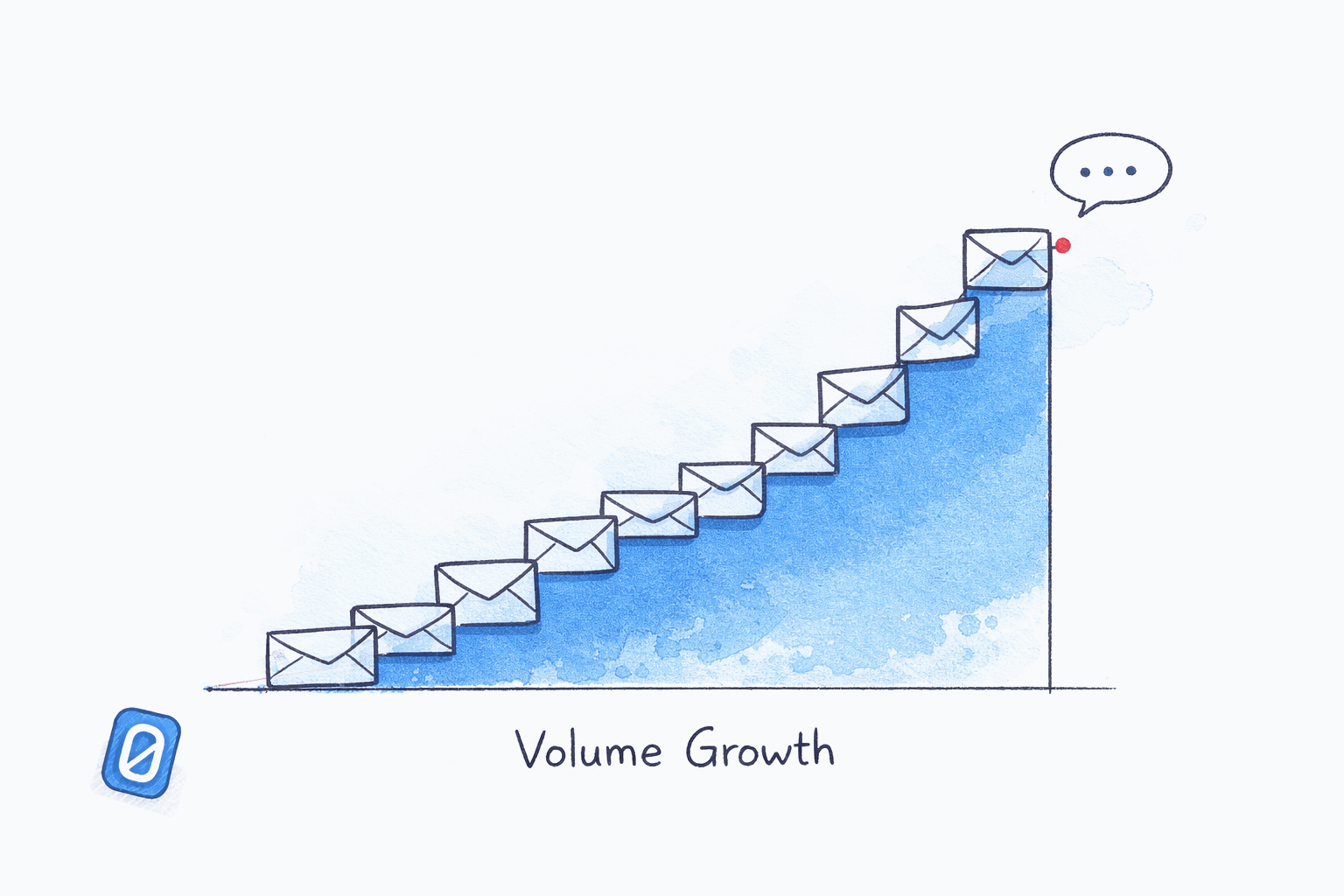
Every year for the past decade, someone has declared email dead. And every year, the global email volume has grown. In 2024, the world sent 361.6 billion emails per day. By 2026, that number is projected to hit 392.5 billion, according to the Radicati Group’s Email Statistics Report, 2024-2028. The email volume growth causes behind these numbers are not mysterious, but they are deeply misunderstood.
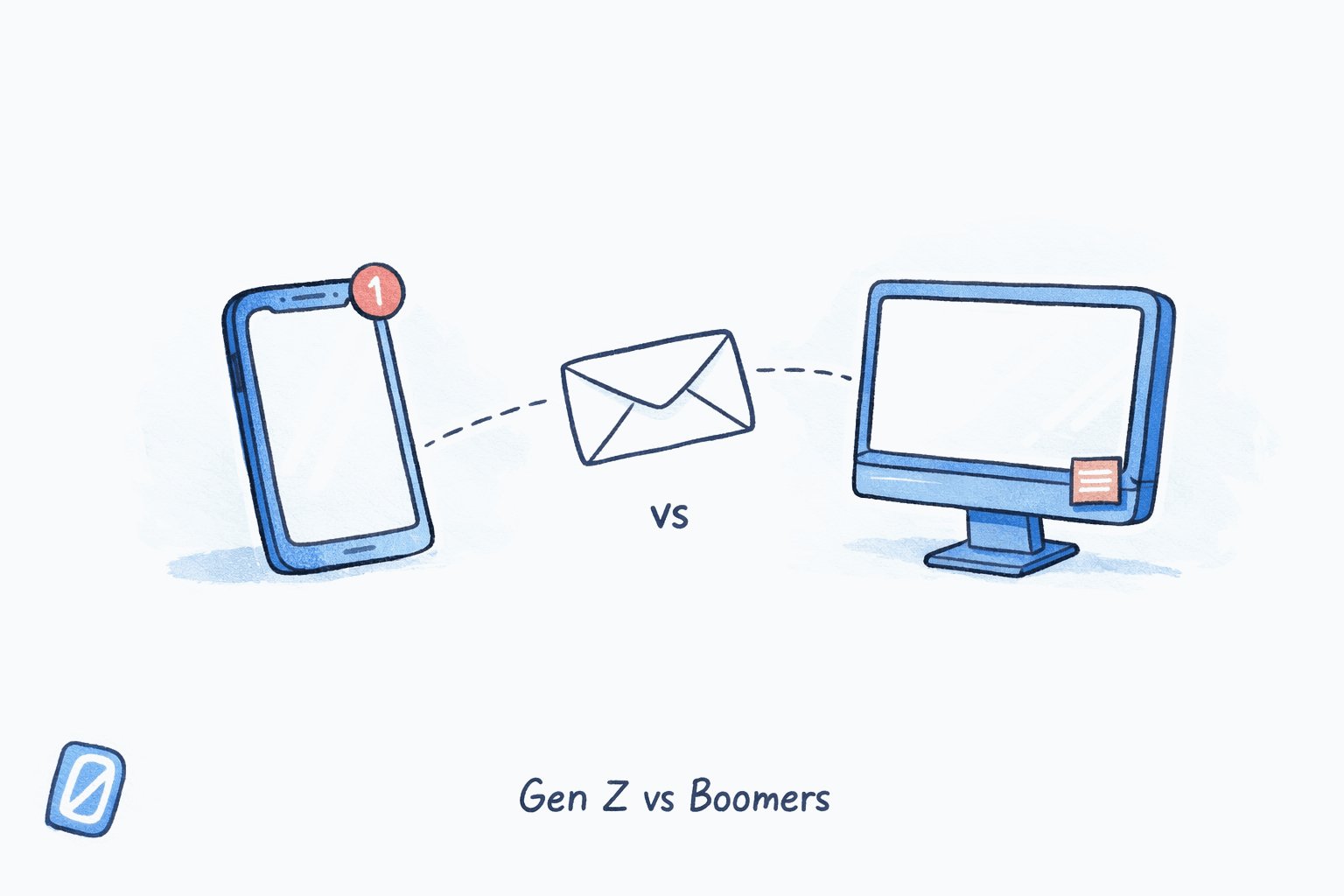
Slack now has over 42 million daily active users. Microsoft Teams surpassed 320 million monthly active users in 2024. Yet the total number of emails sent worldwide has not declined by a single percentage point. If anything, the growth rate has held steady at roughly 4% per year. The question most people ask is “when will email finally die?” The better question is: why does it keep getting bigger?
Here is the uncomfortable answer: email is not dying because nothing else can do what email does. And most of the email volume growth causes have nothing to do with human conversation at all.
Key Takeaway
Email volume keeps growing because the forces adding messages (automated systems, network effects, CC chains, and protocol lock-in) far outpace any messages that Slack or Teams siphon away. Messaging apps moved internal chat off email but left every other email category untouched, and several categories are accelerating.
What Are the Real Email Volume Growth Causes?#
The simplest explanation for why email keeps growing is that most email is no longer written by humans. The fastest-growing category of email in 2026 is transactional and operational messaging: password resets, shipping confirmations, appointment reminders, SaaS notifications, financial statements, and government alerts. According to Business Research Insights’ Transactional Email Service Market Report, this segment is expanding at a compound annual growth rate of 12% from 2025 to 2033. Human-written email, by contrast, grows in the low single digits.
This distinction matters enormously for understanding email volume growth causes. When commentators point to Slack or Teams as evidence that “email is not dying but evolving,” they are usually talking about person-to-person workplace messages. That category represents a shrinking share of total email traffic. The machine-generated layer underneath it is expanding far faster and is completely indifferent to whether your team uses Slack, Teams, or carrier pigeons.
A second driver is account proliferation. The average email user now maintains 1.86 accounts, according to EmailToolTester’s 2026 Email Usage Statistics. Every new SaaS subscription, every online purchase, every government portal generates a new stream of automated messages distributed across those accounts. The result is a per-person email volume growth that compounds across 4.7 billion global email users.
Global Daily Email Volume (Billions)
Source: Radicati Group, Email Statistics Reports 2020-2028
Why Haven’t Slack and Teams Reduced Email Volume Growth?#
Slack and Teams reduced one specific type of email: quick internal messages between coworkers. “Hey, did you see the client’s note?” or “Can you join the 3pm call?” moved to chat. That is a real shift, and for many teams it has improved response times and reduced inbox noise for those particular exchanges.
But that category was never the majority of email traffic. The messages that moved to chat were already short-lived, low-stakes, and conversational. The messages that stayed are the ones chat cannot handle: external communication with clients, vendors, and partners; formal records that require an audit trail; legal notifications with compliance requirements; and the entire tsunami of automated transactional messages described above.
Cal Newport, Georgetown computer science professor and author of A World Without Email, describes email as a “hyperactive hive mind” that is difficult to escape precisely because it is infrastructure rather than merely a tool. “The problem isn’t any particular email,” Newport has argued. “It’s that email became the default operating system for how we coordinate work.” Slack did not replace that operating system. It added a second one alongside it.
The data confirms this layering effect, which is one of the most overlooked email volume growth causes. Microsoft’s own 2025 Work Trend Index, which analyzed trillions of Microsoft 365 productivity signals, found that the average knowledge worker now receives 275 interruptions per day from meetings, emails, and chat messages combined. That total is higher than it was before Teams existed. Workers are not replacing channels; they are stacking them.
| Communication type | Where it lives now | Email volume trend |
|---|---|---|
| Internal quick questions | Moved to Slack/Teams | Declining |
| External client communication | Still email | Growing moderately |
| Formal approvals and records | Still email | Holding steady |
| Automated notifications (SaaS, CI/CD, billing) | Still email | Growing at 12% CAGR |
| Marketing and newsletters | Still email | Growing moderately |
| CC/BCC chains | Split across both | Holding steady |
How Do Network Effects Drive Email Volume Growth?#
Email’s resilience is not accidental. It is a direct consequence of network economics. SMTP, the protocol that underlies all email, is an open, federated standard that no single company owns. Anyone can send an email to anyone else, regardless of which provider either person uses. Gmail users can email Outlook users, who can email ProtonMail users, who can email a self-hosted server in a university basement. No permission is required. No integration is needed.
This is fundamentally different from how Slack and Teams work. Slack’s 42 million daily active users exist in walled gardens. A Slack workspace at Company A cannot natively message a Slack workspace at Company B. Teams operates similarly. Cross-organization communication in both tools requires federation features that are still immature and rarely configured.
The math here follows Metcalfe’s Law: the value of a communication network scales roughly with the square of its connected users. Email connects 4.7 billion users across every provider. Slack connects 42 million users, fragmented into isolated workspaces. The email vs messaging apps growth disparity is not surprising when viewed through this lens. Email’s network is orders of magnitude larger, and every new user (or new automated system) added to it makes the entire network marginally more valuable.
I could write an entire post about why open protocols defeat proprietary ones over long timescales, but the key point about email volume growth causes is simpler: email wins by default because it is the only communication channel where you can reach essentially anyone on Earth without both parties agreeing in advance on which tool to use.
Connected Users by Communication Platform (2025)
Source: Radicati Group 2024, Microsoft 2025, Slack 2025
What Role Does CC Culture Play?#
Network effects explain why email persists. CC culture is among the most stubborn email volume growth causes, explaining why the volume per person keeps climbing even within organizations that have adopted chat tools.
The CC field was designed as a courtesy: a way to keep relevant parties informed without requiring them to respond. In practice, it became a liability shield. People CC their manager to document that they raised a concern. They CC legal to create a paper trail. They CC the entire project team because excluding someone feels politically risky. The result is that a single email from one sender generates inbox entries for five, ten, or twenty recipients, the vast majority of whom gain nothing from reading it.
Research from the SpeakWise Email Overload Statistics Report found that only about 24% of all messages received by the average worker are important enough to warrant attention. The remaining 76% consists of newsletters, automated notifications, internal updates, and threads where the recipient was unnecessarily CC’d. That 76% is not declining. It is growing, because the incentive structures that produce it have not changed. Nobody gets in trouble for CC’ing too many people. People do get in trouble for leaving the wrong person off a thread.
This dynamic is self-reinforcing. The more email people receive, the less carefully they read each message, which increases the perceived need to CC more people to ensure someone actually notices. Gloria Mark, Professor of Informatics at UC Irvine and author of Attention Span, has studied this cycle extensively. Her research found that the average person checks email 75 times per day and that people are just as likely to interrupt themselves to check email as they are to be interrupted by a notification. “Electronic communications have expanded the scope of work,” Mark has observed, “giving workers additional work above and beyond other duties that they have.”
Honestly, CC culture was the email volume growth cause I underestimated most when I started researching this piece. It is not a technology problem. It is a social incentive problem that no tool can solve by default.
If the endless CC chains and notification floods resonate, Swizero reduces your inbox to a fixed card limit per run, so only the messages that matter surface. The 76% that does not deserve your attention never reaches the top of the stack.
Is Email Not Dying Because Email Volume Growth Causes Go Beyond Messaging?#
Yes. And this is the point that most “email is dying” predictions miss entirely.
Email is three things layered on top of each other, and only one of them competes with Slack or Teams:
-
A messaging system. Person-to-person communication. This is the layer Slack and Teams genuinely compete with, and they have captured a meaningful share of internal workplace messaging.
-
A notification bus. Every time you buy something online, reset a password, receive a bank statement, get a shipping update, or have an appointment confirmed, email is the delivery channel. No messaging app has replaced this function, and none is likely to, because email is the lowest-common-denominator channel that every service can rely on every user having.
-
An identity layer. Your email address is your login for almost every online service. It is your account recovery mechanism. It is your two-factor authentication fallback. This function has nothing to do with communication and everything to do with internet infrastructure. The proliferation of online services directly increases email volume through this channel.
When people say “email is not dying,” they are usually thinking about layer one. The real email volume growth causes are layers two and three, which are expanding rapidly and have no viable replacement. As long as every new SaaS product, every e-commerce store, and every government service uses email as its notification and identity layer, total email volume will continue to climb regardless of what happens in workplace chat.
What Does Future Email Volume Growth Look Like?#
Projections from the Radicati Group show daily email volume reaching 408 billion by 2027 and potentially exceeding 500 billion by 2030. The email user base is expected to grow from 4.7 billion in 2026 to 4.9 billion by 2028. Neither number shows any sign of plateauing.
The growth is concentrated in three areas:
Automated and transactional email is the largest contributor, growing at 12% annually. Every new SaaS platform, every new fintech app, every new healthcare portal adds another stream of automated messages. The Transactional Email Software Market is projected to roughly double in value from $1.75 billion in 2024 to $3.85 billion by 2033.
Developing markets are adding hundreds of millions of new email users as internet penetration expands. These users are joining the email network for the first time, not migrating from it to something else.
AI-generated email is an emerging contributor. As AI tools make it easier to draft, personalize, and send messages at scale, the friction cost of sending email drops further. A growing share of marketing and outreach email is now AI-assisted, which increases send volumes without a proportional increase in human effort.
One caveat worth noting: these email volume growth projections assume current trends continue, and forecasting technology adoption beyond a few years is notoriously unreliable. New regulations, protocol innovations, or a genuinely interoperable chat standard could alter the trajectory. But the structural forces described in this article are deeply embedded, and no realistic near-term scenario eliminates them.
| Growth driver | Annual growth rate | Share of total volume | Trend |
|---|---|---|---|
| Transactional/automated email | ~12% CAGR | Growing (estimated 50%+) | Accelerating |
| Human-to-human business email | ~2-3% | Shrinking share | Stable |
| Marketing email | ~4-5% | Stable share | Moderate growth |
| Consumer personal email | ~1-2% | Shrinking share | Slow decline per-user |
The Finish-Line Problem#
Understanding email volume growth causes reframes the inbox management challenge. The problem is not that people send too many messages. The problem is that email is a system without boundaries, absorbing every automated notification, every CC chain, every identity verification, and every marketing campaign into a single stream with no natural stopping point.
Merlin Mann understood this when he created Inbox Zero in 2007. His original point was never about achieving an empty inbox; it was about spending zero time worrying about email. But even that framing assumed a static volume. It did not account for a system where the volume grows 4% per year, indefinitely, driven by forces entirely outside the user’s control.
The real question is not whether email will die. It will not, for the reasons laid out above. The real question is whether individuals can create a finish line within a system that was designed to never have one. That is not a protocol problem. It is a design problem, and it requires tools that impose boundaries rather than tools that merely help you process the unbounded stream faster.
Swizero takes this position seriously: instead of promising to help you get through all your email, it surfaces a fixed card limit of the most important messages per run and lets you finish. The volume keeps growing. Your daily experience of it does not have to.
Frequently Asked Questions#
Why is email volume still growing in 2026?#
The email volume growth causes are structural: global email volume continues to grow at approximately 4% per year, reaching an estimated 392.5 billion messages per day in 2026. The primary driver is automated and transactional email, which grows at roughly 12% annually. Every new SaaS product, e-commerce platform, and digital service generates automated email streams that accumulate across billions of accounts.
Did Slack and Teams fail to replace email?#
Slack and Teams successfully replaced one category of email: short, internal workplace messages between coworkers. However, this category represents a small fraction of total email traffic. External communication, formal records, legal notifications, and automated messages all remained in email. Total volume has not decreased despite widespread adoption of chat tools.
What percentage of email is automated?#
Estimates vary, but automated and transactional messages account for more than half of all daily email traffic. The transactional email services market is growing at a 12% compound annual growth rate, according to Business Research Insights. This category includes password resets, order confirmations, shipping notifications, financial statements, and system alerts.
Why can’t a messaging app replace email entirely?#
Email is built on SMTP, an open federated protocol that allows any email user to message any other email user regardless of provider. Slack and Teams operate as proprietary walled gardens where cross-organization messaging is limited. Until a messaging platform achieves the same universal interoperability as email, replacement is structurally impossible.
What is the role of CC culture in email volume growth causes?#
Research shows that only about 24% of received email is important enough to warrant the recipient’s attention. CC and BCC practices inflate per-person volume by distributing single messages across many recipients who do not need them. The incentive to over-CC (to avoid political risk or create paper trails) is stronger than the incentive to minimize recipients.
Sources#
- Email Statistics Report, 2024-2028. Radicati Group, 2024. Global daily email volume projections: 361.6B in 2024, 376.4B in 2025, 392.5B in 2026.
- 2025 Work Trend Index Annual Report. Microsoft, 2025. Knowledge workers face 275 interruptions per day from meetings, emails, and chat.
- Transactional Email Service Market Report. Business Research Insights, 2025. Transactional email services growing at 12% CAGR through 2033.
- Attention Span: A Groundbreaking Way to Restore Balance, Happiness and Productivity. Gloria Mark, UC Irvine, 2023. Average person checks email 75 times per day; self-interruption as frequent as external notification.
- A World Without Email: Reimagining Work in an Age of Communication Overload. Cal Newport, 2021. Email as the “hyperactive hive mind” operating system for workplace coordination.
- Email Overload Statistics 2026. SpeakWise, 2026. Only 24% of received messages warrant recipient attention; 76% are unnecessary CC, automated, or low-value.
- RFC 5321: Simple Mail Transfer Protocol. IETF. The open, federated standard underlying all email interoperability.
- How Many Email Users Are There in 2026?. EmailToolTester, 2026. Average user maintains 1.86 email accounts; 4.7 billion global email users.
- Transactional Email Software Market Size and Trends. Business Research Insights, 2025. Market projected to grow from $1.75B (2024) to $3.85B (2033).
- Slack Statistics 2025: Daily Active Users and Enterprise Trends. SQ Magazine, 2025. Slack surpassed 42 million daily active users.
Your inbox doesn't have to feel like this.
Be among the first to experience a finished inbox.
Join the finite inbox beta