Merlin Mann Invented Inbox Zero. Everyone Got It Wrong.
By Chris Stefaner, Co-founder of Swizero

Inbox Zero was never about an empty inbox. The man who coined the term has been correcting that misreading for nearly twenty years, and almost nobody has listened.
The “zero” Merlin Mann talked about in his 2007 Google Tech Talk was not a count of messages. It was a count of open decisions: the unresolved threads, the half-considered replies, the “I’ll deal with this later” tabs in your head that the inbox keeps prying back open. Mann said this clearly. He has said it again, in different words, every few years since. The productivity industry heard “zero” and built a fifteen-year cottage industry around the wrong interpretation: an empty inbox as a status symbol, a brag, a screenshot. That was never the point. The point was the absence of unresolved attention, not the absence of email.
This post walks through the real history of Inbox Zero: what Mann actually said in 2007, how the concept was distorted, and what an honest reading of his original idea looks like in 2026.
Key Takeaway
Merlin Mann coined Inbox Zero in 2006 and presented it at Google in 2007. The “zero” referred to attention, not message count; specifically, the amount of brain you cede to thinking about email when you should be doing other work. The popular interpretation flipped this into “empty inbox at any cost,” which Mann himself has repeatedly called wrong. The honest reading: zero is the number of open decisions you carry around, not the number of messages on your screen.
What Merlin Mann Actually Said in 2007#
Mann started writing about email management on his blog 43 Folders in 2006. The phrase “Inbox Zero” appeared in a series of posts about treating an inbox as a processing queue rather than a permanent storage container. By July 2007, he had been invited to give a Google Tech Talk on the topic at the Mountain View campus. That talk (recorded, posted to YouTube, watched millions of times) is where the term entered the bloodstream of the productivity world.
The talk’s actual structure is worth recovering, because most people have never watched it. Mann opens not with a tip but with a definition: the inbox is a place where things wait to be decided, and a healthy inbox is one where decisions get made promptly, not one where messages get hoarded or deleted. He spends almost no time on the literal number of items in the inbox. He spends most of the talk on five verbs (Delete, Delegate, Respond, Defer, Do) which he calls the only honest options for any incoming message. Choosing one is a decision. Refusing to choose is what makes an inbox toxic. Applied inside a timed session, those five verbs become the core of a 30-minute framework that can clear an entire day’s email.
The “zero” in the title was always a play on words. Yes, it referred (in part) to processing your inbox down toward empty as a discipline. But the deeper meaning, the one Mann emphasized in talks and essays for years afterward, was about something else entirely.
“The titular ‘zero’ is not about the number of messages in your inbox. The real ‘zero’ in Inbox Zero is more about consciously managing the amount of our attention that we commit (or, far more often, cede) to thinking and worrying about what may or may not be piling up while we’re away doing the real work of our lives.”
Merlin Mann, creator of Inbox Zero, On Chasing the Right “Zero”
That is the original definition, in his own words. The misreading begins when you stop reading after “zero.”
How Did Inbox Zero Get Distorted Into “Empty Inbox”?#
The short answer: the idea got compressed by everyone who repeated it after Mann, until only the visible part (an empty inbox) remained.
Inbox Zero became a cultural object the moment it left Mann’s hands. By 2008, the term was being repurposed by every productivity blog, time-management coach, and Lifehacker post on the internet. Each retelling shaved off a little nuance. The five verbs got compressed into “process to empty.” “Process to empty” got compressed into “achieve zero.” “Achieve zero” became the brag.
Three forces drove the distortion:
The first is that “zero messages” is screenshot-able and “zero open decisions” is not. Productivity content thrives on visible proof. An empty inbox is a clean composition; an absence of mental nagging is invisible. Authors and influencers selected for the visible version because it generated engagement. The deeper version got buried.
The second is that productivity software companies had a commercial interest in the visible version. If Inbox Zero was about managing attention, the solution was psychological discipline and arguably no software at all. If Inbox Zero was about emptying your inbox, the solution was a faster email client. Guess which interpretation showed up in marketing copy. The pattern continues today, and we covered why it persists in the hidden cost of an inbox that never ends: the productivity industry sells more checking, not less.
The third is that Merlin Mann himself did not stay in the productivity-influencer game long enough to defend the original meaning. By 2008 he was publicly distancing himself from what he called “productivity pr0n,” the genre of content that promises optimization but delivers procrastination. He stopped publishing on 43 Folders for stretches at a time. The misreading filled the vacuum.
The result, by the late 2010s, was a version of Inbox Zero that Mann himself disowned. In a 2020 interview with Inc., he admitted he doesn’t keep his own inbox empty and never has. The term, he said, had been “absolutely misinterpreted.” His clearest restatement of the original idea, written years after the talk, is one of the most concise definitions of the concept he ever produced:
“That ‘zero?’ It’s not how many messages are in your inbox; it’s how much of your own brain is in that inbox. Especially when you don’t want it to be.”
Merlin Mann, Wikiquote
That is a definition about cognitive overhead, not message count. The productivity industry has spent two decades selling the wrong product.
Why Doesn’t Chasing Zero Messages Actually Work?#
Because the goal collapses the moment you reach it. An empty inbox is a state that can be momentarily achieved and never held, and the brain registers that loss as an open loop, which is more cognitively expensive than never having reached zero in the first place.
Bluma Zeigarnik, a Soviet psychologist working under Kurt Lewin at the University of Berlin, demonstrated in her 1927 paper “On Finished and Unfinished Tasks” that people remember interrupted tasks far better than completed ones. Her experiment with 164 subjects found that incomplete tasks were recalled at roughly 90%, versus completed tasks at much lower rates. The implication for email is direct: every unprocessed message is a low-grade open loop your brain refuses to forget. An empty inbox closes those loops momentarily. New messages immediately reopen them. The Zeigarnik effect isn’t a metaphor here; it’s the engine of the anxiety.
David Allen, the productivity author whose 2001 book Getting Things Done shaped Mann’s thinking on the topic, has been explicit about why open loops are the real problem:
“Your mind is for having ideas, not holding them. The reason things are on your mind is that you haven’t decided what to do about them, where they go, or what their next action is.”
David Allen, author of Getting Things Done, founder of the David Allen Company
That is the same point Mann was making, in different vocabulary. The thing eating your attention is not the message. It is the undecided message. An inbox full of decided-and-deferred items would not bother you. An inbox of one undecided item can.
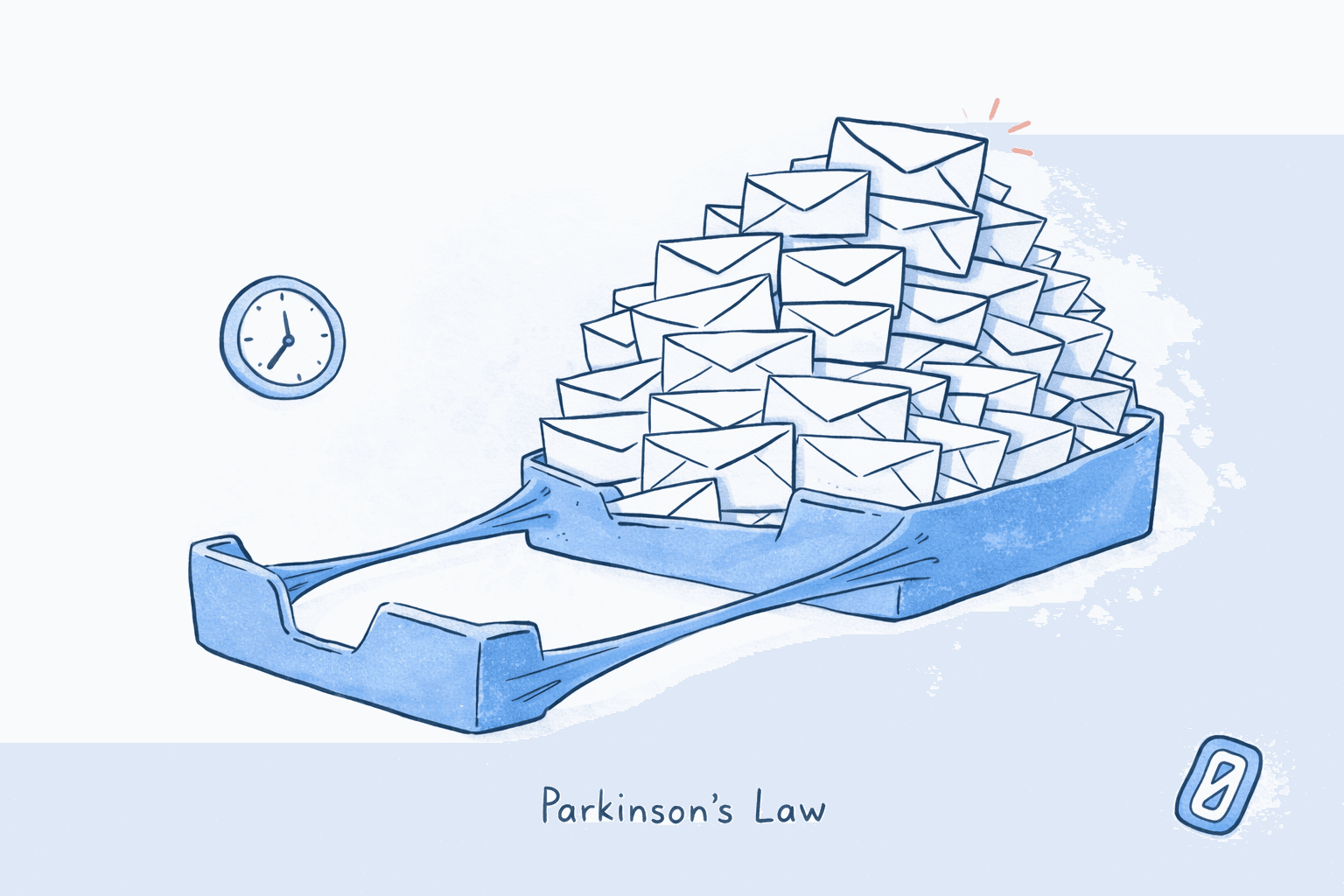
Worse, modern inboxes generate decision load at a rate the original 2007 talk could not have anticipated. According to the Radicati Group’s Email Statistics Report, 2024-2028, the average office worker now receives 121 emails per day, against a global daily volume that has surged past 376 billion messages. That’s not a queue. It’s a river. Decision fatigue research from the American Psychological Association has shown that the human brain treats every micro-decision (Reply? Archive? Defer? Snooze?) as a draw on the same limited cognitive budget you use for important work. Treating the inbox as a list of decisions to grind through is a recipe for what researchers call decision fatigue, not productivity.
There’s also a less-quoted study worth surfacing: Marsh et al. (2024), published in SAGE Open, mapped the “information overload stress cycle” and found that workers who attempted to maintain near-empty inboxes reported higher baseline stress than workers who accepted a steady-state backlog and processed in batches. The empty-inbox group spent more time checking, were more interruptible, and reported less satisfaction with their work. The opposite of what they were promised.
These are not trivial differences. They are the gap between an unbounded goal that creates the stress it claims to solve, and a bounded one that closes the loop and leaves it closed.
If chasing an empty inbox has only ever made you check it more, Swizero takes Mann’s original idea seriously: it caps your inbox at a handful of cards so the decisions are bounded, not infinite. You make them, and you’re done.
What Should Inbox Zero Mean in 2026?#
The honest reading of Mann’s original idea, applied to a 2026 inbox, is this: Inbox Zero is not a count of messages. It is a count of open decisions you are carrying around in your head when you don’t want to be.
That reframing matters because it makes the problem solvable in a way the empty-inbox version never was. You cannot win against an infinite stream by trying to subtract from it faster than it adds. You can win by changing what counts as “done”: from “no messages visible” to “no decisions outstanding.”
The five-verb framework Mann taught in 2007 still holds. For every message: Delete, Delegate, Respond, Defer, or Do. The discipline is making the decision now, not later. Procrastinated decisions are what create the cognitive overhead Mann was actually trying to eliminate. A snoozed email isn’t gone; it’s a deferred decision wearing a costume. Mann would tell you that count matters more than message count.
This is also why feature-stuffing email apps with snooze, pin, label, color-code, AI-priority, and AI-summary tools tends to make the problem worse instead of better. Each new feature is a new way to defer a decision rather than make one. The inbox accumulates not just unread messages but unfinished mental work. We’ve written about this pattern before in why every email app is solving the wrong problem. The short version is that the productivity industry has confused options with progress. More verbs is not more closure. Closure is closure.
Honestly? Tip 4 in this section was the hardest one for me to internalize. I had built my own deferring stack (snooze for 24 hours, snooze until Monday, snooze until “later this week”) and convinced myself it was triage. It was avoidance dressed up in productivity vocabulary. Mann would have called it monkeyballs, which is, unfortunately, the technical term he used in 2020 for exactly this pattern.
How Swizero Implements the Original Idea#
Swizero is the first email app I know of that takes the original Inbox Zero idea (zero open decisions) as a structural commitment rather than a behavioral aspiration. The product caps your inbox at a handful of cards and forces a decision on each one with a swipe: left to clear, right to flag, up to reply, down to archive. There is no snooze. There is no infinite scroll. The session has a finish line, and the finish line is when the cards are gone.
The point isn’t that Swizero invented this idea. The point is that Mann described this idea in 2007 and almost nobody built it. The productivity industry built faster ways to chase an empty inbox. We built an inbox that comes pre-finished. The “zero” in our name is the same zero Mann meant: the count of decisions you carry away from your inbox at the end of a session. We want it to be zero.
If you want the longer version of this argument, your inbox doesn’t need more features, it needs a finish line makes the structural case. And if you want the comparative view of how this approach differs from chasing an empty inbox, the inbox zero vs. inbox finite breakdown goes deeper on the mechanics. This post is the historical version: where the idea came from, how it got mangled, and what it should have meant all along.
One caveat worth naming: I am quoting Mann selectively, like every writer who quotes Mann. He has been ambivalent about the productivity industry for two decades, and his more recent writing on his Ghost blog suggests he would be skeptical of any product that claims to “solve” the email problem, including ours. That skepticism is healthy. The question isn’t whether software can do the work for you. It’s whether the software you’re using has a finish line at all. Most don’t. We do.
Frequently Asked Questions#
Who invented Inbox Zero?#
Merlin Mann, a writer and productivity blogger, coined the term in a 2006 series of posts on 43 Folders and popularized it in a July 2007 Google Tech Talk. The talk has been viewed millions of times and is the canonical reference for the concept.
What does the “zero” in Inbox Zero actually mean?#
According to Mann himself, the “zero” refers to the amount of attention you spend thinking and worrying about your inbox, not the number of messages in it. He wrote in On Chasing the Right “Zero” that the goal is “consciously managing the amount of our attention that we commit (or, far more often, cede) to thinking and worrying about what may or may not be piling up.” It’s about cognitive load, not message count.
Did Merlin Mann really say Inbox Zero is misunderstood?#
Yes, repeatedly. In a 2020 Inc. interview, he confirmed he doesn’t keep his own inbox empty and called the popular interpretation a misreading. He has restated the original meaning across multiple essays, podcasts, and interviews since 2007.
What are the five verbs of Inbox Zero?#
Mann’s framework lists five and only five honest options for any incoming message: Delete, Delegate, Respond, Defer, and Do. The discipline is choosing one immediately rather than letting messages accumulate as undecided. Refusing to choose is what creates the cognitive overhead the system was designed to eliminate.
Is Inbox Zero still relevant in 2026?#
Yes, but only the original version, which is about minimizing open decisions, not minimizing messages. The empty-inbox version is harder than ever to maintain in a world of 121 emails per day per worker, and research suggests it actively raises stress. The attention-based version remains the cleanest framework for managing cognitive load from email that exists.
Sources#
- On Chasing the Right “Zero”. Merlin Mann, personal Ghost blog. The clearest first-person restatement of the original Inbox Zero meaning.
- 43 Folders Series: Inbox Zero. Merlin Mann, 2006-2007. The original blog series introducing the concept.
- Inbox Zero: Google Tech Talk. Merlin Mann, July 23, 2007. The talk that brought the concept into mainstream productivity culture.
- Merlin Mann. Wikiquote. Compendium of attributed Mann quotes including the “how much of your own brain is in that inbox” line.
- The Guy Who Invented Inbox Zero Says We’re All Doing It Wrong. Betsy Mikel, Inc., 2020. The interview where Mann publicly disowned the empty-inbox interpretation.
- On Finished and Unfinished Tasks. Bluma Zeigarnik, Psychologische Forschung, 1927. The original study showing 90% recall for interrupted tasks vs. completed ones.
- Email Statistics Report, 2024-2028. The Radicati Group, 2024. The 121 emails/day figure and global volume statistics.
- Marsh et al., Information Overload and the Stress Cycle. SAGE Open, 2024. Research on stress outcomes for empty-inbox vs. batched-processing strategies.
- Decisions, Decisions: Why Burnout Is on the Rise. American Psychological Association. Background on decision fatigue and cognitive budget.
Your inbox doesn't have to feel like this.
Be among the first to experience a finished inbox.
Join the finite inbox beta