Email Generational Differences: Gen Z vs Boomers
By Chris Stefaner, Co-founder of Swizero
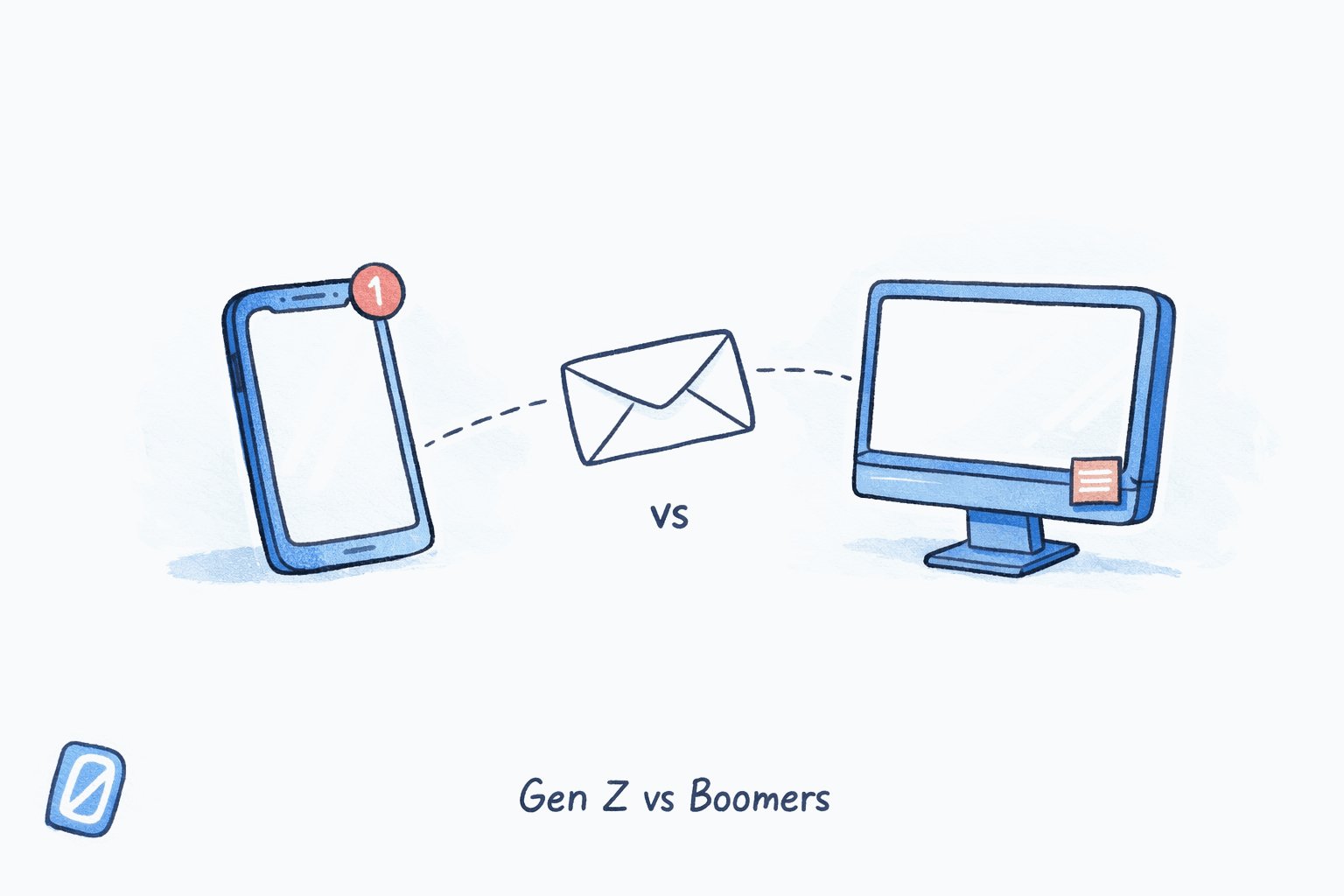
Your 22-year-old colleague signs off with “thx.” Your 58-year-old client sends a five-paragraph email with a PDF attached, a formal salutation, and “Warm regards” at the bottom. Both of them think the other one is doing email wrong.
They’re both right, in a way. Email generational differences are not just anecdotal office comedy. They are measurable, research-backed behavioral patterns that shape how billions of messages land (or misfire) every day. And the friction they create is one of the most underappreciated sources of workplace email stress.
Here is the argument that matters: the problem is not that any generation uses email badly. The problem is that email itself has no opinion. It accepts a three-word reply and a three-page memo with equal indifference. It imposes no norms, no constraints, no finish line. Every generation fills that vacuum with its own assumptions, and then wonders why nobody else got the memo. To understand the full scope of email generational differences, you have to look at each cohort on its own terms.
Key Takeaway
Email generational differences are real and measurable. ZeroBounce’s 2025 survey of nearly 1,400 workers found 53% of Gen Z feel stressed by email, while Boomers use email for 80% of professional communication. The friction isn’t about who’s right; it’s about a tool with no shared rulebook. The fix is structural constraints that work regardless of generational style.
How Does Gen Z Actually Use Email?#
Gen Z treats email the way older generations treat formal letters: something you use when you have to, with a vague sense of anxiety about getting the tone right.
ZeroBounce’s 2025 Gen Z at Work report, surveying nearly 1,400 Gen Z professionals across the US, Canada, UK, and Europe, found that 60% of Gen Z workers use email specifically to avoid awkward conversations and in-person conflict. Women in this group were even more likely to lean on email as a social buffer, at 65%. The same report found that 53% of Gen Z say email stresses them out and 57% aren’t sure how formal their work emails should be.
That formality question is genuinely new and it sits at the center of how email generational differences play out in practice. Previous generations inherited email norms from memos and business letters. Gen Z inherited email from… not much. They grew up on iMessage, Instagram DMs, and Discord. Email arrived in their professional lives as an alien format with unwritten rules that nobody explicitly taught them. Gen Z email habits differ from every other generation in measurable ways, and the data makes the gap hard to dismiss as mere preference.
Despite the stress, 42% of Gen Z workers named email as their favorite workplace communication tool, twice as many as those who chose Slack or WhatsApp. That surprised even the researchers. Gen Z does not hate email. They use it strategically, as a low-pressure, asynchronous shield against the immediacy of real-time conversation.
The catch: their emails tend to be short. Very short. And older colleagues sometimes read brevity as rudeness. This is one of the earliest places email generational differences surface in a new hire’s first weeks on the job.
What Does a Boomer Email Look Like (And Why)?#
Baby Boomers write email the way they were taught to write business correspondence: with structure, context, and formality. According to research compiled by Best Corporate Events’ generational communication analysis, Boomers use email for approximately 80% of their professional communications, relegating instant messaging to just 20%.
This tracks with broader data. Over 93% of Boomers use email consistently, and a Statista survey found that 74% of Boomers consider email the most personal method of brand communication, compared to just 60% of Gen Z.
Boomers’ emails tend to be longer, more detailed, and more likely to include attachments. A 2024 Preply survey on email greetings and sign-offs found that 76% of Boomers advocate for formal email communications, and 60% believe that slang damages a professional brand.
There is a logic to this that younger generations often miss. The classic boomer email style is structured, formal, and detail-heavy because Boomers entered the workforce when written communication was one of the primary signals of competence. A well-structured email was (and in many industries still is) a demonstration of professionalism, not a waste of time. Recognizing this is essential to understanding email generational differences without dismissing an entire cohort’s norms.
The disconnect happens when that five-paragraph email arrives in the inbox of someone who processes 67% of their email on a smartphone. On a 6-inch screen, a formal Boomer email becomes a scroll. And scrolling, for a generation raised on skimmable feeds, signals “this was not written with me in mind.” It is a perfect illustration of how email generational differences turn good intentions into bad experiences.
Are Millennials Still the Email Generation?#
Millennials occupy a strange middle ground. Understanding how millennials use email requires looking at the Slack adoption data alongside their inbox habits. They are the generation that grew up with email, adopted it during its cultural peak, and are now quietly migrating away from it.
Millennials and Gen X report the highest email reliance of any generation, at 98% according to Statista’s 2022 data on U.S. email reliance by age. But reliance does not mean enthusiasm. A Slack survey on informal workplace communication found that 73% of millennials said informal messaging helped them avoid miscommunications and better understand intent, suggesting they find email’s tone ambiguity frustrating rather than useful.
The daily Slack user base exploded from 8.7 million in 2019 to an estimated 38.8 million by 2024, a 346% increase, according to Worklytics’ analysis of workplace communication tools. Millennials drove much of that migration. They did not abandon email; they bifurcated. Quick questions go to Slack. Formal requests and external communication stay in the inbox.
This bifurcation creates its own problem and adds a unique dimension to email generational differences. Millennials now check two inboxes instead of one, doubling the cognitive load of unprocessed messages. A 2025 RivalTech study found that 31% of millennials and Gen Z consumers have more than 1,000 unread emails, suggesting that their email inboxes are not “managed” so much as “tolerated.”
I should be honest here: that 1,000-unread-email statistic is probably low. If you are a millennial reading this, scroll down to your personal Gmail and check the number. I’ll wait.
Why Is Gen X the Quietest Power User?#
Gen X gets overlooked in generational email research, which is ironic because they may be the heaviest users of all. Any honest accounting of email generational differences has to spend time here. Born between 1965 and 1980, they adopted email as young professionals in the 1990s, right when it replaced the memo as the default workplace communication tool. Email is not something Gen X chose. It is something they grew up with professionally, and it stuck.
Statista’s data confirms that Gen X matches millennials at a 98% email reliance rate. But the qualitative difference matters. Where millennials supplemented email with Slack and Teams, Gen X largely did not. A Leaders.com analysis of generational communication preferences found that Gen X professionals overwhelmingly default to email and phone calls, with instant messaging as a secondary tool rather than a primary one.
Gen X is also the generation most likely to be in middle management, which means they absorb email from both directions: formal requests from Boomers above and terse messages from Gen Z below. They are, functionally, the translators of the multigenerational inbox, and the cognitive toll of that translation is real.
Lindsey Pollak, multigenerational workplace expert and New York Times bestselling author of The Remix, describes this dynamic bluntly: professionals should “always err on the side of formality first” in multigenerational email, because the cost of being too formal is zero, but the cost of being too casual can be significant.
That advice works for senders. But it does not address the structural problem underlying email generational differences: email gives you no feedback on whether your formality calibration was right or wrong. You just send it and hope.
Where Do Email Generational Differences Create the Most Friction?#
The real damage is not philosophical. It is operational. Four specific friction points cause the most conflict in multigenerational workplaces.
Response Time Expectations#
According to the Onlypult analysis of generational email expectations, Boomers expect email responses within 24 to 48 hours. Gen X expects a reply within 24 hours. Millennials expect a response within a few hours. Gen Z expects one within an hour.
These expectations are rarely stated explicitly. They are assumed. And when the assumption is violated, the interpretation is always personal: “They’re ignoring me,” “They don’t respect my time,” “They aren’t taking this seriously.” Response time may be the single dimension where email generational differences cause the most day-to-day conflict. The issue isn’t speed. It’s that nobody agreed on the clock.
Formality and Sign-Offs#
ZeroBounce found that 57% of Gen Z workers are unsure how formal their emails should be. Meanwhile, the Preply study on email greetings showed that 76% of Boomers expect formality. The result: Gen Z agonizes over whether “Hi” is too casual, while Boomers wonder why they received an email that starts with no greeting at all.
The Passive-Aggressive Email Economy#
A Preply survey on passive-aggressive email language found that 83% of Americans have received passive-aggressive emails from coworkers. The phrase “per my last email” topped the list. Generationally, 43% of Gen X and millennial respondents admitted to sending passive-aggressive emails, compared to 36% of Gen Z and 29% of Boomers. But Gen Z felt the impact most acutely: 69% said passive-aggressive emails affected them, versus 65% of millennials.
This is a pattern worth noting. The generations that send the most passive-aggressive emails (Gen X and millennials) are not the generations that suffer most from them (Gen Z). There is no universal generational email etiquette because each cohort inherited different norms. The senders grew up in an email culture where indirect language was standard professional armor. The receivers grew up in a culture of text messages, where tone ambiguity is a known source of misinterpretation and anxiety.
Emoji Interpretation#
The thumbs-up emoji became a genuine cultural flashpoint in 2022 when Gen Z users on Reddit declared it passive-aggressive. A story covered by Upworthy documented the clash: Boomers and Gen X consider a thumbs-up a friendly acknowledgment, while many Gen Z users read it as dismissive or sarcastic. Same symbol, different dictionaries. Emoji interpretation is one of the more surprising fronts where email generational differences show up.
If cross-generational email friction sounds familiar, Swizero sidesteps the style wars entirely. Its fixed card limit surfaces only what matters, regardless of whether the sender wrote three words or three paragraphs. The constraint is structural, not cultural.
What Does the Research Say About Email Anxiety Across Generations?#
Email anxiety is not evenly distributed, and the research on email generational differences confirms that stress manifests differently depending on age. ZeroBounce’s 2025 data showed 53% of Gen Z feeling stressed by email, but a 2015 study by Barber and Santuzzi published in the Journal of Occupational Health Psychology found that “workplace telepressure,” the urge to immediately respond to work messages, predicted burnout and sleep disruption across all age groups.
Gloria Mark, Chancellor’s Professor of Informatics at the University of California, Irvine and author of Attention Span, has documented the cognitive cost of email across her research. Her studies found that average screen attention spans dropped from two and a half minutes in 2004 to just 47 seconds by 2023. “We are as likely to self-interrupt as we are to be interrupted by something external to us,” Mark told the APA’s Speaking of Psychology podcast.
That self-interruption pattern does not discriminate by generation. A 55-year-old Gen X manager compulsively checking their inbox and a 24-year-old Gen Z analyst refreshing Slack are exhibiting the same behavior, just on different platforms. The underlying notification addiction is universal; only the delivery mechanism varies.
One caveat worth noting: most of the generational email research relies on self-reported surveys, not behavioral observation. People are notoriously bad at estimating their own email habits. ZeroBounce’s sample of 1,400 is solid, but the Preply survey and some of the communication-preference data are smaller samples. The directional findings are consistent across studies, but the exact percentages deserve a grain of salt.
| Generation | Email Reliance | Response Expectation | Primary Style | Biggest Friction |
|---|---|---|---|---|
| Gen Z (1997-2012) | 42% prefer email at work | Under 1 hour | Short, casual, uncertain about formality | Passive-aggressive tone interpretation |
| Millennials (1981-1996) | 98% reliance rate | 2-6 hours | Medium length, bifurcated across tools | 1,000+ unread email tolerance |
| Gen X (1965-1980) | 98% reliance rate | Under 24 hours | Professional default, email-first | Absorbing both formal and casual styles |
| Boomers (1946-1964) | 80% of professional comms | 24-48 hours | Formal, detailed, attachment-heavy | Brevity read as rudeness |
Sources: ZeroBounce 2025, Statista 2022, Onlypult 2024, Best Corporate Events analysis
How Do You Fix a Tool That Means Different Things to Everyone?#
You do not fix the people. You fix the container.
Nearly every email generational difference stems from a single design flaw: the inbox is an open pipe. Anyone can put anything in it, at any length, in any tone, at any hour, with any expectation of response speed. The tool carries zero opinions about what “good email behavior” looks like, so every generation imports its own norms and every mismatch becomes a personal slight.
SHRM found that 76% of organizations experience communication challenges due to generational differences. Harvard Business Review research reported that 76% of workers believe these communication gaps slow down actual work. Those numbers will not improve by asking Gen Z to write longer emails or asking Boomers to use emoji. If the research on email generational differences teaches anything, it is that style is not the lever.
Constraints are.
The concept behind Swizero’s fixed card limit is that it is generation-neutral by design. It does not care whether an email is three words or three paragraphs, whether it closes with “Best” or “thx” or nothing at all. It reduces the inbox to a handful of cards that AI determines are most important. The style stays. The overwhelm goes.
That matters for cross-generational teams specifically because the card limit removes the implicit judgment. A Gen Z worker swiping through cards is not “ignoring” the Boomer’s detailed email. They are processing it in a system designed to surface it at the right time. And a Boomer is not being “old-fashioned” by writing context-rich messages, because the AI summary distills the essence regardless of length.
Frequently Asked Questions#
Why does Gen Z find email stressful?#
This is one of the most frequently cited email generational differences. ZeroBounce’s 2025 survey of nearly 1,400 Gen Z professionals found that 57% are unsure how formal work emails should be and 51% are uncertain when to follow up. Unlike older generations who inherited email norms from business letter conventions, Gen Z learned digital communication through text messages and social media, where tone rules are implicit and different. The unfamiliarity with email’s unwritten rules, combined with exposure to passive-aggressive email culture, creates measurable anxiety: 53% report that email stresses them out.
Do Boomers use email more than younger generations?#
Yes. Research shows Baby Boomers use email for approximately 80% of their professional communications, compared to Gen Z’s roughly 30%. Over 93% of Boomers use email consistently, and 74% consider it the most personal form of brand communication. Boomers were the first generation to adopt email as a workplace standard, and their habits reflect decades of treating it as the default professional channel.
What are the biggest email friction points between generations?#
The research on email generational differences highlights four friction points that dominate: response time expectations (Boomers expect 24-48 hours; Gen Z expects under an hour), formality levels (76% of Boomers want formal emails; 57% of Gen Z are unsure how formal to be), passive-aggressive language (83% of workers have received passive-aggressive emails, with Gen Z feeling the most impact at 69%), and emoji interpretation (the thumbs-up emoji reads as friendly to Boomers but dismissive to many Gen Z users).
How do millennials use email differently from other generations?#
Millennials have the highest email reliance rate at 98% but are actively migrating routine communication to tools like Slack, whose daily users grew 346% from 2019 to 2024. They bifurcate communication: formal and external messages stay in email, while quick questions go to messaging platforms. One consequence is that 31% of millennials have over 1,000 unread emails, suggesting their inboxes are tolerated rather than managed.
Is email etiquette different across generations?#
Significantly so. Email generational differences in etiquette are well-documented. Boomers value formal greetings, full sentences, and professional sign-offs like “Best regards.” Gen Z uses shorter messages, casual tone, and sometimes skips greetings entirely. Gen X and millennials fall between these poles, with 43% admitting they send passive-aggressive emails. Lindsey Pollak, author of The Remix, advises defaulting to formality when communicating across generations, because the cost of being too formal is lower than the cost of being too casual.
Sources#
- Gen Z at Work: The 2025 ZeroBounce Report. ZeroBounce, 2025. Survey of nearly 1,400 Gen Z professionals on email stress, formality uncertainty, and workplace communication preferences.
- Generational Communication Differences in the Workplace. Best Corporate Events, 2024. Boomers use email for 80% of professional communications.
- U.S. Users Relying on Email by Age. Statista, 2022. Millennials and Gen X at 98% email reliance.
- The Generational Gap in Business Emails. Onlypult, 2024. Response time expectations by generation.
- Survey: 83% of Americans Hit by Passive-Aggressive Emails. Preply, 2023. Passive-aggressive email frequency and generational impact.
- Study Shows the Most Savage Ways to Begin or End an Email. Preply, 2024. 76% of Boomers advocate for formal email communications.
- Managing Multi-Generational Communication in the Workplace. SHRM, 2024. 76% of organizations experience generational communication challenges.
- Slack vs Email: A Data-Driven Guide. Worklytics, 2024. Slack daily users grew from 8.7M to 38.8M (2019-2024).
- Attention Span. Gloria Mark, 2023. Screen attention spans dropped from 2.5 minutes to 47 seconds.
- Workplace Telepressure and Burnout. Barber and Santuzzi, Journal of Occupational Health Psychology, 2015.
- 5 Email Etiquette Rules for the Multigenerational Workforce. Lindsey Pollak, 2023. “Always err on the side of formality first.”
- Mobile Email Engagement Statistics 2026. Genesys Growth, 2026. 67% of Gen Z use smartphones as primary email device.
- Thumbs-Up Emoji Controversy. Upworthy, 2022. Generational divide in emoji interpretation.
- Informal Communication in Hybrid Work. Slack, 2024. 73% of millennials say informal messaging reduces miscommunication.
Your inbox doesn't have to feel like this.
Live on iPhone with Gmail. Access opens in rounds.
Get Swizero