Email Overload: Why You Have Too Many Emails (and What Actually Works)
By Chris Stefaner, Co-founder of Swizero
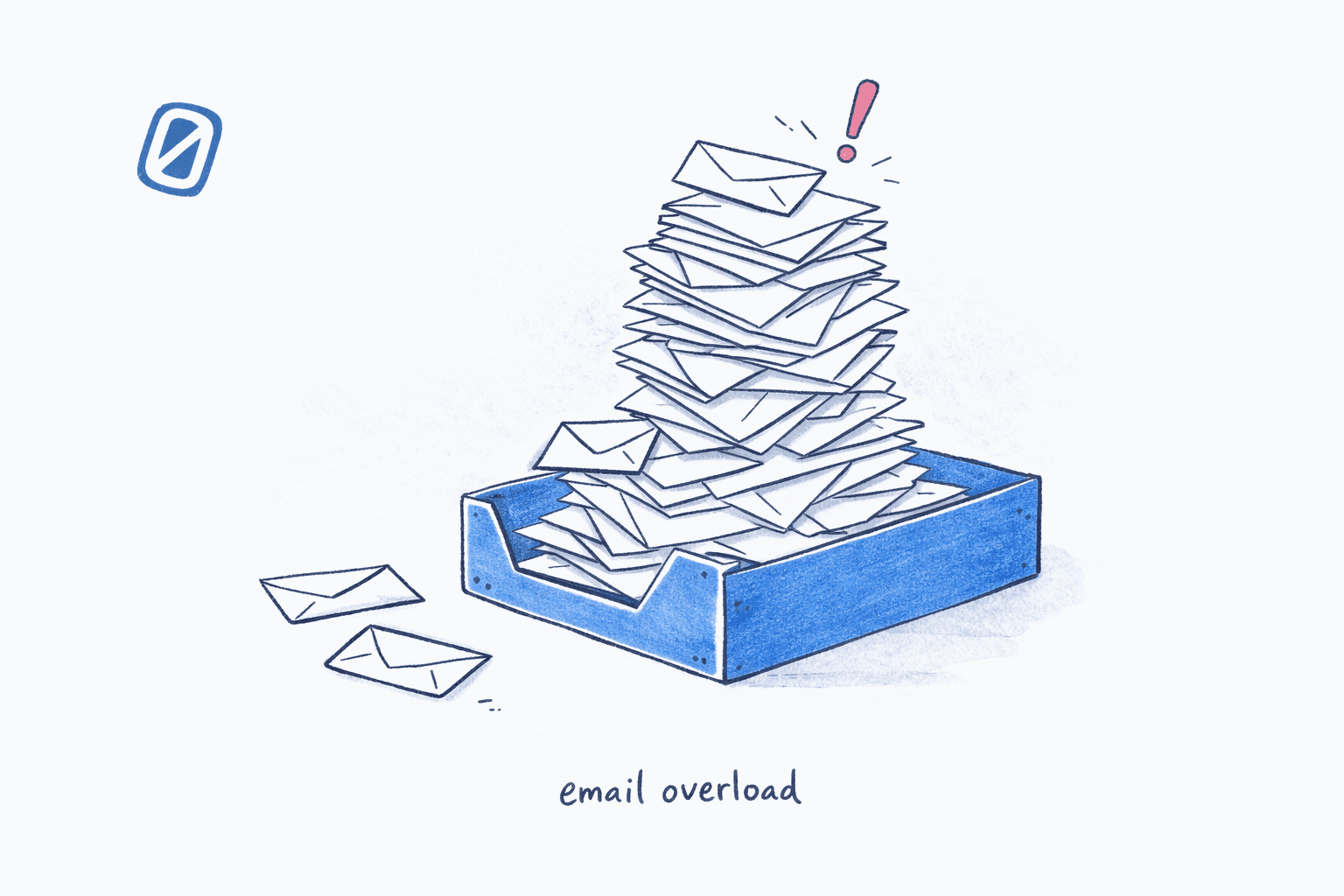
Most advice about email overload starts with the problem and ends with a productivity hack. Here is a different starting point: the problem is not that you receive too many emails. The problem is that email has no natural stopping point, so your brain treats every session as an incomplete task.
That distinction matters more than any tip about filters or folders. Researchers have spent two decades documenting what an unbounded inbox does to cognition, stress, and output. The evidence points to a specific conclusion: the most effective email overload solutions are not the ones that help you move through messages faster. They are the ones that make email a completable task.
This is the idea behind what we call the “finish line” philosophy. Email is not broken; it is unbounded. And the fix is constraints, not features.
Key Takeaway
Email overload is less about volume and more about the absence of a finish line. Research shows that capping your inbox, batching your sessions, and treating email as a bounded task reduces both stress and time spent more effectively than any sorting or filtering technique.
What Is Email Overload, Really?#
Email overload is the state where incoming message volume exceeds your capacity to process it meaningfully. But volume alone does not explain why it feels so bad. A 2024 study published in Frontiers in Psychology surveyed 1,372 employees and found that email overload during work hours increased job stress and reduced both job satisfaction and life satisfaction. Critically, employees who experienced email overload during both work and leisure time reported the worst outcomes, suggesting the problem is not just about how many messages arrive, but about the inability to ever fully disengage from them.
That finding aligns with what Gloria Mark, Chancellor’s Professor of Informatics at UC Irvine and author of Attention Span, has documented across years of workplace observation. Her research shows that the average knowledge worker now spends just 47 seconds on any single screen before shifting attention, and that we interrupt ourselves more often than we are interrupted by external notifications. “We are prone to self-interruption,” Mark has written, noting that the urge to check email is driven by internal anxiety as much as external pings.
The word “overload” implies the fix is reducing volume. But the research consistently shows something subtler: it is the open-endedness that causes the most damage.
How Did We Get to 117 Emails a Day?#
The scale of the problem is easy to understate. Microsoft’s 2025 Work Trend Index, based on anonymized telemetry from millions of Microsoft 365 users, found that the average knowledge worker receives 117 emails per day. That is not a self-reported survey number; it is measured behavior across millions of accounts.
Those 117 emails do not arrive in isolation. The same report found that employees face 275 interruptions per day during core work hours, roughly one every two minutes, from the combined pressure of email, chat, and meetings. Forty percent of employees who are online at 6 a.m. are already triaging their inbox. Twenty-nine percent return to email by 10 p.m. Microsoft called this pattern the “infinite workday,” and the data supports the label.
But email volume is only half the equation. The other half is what Rob Cross, Reb Rebele, and Adam Grant documented in Harvard Business Review: collaborative demands on individual workers have increased by 50% or more over two decades. At many companies, people now spend roughly 80% of their time in meetings or responding to colleagues’ requests. Email is the connective tissue of that collaboration, which means reducing your email load often requires renegotiating how your entire team communicates.
I could write a whole post about organizational email culture alone, but the key point here is this: your email overload is not a personal failure. It is a structural outcome of how modern work is organized.
What Does Email Overload Actually Cost You?#
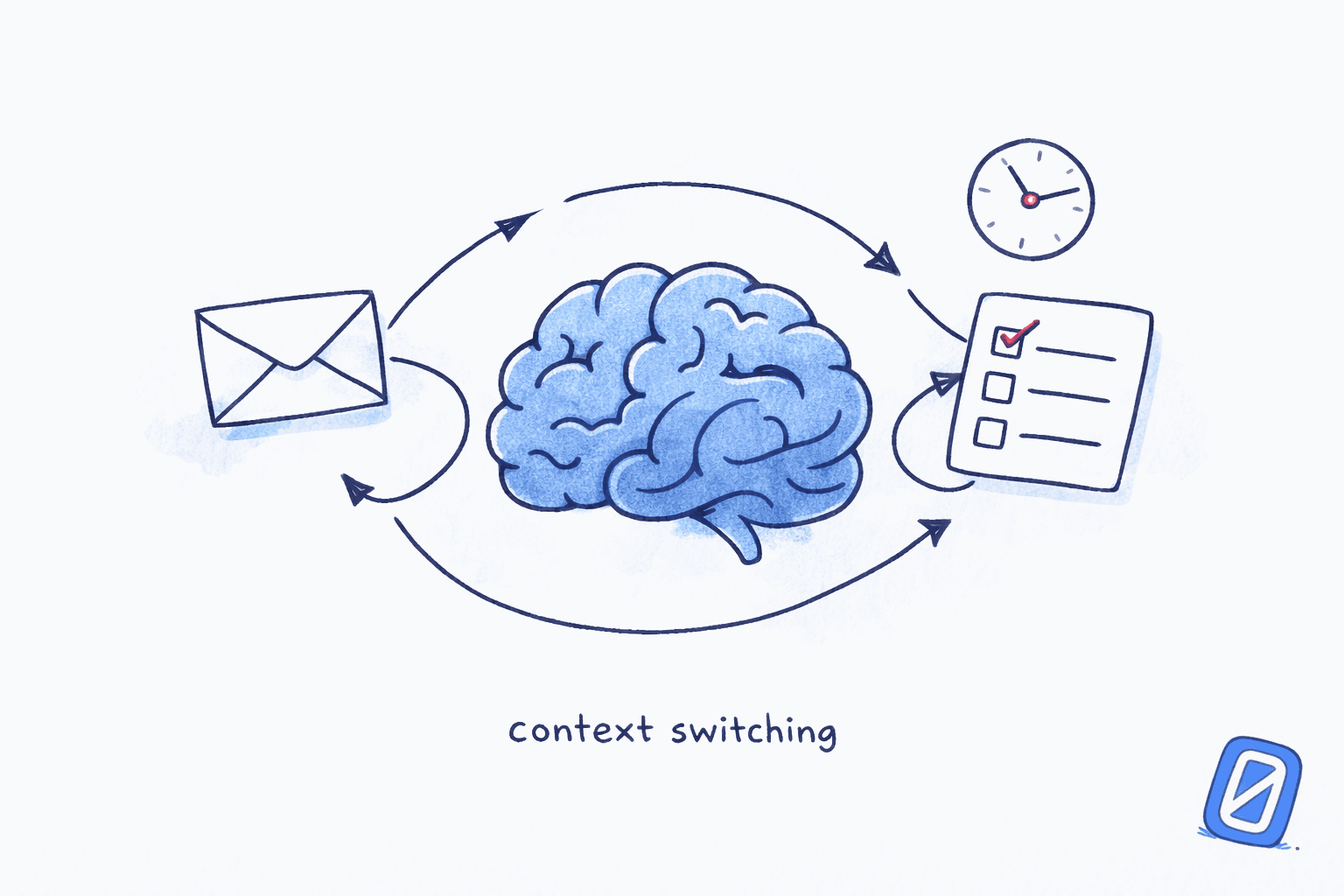
The cognitive cost of email overload extends well beyond the hours spent reading and replying. Cal Newport, Professor of Computer Science at Georgetown University and author of A World Without Email, describes the core mechanism: “The cognitive overhead generated by all of this context switching is exhausting and makes people miserable.” Newport’s argument, backed by his review of attention research, is that the “hyperactive hive mind” workflow created by constant email checking does not just waste time. It degrades your ability to think clearly.
The financial cost follows from the time cost. McKinsey Global Institute’s The Social Economy put email at 28% of the average knowledge worker’s week. On a $100,000 salary, that is roughly $28,000 a year of paid time routed through an inbox, most of it spent on messages that never needed the recipient’s judgment at all.
| Impact | Finding | Source |
|---|---|---|
| Share of the workweek | 28% spent reading and answering email | McKinsey Global Institute, The Social Economy |
| Communication load | 60% of the workday goes to meetings, email, and chat | Microsoft Work Trend Index, 2025 |
| Interruption rate | A ping roughly every 2 minutes for the heaviest-hit workers | Microsoft Work Trend Index, 2025 |
| Recovery time | 25 minutes to refocus after interruption | Gloria Mark, UC Irvine |
| Stress | 40% of employees report significant daily stress | Gallup State of the Global Workplace, 2026 |
The Stress Multiplier#
The Gallup State of the Global Workplace 2026 Report found that global employee engagement dropped to 20% in 2025, its lowest point since 2020, costing the world economy an estimated $10 trillion in lost productivity. Roughly 40% of employees worldwide reported experiencing “a lot of stress” during the previous day.
Email overload is not the only cause of that stress, obviously. But it is the one that touches nearly every worker, every day, multiple times per day. And unlike a bad meeting or a difficult project, email stress is ambient. It follows you home. The 2024 Frontiers in Psychology study found that employees who cannot disengage from email during leisure time experience compounding reductions in life satisfaction, not just job satisfaction.
If the inability to disengage from email resonates, Swizero caps your inbox at a fixed card limit so every email session has a clear ending point. When the stack is empty, email is done.
Why Standard Email Overload Advice Fails#
Search for “email overload solution” and you will find a predictable list: batch your email, turn off notifications, use filters, unsubscribe from newsletters, adopt the two-minute rule. This advice is not wrong, exactly. It is incomplete.
Batching works, within limits. The frequently cited 2015 UBC study by Kushlev and Dunn showed that limiting email checks to three times per day reduced stress compared to unlimited checking. But a 2022 randomized controlled trial by Wijngaards, Pronk, and Burger added nuance: batching reduced exhaustion only for high-volume email users. For people who receive a moderate number of emails, the effect was negligible. And Mark and Iqbal’s 2016 CHI study found that batching correlated with higher self-reported productivity but did not significantly reduce stress.
Honestly, the “just batch your email” advice was the hardest for me to examine critically, because it feels so obviously right. But the research is more complicated than the advice.
Filters and labels help with organization but create their own overhead. Every filter is a rule you have to maintain. Every label is a decision you have to make. For people already experiencing email decision fatigue, adding more sorting systems can make the problem worse, not better.
Unsubscribing is useful but addresses only a fraction of the problem. Most email overload comes from colleagues and clients, not newsletters. The Microsoft telemetry showing 117 emails per day is measuring work communication, not marketing.
The two-minute rule (reply immediately to anything that takes less than two minutes) sounds efficient but creates a reactive posture that undermines how fast you can actually process email. If you process 117 emails and 30 of them are “two-minute” tasks, you have just spent an hour reacting, with 30 context switches embedded in it.
What Actually Works to Fix Email Overload#
The strategies that hold up under scrutiny share a common thread: they impose structure on an inherently unstructured system.
Constrained sessions, not unlimited access#
The most consistent finding across the research is that bounded email sessions outperform continuous monitoring. This does not just mean “check less often.” It means treating email as a discrete task with a defined start, middle, and end. The difference between checking email three times per day and having three bounded sessions per day is subtle but significant. The first is a frequency rule. The second is a completion rule.
When email has a finish line, the Zeigarnik effect works in your favor. Incomplete tasks occupy working memory; completed tasks release it. An inbox that can be “done” is cognitively cheaper than an inbox that is merely “checked.” This is the core mechanism behind the inbox finite approach: rather than trying to reach zero messages (a state that immediately reverses), you cap the number of messages you engage with per session.
Reducing decisions, not just messages#
Email overload is partly a volume problem and partly a decision problem. Each message in your inbox represents at least one unmade decision: reply, defer, delete, or ignore. Research on choice overload, including Iyengar and Lepper’s landmark 2000 study, demonstrates that more options lead to worse decisions and lower satisfaction.
Reducing the number of decisions per email session, whether through AI-assisted prioritization, pre-sorted categories, or a fixed card limit, addresses a dimension of overload that volume reduction alone misses. The goal is not an empty inbox. The goal is fewer open decisions at any given moment.
Protecting recovery time#
The Microsoft data showing employees are interrupted every two minutes points to a recovery problem as much as a volume problem. Gloria Mark’s research documents that it takes roughly 25 minutes to return to full cognitive engagement after an interruption. If you are checking email between tasks, you are paying that 25-minute tax repeatedly.
The practical implication: email sessions should be separated from deep work blocks by genuine transition time. Checking email “just for a second” before a focus session is not a neutral act. It loads your working memory with open loops that compete for attention during the work that follows.
Using constraints as a forcing function#
Swizero takes the constraint approach literally: it surfaces only a fixed card limit of AI-ranked emails per session. You swipe through them, and when the stack is empty, the session is over. This is not a filter or a label. It is a structural limit on how many decisions your inbox can demand from you at once.
Yes, this is another article recommending constraints over features. But the converging evidence from decision science, attention research, and workplace surveys keeps pointing in the same direction. The inbox does not need better organization. It needs a boundary.
Frequently Asked Questions#
How many emails per day is considered email overload?#
There is no universal threshold, but Microsoft’s 2025 Work Trend Index found the average knowledge worker receives 117 emails daily. Research suggests that volume becomes overload when incoming messages consistently exceed your capacity to process them in a reasonable timeframe, typically when you spend more than two hours per day on email.
Can email overload cause burnout?#
Yes. The Gallup State of the Global Workplace 2026 report found that 40% of employees experience significant daily stress, and a 2024 study in Frontiers in Psychology confirmed that email overload during both work and leisure time reduces life satisfaction. Chronic inability to disengage from email is a documented pathway to burnout.
What is the best email overload solution?#
Research points to bounded email sessions over continuous monitoring. The 2015 UBC study by Kushlev and Dunn showed that limiting email checks to three times per day reduced stress. More recent evidence suggests that combining batched sessions with a fixed cap on messages per session produces better outcomes than frequency limits alone.
Does turning off email notifications help with overload?#
Turning off notifications reduces external interruptions but does not address self-interruption, which Gloria Mark’s research shows is actually more common. Notifications are one trigger among many. A more effective approach is creating structured email sessions that satisfy the urge to check rather than simply suppressing it.
Is email overload getting worse?#
The data suggests yes. Global email volume reached 376 billion messages per day in 2025 and continues to grow. Microsoft’s Work Trend Index documented the rise of the “infinite workday,” with 40% of early-morning workers triaging email before 6 a.m. and after-hours chat volume rising 15% year over year.
Sources#
- Breaking Down the Infinite Workday. Microsoft Work Trend Index, 2025. Knowledge workers receive 117 emails/day, face 275 interruptions/day, 40% check email before 6 a.m.
- The Social Economy: Unlocking value and productivity through social technologies. McKinsey Global Institute, 2012. Interaction workers spend an estimated 28% of the workweek managing email.
- E-mail overload: Exploring employees’ experiences using e-mail during worktime and leisure time. Frontiers in Psychology, 2024. Survey of 1,372 employees; email overload during work and leisure reduces life satisfaction.
- Collaborative Overload. Rob Cross, Reb Rebele, and Adam Grant, Harvard Business Review, 2016. Collaborative demands up 50%+; 80% of time spent on meetings and requests.
- State of the Global Workplace 2026. Gallup, 2026. Employee engagement at 20% (lowest since 2020); 40% report significant daily stress.
- Checking Email Less Frequently Reduces Stress. Kushlev and Dunn, Computers in Human Behavior, 2015. Limiting email to 3 checks/day reduced stress in experimental conditions.
- Attention Span: A Groundbreaking Way to Restore Balance, Happiness and Productivity. Gloria Mark, UC Irvine, 2023. Average attention span on screens: 47 seconds; 25-minute recovery after interruption.
- A World Without Email. Cal Newport, Portfolio/Penguin, 2021. Context switching creates cognitive overhead that reduces thinking quality.
- Batching and the effect of email checking frequency on work-related well-being. Wijngaards, Pronk, and Burger, Computers in Human Behavior, 2022. Batching reduced exhaustion only for high-volume email users.
- The Cost of Interrupted Work: More Speed and Stress. Mark and Iqbal, CHI, 2016. Batching correlated with productivity but not stress reduction.
- When Choice Is Demotivating. Iyengar and Lepper, Journal of Personality and Social Psychology, 2000. More options reduce decision quality and satisfaction.
Your inbox doesn't have to feel like this.
Swizero finishes your email in minutes, not hours.
Give your inbox a finish line