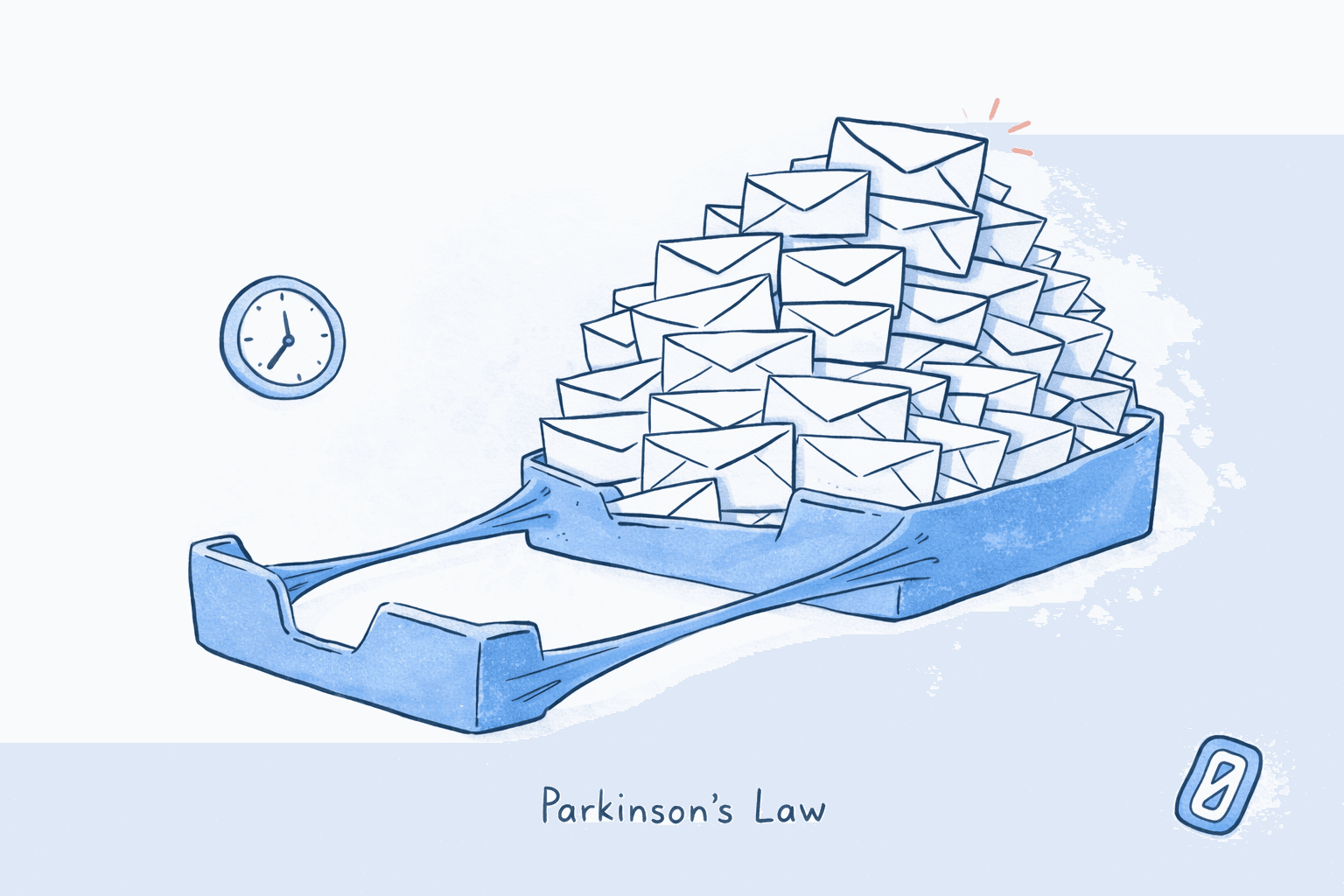
The Asymmetry Problem: Why Sending Email Is Free But Reading It Costs Everything
By Chris Stefaner, Co-founder of Swizero
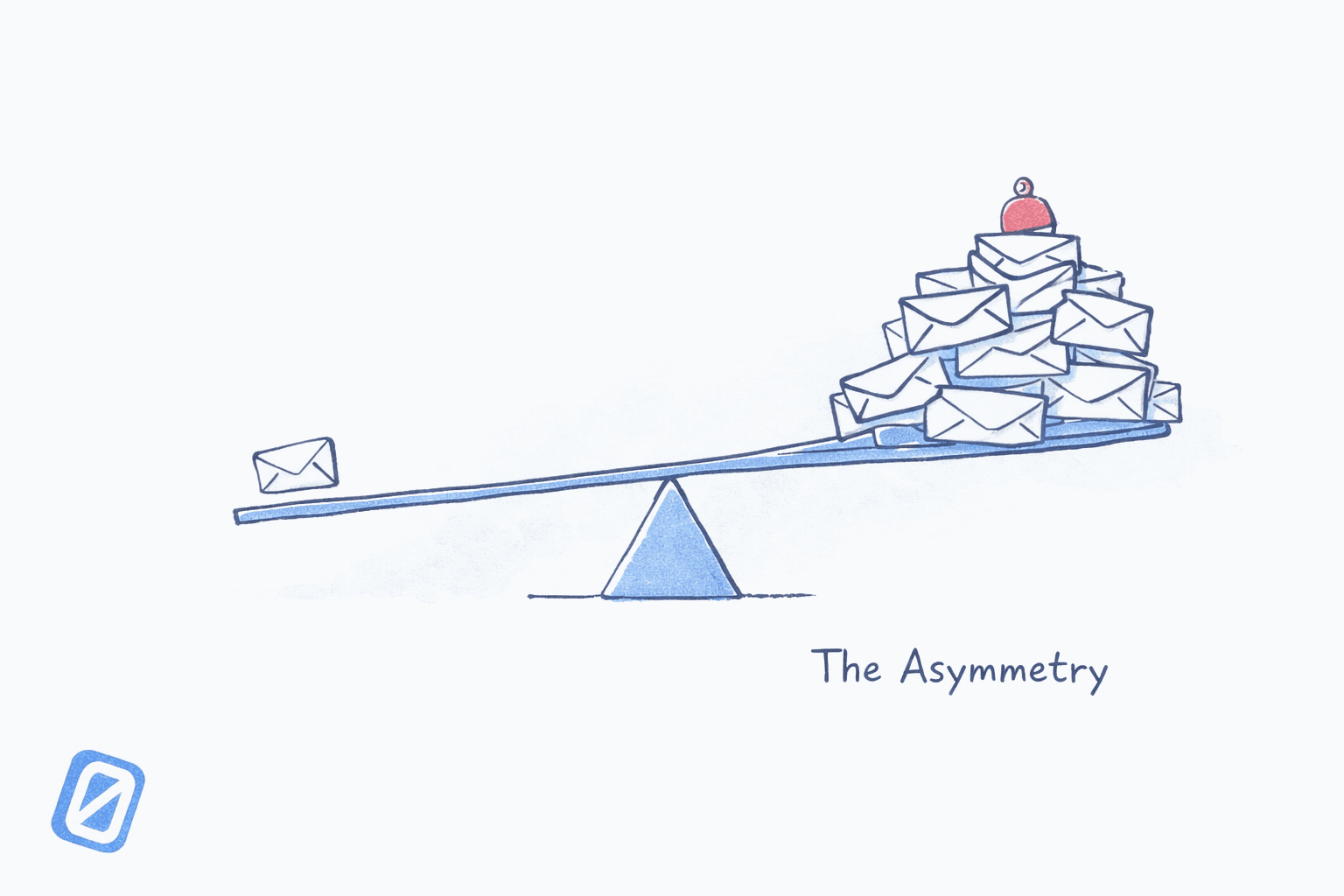
Email has a design flaw that no app, filter, or AI assistant has fixed, because almost nobody talks about it correctly. The problem is not volume. The problem is asymmetry: sending an email costs the sender virtually nothing, but processing that same email costs the recipient their most finite resource, focused attention. This imbalance is not a bug in email culture. It is baked into the protocol itself, and it explains why your inbox feels like a losing game no matter how disciplined you are.
Economists have a name for this kind of failure. When one party’s action imposes costs on another party without compensation, that is a negative externality. Pollution is the classic example. Email is the digital equivalent: every message sent externalizes a cognitive cost onto the recipient, and the sender never pays for it.
This is the argument most email productivity advice ignores entirely. Tips about batching, filtering, and two-minute rules treat the symptoms. The asymmetry problem is the disease. And until you see email through this lens, you will keep optimizing around a system that is structurally rigged against the reader.
Key Takeaway
Email’s core dysfunction is economic, not behavioral. Sending a message costs near zero, but each received email imposes an average 23-minute attention recovery cost on the recipient. This 100:1 externality ratio makes email the most lopsided cost structure in modern knowledge work, and it is the fundamental reason inbox overload exists.
What Does “Email Asymmetry” Actually Mean?#
Email asymmetry refers to the radical gap between what it costs to send a message and what it costs to process one. For the sender, email is essentially free: no stamp, no fee, no throttle. Typing a few sentences and hitting send takes under a minute. But for the recipient, each email triggers a cascade of hidden costs: the time to read it, the cognitive effort to evaluate it, the decision fatigue of choosing what to do with it, and the recovery time needed to return to whatever you were doing before.
This is not a theoretical problem. Gloria Mark, Professor of Informatics at UC Irvine and author of Attention Span, has measured the concrete cost of each interruption. Her research team tracked knowledge workers and found that it takes an average of 23 minutes and 15 seconds to fully refocus on a task after an interruption. Not 23 seconds. Twenty-three minutes.
Now multiply that recovery cost across the 121 emails the average knowledge worker receives each day. Even if only a fraction of those emails break your focus, the aggregate attention cost is staggering. The sender spent one minute. You lost the better part of an hour.
The Externality Ratio: Email vs. Pollution#
Justin Rao and David Reiley, researchers at Microsoft and Google respectively, formalized this intuition in their 2012 paper The Economics of Spam, published in the Journal of Economic Perspectives. They calculated that the external costs imposed by spam on American firms and consumers reach approximately $20 billion annually, while spammers and the merchants they advertise for collect roughly $200 million in revenue. That yields an externality ratio of about 100:1.
To put that in context, Rao and Reiley compared email spam to other activities with well-known negative externalities. The externality ratio for automobile pollution is approximately 0.1 to 0.3. For property crime, the ratio is between 7 and 30. Spam email, at 100:1, is among the most lopsided externalities ever measured in economic literature.
Here is the part that should unsettle you: this ratio was calculated for spam. Legitimate workplace email shares the same structural asymmetry. The sender bears near-zero cost. The recipient bears all of it. The ratio is smaller for non-spam messages, but the imbalance is identical in direction. Every time someone hits “Reply All” to say “Thanks!” or CCs you on a thread for visibility, they are externalizing their convenience onto your attention budget.
Externality Ratios: Email vs. Other Negative Externalities
Source: Rao & Reiley, Journal of Economic Perspectives, 2012
Why Does This Asymmetry Exist?#
The answer is surprisingly simple. Benjamin Hermalin and Michael Katz, economists at UC Berkeley, explored this question in their influential 2004 paper Sender or Receiver: Who Should Pay to Exchange an Electronic Message? published in the RAND Journal of Economics. Their finding: because email infrastructure charges the sender nothing beyond their existing internet connection, there is no price signal to regulate message volume. The marginal cost of sending one more email is effectively zero.
In any market where the marginal cost of production is zero but the marginal cost of consumption is significant, you get overproduction. Economists call this a tragedy of the commons. The shared resource being depleted is not bandwidth or server space. It is human attention.
Cal Newport, Professor of Computer Science at Georgetown and author of A World Without Email, has written extensively about how this zero-cost structure distorts workplace communication. “Because email has zero marginal cost,” Newport argues, “people will dash things off at the slightest whim.” He points to a deeper design implication: “You need to make the cost higher for the person about to commandeer attention than it is for the people whose attention is commandeered. These asymmetries are very good at regulating systems.”
Newport is describing, in plain language, what economists call a Pigouvian correction: adding cost where externalities exist, so that private incentives align with social costs. The problem is that nobody has built this correction into email.
I should be honest here: the Pigouvian framework is a simplification. Email is not pure pollution. Many messages genuinely benefit the recipient. The asymmetry problem is not that email should cost money to send. The problem is that the current cost structure provides zero feedback to senders about the attention burden they impose. And without that feedback, volume will always trend upward.
How Much Does Each Email Actually Cost the Recipient?#
Here is where the numbers get concrete. Basex, a research firm specializing in knowledge worker productivity, estimated in a 2008 study that information overload costs the U.S. economy $900 billion per year in lowered productivity and reduced innovation. Nathan Zeldes, a principal engineer at Intel who chaired the Information Overload Research Group, found that Intel’s own knowledge workers were losing approximately eight hours per week to information overload, costing the company an estimated $1 billion annually.
Intel’s internal data revealed that the average employee received 50 to 100 emails daily, with 30% of those emails deemed unnecessary. Top executives reported receiving up to 300 messages per day. The company was processing 3 million emails daily as an organization.
More recent workplace research puts the per-email cost in sharper focus. When you factor in reading time, evaluation time, context-switching costs, and recovery time, each unnecessary email costs an organization approximately $1 in lost productivity. That figure sounds small until you realize that 76% of received emails require no action from the recipient, according to 2025 workplace data. For a 100-person company receiving the average 121 emails per person per day, that means roughly 9,200 unnecessary emails landing across the organization every single workday.
| Cost Component | Time Per Email | Annual Cost (per worker) |
|---|---|---|
| Reading and evaluating | 30-60 seconds | ~110 hours |
| Context switching | 1 min 25 sec to re-engage | ~170 hours |
| Full recovery to deep focus | Up to 23 min 15 sec | Incalculable |
| Decision: reply, file, or delete | 10-30 seconds | ~60 hours |
| Total email time per week | - | ~11.7 hours |
Sources: Gloria Mark, UC Irvine (2023); Basex (2009); Readless workplace analysis (2026)
If the attention cost of every received email resonates, Swizero addresses the asymmetry by capping your inbox to a handful of cards. Instead of processing 121 emails, you process the ones that actually matter.
Why Haven’t We Fixed This?#
The short answer: fixing email asymmetry requires making sending harder, and nobody wants to be the one to do that.
There have been attempts. In the early 2000s, several economists proposed “attention bonds,” essentially micropayments attached to emails that the recipient could claim. The idea was elegant in theory: senders would self-regulate because each message would carry a real cost. But the proposal died on implementation. Nobody could agree on the payment infrastructure, and users balked at the complexity.
More recently, some individuals have tried building their own friction. Cal Newport describes a computer programmer who replaced his email address with a web form requiring senders to describe their purpose in structured text boxes. The result was remarkable: incoming message volume dropped by a factor of 40. The extra effort was minimal for the sender, just a few minutes of form-filling, but it was enough to eliminate the casual, low-thought messages that constitute most email volume.
This is a revealing experiment. It proves that the asymmetry problem is not about bad actors or spam. It is about the absence of friction in legitimate communication. When you add even a small cost to the sender side of the equation, message volume plummets because most messages were not important enough to justify the effort.
The email industry has not adopted this approach because their business model depends on volume. More emails mean more engagement, more data, more opportunities to upsell premium features. I could write a whole post about the perverse incentives of email platforms, but the core point is this: the platforms that host your inbox profit from the asymmetry. They have no incentive to fix it.
What Does a Structural Fix Look Like?#
Most email advice operates within the asymmetry. Batching, filtering, triage systems, unsubscribing: these are all strategies for managing a system that structurally overproduces messages at the recipient’s expense. They work to a degree. But they cannot solve the underlying problem because they leave the sender’s cost at zero.
A structural fix changes the equation. It creates boundaries that constrain how much of the sender’s cost gets externalized onto the recipient.
This is why Swizero’s approach begins with a fixed card limit rather than a smarter filter. Filters and AI sorting tools help you process more email faster, but they do not change the fundamental asymmetry. They make you a more efficient absorber of other people’s externalities. A card limit, by contrast, creates a hard boundary. The AI decides which emails clear the bar, and everything else waits. The recipient’s attention is no longer an unlimited commons that any sender can dump into. It becomes a protected, finite resource.
This framing is not just philosophy. It is the same logic that environmental regulation uses to address pollution externalities. You do not solve air pollution by giving everyone better gas masks. You cap emissions at the source or, at minimum, you limit how much pollution any individual has to absorb. The email finish line applies the same principle to attention.
Is the Asymmetry Getting Worse?#
Yes, and the trajectory is clear. According to the Radicati Group’s 2023-2027 forecast, global daily email volume will reach 376 billion messages by 2026, up from 306 billion in 2020. That is a 23% increase in six years. Meanwhile, human attention capacity has not grown at all. Gloria Mark’s research shows that average sustained attention on a single screen has actually declined, from two and a half minutes in 2004 to just 47 seconds today.
So the asymmetry is compounding: more messages hitting recipients whose attention spans are shrinking. The gap between sender cost and recipient cost grows wider every year. AI-generated email will likely accelerate this trend further, as tools that make composing emails even faster will reduce sender effort to near zero while doing nothing to reduce the recipient’s processing burden.
One caveat worth noting: these trend lines are approximate and derived from different research methodologies. The email volume figures track workplace averages, while attention span measurements come from screen-focus studies. The directional story is robust, but the exact magnitudes should be read as indicative rather than precise.
Frequently Asked Questions#
Why is email free to send but costly to receive?#
Email was designed as a decentralized, open protocol with no built-in cost mechanism for sending messages. Unlike postal mail, which requires a stamp, or phone calls, which historically charged per minute, email’s infrastructure costs are borne by internet service providers and absorbed into flat-rate subscriptions. The recipient, meanwhile, pays in attention, time, and cognitive load. This cost structure creates a negative externality where senders face no price signal to limit message volume.
What is the real productivity cost of email overload?#
Basex estimated that information overload costs the U.S. economy $900 billion per year in reduced productivity and innovation. At the individual level, knowledge workers spend approximately 28% of their workweek on email, roughly 11.7 hours. Each interruption carries a recovery cost of up to 23 minutes, according to research from Gloria Mark at UC Irvine. For a mid-sized company, unnecessary emails alone can cost tens of thousands of dollars annually in lost productivity.
Could charging for email solve the asymmetry problem?#
Economists have explored this idea since the early 2000s. Hermalin and Katz’s 2004 RAND Journal paper analyzed optimal pricing for electronic messages and found that efficient pricing requires consideration of both sender and receiver costs. “Attention bonds,” small micropayments attached to emails, have been proposed but never implemented at scale due to infrastructure and adoption barriers. The more practical approach involves adding structural friction, such as web forms, message caps, or AI-powered prioritization, rather than direct monetary charges.
How does email asymmetry compare to spam?#
Spam is the extreme case of email asymmetry, with an externality ratio of approximately 100:1 according to Rao and Reiley’s 2012 research. Legitimate workplace email shares the same structural imbalance in a less dramatic form. The key insight is that even non-spam email externalizes attention and cognitive costs onto recipients without compensation. Reply-all messages, unnecessary CCs, and low-priority FYI emails all exploit the same zero-cost sending structure that makes spam economically viable.
Sources#
- The Economics of Spam - Justin M. Rao & David H. Reiley, Journal of Economic Perspectives, 2012. Externality ratio of spam estimated at 100:1.
- Sender or Receiver: Who Should Pay to Exchange an Electronic Message? - Benjamin E. Hermalin & Michael L. Katz, RAND Journal of Economics, 2004. Optimal pricing analysis for electronic messages.
- Attention Span: A Groundbreaking Way to Restore Balance, Happiness and Productivity - Gloria Mark, UC Irvine, 2023. Average refocus time of 23 minutes 15 seconds after interruption; attention span decline from 2.5 minutes to 47 seconds.
- Information Overload Now $900 Billion Cost to U.S. Economy - Basex, 2008. U.S. economic cost of information overload.
- Intel’s War on Information Overload: A Case Study - Basex, 2009. Intel knowledge workers losing 8 hours/week; $1 billion annual cost.
- To Make Email Easier We Must Make It Harder - Cal Newport, 2021. Zero marginal cost of email and sender-friction experiments.
- Radicati Email Statistics Report, 2023-2027 - Radicati Group. Global email volume projections reaching 376 billion daily messages by 2026.
Your inbox doesn't have to feel like this.
Be among the first to experience a finished inbox.
Join the finite inbox beta