How Email Affects Your Sleep: The Zeigarnik Effect and Your Inbox
By Chris Stefaner, Co-founder of Swizero
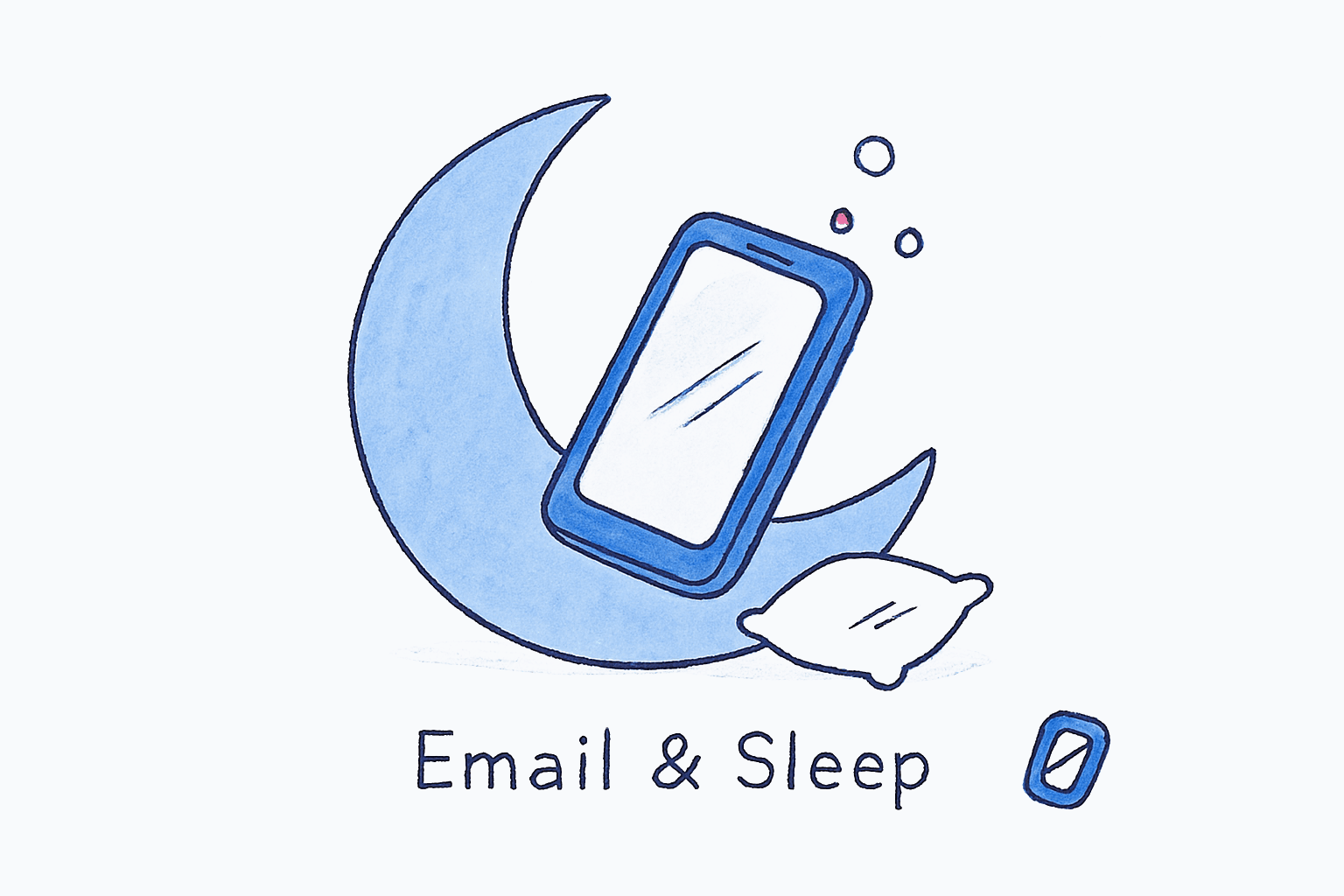
You’re lying in bed. The lights are off. Your partner is already asleep. You tell yourself you’re just going to glance at your inbox, thirty seconds tops. One subject line catches your eye: a client asking to “revisit the timeline.” Another: your boss forwarding a thread with “thoughts?” and nothing else. Now your jaw is tight. You’re composing a reply in your head. Twenty minutes later you’re still staring at the ceiling, running scenarios for a meeting that doesn’t happen until Thursday.
That thirty-second glance just cost you an hour of sleep. Understanding how email affects sleep requires looking at the damage, which goes deeper than you think.
Here’s a claim I’ll defend throughout this piece: checking email before bed is not a bad habit; it’s a neurological ambush. It attacks your sleep through three simultaneous pathways that no amount of willpower can override. The email industry doesn’t talk about this because their entire model depends on you staying connected around the clock. But the neuroscience is unambiguous, and it points toward a solution most productivity advice ignores: you need a finish line for email, not a dimmer switch.
Key Takeaway
Email before bed disrupts sleep through three compounding mechanisms: blue light suppresses melatonin production, work-related content triggers cortisol release, and unanswered messages create open cognitive loops (the Zeigarnik effect) that prevent your brain from downshifting into sleep mode. Research shows that session-based email, processing everything at a set time and then stopping, neutralizes all three pathways by giving your brain a clear “done” signal hours before bed.
Why Does Email Before Bed Damage Sleep More Than Other Screen Time?#
Email before bed sleep disruption is worse than scrolling social media or watching a show, and not for the reason most people assume. The standard explanation focuses on blue light, and blue light does matter. But the deeper problem is that email is cognitively activating in a way that passive screen use is not.
Dr. Matthew Walker, Professor of Neuroscience and Psychology at UC Berkeley and author of Why We Sleep, has described the last sixty minutes before bed as a transition zone he calls the “power down hour.” The final twenty minutes should involve activities requiring almost no cognitive load and zero emotional arousal. Work email violates both conditions simultaneously. Every message is a micro-decision: respond now? Flag it? Ignore it and feel guilty?
Walker has recently clarified that he’s “down-regulated” his belief in blue light as the primary sleep disruptor. The bigger issue, he now argues, is that devices activate us; they mask our sleepiness so we go to bed later. Email is the most activating thing you can do on a screen because it forces decision-making and emotional processing in real time.
Honestly, I found Walker’s evolution on this point refreshing. The blue-light-as-villain narrative is simple and satisfying, but it lets the real culprit (cognitive arousal) off the hook.
The Three-Pathway Attack: How Email Affects Sleep by Hijacking Your Night#
What makes email before bed uniquely destructive is that it doesn’t attack your sleep through one mechanism; it hits you through three at once, and they compound each other.
Pathway 1: Blue Light and Melatonin Suppression#
A landmark 2014 study published in PNAS by Anne-Marie Chang, Daniel Aeschbach, Jeanne F. Duffy, and Dr. Charles Czeisler (Baldino Professor of Sleep Medicine at Harvard Medical School and Director of the Division of Sleep Medicine at Brigham and Women’s Hospital) found that participants who read on a light-emitting device for four hours before bed took longer to fall asleep, had reduced melatonin secretion, experienced a delayed circadian clock by more than one hour, and reported reduced next-morning alertness compared to those who read printed books.
Dr. Czeisler’s broader research at Harvard has shown that blue light suppresses melatonin for about twice as long as green light of comparable brightness and shifts circadian rhythms by twice as much: three hours versus one and a half hours. Your phone screen, radiating at precisely the wavelength your circadian system is most sensitive to, is sending a biological signal that says “it’s midday” while the clock on your nightstand reads 11:47 PM.
Pathway 2: Cortisol Activation from Work Content#
Blue light is the part everyone talks about. Cortisol is the part that actually ruins your night.
When you read an email that requires a decision, triggers anxiety, or creates uncertainty, your hypothalamic-pituitary-adrenal (HPA) axis responds with a cortisol release. Cortisol is an alertness hormone; it’s supposed to peak in the morning and decline throughout the day. A 2024 study in SLEEP by researchers using daily salivary cortisol sampling found that higher presleep cortisol predicted shorter total sleep time, lower sleep efficiency, and longer sleep onset latency that night. The relationship was bidirectional: poor sleep then flattened the next day’s cortisol slope, creating a cycle that worsened over days.
One email from a difficult client at 10 PM can spike your cortisol at exactly the hour it should be at its daily nadir. Your body then has to fight its own stress chemistry to fall asleep.
Pathway 3: The Zeigarnik Effect; Open Loops That Won’t Close#
This is the pathway that makes email uniquely worse than other screen activities. In the 1920s, psychologist Bluma Zeigarnik discovered that people remember incomplete tasks far better than completed ones: the brain essentially keeps an open cognitive loop running until the task is resolved. Every unanswered email is an open loop. Every “I’ll deal with this tomorrow” is a thread your brain refuses to release.
A 2017 study by Syrek, Weigelt, Peifer, and Antoni published in the Journal of Occupational Health Psychology confirmed this mechanism with real-world data. Tracking 59 employees over 12 weeks, they found that unfinished tasks at the end of the workweek significantly impaired weekend sleep quality through what they termed “affective rumination.” The relationship was dose-dependent: more unfinished tasks meant worse sleep, and the effect persisted across months.
Checking email before bed is essentially manufacturing new open loops at the worst possible time. Each unanswered message becomes another cognitive thread your brain will try to process while you’re attempting to sleep.
What Does the Research Say About Screens and Sleep Onset?#
Screens before bed measurably delay when you fall asleep, but the size of the effect depends on what you’re doing on the screen. A 2024 cross-sectional study published in JAMA Network Open analyzing electronic screen use and sleep timing in adults found that increased screen time in the hour of and after bedtime was associated with greater sleep onset latency and shorter total sleep duration. Smartphone use specifically was associated with a sleep latency greater than 30 minutes (OR 1.98, 95% CI: 1.51-2.60).
The National Sleep Foundation’s 2024 consensus statement, published in Sleep Health, concluded that “greater use of screen-based digital media, particularly around bedtime, is consistently associated with negative sleep health outcomes across the lifespan.” Their polling found that 58% of Americans look at screens within an hour of bedtime.
But here’s what those aggregate numbers miss: not all screen activities are equal. Passive consumption (watching a familiar show, reading fiction) generates far less cognitive arousal than interactive, decision-requiring activities like email. The problem isn’t the photons. It’s the demands.
If the open-loop problem resonates, Swizero is built around closing every loop in a single session. You do your Swizero Run (a fixed set of cards, swiped to completion) and your inbox is genuinely done. No lingering threads. No “I should check one more time.” The Zeigarnik effect needs open loops to function. Remove the open loops, and your brain can actually let go.
Why Can’t You Just “Stop Checking” Before Bed?#
Because the problem is structural, not behavioral. Every email app on your phone is designed to be always-on, always showing a badge count of unprocessed messages. The unread count is the open loop. Telling someone to stop checking is like telling them to stop thinking about a white bear.
Professor Russell Foster, Head of the Sleep and Circadian Neuroscience Institute at the University of Oxford and author of Life Time: Your Body Clock and Its Essential Roles in Good Health and Sleep, has noted that the real problem with screens before bed is their stimulating effects, not purely the light. Foster cautions that “many recommendations we hear today are largely, if not exclusively, based on laboratory studies”; in the real world, behavioral activation from devices matters as much or more than photobiology.
Blue-light-blocking glasses aren’t enough. Night mode isn’t enough. The content you’re consuming before bed, and whether it creates unresolved cognitive demands, is what determines whether your sleep is protected or sabotaged.
What Actually Works: The Session-Based Alternative#
The research points to a surprisingly simple structural fix: finish your email at a set time, and make “finished” mean actually finished, not “I stopped checking but my inbox still has 47 unread messages.”
A 2018 study at Baylor University, published in the Journal of Experimental Psychology, found that participants who spent five minutes writing a specific to-do list before bed fell asleep nine minutes faster than those who journaled about completed tasks, in about 16 minutes versus 25. The more specific the list, the faster the sleep onset. The researchers concluded that offloading incomplete tasks (closing the cognitive loops) released the brain from its Zeigarnik-driven vigilance.
Arianna Huffington, founder of Thrive Global and author of The Sleep Revolution, has advocated for a structural version of this insight. Huffington recommends picking a time each night to “turn off all your devices and gently escort them out of your bedroom.” Not silence them. Not flip to Do Not Disturb. Physically remove them.
“I have a specific time at night when I regularly turn off my devices; and gently escort them out of my bedroom. Our phones are repositories of everything we need to put away to allow us to sleep.”
Arianna Huffington, founder of Thrive Global, author of The Sleep Revolution
The “gentle escort” sounds soft, but the principle is hard-edged: you need a structural barrier between your work communication and your sleep environment. Willpower is not a barrier. A policy is not a barrier. A system that gives you a clear endpoint is.
This is what the session-based email model is designed to do. Instead of an inbox that’s always partially processed and perpetually nagging, you do one Swizero Run at a set time; say, 5 PM. You process a fixed number of cards. You swipe left to clear, down to archive, right to flag, up to reply. When the cards are done, email is done. Not “paused.” Done. The distinction matters neurologically: your brain can release the open loops because there are no open loops left.
I could write a whole post about why the concept of “inbox zero” fails where session-based processing succeeds; inbox zero is an aspirational state you’re always falling short of, while a fixed card limit is a completion event your brain can register and release.
The Economic Cost of Sleep You’re Losing to Email#
A 2016 RAND Europe study (Why Sleep Matters: The Economic Costs of Insufficient Sleep) estimated that sleep deprivation costs the U.S. economy up to $411 billion annually, equivalent to 2.28% of GDP. Workers sleeping fewer than six hours a night had a 13% higher mortality risk. The Sleep Foundation reports that sleepy employees are 70% more likely to be involved in a workplace accident.
The irony is almost too clean: you check email at 11 PM because you’re worried about falling behind at work, and the resulting sleep loss makes you worse at work the next day. It’s a trap disguised as diligence. Breaking the cycle requires recognizing that protecting your sleep is protecting your productivity, which means email needs a hard stop, not a soft fade. (For more on the mental health impact, see our piece on email and mental health.)
“The shorter your sleep, the shorter your life. The leading causes of disease and death in developed nations; diseases that are crippling health-care systems, such as heart disease, obesity, dementia, diabetes, and cancer; all have recognized causal links to a lack of sleep.”
Matthew Walker, Professor of Neuroscience and Psychology, UC Berkeley, author of Why We Sleep
Frequently Asked Questions#
How long before bed should I stop checking email?#
Sleep researchers generally recommend at least 60 minutes of screen-free wind-down time before bed. Matthew Walker’s “power down hour” concept suggests dimming lights and disconnecting from all cognitively stimulating activities in the final hour. However, the Zeigarnik effect research suggests the real variable is not timing but completion: if you finish processing your email at 5 PM and have no open loops, the time buffer matters less. If you glance at new messages at 9 PM and create fresh open loops, even two hours may not be enough for your brain to let go.
Do blue-light-blocking glasses help with email before bed?#
They address only one of the three pathways. Blue-light filters may reduce melatonin suppression, but they do nothing about cortisol activation from stressful email content or the Zeigarnik effect from unanswered messages. The Chang et al. 2014 study in PNAS found measurable melatonin changes from light-emitting screens, but both Walker and Foster have emphasized that cognitive arousal (not photobiology alone) is the primary driver of screen-related sleep disruption.
Is checking personal email before bed as bad as work email?#
Probably not, but it depends on the content. The Syrek et al. 2017 study specifically measured the effect of unfinished work tasks on sleep quality through affective rumination. Personal email that requires no action (a friend’s vacation photos, a shipping notification) is unlikely to trigger the same cortisol or Zeigarnik responses. Personal email that creates obligations or stress (a difficult family thread, a billing dispute) likely carries similar risks.
Can writing a to-do list before bed replace stopping email earlier?#
The Baylor University 2018 study found that writing a specific to-do list for five minutes before bed helped participants fall asleep nine minutes faster. This works by externalizing open loops, giving your brain permission to release unfinished tasks. It is a useful backup strategy, but it treats the symptom rather than the cause. Session-based email processing eliminates the open loops upstream, so there is nothing left to offload at bedtime.
Sources#
- Evening use of light-emitting eReaders negatively affects sleep, circadian timing, and next-morning alertness. Chang, Aeschbach, Duffy, Czeisler, PNAS, 2014. iPad readers had delayed circadian rhythm by more than one hour and reduced next-morning alertness.
- Blue light has a dark side. Harvard Health Publishing. Blue light suppresses melatonin for twice as long as green light.
- Zeigarnik’s Sleepless Nights: How Unfinished Tasks at the End of the Week Impair Employee Sleep on the Weekend Through Rumination. Syrek, Weigelt, Peifer, Antoni, Journal of Occupational Health Psychology, 2017. Unfinished tasks impaired weekend sleep through affective rumination across 12 weeks.
- The Effects of Bedtime Writing on Difficulty Falling Asleep: A Polysomnographic Study. Scullin et al., Baylor University, Journal of Experimental Psychology, 2018. To-do list writers fell asleep nine minutes faster.
- Why Sleep Matters; The Economic Costs of Insufficient Sleep. RAND Europe, 2016. Sleep deprivation costs the U.S. economy up to $411 billion annually.
- Electronic Screen Use and Sleep Duration and Timing in Adults. JAMA Network Open, 2024. Smartphone use associated with sleep latency >30 minutes.
- Daily associations between salivary cortisol and EEG-assessed sleep. SLEEP, 2024. Higher presleep cortisol predicted shorter total sleep time and lower sleep efficiency.
- The impact of screen use on sleep health across the lifespan. National Sleep Foundation consensus statement, Sleep Health, 2024. Screen use before bed consistently associated with negative sleep outcomes.
- Poor Sleep Linked to $44 Billion in Lost Productivity. Gallup, 2022. Workers with poor sleep quality report higher unplanned absenteeism.
- Screen Use Disrupts Precious Sleep Time. National Sleep Foundation, 2022. 58% of Americans look at screens within an hour of bedtime.
- Life Time: Your Body Clock and Its Essential Roles in Good Health and Sleep. Russell Foster, Oxford University Press, 2022. Behavioral activation from devices matters as much as photobiology.
- The Sleep Revolution: Transforming Your Life, One Night at a Time. Arianna Huffington, 2016. Devices should be physically removed from bedrooms before sleep.
- Sleep and Job Performance. Sleep Foundation, 2025. Sleepy employees are 70% more likely to be involved in a workplace accident.
Your inbox doesn't have to feel like this.
Email with a beginning, middle, and end.
Make email a bounded session