Email vs Slack: When Async Beats Real-Time
By Chris Stefaner, Co-founder of Swizero
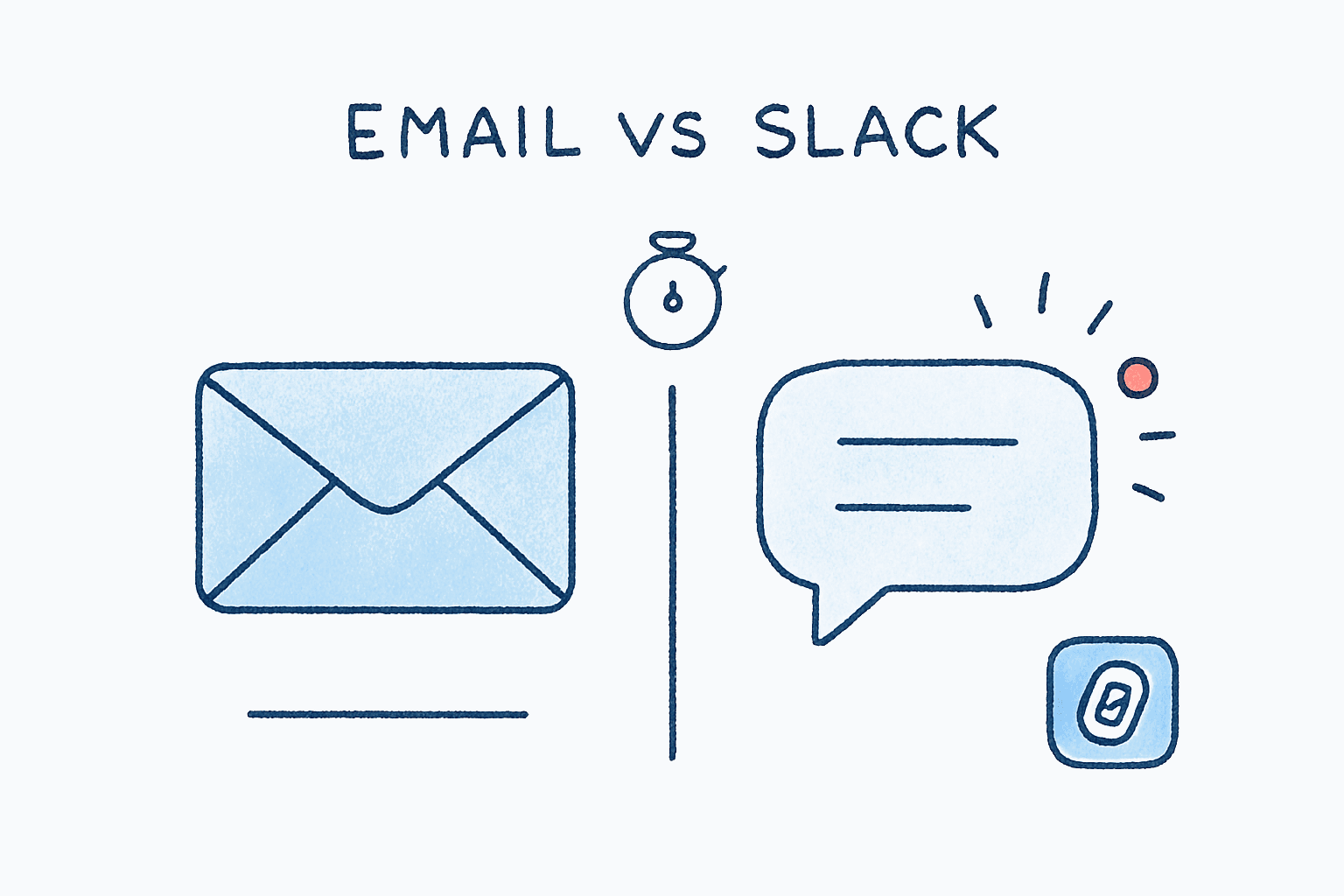
The email vs Slack debate that runs on LinkedIn is misleading. “Slack killed email.” “Email is still here.” The framing assumes you have to pick one. Almost no one picks one. According to Microsoft’s 2025 Work Trend Index, the average knowledge worker now processes 117 emails and 153 Teams messages every day; and gets pinged by something every two minutes during core hours, 275 times a day.
That is the real story. The proliferation of chat tools didn’t replace email. It stacked on top of it, compounding the email overload problem. And the stack; not either channel on its own; is what makes a modern inbox feel impossible.
Key Takeaway
Async beats real-time when a message can wait 4+ hours, requires considered thought, or needs a durable record. Real-time wins when latency genuinely costs money or a decision is blocked. The overwhelm most people blame on email is actually the cost of running both channels simultaneously without rules.
Email has no finish line, and Slack has no edges. Run them together, untriaged, and you get a workday with no surface area left for actual work. The fix isn’t switching tools; it’s deliberate channel choice. This post lays out when async (email) genuinely beats synchronous chat, the research on what mixing channels actually costs, and a simple decision rule you can apply tomorrow morning.
Contents#
- Email vs Slack: The Myth That Slack Replaced Email
- What Does Mixing Channels Actually Cost?
- When Is Async Email Genuinely Better Than Slack?
- The Deliberate Channel Choice Framework
- Why Both Channels Need a Finish Line
- Frequently Asked Questions
- Sources
Email vs Slack: The Myth That Slack Replaced Email#
Slack’s pitch in 2014 was that it would “kill email.” A decade later, the platform has 47 million daily active users sending around 92 messages each, checking the app 13 times a day, and remaining signed in for an average of nine hours per workday. By the platform’s own numbers, that’s 1 hour and 42 minutes of active engagement; not background presence.
Email did not collapse to fill the gap. Global email volume keeps climbing. What actually happened is that real-time messaging was layered onto a still-growing email channel, and most companies adopted both without ever defining what each was for.
The result is a strange kind of double-counting. A project update lands in #project-foo. The same update goes to a stakeholder by email. A follow-up question hits Slack DMs because it’s faster. The thread eventually moves to email when a decision needs to be documented. By the end, four people have read the same information four times across three surfaces, and nobody can find the canonical version.
The pitch was never that Slack would kill email. It was that real-time chat would absorb the informal tier of work communication. Instead, it absorbed everything; and then email kept its old volume too.
What Does Mixing Channels Actually Cost?#
Mixing channels costs roughly 9.5 minutes of refocus time per switch, repeated dozens of times a day. A study by Qatalog and Cornell University, reported by Asana, found that the average worker takes 9 minutes and 30 seconds to get back into productive workflow after toggling to a different digital application. Asana’s own Anatomy of Work Index puts the average knowledge worker at 10 apps per day with 25 switches between them.
The math is unforgiving. Twenty-five switches at 9.5 minutes of recovery each is roughly four hours of fragmented re-engagement per day; assuming you ever fully recover, which Gloria Mark’s research suggests you usually don’t.
Mark, a Professor of Informatics at UC Irvine and author of Attention Span, has shown that workers switch tasks every three minutes on average and need 23 minutes and 15 seconds to fully refocus after a meaningful interruption. Her 2019 thermal imaging study added a more visceral finding: 70% of emails are opened within six seconds of arrival, and it takes a median of 64 seconds just to resume the original task afterward; physiological stress markers spike for far longer.
Cal Newport, the Georgetown computer science professor and author of Deep Work, made the structural argument plainly in his 2020 New Yorker essay Slack Is the Right Tool for the Wrong Way to Work. Citing RescueTime telemetry, he noted that the average Slack user goes only five minutes between checks of a communication channel. Newport’s claim isn’t that chat is bad; it’s that ambient real-time chat trains the brain to never settle, and that the cost compounds across teams.
A 2022 Harris Poll found managers estimating their teams lose 7.47 hours per employee per week; nearly a full workday; to poor communication, at a cost of roughly $12,506 per employee per year. The losses do not break down by channel because the channels can’t be separated; the cost is the interaction between them.
Honestly, the part that surprised me when I went looking for the data was how rarely anyone studies email and chat together. Almost every paper isolates one channel. The lived experience is the opposite; nobody experiences “email stress” in a vacuum anymore.
If running both channels at once has turned your inbox into a graveyard of half-read threads, Swizero caps your email at a handful of cards per session. The chat platforms can stay live; email becomes the calm channel again; finite, scannable, finished in one pass.
When Is Async Email Genuinely Better Than Slack?#
Async email is genuinely better than Slack any time the message benefits from delay. That’s a deliberately broad rule, because most messages do; and most people default to chat anyway, on the assumption that “fast” equals “better.”
Three categories where email reliably wins:
Considered decisions. A draft proposal, a contract revision, a strategy memo. These improve when the recipient has time to read, draft, and revise. A 2025 analysis from Worklytics found that teams heavily dependent on synchronous tools like Slack had measurably less uninterrupted Focus Time than teams with async-first workflows; the productivity boost from “instant” replies came at the cost of the depth of the replies themselves.
Durable records. Anything that needs to be searchable in six months. Slack search is fine inside the platform; nobody who hasn’t already joined the channel will ever find a decision archived there. Email threads, for all their flaws, leave a forwardable, attachable, legally-discoverable record by default.
Cross-organization communication. Vendors, clients, candidates, regulators, journalists. Slack Connect exists, but it adds platform fragmentation for the recipient; which is the wrong cost to externalize. Email is the universal protocol. It will outlive every chat tool.
Real-time chat earns its place in narrower territory: blocking decisions, time-sensitive coordination during a live event, social presence in a remote team. Sophie Leroy, a professor at the University of Washington whose “attention residue” research underpins much of the modern context-switching literature, has framed the trade-off cleanly: every shift between unfinished tasks leaves a cognitive trace that degrades performance on the next task. The implication isn’t that chat is forbidden; it’s that you pay for it whether you notice or not.
| Channel choice | Best for | Worst for | Latency expectation |
|---|---|---|---|
| Considered replies, decisions, external comms, durable records | Live coordination, social presence | Hours to a day | |
| Slack/Teams chat | Quick coordination, live questions, team rapport | Decisions that need a paper trail, deep work signals | Minutes |
| Scheduled call | High-context discussions, sensitive feedback | Status updates, simple questions | Synchronous |
| DM during deep work | Almost nothing | Almost everything | N/A; don’t |
Source: synthesized from Newport (2020), Mark (2019, 2024), Worklytics (2025).
The Deliberate Channel Choice Framework#
Deliberate channel choice means deciding the medium before you start composing the message; not after. It’s a five-second test, not a productivity system.
Ask three questions of any message you’re about to send:
- Will this matter in a week? If yes, email. Slack messages decay; channels rotate; threads vanish under newer threads. Anything that needs to survive belongs in email.
- Does the recipient need to think before replying? If yes, email. Real-time chat creates pressure to reply quickly with whatever comes to mind first. That’s fine for “lunch?” It’s terrible for “should we change our pricing?”
- Is the actual cost of a 4-hour delay greater than zero? If no, email. Most messages; including ones we send via chat reflexively; could wait four hours with no measurable cost. The reason we send them via chat is psychological: it makes us feel responsive. The recipient doesn’t experience it that way; they experience it as another ping.
If you adopt this as a personal rule, you’ll roughly halve your chat output in a week. If your team adopts it, you’ll halve everyone’s. The reason chat volume feels overwhelming isn’t that any individual message was wrong to send; it’s that the aggregate of casually-routed messages exceeds anyone’s processing capacity.
This connects to a broader pattern we’ve covered before: the psychology of an inbox that has no finish line is not exclusive to email. Slack inherits the same failure mode and amplifies it with sound and motion. The fix is the same in both places; boundaries the tool itself enforces; but most people only think of email as the broken channel because email is older and more emotionally loaded.
If you’ve followed our piece on the cognitive cost of constant email checking, you already know the case for batching. The same logic applies to chat, but with one twist: chat’s ambient presence makes batching feel transgressive. People expect you on Slack the way they don’t expect you on email. Naming that expectation; out loud, in a team norms doc; is half the work.
Why Both Channels Need a Finish Line#
Email is unbounded. Slack is unbounded. Mixing them produces something worse than either: a communication surface with no edges in any dimension. You can’t be done with your inbox if it’s three inboxes that interrupt each other.
The “finish line” framing matters here because it reveals what neither tool gives you by default. Email shows you 2,847 unread. Slack shows you a red dot that resets the moment a colleague types in #random. Both states are designed to keep you returning. Neither tool has any incentive to tell you “you’re done.”
Constraints are the answer. They have to come from somewhere; a personal rule, a team norm, an app like Swizero that caps your email session to a fixed card limit. The specific constraint matters less than the fact that one exists. A workday with edges produces better communication than a workday without them, on every channel, every time.
One caveat worth naming: this only works if your team agrees on it. A unilateral commitment to async email inside a team that runs on Slack DMs will make you look unresponsive, not focused. Channel choice is a team protocol before it’s an individual practice. If you’re going to make the case, make it as a norms conversation, not a unilateral defection.
The harder shift is psychological. Most people experience the ping of a new message as urgency. It almost never is. When you build the habit of asking “does this need to be real-time?” before every send and every check, the channels stop competing for your attention because you stopped granting either of them automatic priority. The communication stack didn’t change. Your relationship to it did.
So here’s the challenge; for the next week, before you send a single Slack DM, ask the three questions above. Most of those messages are going to migrate back to email. Notice how that feels for both you and the recipient. The data above suggests the answer will surprise you.
Frequently Asked Questions#
Why does Slack feel more overwhelming than email even though I get fewer messages?#
Slack feels more overwhelming because it sends ambient signals; sounds, badges, presence indicators; that train your brain to check it every few minutes. RescueTime data cited by Cal Newport shows the average Slack user goes only five minutes between checks. Email tolerates batching; chat tools are designed to resist it. The result is that 92 chat messages can feel heavier than 117 emails, even though the email count is larger.
Is it rude to reply to a Slack message hours later?#
It’s rude only if your team has agreed that Slack is the urgent channel. Most teams haven’t actually had that conversation; they’ve just adopted the assumption. If you respond to non-urgent Slack messages within the same business day, you’re being responsive by any reasonable professional standard. The implicit expectation that chat means “minutes” is a norm, not a rule.
When should I move a Slack thread to email?#
Move it the moment a decision is being made, a record needs to exist, or a non-channel-member needs visibility. Slack’s search and archival are fine for the people already inside a channel and useless for everyone else. If you can imagine someone six months from now needing to find this thread and not knowing which channel it lived in, it belonged in email from the start.
Does using both email and Slack actually slow people down?#
Yes; measurably. The Qatalog/Cornell study found a 9.5-minute average refocus time after toggling between digital tools, and Asana’s Anatomy of Work Index puts the average worker at 25 such switches per day. Worklytics’ 2025 analysis found that teams heavily dependent on synchronous tools had less Focus Time than async-first teams, even when their per-message response time was faster. The speed of any single reply is a poor proxy for productivity.
What’s the simplest rule for choosing between email and chat?#
If the message can wait four hours without cost, send email. If a 4-hour delay would block someone, change the outcome of a decision, or cost real money, send chat. Most messages can wait four hours. The reason we default to chat is that it makes the sender feel productive; not that it serves the recipient.
Sources#
- Breaking Down the Infinite Workday. Microsoft Work Trend Index, 2025. 117 emails and 153 Teams messages per day; 275 interruptions; 60% of work time spent communicating.
- Slack Statistics 2025. SQ Magazine, 2025. 92 messages sent per user per day; 13 daily checks; 102 minutes of active engagement.
- Slack Is the Right Tool for the Wrong Way to Work. Cal Newport, The New Yorker, 2020. Average Slack user goes only 5 minutes between communication-channel checks.
- Email Makes You Sweat: Examining Email Interruptions and Stress with Thermal Imaging. Mark, Iqbal, Czerwinski et al., CHI 2019. 70% of emails opened within 6 seconds; 64-second median resume time.
- Context Switching Explained: Costs + 9 Fixes at Work. Asana, citing Qatalog/Cornell, 2025. 9.5-minute refocus time after app toggling.
- Slack vs Email: A Data-Driven Guide to Smarter Workplace Communication. Worklytics, 2025. Synchronous-heavy teams had less Focus Time than async-first teams.
- Why Constant Communication Is So Bad for Business. Harris Poll, summarized in The Wall Street Journal, 2022. $12,506 per employee per year cost of poor communication.
- Why Is It So Hard to Concentrate?; Sophie Leroy on Attention Residue. Leroy, Organizational Behavior and Human Decision Processes, 2009. Originator of attention residue research.
Your inbox doesn't have to feel like this.
A different approach to email, side by side.
See how Swizero compares